A product team can have a polished wallet interface and still lose money every day. Users abandon onboarding when they must understand seed phrases, transactions fail because customers don't hold native gas, and finance can't reconcile sponsored operations with what the chain settled. Meanwhile, compliance teams are asked to approve a system whose signing, recovery, and payment rules are distributed across smart contracts, bundlers, custody providers, and application code.
An account abstraction wallet is a smart contract account that decouples transaction validity from a single ECDSA private key, allowing validation rules to live in programmable code. That distinction matters far beyond wallet UX. It changes how a business handles sponsorship, signing authority, recovery, event processing, ledger entries, and audit evidence.
This is an operating guide for teams evaluating that change. It focuses on the ERC-4337 primitives, paymaster economics, MPC co-signing, BroSettlement, BroWallet, AI Agents, Co-Signer controls, WebSocket events, ledger reconciliation, idempotency, and scoped API keys that turn a smart wallet from a feature into an accountable production system.
Table of Contents
- Why Builders Are Reaching for Account Abstraction Wallets
- How ERC-4337 Actually Moves Transactions
- Smart Wallets vs Externally Owned Accounts
- Paymasters and the Real Cost of Sponsorship
- Wiring AA Wallets Into MPC and Ledger Stacks
- Security, Risk, and Compliance in an AA World
- Choosing an AA Stack Without Buying Lock-In
Why Builders Are Reaching for Account Abstraction Wallets
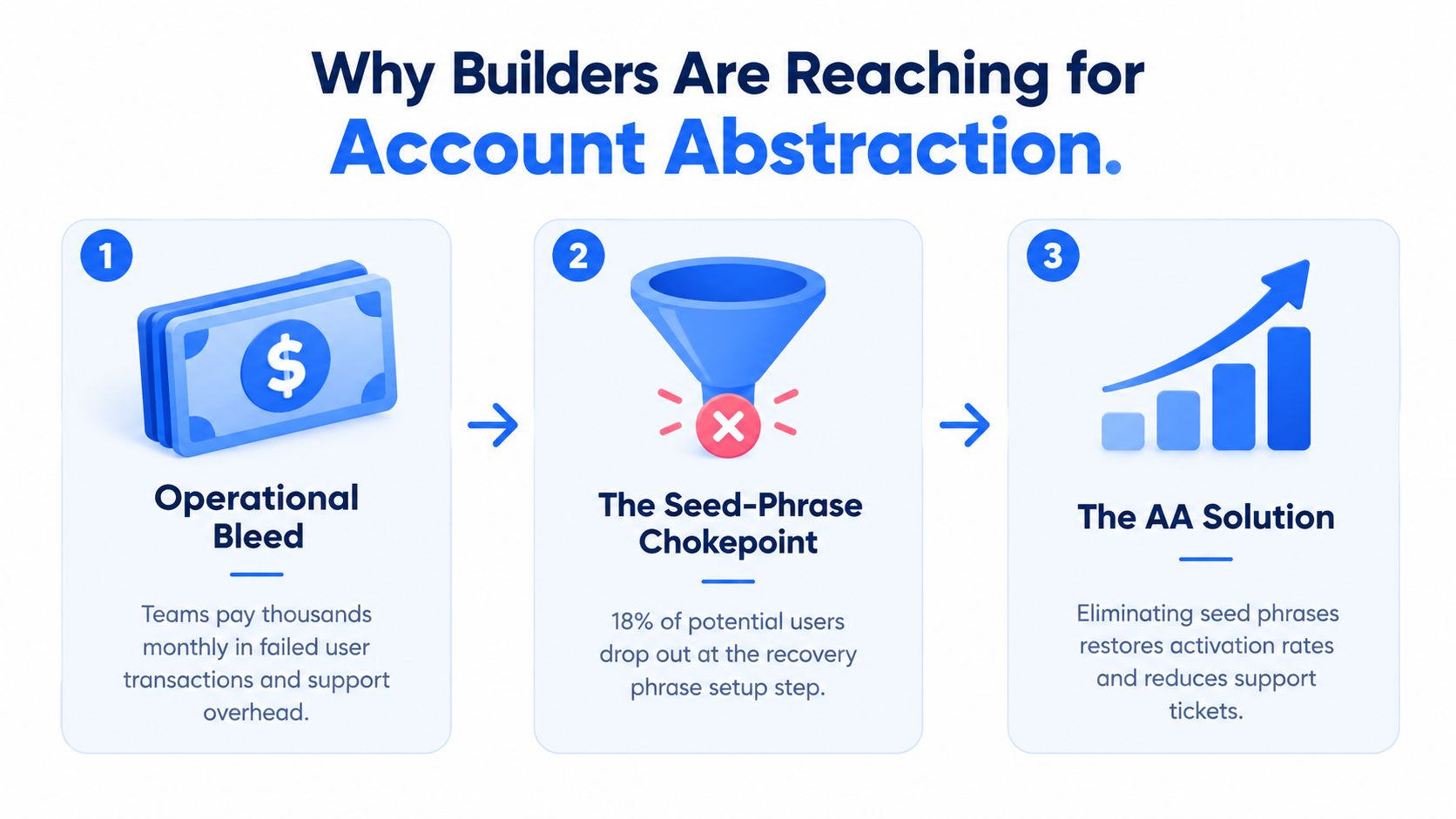
A fintech team can spend thousands per month on failed user transactions, lose 18% of activations at the seed-phrase step, and still treat each symptom as a separate product issue. Support handles gas refund requests, engineering investigates reverted transactions, finance estimates the cost of incentives, and compliance asks who authorized the transaction in the first place. The common cause is an account model designed around a technically capable wallet owner, not an institution serving customers.
An account abstraction wallet changes that model. The account is a smart contract with validation and execution logic, so the application can define how signatures, spending rules, recovery, and payment authorization work. Users may still approve an action, but the business no longer has to expose every blockchain constraint directly in the interface.
The important question isn't whether an AA wallet can remove a gas prompt. It's whether the surrounding operating model can control the new moving parts.
The operational problem is larger than onboarding
Legacy externally owned accounts force several responsibilities onto one keyholder. That keyholder must protect a private key, hold native gas, sign each action separately, understand recovery, and accept whatever transaction policy the application presents. That works for a simple personal wallet. It becomes awkward when the account belongs to a customer, player, trading strategy, AI agent, or business process.
ERC-4337 became a major Ethereum wallet milestone when its EntryPoint contract deployed on mainnet on March 1, 2023, without changing Ethereum's core protocol. Ethereum's roadmap page states that by September 2026, ERC-4337 had enabled more than 26 million smart wallets and 170 million UserOperations, evidence that programmable accounts moved from experimental design into production use in just over three years. See the Ethereum account abstraction roadmap for the protocol's current status.
That adoption doesn't remove implementation risk. It makes integration discipline more important because more businesses now depend on the same account, bundler, and paymaster patterns.
Practical lesson: Treat account abstraction as a transaction-control project. Better onboarding is the visible output, not the architecture.
A credible implementation brief should answer five questions early:
- Who can authorize an operation? Define users, services, AI agents, MPC signers, and emergency operators separately.
- Who pays for execution? Model sponsorship as a controlled expense, not an invisible product subsidy.
- What does finance record? Capture the UserOperation, gas outcome, rebate, account state, and customer liability in an append-only ledger.
- What does compliance review? Store screening outcomes, policy decisions, destination data, and signer identity with the operation.
- What happens when infrastructure disagrees? Design for delayed receipts, duplicate callbacks, rejected operations, and chain reorganizations.
The rest of the architecture follows from those answers.
How ERC-4337 Actually Moves Transactions
ERC-4337 doesn't turn a smart contract account into a protocol-level transaction sender. It introduces a higher-layer flow built around a UserOperation, an alternative mempool, a bundler, and the on-chain EntryPoint contract. The ERC-4337 core standard describes this pseudo-transaction path and its separation from the conventional transaction mempool.
A useful lifecycle is:
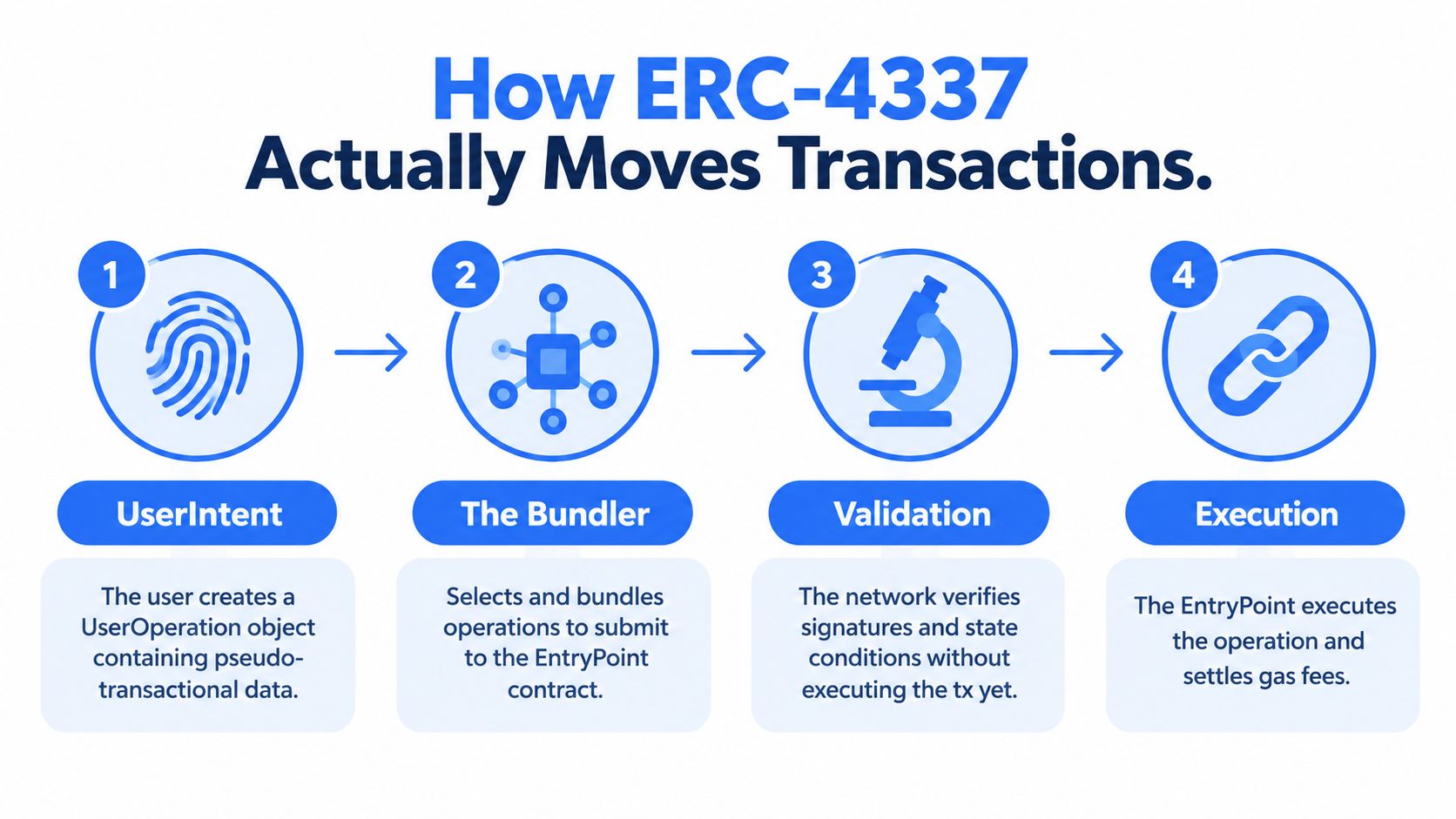
The application creates intent. A user approves an action, such as transferring USDC or calling a contract. The wallet creates a UserOperation containing the sender, call data, gas fields, signature data, and, when sponsorship applies,
paymasterAndData.The wallet signs according to its account logic. An EOA generally validates an ECDSA signature against one address. A smart account can route the request through
validateUserOp, where it checks a session key, multisig threshold, spending limit, recovery state, or another policy.The operation enters the alternative mempool. It isn't sent as an ordinary user transaction. Bundlers inspect pending UserOperations, apply their own validity and profitability checks, and select operations for inclusion.
The bundler calls EntryPoint. The bundler packages operations into one blockchain transaction and calls the EntryPoint contract's
handleOpsfunction. EntryPoint validates the account and any paymaster before execution, then calls the smart account with the requested calldata.
Validation comes before execution
The separation matters operationally. EntryPoint first checks whether the account's validation logic accepts the operation and whether the gas payment arrangement is valid. Only after that stage does it execute the requested call. The design limits the chance that an invalid signature, expired session, or unacceptable sponsorship request reaches the business action.
Consider a sponsored USDC transfer approved by a session key. The application creates a UserOperation that says, in effect, “this session key may transfer USDC from this account under the permitted policy.” The smart account validates the session key and its constraints, the Paymaster validates that the user and action qualify for sponsorship, and the bundler submits the operation through EntryPoint. The user doesn't need native gas at the moment of interaction, but the business still needs to validate the policy before paying for it.
This isn't the same as eliminating replay risk. The account must bind authorization to the relevant chain, EntryPoint, nonce, expiration, and policy context. The application should also persist a stable operation identifier before submission so a retry cannot create an unintended second transfer.
For a deeper account-model comparison, BroLabel's guide to smart contract wallets and their operating model is a useful reference.
The architectural shift is therefore not “gasless transactions.” It's that authorization moves into account code and becomes an inspectable part of the transaction lifecycle. Every UserOperation can be treated as a structured event with intent, validation result, execution result, gas outcome, and reconciliation state.
Smart Wallets vs Externally Owned Accounts
The right comparison isn't “modern wallet versus old wallet.” It's programmable control versus minimal protocol surface. An EOA is simple, widely supported, and easy to reason about when one person controls one key. An AA smart wallet introduces more capabilities, but it also introduces contract code, deployment considerations, provider dependencies, and upgrade decisions.
| Dimension | AA Smart Wallet | EOA |
|---|---|---|
| Key custody | Can use multiple signers, MPC, session keys, or custom validation | Usually centered on one private key or seed phrase |
| Transaction batching | Native account logic can combine actions | Usually requires separate transactions or contract-specific support |
| Recovery | Can support social recovery, multisig, or policy-based recovery | Recovery normally depends on the seed phrase or custodian |
| Gas payment | Can use sponsorship or supported token-payment policies | Normally requires the native asset in the signing account |
| Policy enforcement | Spending limits, allowlists, roles, and custom validation can live in code | Policy is mostly external to the account |
| dApp compatibility | Depends on smart-account, wallet, and provider support | Broad compatibility across existing dApps |
| Upgrade exposure | Account implementation and modules require review | No smart-account upgrade path to manage |
| Deployment | May require smart-account deployment or another account-activation path | Address exists from key generation |
| Failure modes | Includes contract, paymaster, bundler, signer, and module failures | Concentrated key-compromise and transaction-signing risks |
The AA side wins when the product needs batching, session keys, spend limits, social recovery, or sponsored gas. It also gives a compliance team a better place to express policy because authorization can be enforced before execution, not merely logged after the fact. The trade-off is that every additional module becomes part of the attack and change surface.
EOAs still win for minimal treasury holds, broad compatibility, and workflows where the organization wants no smart-account deployment or upgrade dependency. They're also easier to use in ecosystems that don't consistently support smart-account interfaces.
The middle ground is expanding
EIP-7702 provides a middle path by allowing an existing EOA to authorize code behavior without converting the address into a newly deployed smart-account address. It can reduce the account-activation burden, but it doesn't eliminate the need to evaluate authorization, delegation, provider support, and migration behavior.
Teams comparing wallet models should also review adjacent identity and access practices. For a broader treatment of identity controls, browse identity management guides before mapping wallet roles to internal services and operators.
The product archetype usually determines the answer:
- Consumer applications and embedded wallets often benefit from AA because onboarding, batching, and gas abstraction affect the primary user journey.
- AI agent wallets benefit from scoped session authority and explicit spending limits, provided the agent cannot expand its own permissions.
- Exchanges and treasury systems may prefer EOAs or MPC-controlled accounts where compatibility and asset custody dominate.
- Simple DAO voting or passive holding can find AA unnecessary unless recovery, delegation, or policy enforcement is a specific requirement.
Custody architecture should be evaluated alongside the account model, not after it. BroLabel's overview of custodial and non-custodial wallet structures helps frame that decision.
Paymasters and the Real Cost of Sponsorship
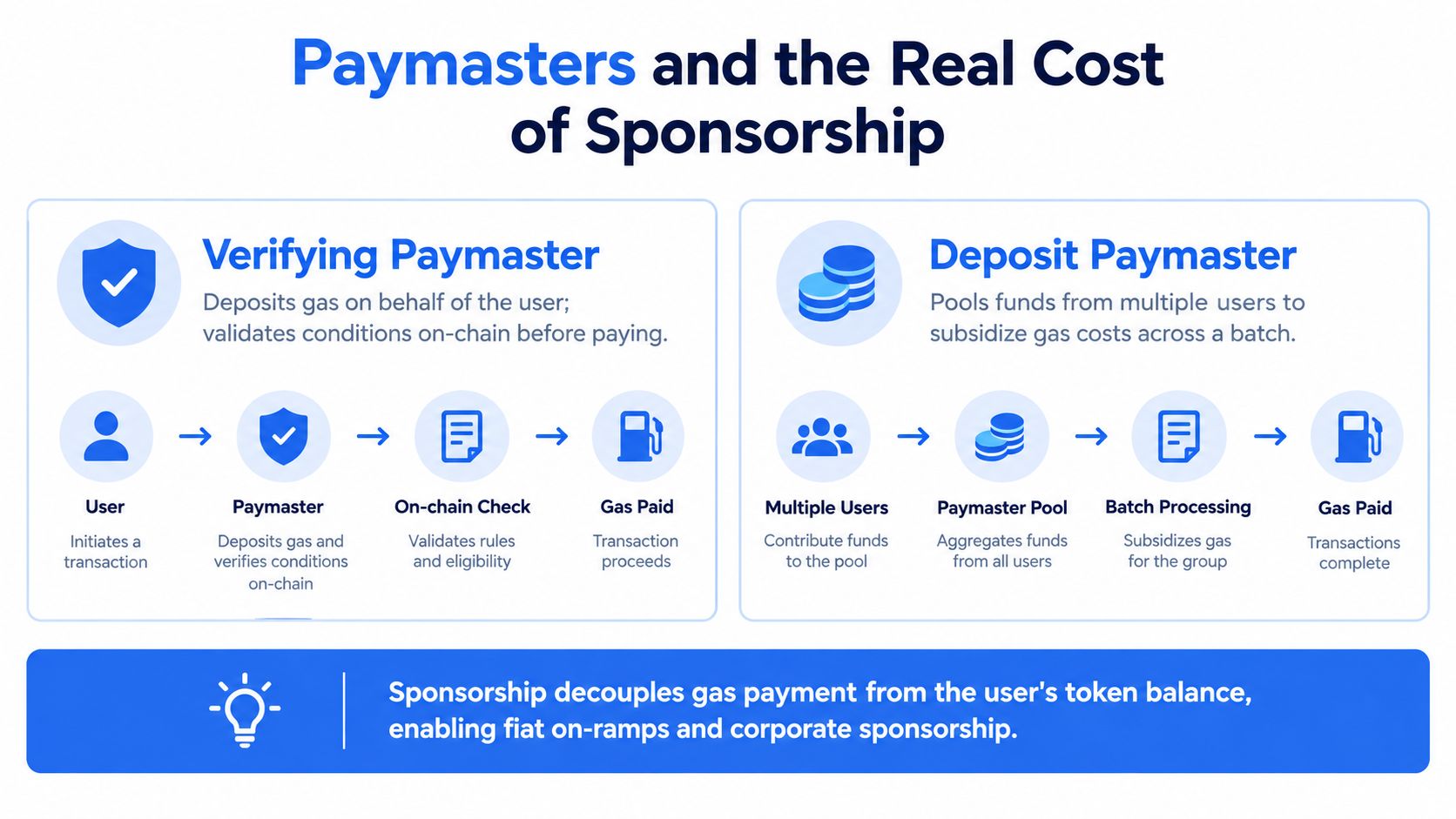
Gas sponsorship changes who pays, not whether gas exists. A Paymaster can pre-fund EntryPoint and cover an eligible UserOperation, while the bundler submits the enclosing transaction and receives reimbursement through the execution economics. The user sees a simpler flow. The operator inherits a budget, abuse, reconciliation, and compliance problem.
Two broad patterns appear in production designs:
- Verifying paymasters authorize sponsorship for a specific operation after checking an off-chain policy or signature. The contract validates the authorization on-chain before it accepts the operation.
- Deposit-based paymasters maintain prefunded balances associated with the sponsorship service. The balance supports eligible operations, but the operator still needs accounting by tenant, product, customer, and use case.
The off-chain component typically evaluates eligibility, constructs or signs sponsorship data, applies rate limits, and rejects suspicious requests before submission. That component doesn't replace on-chain enforcement. It must produce data the Paymaster can verify, and the business must reconcile the decision with the eventual EntryPoint result.
Sponsorship needs a budget owner
A Paymaster can support gasless onboarding, ERC-20 fee payment, whitelists, and rate limits. It can also become an uncontrolled subsidy if the business measures successful registrations but not rejected operations, duplicated attempts, failed execution, or gas consumed by abusive accounts.
Common abuse paths include:
- Replay attempts: A sponsorship authorization is reused after its intended operation. Bind authorization to nonce, chain, account, validity window, and operation context.
- Unreliable gas estimates: An attacker submits operations with excessive or manipulated gas requirements. Bound limits and reject values outside the product's expected profile.
- Sybil onboarding: A user creates many accounts to consume introductory sponsorship. Link eligibility to a controlled identity or account policy where appropriate.
- Paymaster reverts: A policy check or balance failure causes operations to remain stuck or repeatedly retry. Make rejection states explicit and alert on pending-age thresholds.
- Tenant leakage: One customer or agent consumes another tenant's budget. Keep sponsorship identity and accounting dimensions separate from the wallet address alone.
The operating ledger should record the requested sponsorship, approved amount, actual gas outcome, refund or rebate, and responsible tenant. Without that record, finance sees a wallet balance change while product sees a conversion incentive, and neither can explain the difference.
A serious policy engine should cap spend at several levels:
- Per operation: Prevent one unusual call from consuming an outsized budget.
- Per account: Limit repeated activity from one wallet or customer identity.
- Per tenant: Keep an embedded customer, game, agent, or business unit within its allocation.
- Per time window: Detect sudden changes in usage rather than waiting for month-end review.
- Per destination and method: Restrict contracts and function selectors to approved business actions.
The practical question isn't whether the user should pay gas. It's whether the operator can prove why each sponsored operation was allowed, what it cost, and which margin or compliance policy absorbed it.
Wiring AA Wallets Into MPC and Ledger Stacks
An AA wallet becomes institution-ready only when signing, authorization, accounting, and observability share the same operation identity. A four-layer stack works well because it separates cryptographic authority from business policy and financial truth.
Layer one is controlled signing
The smart account can accept signatures produced by an MPC co-signer, provided the account's validation module recognizes the resulting authorization. BroSettlement can provide DKG/MPC 2-of-3 signing, a client-controlled Co-Signer, and network broadcast across supported chains. The important control is not the vendor label. It's the separation of duties: an application service can request an operation without holding enough authority to finalize it alone.
For AI Agents, create a distinct wallet or account scope per agent, define role permissions, and make the agent's allowed actions narrower than the operator's. The agent should request a UserOperation. A policy service should decide whether that request can reach the MPC signing path.
Layer two is bounded API access
Scoped API keys should be issued per service, environment, tenant, or operational role. A withdrawal service doesn't need permission to create arbitrary accounts, change policy modules, or access another tenant's ledger. IP allowlists, replay protection, and role-based access can support the boundary, but the key scope should remain meaningful even if a service is compromised.
Idempotency is equally important. Store an idempotency key with the intended action and map it to the resulting UserOperation hash or terminal rejection. A retry after a timeout should retrieve the existing operation rather than create a second transfer.
Layer three is financial truth
An immutable operating ledger should record the business event before or alongside broadcast, then update it as the operation progresses. Entries need to distinguish customer assets, platform fees, sponsored gas, paymaster prefunding, rebates, and failed or reversed actions.
| Layer | Responsibility | Example Module |
|---|---|---|
| Signing authority | Produce threshold authorization under defined policy | BROsettlement MPC 2-of-3 and client-controlled Co-Signer |
| Wallet and account scope | Create user, agent, player, or business wallet contexts | Embedded wallet API and AI Agent Wallets |
| API security | Restrict services and prevent duplicate requests | Scoped API keys, Ed25519 auth, IP allowlist, idempotency |
| Ledger and reconciliation | Record liabilities, fees, gas, and settlement state | Immutable operating ledger |
| Event delivery | Publish state changes to operational systems | WebSocket events |
| Network execution | Submit and observe blockchain operations | Broadcast, bundler, paymaster, and chain adapters |
Layer four is event-driven evidence
WebSocket events should feed the audit and reconciliation pipelines, not only the UI. Define events such as OperationCreated, OperationMined, and AccountChanged, then preserve the raw event, normalized state, source timestamp, and processing status.
Out-of-order bundler receipts are normal enough to design for. A mined event may arrive before a separate service has processed the submission response. Nonce delegation can also create races when two workers believe they have authority to issue the next operation. Use a state machine with monotonic transitions, durable locks or reservations, and reconciliation against chain data rather than trusting callback order.
For the custody boundary itself, teams can use MPC wallet infrastructure for threshold-controlled signing while keeping business policy and accounting in their own systems.
Security, Risk, and Compliance in an AA World
Account abstraction doesn't remove the threat model. It distributes it across smart-account code, validation modules, signers, paymasters, bundlers, recovery mechanisms, API services, and upgrade paths. That distribution can improve control, but it also creates correlated failure modes. A compiler bug, unsafe module, compromised signer, or permissive paymaster policy could affect many accounts through one shared component.
The first control is architectural separation. Keep the following decisions distinct:
- Authorization: Which user, service, agent, or operator requested the action?
- Validation: Does the smart account accept the signature and policy context?
- Sponsorship: Is the operation eligible for gas coverage?
- Execution: Which contract and method will run?
- Settlement: What did the chain confirm?
- Reporting: What evidence must be retained for finance, risk, and compliance?
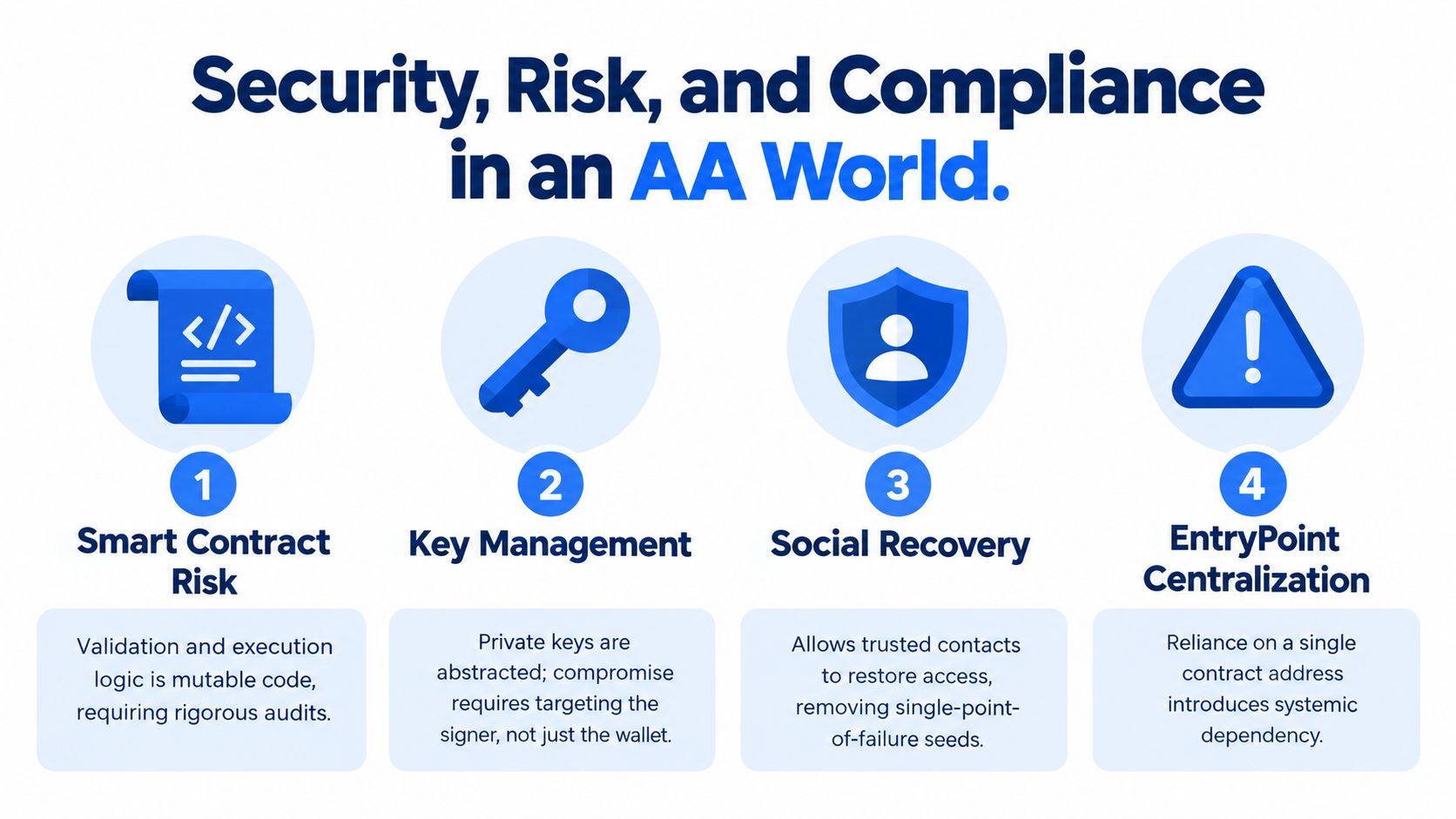
Controls should be enforced before signing
A policy engine should allowlist destination contracts, methods, assets, and transaction patterns. RBAC should limit who can create policies, approve changes, rotate signers, or trigger recovery. MPC threshold signing adds resilience, but it doesn't make an unsafe request safe. The Co-Signer should enforce a production signing policy that the application cannot bypass.
Keep an immutable audit trail for every UserOperation, including the original request, policy result, signer decision, sponsorship decision, bundler response, EntryPoint outcome, and reconciliation status. Store enough context to answer who initiated the action, what account acted, which tenant owned it, and why the system allowed it.
On-chain reconciliation must compare the actual state transition with the internal ledger. A successful API response isn't settlement. A submitted operation isn't a confirmed withdrawal. Finance needs a controlled progression from requested to signed, broadcast, mined, reconciled, and, where relevant, finalized.
Compliance belongs in the event schema
Sanctions screening, Travel Rule data, and MiCA-related reporting requirements shouldn't be bolted onto a wallet after the transaction is complete. The signed event schema should preserve originator and beneficiary context where applicable, screening decisions, risk scores or decision references, jurisdictional controls, and the responsible policy version.
SOC 2-aligned operations also require attention to the infrastructure around the wallet. Review access to bundler and paymaster services, secret handling, change management, incident response, monitoring, and evidence retention. An AA system is only as auditable as the off-chain services that authorize and explain its on-chain actions.
A smart account can make policy executable. It can't make an undocumented policy defensible.
Choosing an AA Stack Without Buying Lock-In
Vendor selection should start with exit conditions, not feature screenshots. An account abstraction stack can look portable because ERC-4337 defines shared primitives, yet teams can still become dependent on one smart-account implementation, one bundler, one paymaster service, one SDK, or one key-management model.
Ask five questions before committing:
- Which EntryPoint versions and implementations are supported? Confirm compatibility with an audited ERC-4337 v0.7 or later deployment, and document how upgrades are handled.
- Can infrastructure components be replaced independently? You should be able to change bundlers or paymasters without rewriting account creation, policy, ledger, and event services.
- Does the SDK expose the smart-account address and operation identifiers? Existing custody, indexing, screening, and accounting systems need stable identifiers.
- Can signer modules be replaced? Test whether an in-house HSM, external MPC cluster, or client-controlled co-signer can sit beside a third-party key-management option.
- How do migrations work? Review replay protection, account implementation changes, module upgrades, address continuity, recovery, and rollback procedures.
| Vendor-shortlist criterion | What to verify | Evidence to request |
|---|---|---|
| Account implementation | Validation, execution, recovery, and upgrade behavior | Audits, deployed addresses, version policy |
| Bundler portability | Submission API, receipt model, failure handling | Sandbox tests with more than one provider |
| Paymaster control | Policy hooks, deposits, limits, and reporting | Budget model and rejection scenarios |
| Custody integration | MPC, HSM, multisig, or external signer support | Signing-policy test and key-rotation runbook |
| Ledger compatibility | Idempotent events and reconciliation fields | Sample schemas and replay tests |
| Compliance operations | Screening, RBAC, audit retention, and review workflows | Control matrix and evidence export |
| Migration path | Address, module, nonce, and replay behavior | Migration rehearsal with failure recovery |
Where an account abstraction wallet fits
AA is a strong candidate for consumer applications, embedded wallets, payment products, games, iGaming flows, and AI agents where onboarding, batching, session authority, or sponsored gas materially affects the product. It's also useful when the business needs programmable recovery or policy enforcement at the account layer.
It can be overkill for a simple treasury hold, a low-frequency administrative wallet, or a DAO voting flow that already has a well-understood multisig and doesn't need sponsorship or batching. In those cases, the added contract and infrastructure surface may not justify the operational complexity.
Risk-control summary
Reduce authority: Separate application requests, policy decisions, and MPC signing.
Make state durable: Tie idempotency, UserOperation hashes, ledger entries, and WebSocket events together.
Preserve optionality: Keep account, bundler, paymaster, signer, and reconciliation interfaces replaceable.
BroLabel provides embedded MPC wallets, API-created user or agent wallet contexts, an immutable operating ledger, network broadcast, real-time WebSocket events, scoped developer controls, and client-controlled Co-Signer workflows. For teams evaluating an account abstraction wallet as an institutional integration, BroLabel can be assessed as a modular infrastructure option alongside the team's chosen smart-account, bundler, and paymaster components.