A simple wallet request hides the real control problem
"Create a wallet so I can receive and send transactions" is a reasonable request for an AI agent. The unsafe answer is to generate a seed phrase in chat and tell the user to store it somewhere. That creates a wallet-shaped security problem, not wallet infrastructure.
For BroLabel, this request should be treated as a product workflow. The user does not really need a secret printed in a prompt. They need a wallet that can receive funds, send transactions, expose clear status, and keep signing control outside the model. That is where BroLabel AI Agents, BroSettlement, and Agent Skills fit together.
An AI agent can guide setup, prepare an API identity, help run a Co-Signer, check MPC/DKG readiness, create a testnet wallet, generate a deposit address, and execute the first controlled transaction. It should not receive the private key, MPC share material, or unlimited authority over funds.
Short Answer
Yes, an AI agent can help create a wallet for receiving and sending transactions, but it should not receive the private key. A safer flow is to install Agent Skills, create a scoped Ed25519 API key, run a customer-hosted Co-Signer, complete MPC/DKG readiness, create a testnet wallet, generate a deposit address, and send transactions only through limits, allowlists, an idempotency key, WebSocket events, and ledger tracking.
How It Works
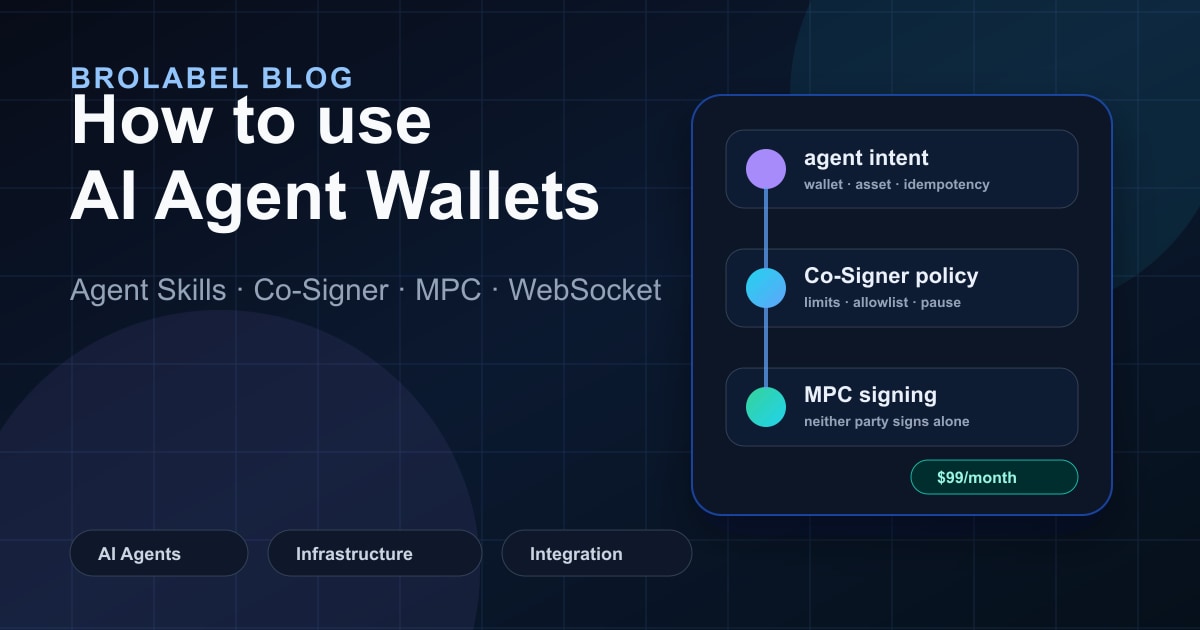
The right model is straightforward: the agent forms intent, infrastructure enforces control. The model can understand the task, ask clarifying questions, prepare parameters, call APIs, and explain the result. Signing, policies, secrets, and audit records should remain in a controlled runtime.
In a BroSettlement workflow, the layers look like this:
- Agent Skills. The agent receives instructions for working with BroSettlement API and onboarding flows instead of inventing unsafe steps.
- Scoped API identity. Automation uses an Ed25519 API key with limited permissions, not a wallet private key.
- Customer-hosted Co-Signer. Part of the signing process runs in the customer's environment and enforces local policy.
- MPC/DKG readiness. The wallet is not ready for signing until the threshold setup is complete.
- Wallet and address creation. The agent can create a testnet wallet and generate an address for deposits.
- Transaction intent. For sending, the agent creates a structured request: wallet, network, asset, amount, destination, and idempotency key.
- Events and ledger. WebSocket events and the ledger show what was created, signed, broadcast, confirmed, or rejected.
This is not "the AI has the wallet." It is "the AI operates through wallet infrastructure that prevents it from bypassing controls."
Receiving Transactions
Receiving funds does not end with an address. If the agent creates an address but the product cannot see confirmations, balance impact, and the internal owner, finance and support still need manual work.
A practical receive flow looks like this:
- the agent creates or selects a wallet for a specific user, account, or use case;
- BroSettlement returns a deposit address for the required network and asset;
- the product shows the address to the user or passes it to the paying service;
- an incoming transaction appears on the network;
- a WebSocket event reports deposit detection;
- the system waits for the required confirmations;
- the ledger records the balance change and transaction history;
- the agent or support interface can explain the final status.
The critical part is mapping. An address should be tied to an internal account, agent workflow, invoice, or operating action. Without that context, the team sees an on-chain hash but not the business reason behind it.
Sending Transactions
Sending needs tighter controls because the agent is moving value out of a balance. A useful agent should not simply decide, "I think this payment is fine." It should create a transaction intent that infrastructure can evaluate.
A send request should include:
- wallet;
- network;
- asset;
- amount;
- destination;
- idempotency key;
- business reason or reference;
- policy context, when a callback is needed.
The idempotency key is not an API decoration. It protects the operation if the agent or runtime retries a request after a timeout. In financial systems, retry logic without idempotency can become a duplicate withdrawal problem.
Then the Co-Signer checks policy: allowed network, allowed asset, amount within limit, destination on the allowlist or not blocked, velocity limits respected, and whether manual approval is required. If policy fails, the transaction should not be signed, even if the model is confident.
If policy allows the action, MPC signing produces a valid signature without assembling the full private key. After broadcast, the team tracks status through WebSocket events and the ledger rather than a screenshot from a block explorer.
What Never Goes Into a Prompt
Model context is not a secret store. This rule should appear in the onboarding checklist for every team giving an AI agent access to wallet operations.
These items should not appear in prompts, chat history, tool output, or logs:
- seed phrase;
- raw private key;
- encryption key;
- MPC share material;
- unscoped production API secret;
- Co-Signer persistent volume contents;
- recovery material;
- credentials the agent can modify or export by itself.
The agent can know that a wallet, policy, limit, and API endpoint exist. It should not know secret material. If an action requires a secret, that secret belongs in the runtime, vault, Co-Signer, or another controlled environment, not in text instructions.
The agent should also not be able to increase its own authority. If it can change its spending limit, add a new destination to the allowlist, and immediately send funds there, that is not autonomy. It is a missing control boundary.
Step-by-Step Flow
For a first launch, use a testnet-first workflow:
- Open BroLabel AI Agents and copy the installation prompt.
- Install the official
brosettlement-onboardingandbrosettlement-apiAgent Skills. - Inspect
SKILL.md, scripts, and the destination folder before running them. - Create or confirm the BroSettlement organization.
- Create a scoped Ed25519 API key for the agent runtime.
- Run the customer-hosted Co-Signer in a controlled environment.
- Complete MPC/DKG readiness checks.
- Create a testnet wallet.
- Generate a deposit address and make a test deposit.
- Verify WebSocket events, confirmations, and the ledger entry.
- Create a send intent with an idempotency key and a small testnet amount.
- Verify Co-Signer policy, MPC signing, broadcast, and final status.
- Only then define production limits, allowlists, emergency pause, and review rules.
This path is slower than "here is a seed phrase," but it scales. The team gets a repeatable operating model, not a one-off wallet.
Production Control Matrix
| Question | What should be ready |
|---|---|
| Who can create a wallet? | Scoped API role and audit trail |
| How does the agent receive funds? | Address mapping, deposit events, confirmations |
| How does the agent send funds? | Transaction intent, idempotency key, Co-Signer policy |
| Where do secrets live? | Not in prompts; inside runtime, vault, or Co-Signer boundary |
| How can the agent be stopped? | Emergency pause, revoked API key, disabled policy |
| How does finance reconcile? | Ledger entries, transaction references, balance history |
| How does support see status? | WebSocket events and clear state transitions |
This matrix matters more than a polished wallet UI. If a team cannot answer these questions, the agent wallet is not ready for real funds.
FAQ
Can an AI agent create a wallet?
Yes, if it works through a controlled onboarding flow and API. The agent can create a testnet wallet, generate an address, and prepare a transaction, but it should not generate or store a private key in the prompt.
Does the agent receive the private key?
No. In the right architecture, the agent operates through scoped API access, Co-Signer policy, and MPC signing. Secret material should not enter the model, chat, or logs.
How does the wallet receive transactions?
The system creates a deposit address, maps it to an account or workflow, listens for WebSocket events, waits for confirmations, and records balance impact in the ledger.
How does an AI agent send a transaction?
The agent creates a transaction intent with network, asset, amount, destination, and idempotency key. The Co-Signer checks policy, MPC signs an approved action, and BroSettlement exposes status through events and the ledger.
What should happen before production?
Run a testnet flow, verify DKG/MPC readiness, define limits, allowlists, emergency pause, callback or manual review, and confirm finance can see ledger and reconciliation data.
Takeaway
The request "create a wallet for me" should not end with a private key in chat. For AI agents, the right answer is a controlled wallet workflow: Agent Skills, scoped Ed25519 API key, customer-hosted Co-Signer, MPC signing, idempotency, WebSocket events, and a ledger.
AI can help create the wallet and run the first transactions. Control over funds should stay in the infrastructure.