At 2:14 AM, a procurement agent renews a vendor contract under its approved spending limit. The network connection drops after the payment request reaches the signing service. The agent retries, the second instruction looks legitimate, and both payments clear before the finance team's morning reconciliation job runs.
That failure has little to do with checkout design. It comes from weak payment operations: no signing-layer idempotency, no narrowly scoped mandate, no event trail that reconstructs the decision, and no human override that can pause the agent without restarting the entire workflow. AI agent payments are an infrastructure problem first and a user-experience problem second.
Teams building autonomous workflows can borrow useful patterns from practical guides to agent identity, tool access, and execution, including this Agentable practical agent guide. The same principle applies to money: every payment initiated by software must remain explainable, bounded, and reversible at the control-plane level.
Table of Contents
- The Problem Most Teams Underestimate
- What AI Agent Payments Actually Are
- The Four Layers of an Agent Payment Stack
- MPC Wallets and the Client-Controlled Co-Signer
- Security and Compliance Controls That Must Run by Default
- Representative Use Cases Across iGaming, Fintech, and Treasury
- Governance, Not Checkout UX, Is the Scaling Blocker
- An Operating Checklist Before You Ship
The Problem Most Teams Underestimate
An agent authorized to renew contracts under a defined limit still needs more than a budget. The system must know which agent issued the instruction, which principal delegated authority, which vendor was approved, what policy matched, and whether the request is new or a retry of an earlier operation.
A card attached directly to an agent fails that test. The model can choose a tool, parse a response incorrectly, or repeat a call after a timeout. If the payment credential has broad access, a prompt mistake becomes a treasury event. If the platform can sign without an independent policy decision, the organization may struggle to establish who approved the transaction and whether the agent stayed within its mandate.
Practical rule: Treat every agent payment as a signed business decision, not as an API call with a card attached.
The operational gap usually appears in four places:
- Duplicate obligations: A retry creates a second invoice payment because the system deduplicates at the application layer but not at the signing or ledger layer.
- Mandate drift: The agent can spend from a wallet, but the wallet doesn't enforce the approved merchant, asset, network, or amount.
- Audit uncertainty: Logs show that a request happened, but not the policy version, counterparty data, authorization result, or final settlement identifier.
- Operator lockout: A finance or risk user can only intervene by killing the process, revoking all credentials, or waiting for a scheduled review.
The right baseline is straightforward. The agent should create an intent. A policy engine should evaluate it. A signing control should approve or reject it. The rail should settle it and emit events. The ledger should preserve the complete sequence.
That separation gives engineering, finance, and compliance teams different views of the same payment without allowing any one component to bypass the others.
What AI Agent Payments Actually Are
AI agent payments are transfers of value initiated by a non-human actor operating under a pre-approved mandate. The agent may select a vendor, call a paid API, purchase data, settle a payout, or move stablecoins, but its authority must come from a principal and remain constrained by explicit rules.
An agent wallet is not just a consumer wallet with a conversational interface. It behaves more like a corporate card with a hard spending limit. The agent can use it for approved purposes, but it shouldn't receive unrestricted access to the organization's underlying account or signing secret.
An agent mandate resembles a power of attorney with narrow terms. It can authorize payments to specified counterparties, in approved assets, on selected rails, during defined time windows, and within configured limits. The mandate should be machine-readable so the signing service can enforce it consistently rather than relying on the agent to interpret policy correctly.
The signing layer is similar to a notarized approval. It produces cryptographic evidence that the requested action passed the required controls, giving the ledger something it can verify later. The signature doesn't decide whether a purchase is commercially sensible. It proves that the transaction met the authority and security conditions required to move forward.
A useful vocabulary includes four building blocks:
- Identity: Which agent issued the request, and which person, team, or legal entity is responsible for it?
- Authorization: What is the agent allowed to do, for whom, with which assets, and under what conditions?
- Signing: Which control produces the cryptographic approval, and can the request be replayed or duplicated?
- Rail execution: Where does settlement occur, such as ACH, SEPA, card networks, or a stablecoin network?
This distinction matters because a payment account can be technically valid while still being operationally unsafe. Teams evaluating the wider crypto payment infrastructure should ask whether identity, authority, signing, settlement, and reconciliation are represented as separate controls.
The Four Layers of an Agent Payment Stack
A dependable stack keeps identity, authorization, signing, and rail execution distinct. Each layer blocks a different failure class. Combining them may reduce apparent complexity, but it also removes the independent evidence needed to diagnose and contain a failure.
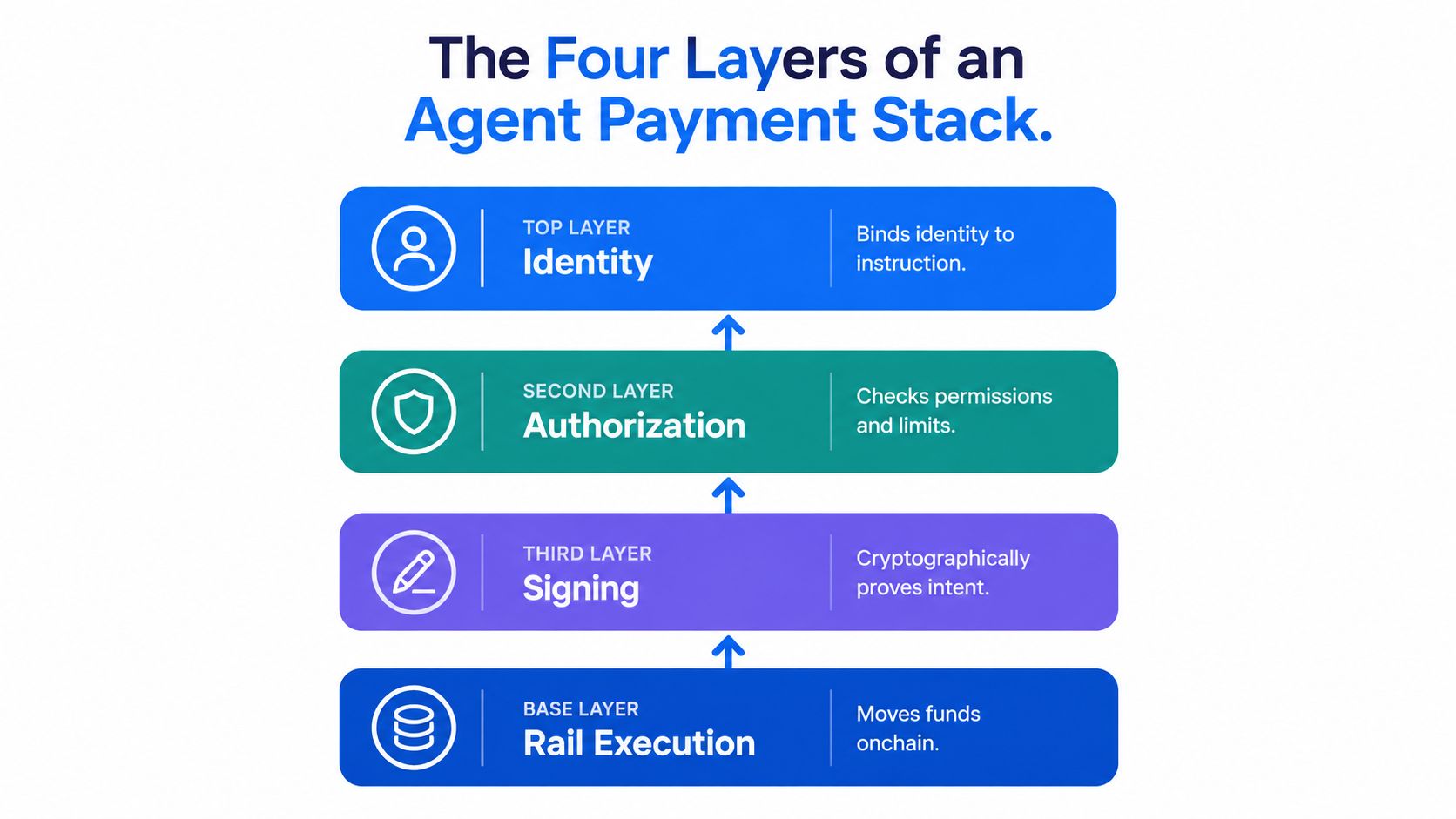
Identity binds the instruction
The identity layer links the payment request to a specific agent and its principal. It should carry an agent identifier, tenant or legal-entity context, credential metadata, and enough attribution to distinguish one workload from another.
Without that binding, a compromised key may still produce a valid signature, but investigators can't reliably determine whether the request came from the intended agent, a substituted workload, or an unauthorized integration. Identity prevents identity drift, where credentials remain valid after the workload, owner, or purpose has changed.
Authorization defines the mandate
Authorization turns business rules into enforceable conditions. A mandate can restrict destinations, assets, networks, transaction amounts, time windows, and spending velocity. It can also require a human decision for transactions that exceed a threshold or violate a normal operating pattern.
This layer prevents mandate bypass. The agent may propose a payment, but it shouldn't be able to redefine its own authority by changing a prompt, tool result, or local configuration.
Signing creates the approval record
The signing layer evaluates the authorized intent and produces a replay-resistant cryptographic approval. It also needs deterministic idempotency. If the same logical payment arrives twice, the system should identify the duplicate before creating a second obligation.
That protects against double-spend and duplicate settlement, including failures caused by network jitter, worker restarts, or webhook retries. Guidance on designing reliable agent-facing integrations is also available in these AI agent API patterns for 2026.
Rail execution moves and reports value
The rail layer broadcasts or submits the transaction and returns status events. It can fail after signing, remain pending, be rejected by the network, or settle with a transaction identifier that arrives later than the original request.
This layer prevents silent rail failure when paired with clear state transitions and reconciliation. The ledger shouldn't mark a payment complete merely because a signing service accepted it. It should distinguish intent, policy decision, signature, submission, confirmation, rejection, reversal, and reconciliation status.
The common architectural mistake is collapsing authorization into signing or treating rail execution as a synchronous extension of the agent call. Independent layers make failures visible. They also let the organization revoke a mandate, pause signing, or change a rail without destroying identity records and historical evidence.
MPC Wallets and the Client-Controlled Co-Signer
MPC, the co-signer, and signing policy work best as one control plane. A practical threshold arrangement uses 2-of-3 signing: the agent holds one key share, a client-controlled co-signer holds a second, and a vaulted recovery share remains offline.
No single party should be able to move funds alone. The agent can't unilaterally authorize a transfer, and the platform can't exercise the client's treasury without the required threshold and policy path. The key material also stays distributed rather than being assembled as a complete private key during normal operations.
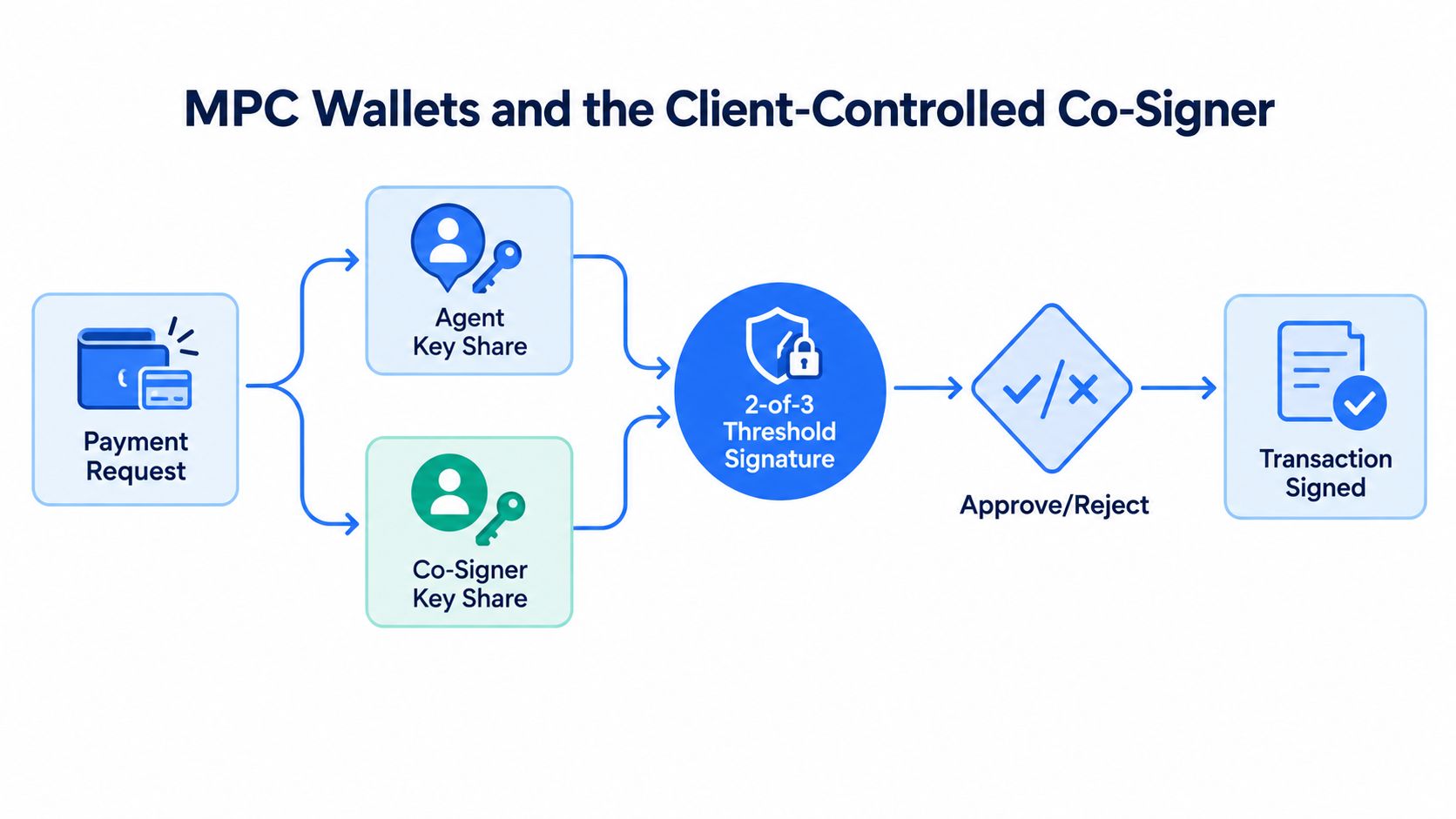
What the co-signer enforces
The co-signer should run in the client's cloud account or HSM-backed environment. It evaluates the transaction intent at signing time rather than trusting an earlier application check.
Typical policy inputs include:
- Per-transaction caps, which limit the maximum amount for one instruction.
- Allowlisted counterparties, which restrict where the agent can send value.
- Asset and network rules, which prevent an agent from switching to an unapproved settlement path.
- Time windows, which restrict activity to an operating schedule where required.
- Velocity checks, which detect repeated or unusually rapid requests.
- Emergency pause, which allows an authorized operator to stop signing without terminating the agent process.
The payment lifecycle should be explicit. The agent submits an intent with a stable request identifier. The co-signer authenticates the caller, evaluates the mandate, checks replay state, and either returns a partial signature or emits a structured rejection. The agent combines its share with the approved co-signer result, and the resulting transaction moves to broadcast.
A failed policy check must never disappear into a timeout. The rejection event should include the decision, policy version, reason category, agent identity, counterparty, amount, asset, and correlation identifier. Operators need to know whether the system rejected a forbidden vendor, a duplicate request, an exceeded cap, or a temporary service failure.
This is stronger than raw key custody because the platform doesn't hold unilateral signing authority. It's also more operationally flexible than a naive multisig flow when the co-signer can apply deterministic policy while keeping the client in control of revocation and recovery. BroLabel's MPC wallet architecture is one example of treating threshold signing and client-controlled approval as a combined operating model.
Security and Compliance Controls That Must Run by Default
Production systems should install four primitives before an agent receives access to funds. They belong in the deployment baseline, not in the backlog reserved for the first incident.
Idempotency belongs at every boundary
Use a stable idempotency key on every incoming webhook, API request, internal command, and signing instruction. Persist the key with the resulting ledger operation, then return the original result when the same logical request arrives again.
This prevents a flaky connection from turning one approved invoice into multiple obligations. It also gives workers a safe retry contract. The application can retry without guessing whether the previous attempt reached the signing service or the settlement rail.
The ledger must reconstruct decisions
An append-only ledger should record the intent, authorization result, signature event, submission status, settlement identifier, and reconciliation outcome. Include timestamps, policy versions, agent and tenant identity, asset, amount, counterparty, and correlation identifiers.
That record supports dispute handling and evidence requests. It also separates the operating ledger from mutable application tables, where a later update can obscure what the system knew at the time of approval. BroLabel describes this broader workflow in its compliance management process.
WebSocket events expose live state
Polling gives operators a delayed and incomplete view of payment state. WebSocket events can push deposits, confirmations, withdrawals, policy decisions, co-signer outcomes, and rejection events to the dashboard as they occur.
A useful event stream lets the operations team compare the agent's intent with the signed payload and final rail result. It can surface a session that is generating repeated rejections, a counterparty that suddenly appears outside policy, or a signing flow that stops emitting expected confirmations.
Scoped API keys contain the blast radius
Create separate credentials per agent, tenant, environment, and operational role. Scope each key to the wallets, assets, networks, actions, and environments it needs. Pair that isolation with replay protection, IP allowlisting where appropriate, and strong request authentication.
A compromised prompt shouldn't expose a treasury. If an agent only has access to one wallet and one approved asset, the failure remains bounded even when the model selects the wrong tool or interprets a response incorrectly.
| Control | What It Does | Failure Mode It Prevents | Default Setting |
|---|---|---|---|
| Idempotency key | Deduplicates repeated logical requests | Duplicate payment after retry | Required on every request |
| Append-only ledger | Preserves decisions and state transitions | Missing audit or dispute evidence | Write-only operational history |
| WebSocket events | Streams signed status and policy outcomes | Delayed anomaly detection | Enabled for every payment flow |
| Scoped API keys | Limits identity, actions, assets, and environments | Unauthorized treasury access | Separate credentials per agent |
| Client-controlled co-signer | Applies independent signing policy | Unilateral fund movement | Required before production signing |
These controls align with the broader security model for agent payments, which calls for signed credentials, secure transport, nonces, timestamps, hash-chained audit trails, and fail-closed behavior when screening fails or times out. The important implementation detail is that the controls should be wired into infrastructure templates, access policies, and service defaults from the first deployment.
Representative Use Cases Across iGaming, Fintech, and Treasury
The same payment control plane behaves differently across industries. The wallet model may remain consistent, while the mandate, settlement rail, and human approval rule change substantially.
In iGaming, an agent may manage per-player balances, observe deposits, and prepare payouts. The policy file should bind each wallet to the correct player or game context, restrict assets and networks, and stop a payout when jurisdictional rules or operator limits fail. Sub-second operational feedback matters because the platform needs to distinguish an observed deposit, a confirmed deposit, a policy decision, and a signed withdrawal without relying on a batch process.
In consumer fintech, a budgeting or bill-pay agent acts on behalf of an identifiable user. The control surface shifts toward visible consent, clear authorization prompts, bank withdrawal rails such as ACH or SEPA, and consent receipts that a support team can explain to the account holder. The agent may prepare recurring payments, but a change in vendor, amount, or account destination can trigger renewed user approval.
Enterprise treasury has a different shape. An agent may route vendor payments across subsidiaries, prepare multi-leg foreign exchange instructions, or reconcile settlement across legal entities. The ledger must support multi-currency accounting, while policy hierarchies should reflect entity-level authority and ERP workflows in systems such as NetSuite or SAP.
| Vertical | Primary Agent Action | Key Policy Lever | Settlement Rail | Human-in-the-Loop Trigger |
|---|---|---|---|---|
| iGaming | Prepare player deposits and payouts | Player, game, jurisdiction, and payout rules | Stablecoin or configured wallet rail | Regulatory exception or out-of-policy payout |
| Consumer fintech | Pay approved bills and recurring vendors | User consent, vendor scope, and account destination | ACH, SEPA, card, or bank rail | New payee, changed amount, or unusual request |
| Enterprise treasury | Route vendor and intercompany payments | Legal-entity hierarchy, currency, and counterparty rules | Bank, card, FX, or stablecoin rail | Threshold breach, new beneficiary, or policy conflict |
The primitives don't change: MPC signing, scoped mandates, idempotent requests, an append-only ledger, and event-driven reconciliation. What changes is the policy file and the point at which a human must approve the next step.
Governance, Not Checkout UX, Is the Scaling Blocker
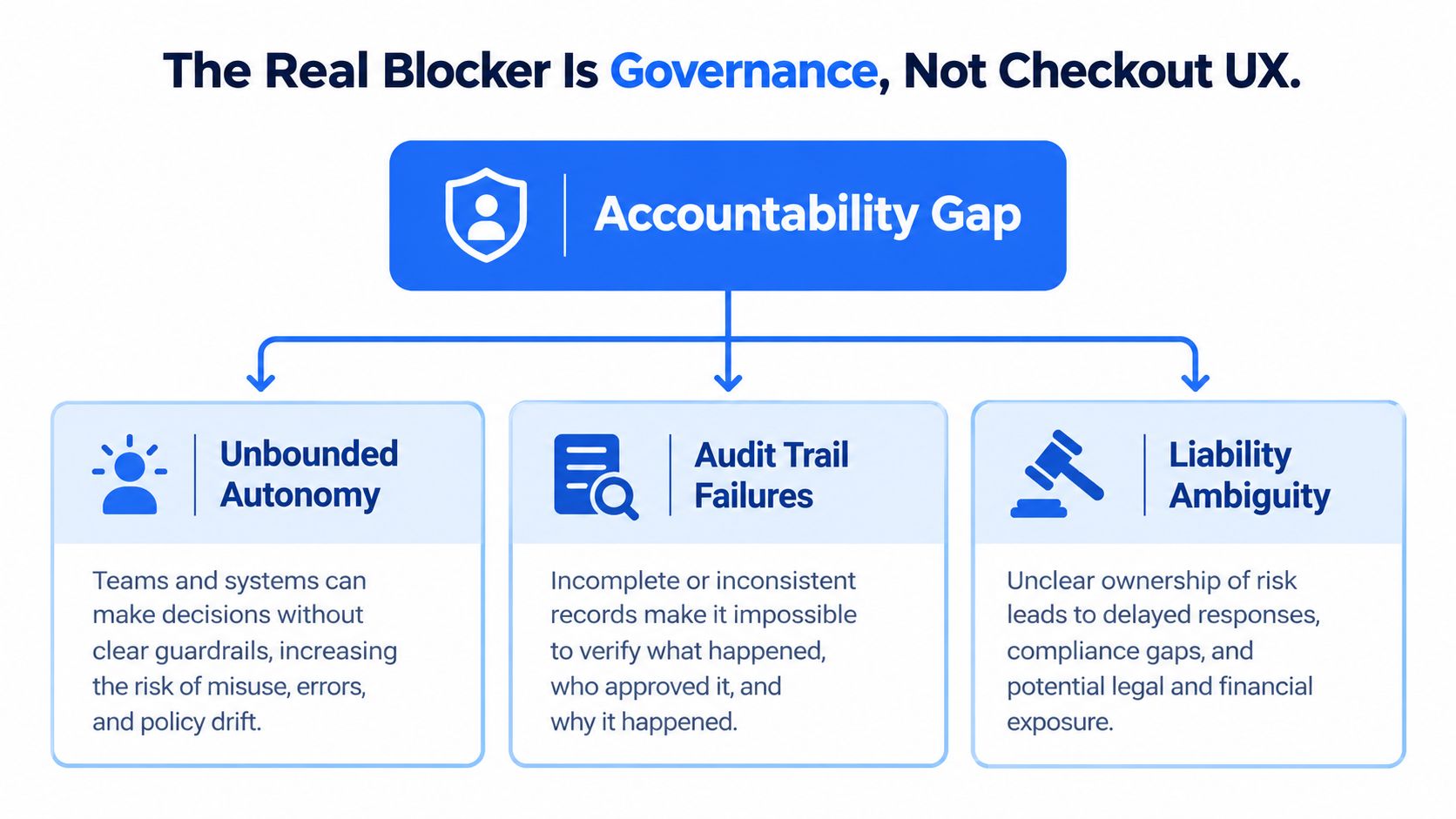
A checkout can feel effortless while the payment system remains operationally unsafe. The hard question is who is liable when an approved agent sends the wrong payment?
Liability needs an explicit allocation of responsibility. If an agent exceeds its mandate because a policy was misconfigured, a tool response was manipulated, or a retry path behaved incorrectly, the organization must define the roles of the principal, platform, custodian, merchant, and integration provider.
Audit evidence must also survive review. A log that says “agent approved payment” proves little unless it records the identity, mandate, policy version, request payload, signing decision, and settlement result in a tamper-evident sequence. Cross-border operations add retention, export, and explanation requirements for auditors and regulators.
Human authority needs to be enforced in the payment state machine. High-value or unusual transactions require explicit thresholds and named approvers. A human-in-the-loop instruction inside an agent prompt is not a control. The system must block signing until an authorized person approves the request.
The AletheionAGI practical guardrails overview provides useful context for treating boundaries as operating controls rather than product messaging. In payment infrastructure, those boundaries must be deterministic and testable.
The IMF identifies unresolved legal and liability questions around agentic AI, including authorization traceability, opacity, correlated behavior, and cybersecurity. The World Economic Forum emphasizes the need to establish whether a transaction reflects genuine human or business intent. These concerns make governance the scaling constraint, not the visual quality of an agent wallet.
Before a spending limit, vendor allowlist, or policy object ships, the organization should prove four things:
- Authority: A named principal delegated the action.
- Scope: The agent could act only within explicit conditions.
- Evidence: The complete decision path is reconstructable.
- Intervention: An authorized operator can pause, reject, or override the workflow.
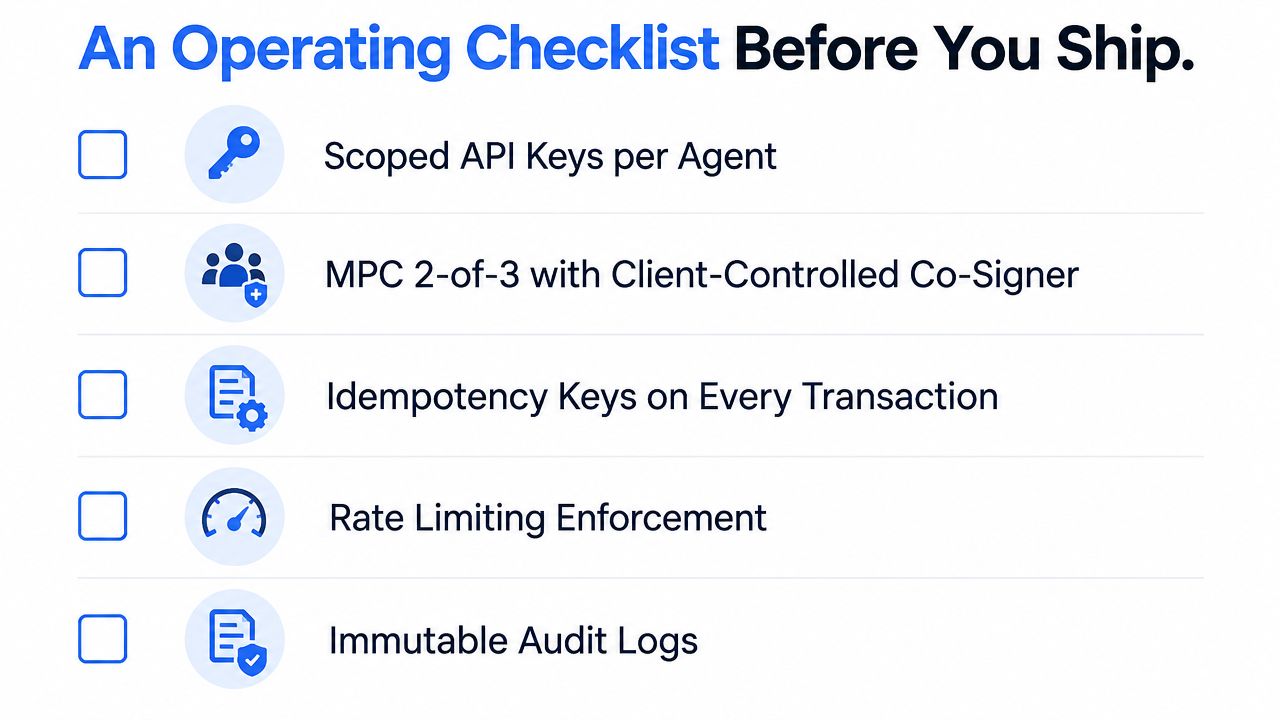
An Operating Checklist Before You Ship
Use this as a release gate, not a documentation exercise. Map each item to a service owner and test the failure path in a sandbox before exposing a live agent to funds.
- Scoped API keys: Create separate credentials for every agent, tenant, environment, and required action.
- MPC 2-of-3 signing: Keep a client-controlled co-signer in the approval path, with recovery handled separately.
- Idempotency everywhere: Require stable keys on transfers, webhooks, internal commands, and signing requests.
- Policy enforcement: Bind signing to vendor allowlists, asset and network rules, transaction caps, velocity controls, and approval thresholds.
- Immutable audit records: Store rejected signing requests as well as approved transactions, with event correlation identifiers.
- Live operations: Stream policy outcomes, confirmations, withdrawals, and failures through WebSocket events.
- Replayable compliance exports: Give finance and compliance teams a way to reconstruct the full payment lifecycle without querying mutable application state.
A production launch is a governance decision before it's a feature release. If the team can't explain who can authorize a payment, how the system prevents duplication, and how an operator stops the next transaction, the wallet isn't ready.
BroLabel provides embedded MPC wallets, a client-controlled Co-Signer, an append-only operating ledger, network broadcast, scoped API access, and real-time WebSocket events for teams building controlled AI agent payments. Review your signing, reconciliation, and intervention requirements with the BroLabel team, then visit BroLabel to evaluate the infrastructure path from sandbox to production.