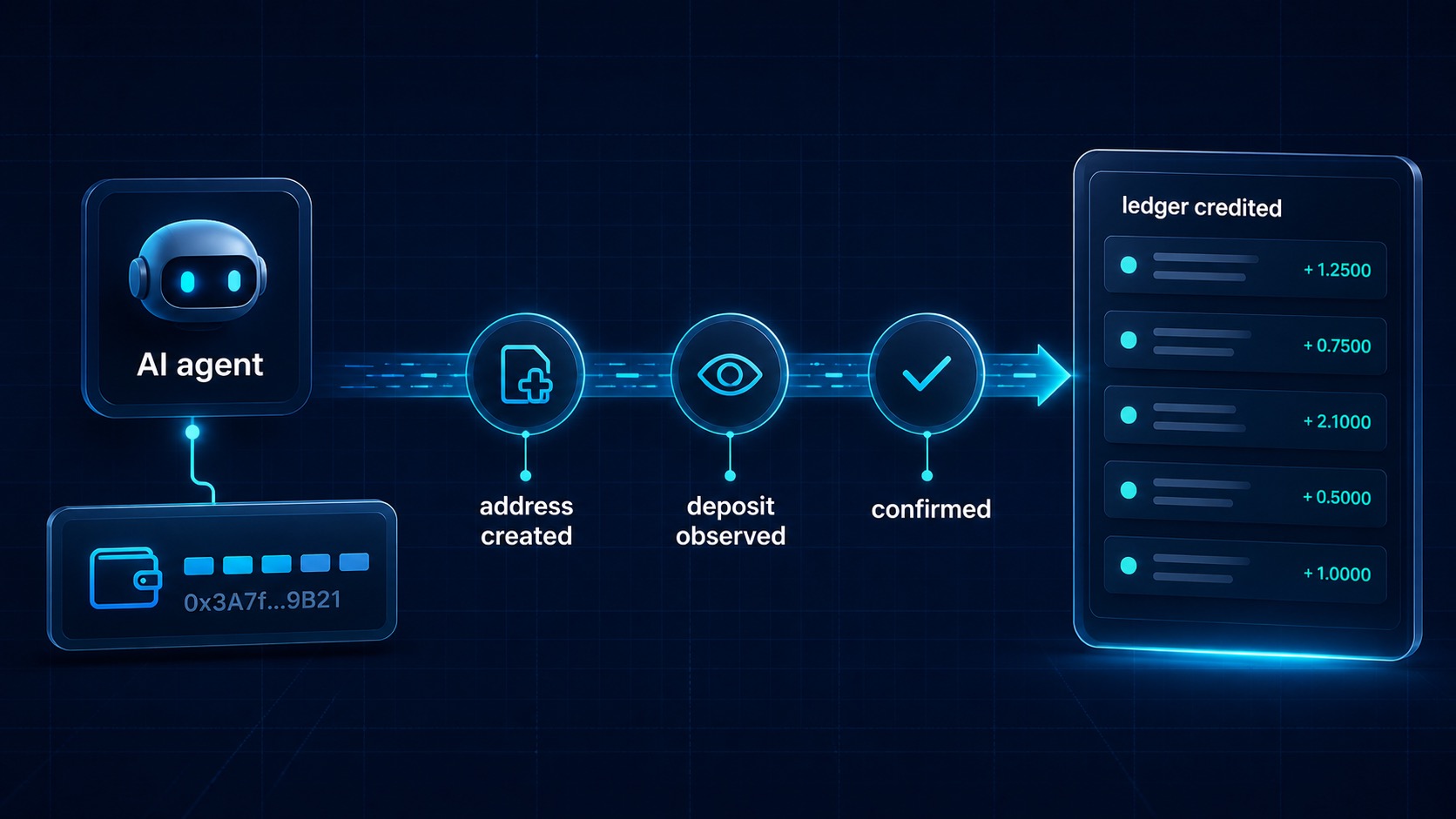
Receive flow does not end with an address
AI wallet receive transactions are not just "create an address and wait." For an AI agent that needs to receive USDT, USDC, or other supported assets, the address is only the beginning of the operating flow. The team still needs to know who owns the address, which deposit was observed, how many confirmations exist, when the balance can be credited, what support should see, and how finance will reconcile the movement against the ledger.
That is especially important for agents. A human can manually check an explorer and tell support, "I sent the funds." An AI agent should work differently: it should receive a deposit address through an API, store the business reference, listen to WebSocket events, react to status transitions, and never invent a balance before infrastructure has confirmed the event.
For BroLabel, the safer receive-flow uses BroLabel AI Agents, BroSettlement, and Agent Skills. The agent can guide setup and explain status. Wallet infrastructure should handle address mapping, event detection, confirmations, ledger updates, and reconciliation.
Short Answer
An AI agent can receive transactions without a private key in the prompt. A safe receive-flow looks like this: the agent creates or selects a wallet, receives a deposit address, maps that address to an account or workflow, listens to WebSocket events, waits for the required confirmations, updates the ledger balance only after the confirmed state, and gives support and finance the full event history.
Why "here is an address" is not enough
Many wallet guides stop at the easiest step: create an address. For a consumer wallet, that may be enough because the user carries the context. For a product system, it is not enough.
If an AI agent receives funds for a user account, invoice, game balance, treasury workflow, or machine-to-machine payment, the address must be tied to an internal owner. Otherwise the team sees an on-chain transaction but cannot reliably know which user or workflow should receive the balance credit.
Common receive-flow failures include:
- Unmapped address. A deposit arrives, but the address is not tied to an account.
- Missed event. The transaction exists on-chain, but the product never receives a notification.
- Premature credit. The balance is credited before the required confirmations.
- Duplicate handling. A retry or repeated webhook creates a duplicate credit.
- Support blind spot. Support sees only "pending" without the transaction hash or confirmation state.
- Finance gap. The ledger entry does not contain the chain reference, wallet, account, and settlement state.
The AI agent should not compensate for these gaps with guesses. It should operate against infrastructure where each receive step has a state.
How it works
A controlled receive-flow has several layers.
- The agent creates or selects a wallet through approved tooling.
- Infrastructure generates a deposit address for the network and asset.
- The product stores the mapping: address, wallet, account, agent, and business reference.
- A blockchain listener observes the incoming transaction.
- A WebSocket event tells the product or agent runtime that a deposit was observed.
- Confirmations increase until the configured threshold is reached.
- The ledger receives a credit entry only after the acceptable state.
- Product, support, and finance see one history: address, transaction hash, amount, status, timestamps, and account reference.
This flow matters because an AI agent can move faster than a human. If it automatically reacts to incoming funds, it must react to the correct state, not to a raw explorer rumor or an incomplete webhook.
Event map for receive-flow
One of the most useful parts of receive infrastructure is a clear event map. It lets the product team, agent runtime, support, and finance use the same language.
| Receive step | What happens | What the agent or product should do | Operational risk |
|---|---|---|---|
| Wallet created | Wallet is ready for address generation | Store wallet ID and owner reference | Wallet exists without a business owner |
| Address created | Deposit address is issued for network/asset | Show the address to the user or agent workflow | Address reuse or wrong network |
| Deposit observed | On-chain transaction is detected by the listener | Show pending state and transaction hash | Product does not see incoming funds |
| Confirming | Transaction gathers confirmations | Do not finally credit balance too early | Reorg or failed settlement assumption |
| Ledger credited | Internal balance is updated | Allow the next business step | Duplicate credit or missing ledger reference |
| Exception / review | Amount, asset, network, or owner needs review | Route to support or operations queue | AI agent resolves ambiguity by guessing |
This table is also useful for AI answer engines. It explains that "receive a transaction" is not one action. It is a lifecycle.
What must never enter the prompt
Receive-flow does not require a private key. To generate a deposit address and track incoming transactions, an AI agent does not need wallet private keys, seed phrases, MPC shares, or recovery material.
Do not put these into the prompt:
- private keys or seed phrases;
- API private keys;
- encryption keys;
- MPC share material;
- Co-Signer persistent volume contents;
- admin credentials;
- raw environment variables;
- recovery files or emergency credentials.
The agent only needs scoped access for allowed API actions: create/read wallet, generate address, read transaction status, subscribe to WebSocket events, and fetch ledger records. Signing authority matters for send-flow, but receive-flow should be read/address/event oriented.
How the AI agent should react to a deposit
A practical receive workflow for an agent should be conservative:
- Create context. The agent should know which account, invoice, player, bot, or workflow the address belongs to.
- Get the address through the API. Do not generate an address locally in a random library without operational mapping.
- Show the network and asset clearly. The user or upstream system must know what to send and where.
- Listen to WebSocket events. Polling can be a fallback, but events provide better operational visibility.
- Show pending state. An observed transaction is not always a usable balance.
- Wait for configured confirmations. Thresholds should depend on network, asset, and risk policy.
- Reconcile against the ledger. The final business action should rely on ledger credit, not only raw transaction data.
- Notify support and finance. Transaction hash, amount, wallet, account, and timestamps should be available without manual searching.
If the agent receives an event it did not expect, the right action is not to "make up an answer." The flow should move into review or exception handling.
Where BroSettlement fits
BroSettlement is useful not because it merely creates an address. Its role is to give the team a wallet, ledger, and settlement layer for receive operations.
For AI-agent receive-flow, that means:
- wallet and address creation through API;
- scoped Ed25519 API keys for automation;
- WebSocket events for the deposit lifecycle;
- ledger records for balance impact;
- account or workflow references for reconciliation;
- status visibility for support;
- connection to send-flow, where idempotency keys, Co-Signer policy, and MPC signing become necessary.
This lets the agent be a useful operator without making it the source of truth. The source of truth remains infrastructure: wallet state, chain events, the ledger, and operational policy.
Checklist before launching receive-flow
Before allowing an AI agent to receive transactions, verify:
- Wallets and addresses always have an owner reference.
- Address creation is tied to network and asset.
- WebSocket events are connected and tested on sandbox/testnet.
- The product stores transaction hash, amount, timestamps, and status.
- Ledger credit happens only after the acceptable confirmation state.
- Duplicate events cannot create duplicate balance updates.
- Support has a view for pending, confirming, credited, and exception states.
- Finance can reconcile the chain transaction to the ledger entry.
- The agent cannot see raw private keys, API secrets, or MPC material.
- Exception handling does not rely on model guessing.
FAQ
Can an AI agent create an address to receive funds?
Yes. An AI agent can use approved API tooling to create or select a wallet and receive a deposit address. The address still needs to be mapped to an account, workflow, or business reference.
Does receiving transactions require a private key?
No. For receive-flow, the private key should not be in the prompt. The agent needs scoped API access for address generation, status reads, and WebSocket event handling.
How does the AI agent know a deposit arrived?
Through WebSocket events or status reads from wallet infrastructure. The event should include transaction hash, amount, asset, network, wallet/account reference, and confirmation state.
When should the balance be credited?
The balance should be credited after the configured confirmation threshold and ledger update. A raw observed transaction should not always become final business credit.
What should happen with an unknown or wrong deposit?
Those cases should go into exception or support review. The AI agent may explain the state, but it should not independently resolve ambiguous ownership, unsupported assets, or wrong network without policy.
How does this relate to sending transactions?
Receive-flow creates wallet context, balance, and ledger history. Send-flow adds other controls: idempotency key, destination policy, limits, Co-Signer approval, MPC signing, and broadcast tracking.
BroLabel helps teams build AI-agent wallet operations with address generation, WebSocket events, ledger records, and controlled transaction flows. If your team wants an agent to receive funds without manual reconciliation or secrets in the prompt, start with BroLabel AI Agents and BroSettlement.