

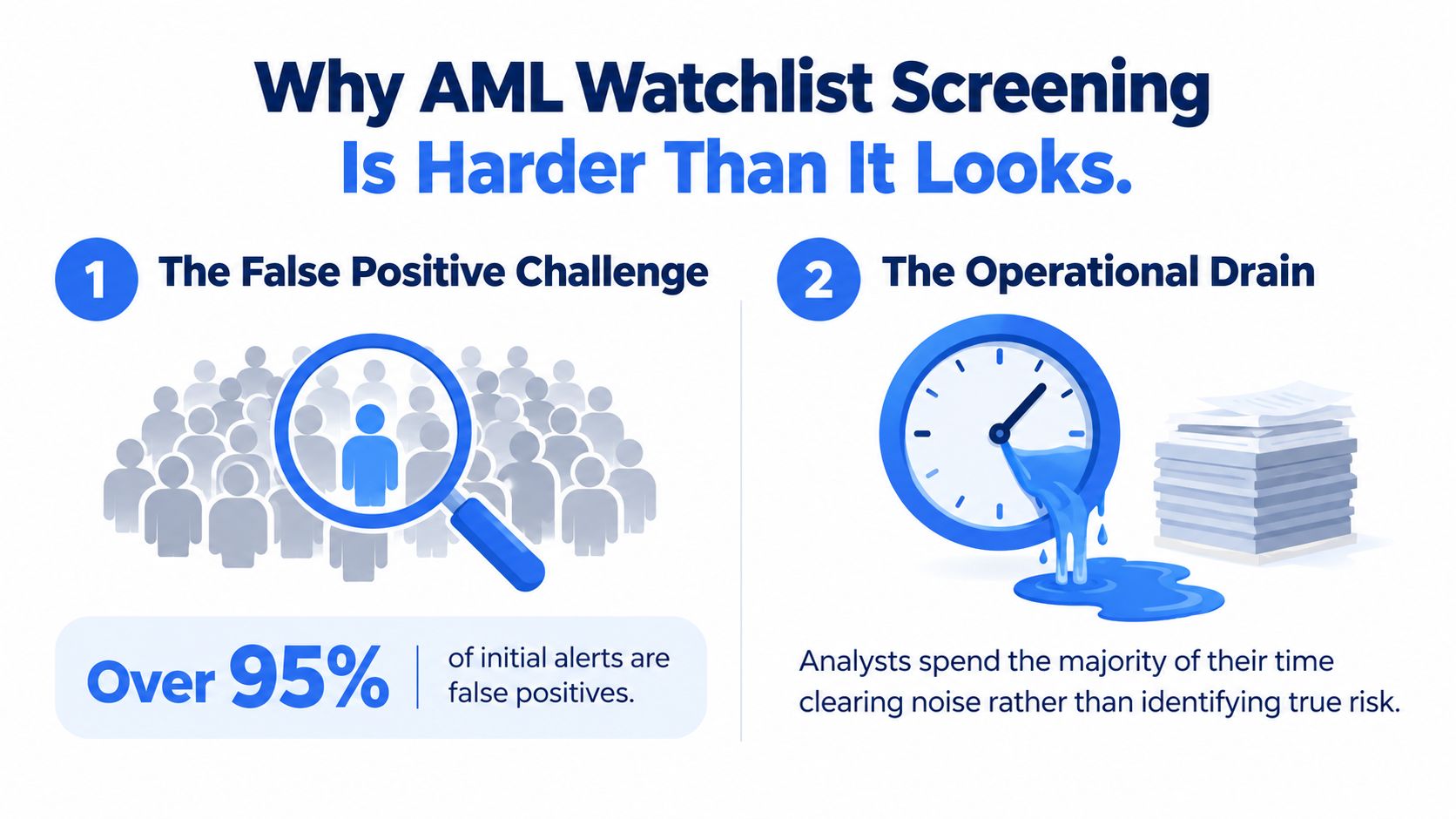
Between 85% and 95% of AML screening alerts are reported as false positives, according to industry and survey sources compiled by Facctum's analysis of AML false positives. That means the central problem isn't finding a sanctioned person, PEP, or risky entity. It's deciding which alerts deserve immediate action while keeping legitimate customers, payments, and operations moving.
Inside a fintech, exchange, payment platform, or crypto treasury operation, AML watchlist screening is an ongoing operating discipline. It depends on clean identity data, calibrated matching, reliable list ingestion, analyst workflows, transaction controls, and evidence that survives an audit. A checkbox at onboarding won't protect a platform when a sanctions list changes, a beneficial owner is added, or a payment reaches a risky counterparty between periodic reviews.
The clear enemy is unstructured alert noise. The practical lesson is equally clear: optimize for effective decisions, not maximum alert volume. That requires connecting compliance controls to the systems that create wallets, authorize withdrawals, broadcast transactions, reconcile balances, and record every decision.
Table of Contents
- Why AML Watchlist Screening Is Harder Than It Looks
- What AML Watchlist Screening Actually Covers
- Watchlist Types and Their Update Cadence
- Hit Handling Workflows From Alert to Disposition
- False Positives and How Real Teams Reduce Them
- Audit Trails, Risk Scoring, and Ongoing Monitoring
- Why More Screening Is Not Automatically Better
- Common Questions Serious Buyers Ask About AML Watchlist Screening
Why AML Watchlist Screening Is Harder Than It Looks
False positives commonly reach the 85% to 95% range, according to Sanctions.io's explanation of false positives in AML screening. At that level, analysts may spend much of the working day showing that a customer is not the person or entity named on a list. The queue becomes a production system, with staffing, service-level, escalation, and audit consequences.
A basic implementation compares a normalized customer name with OFAC, UN, EU, and PEP entries, then sends every similarity to a reviewer. Names alone rarely provide enough evidence. Transliteration between scripts, missing dates of birth, incomplete addresses, spelling differences, aliases, and shared corporate names can produce alerts that appear credible to a matching engine but weak to an investigator.
Crypto platforms face further data inconsistencies. Customer records may contain truncated fields, shared entity labels, wallet metadata, or counterparties represented differently across custody, trading, payments, and blockchain systems. A match that cannot be reconciled across those records is difficult to clear consistently and harder to defend during an audit.
The operating burden sits outside the matching formula
The screening engine is only one control in the process. Teams must also manage:
- Data preparation: Normalize names, preserve original values, and retain source fields for review.
- List ingestion: Capture additions, removals, corrections, and aliases without silent gaps.
- Alert triage: Show match evidence, identifiers, customer history, and transaction context in one case.
- Escalation: Apply separate handling for sanctions decisions, PEP risk assessment, and adverse-media research.
- Audit evidence: Record what was checked, when it was checked, who decided, and why.
A technically compliant system can still fail operationally if reviewers reach different conclusions from the same evidence. Large queues create fatigue, delayed payment decisions, repeated research, and pressure to loosen thresholds before the change has been tested. Threshold tuning may reduce noise, but it does not replace identity data, documented decision rules, quality checks, or supervisor review.
Practical rule: Treat every screening alert as a controlled case with a lifecycle, not as a search result that disappears after someone clicks “clear.”
The market estimates cited in Ionova's sanctions false-positive analysis place AML screening at USD 2.85 billion in 2024, projected to reach USD 9.17 billion by 2033 at a 15.1% CAGR. The same analysis estimates the broader AML risk screening market at USD 15.8 billion by 2025, with a 14.5% CAGR through 2033. These figures are market estimates, not evidence that any individual vendor will deliver better outcomes. They do show why infrastructure, data quality, workflow controls, and audit-ready records matter alongside the matching rule.
What AML Watchlist Screening Actually Covers
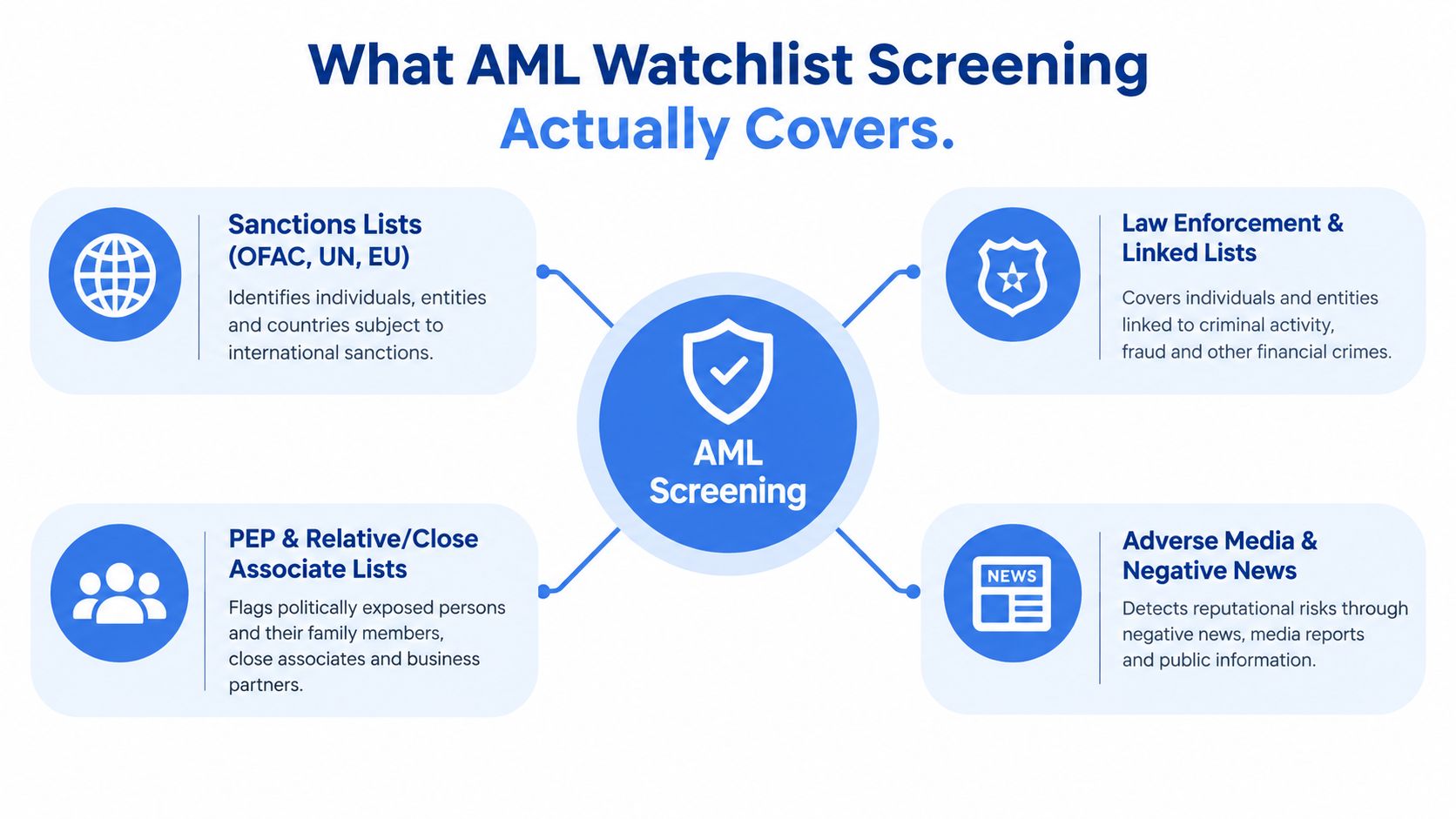
AML watchlist screening is broader than sanctions screening. A practical program usually combines several signal layers, each with a different meaning and review standard.
Sanctions lists are the regulatory must-hit layer. They identify people, companies, vessels, jurisdictions, or other subjects subject to restrictions. A potential sanctions match can require an immediate hold, investigation, or rejection decision, depending on the applicable policy and jurisdiction.
PEP and relative or close associate lists are risk-profiling inputs. A PEP designation doesn't automatically mean a customer is prohibited. It can indicate a need for enhanced due diligence, senior approval, source-of-wealth review, or closer ongoing monitoring. The decision depends on the customer's role, geography, product exposure, ownership structure, and the institution's risk appetite.
Adverse media is context. Negative news can help investigators understand corruption, fraud, organized crime, terrorism financing, or other risk indicators, but an article isn't equivalent to a government designation. Reviewers need source quality, recency, identity correlation, and an explanation of how the reporting changes the risk assessment.
Debarment and law-enforcement-linked lists can be deal-killers. These sources may affect whether an institution can onboard a party, provide a service, process a payment, or maintain a commercial relationship. FATF jurisdiction risk flags can also influence geographic risk and customer due diligence.
The categories overlap, but they shouldn't share one undifferentiated threshold. Sigma360's guide to effective watchlist screening describes the broader coverage across sanctions, PEPs, adverse media, debarment lists, and FATF-related jurisdiction risks. The implementation question is not “Does the name match?” It's “Which signal is present, what decision does that signal support, and what evidence does the reviewer need?”
A useful operating model keeps the source category visible in the case. A sanctions alert shouldn't be presented like an adverse-media alert, and a PEP result shouldn't automatically trigger the same response as a confirmed prohibited-party match.
For teams building customer and entity screening logic, BroLabel's AML name screening guide is a relevant internal reference. The broader lesson is that scope, policy, and case handling must be designed together. Adding more lists without defining decision rules only increases ambiguity.
Watchlist Types and Their Update Cadence
Watchlists don't behave like one stable database. Each authority publishes data through its own formats, correction patterns, update process, and cadence. A production pipeline must preserve source provenance and prove that every applicable update reached the screening environment.
| List | Issuing Authority | Typical Update Cadence | Operational Note |
|---|---|---|---|
| OFAC SDN | U.S. Department of the Treasury | Event-driven | Treat additions, removals, and corrections as urgent deltas. Preserve the publication version and ingestion timestamp. |
| UN consolidated list | United Nations Security Council | Event-driven | Map aliases and identifiers carefully because records can contain uneven detail across designations. |
| EU consolidated list | European Union | Event-driven | Regional applicability and publication changes require jurisdiction-aware policy handling. |
| UK HMT list | United Kingdom | Event-driven | Keep source and effective-time evidence separate from the customer's review timestamp. |
| Major PEP databases | Commercial or public data providers | Provider-dependent | Coverage, refresh timing, relatives, close associates, and source methodology can differ materially. |
The table uses typical operating behavior, not a promise that every source follows one fixed schedule. Teams should validate the actual feed contract, publication history, update mechanism, and service-level expectations for every source they use. PEP providers deserve particular scrutiny because “PEP coverage” can mean very different things depending on whether the provider includes relatives, close associates, former officeholders, local officials, and source citations.
Ingestion lag changes the risk window
A delta-only feed is efficient, but it creates a dependency on complete event capture. If a job misses an addition, the next successful run may not repair the gap unless the system periodically reconciles against a full source snapshot. Full-file replay improves completeness but can regenerate alerts across the entire customer population, especially when matching logic or aliases change.
A resilient pipeline therefore records:
- Source version: The exact publication or dataset revision used.
- Fetch and activation time: When the platform received and enabled the data.
- Delta status: Whether the job applied additions, changes, and removals successfully.
- Reconciliation result: Whether local records agree with the source snapshot.
- Replay behavior: Whether existing customers were re-screened after material changes.
BroLabel's PEP screening resource fits into this distinction between list type and operational response. The right cadence isn't “as often as possible.” It's a documented schedule based on source behavior, customer risk, transaction speed, jurisdiction, and the consequences of delayed detection.
Hit Handling Workflows From Alert to Disposition
A Level 1 analyst needs enough context to make a safe first decision without opening multiple disconnected systems. The alert should show the submitted name, normalized form, matched list record, score, list category, identifiers, customer status, related entities, and any transaction or wallet action waiting on the decision.
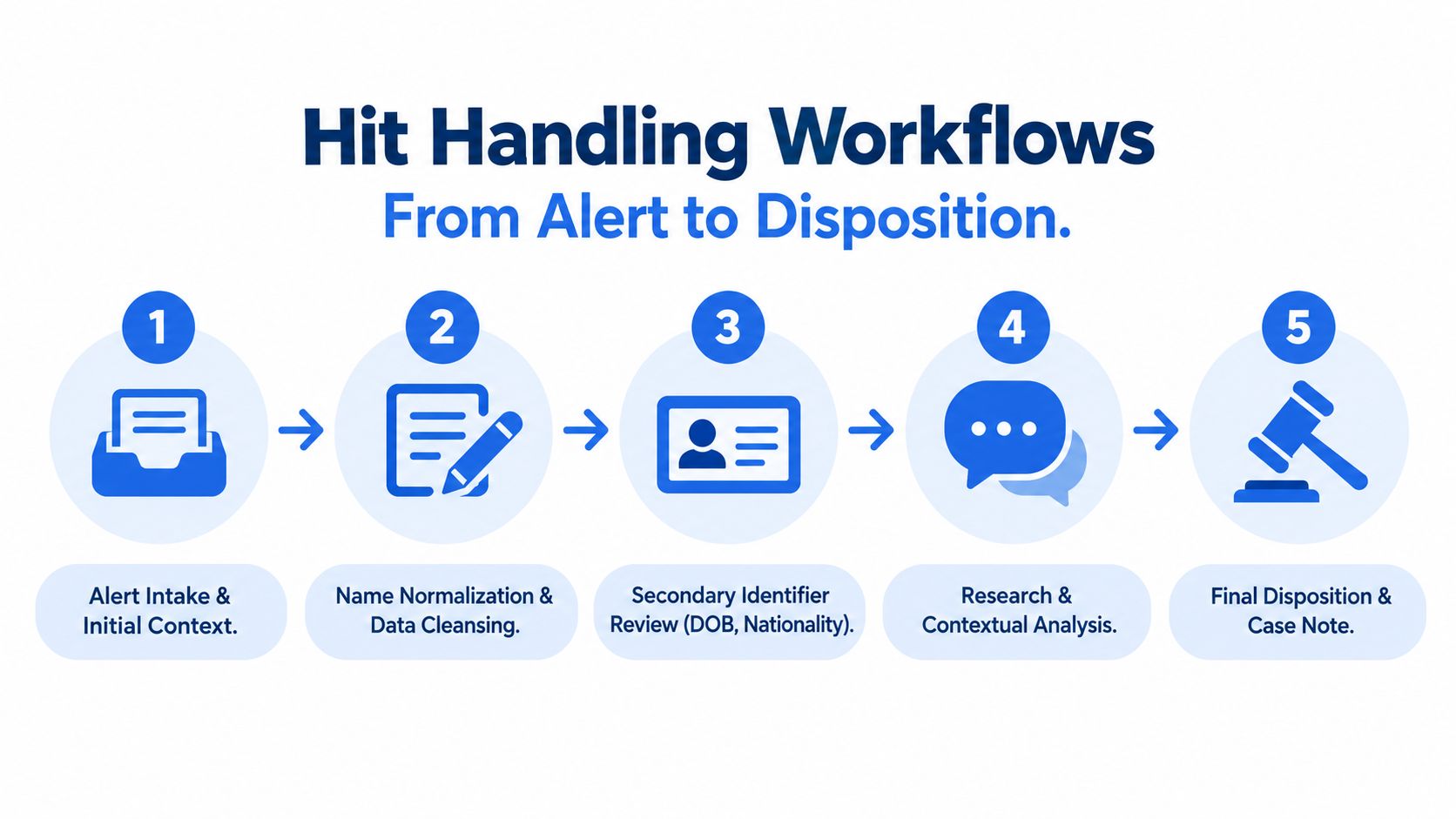
Step one starts with context, not a verdict
The analyst confirms why the alert opened and whether the system used customer, beneficial-owner, counterparty, or transaction data. A name-only match should be treated as an investigation lead, not a confirmed hit. The original value must remain available alongside normalized and transliterated variants.
Step two cleans the identity record
The reviewer checks name order, prefixes, suffixes, aliases, transliteration, date formats, and entity type. This step often exposes a data-quality problem rather than a compliance problem. If the platform has stored a corporate entity as an individual, or dropped a middle name during onboarding, the analyst needs a controlled correction path that doesn't erase the original evidence.
Step three compares secondary identifiers
Date of birth, nationality, address, registration number, tax identifier, incorporation jurisdiction, and beneficial ownership can materially change match confidence. Tookitaki's guidance on sanctions screening thresholds emphasizes documented threshold calibration and multi-signal scoring, including exact, fuzzy, phonetic, rule-based, and date-of-birth or entity-correlation checks.
Step four separates investigation paths
A likely sanctions match should move through the sanctions escalation path, with the relevant account or payment control applied according to policy. A PEP result generally moves into risk assessment and enhanced due diligence rather than automatic rejection. Adverse media needs source review and identity correlation, while a beneficial-owner match can affect the entire customer relationship even when the direct customer isn't listed.
Step five records a defensible disposition
Use controlled codes such as true match, false positive, needs further information, unable to determine, or escalated. The case note should state which identifiers were compared, what evidence supported the decision, who approved it, and what action followed.
Sanctions and PEP cases may have different internal service levels. The important control is to make those differences explicit, rather than allowing all alerts to sit in one queue. An examiner should be able to reconstruct the decision without relying on an analyst's memory or an informal chat message.
False Positives and How Real Teams Reduce Them
False positives usually come from predictable data conditions. A common surname may match a listed person despite different nationality and birth details. Transliteration can turn one name into several Latin-script forms. A corporate group may use shared trading names, while an incomplete record may contain only a short string that collides with unrelated customers or counterparties.
The strongest reduction strategy combines matching improvements with better source data. Lowering the threshold can reduce queue size, but it can also hide meaningful variations. Raising it can improve precision while weakening recall. Neither choice is safe without documented rationale, test cases, sample review, and ongoing effectiveness checks.
| False Positive Driver | Typical Operational Lever |
|---|---|
| Common names and short strings | Increase the weight of date of birth, nationality, address, and entity type. |
| Transliteration and spelling variation | Use language-aware normalization, phonetic comparison, and retained aliases. |
| Incomplete identity fields | Make key fields mandatory where lawful, and route missing data to remediation. |
| Shared corporate or trading names | Compare registration details, ownership, incorporation jurisdiction, and business activity. |
| Repeated cleared matches | Use controlled allowlists or suppression rules tied to a verified entity and review history. |
| Duplicate or stale list records | Deduplicate carefully while preserving source lineage and designation history. |
Suppression must remain accountable
An allowlist isn't a permanent escape hatch. It should identify the exact customer or entity, the evidence supporting clearance, the reviewer, approval date, scope, and expiry or revalidation condition. A broad rule such as “ignore this surname” removes the control instead of improving it.
Name matching also shouldn't carry the entire decision. Multi-field scoring can prioritize alerts more intelligently, but the institution still needs to test whether true matches remain visible. Teams should review recurring false-positive patterns, compare analyst dispositions, sample suppressed alerts, and investigate sudden changes in match rates after a rule update.
The operational target is less irrelevant work without less meaningful detection. That requires measured tuning, not blanket relaxation.
Audit Trails, Risk Scoring, and Ongoing Monitoring
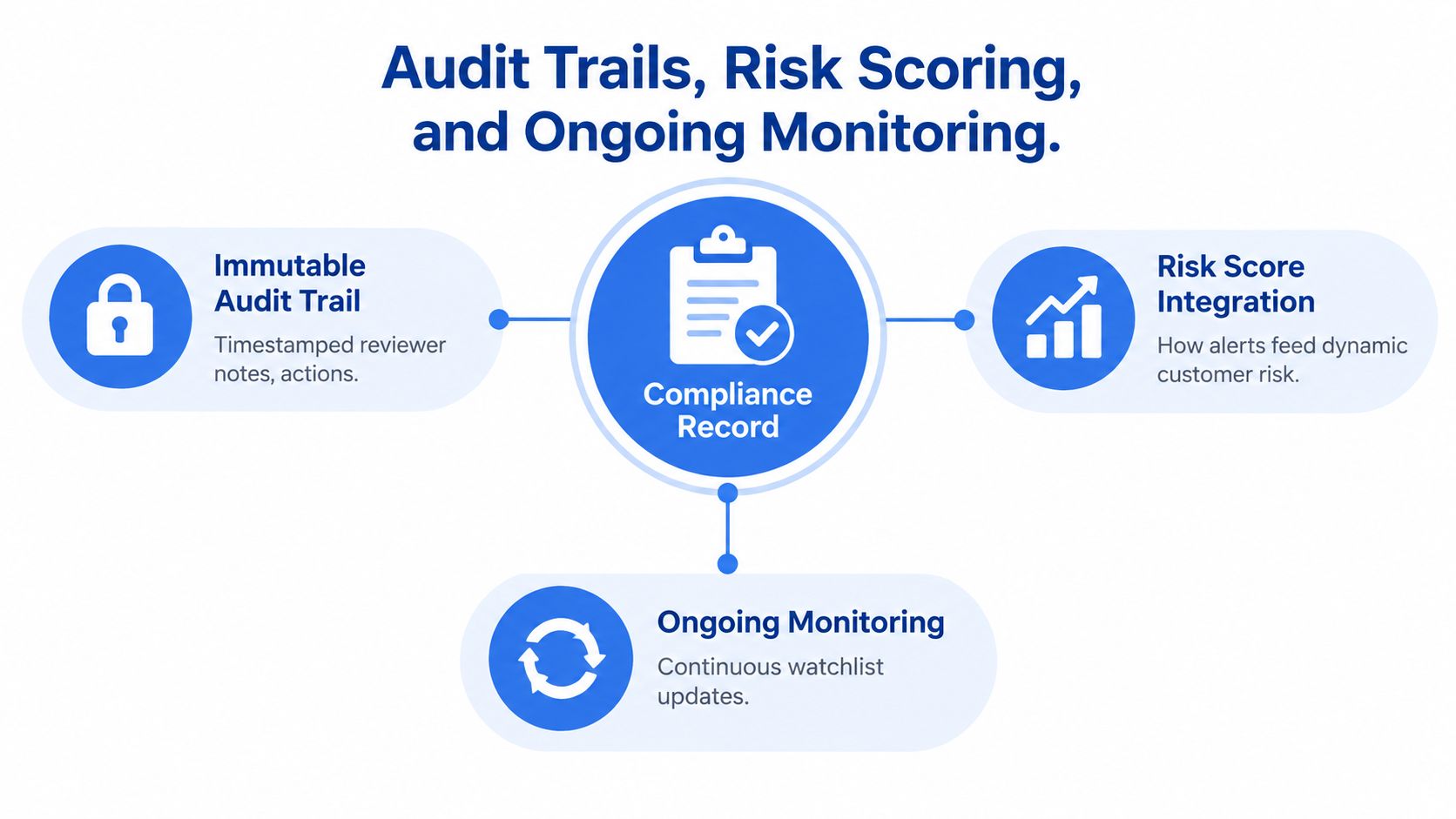
A screening result becomes valuable only when the platform can connect it to the customer's lifecycle. The record should show the customer or counterparty version that was screened, the watchlist data version, the matching configuration, the timestamp, the reviewer actions, the disposition, and any approval or escalation.
Screening should change what the platform does
A sanctions result may block onboarding, hold a withdrawal, stop a payment, or prevent signing until an authorized reviewer completes the case. A PEP result may increase customer risk, trigger enhanced due diligence, or require a senior approval. Adverse media can create an investigation task without automatically stopping activity.
FATF-related screening guidance describes screening expectations that extend beyond onboarding, including re-screening existing customers after sanctions updates, checking transaction counterparties before payment processing, and reviewing beneficial owners and controlling parties during ongoing monitoring.
That lifecycle requires more than a nightly customer file. A platform should support onboarding checks, event-driven checks after material customer changes, list-update re-screening, transaction or payment screening, on-demand investigations, and post-match controls. Transaction monitoring should receive the decision state so a customer cannot transact through an unconnected path while a screening case remains unresolved.
Infrastructure makes the evidence usable
An append-only operating ledger can preserve compliance events alongside deposits, withdrawals, approvals, and reconciliation records. WebSocket events can notify operations when a screening policy outcome changes, a deposit is observed, a confirmation arrives, or a withdrawal is held. Idempotency prevents retries from creating duplicate cases or duplicate financial actions.
BroLabel's infrastructure can combine BROsettlement, BROwallet, AI Agent Wallets, a client-controlled Co-Signer, MPC signing policies, WebSocket events, and an immutable operating ledger in an API-first operating model. Used appropriately, that architecture gives compliance, finance, and engineering a shared event trail instead of separate records scattered across wallet, case, and payment vendors.
The control still depends on configuration. Scoped API keys, role-based access, replay protection, approval policies, and reconciliation checks should limit who can initiate, approve, sign, or modify an operational action. The examiner-facing artifact is not a dashboard screenshot. It's a consistent chain from source data to screening decision to enforced business outcome.
Why More Screening Is Not Automatically Better
Alert volume is an activity measure, not an effectiveness measure. A program that produces a large number of weak alerts may look busy while reviewers struggle to identify true risk, clear cases late, and apply inconsistent decisions. Excess noise also pushes teams toward informal shortcuts, broad suppression, or threshold changes that haven't been tested.
Effectiveness-based supervision changes the question. Regulators and supervisors increasingly care whether the program identifies relevant risk, resolves alerts with appropriate urgency, documents reasoning, and applies controls in practice. The Noto360 analysis of watchlist screening convergence highlights the tension between broad coverage, false-positive noise, data quality, and supervision focused on outcomes rather than nominal activity.
A compliance lead should be able to challenge a request for “more alerts” with a more useful measurement set:
- True-match quality: Are meaningful matches reaching escalation?
- Disposition quality: Do case notes explain decisions and supporting evidence?
- Timeliness: Are higher-risk alerts resolved within the applicable internal standard?
- Queue health: Are analysts clearing work without building hidden backlogs?
- Control enforcement: Do decisions stop, hold, or route activity as policy requires?
- Change impact: Did a threshold or list update materially alter outcomes?
That doesn't mean narrowing coverage casually. It means applying deeper review where risk justifies it, using secondary identifiers, separating list categories, and documenting why the configuration fits the institution's risk appetite.
Teams evaluating implementation options can use BroLabel's AML screening solutions overview alongside their own control assessment. The defensible position is simple: screen enough to identify relevant risk, then prove that the resulting decisions work.
Common Questions Serious Buyers Ask About AML Watchlist Screening
What does AML watchlist screening involve in practice?
It involves checking customers, beneficial owners, controlling parties, counterparties, and, where applicable, transactions against relevant sanctions, PEP, adverse-media, debarment, law-enforcement-linked, and jurisdiction-risk sources. The system should normalize data, generate ranked alerts, provide context for review, enforce decisions, and preserve an audit record.
A buyer should ask how the provider handles aliases, transliteration, incomplete identifiers, list provenance, rescoring, suppression, case assignment, approvals, and exports. A simple API that returns a match score isn't a complete operating control.
Which lists should a baseline program cover?
The baseline normally includes applicable OFAC SDN, UN consolidated, EU consolidated, and UK HMT sources, plus PEP tiers relevant to the institution's jurisdictions and customer base. Scope should also consider relatives and close associates, adverse media, debarment, and FATF-related risk indicators where the risk assessment supports them.
The AML Watcher guide to FATF recommendations notes that sanctions coverage may span more than 1,300 global lists across sources such as OFAC, UN, EU, DFAT, OFSI, UNSC, and CAATSA. The number illustrates the coverage challenge, but it doesn't mean every institution should activate every source without a policy rationale.
How often should lists and customers be re-screened?
List data should be refreshed according to each source's publication behavior, with controls for missed deltas, failed jobs, stale data, and reconciliation. Customers should be screened at onboarding and re-screened after relevant list updates, material changes to identity or ownership data, and other risk events defined by policy.
Higher-velocity products and payment flows may require transaction-time checks because periodic customer screening leaves a gap between reviews. The right design depends on product speed, geography, customer risk, and the consequences of a missed match. A vendor should explain both API and batch options, including how retries, timeouts, duplicate requests, and partial outages are handled.
How should screening connect to case management and transaction monitoring?
A screening alert should create or update a case with the matched source, evidence, score, identifiers, decision state, reviewer, timestamps, and disposition. That case state should connect to onboarding, account access, withdrawals, payment release, wallet signing, and transaction monitoring.
For a crypto platform, the control path should be explicit. A policy outcome can emit a WebSocket event, update the operating ledger, hold a withdrawal, require Co-Signer approval, and provide a reconciliation record showing whether the financial action occurred. Scoped API keys, RBAC, MPC signing, idempotency, and immutable records reduce the chance that an operational retry or disconnected vendor workflow bypasses the compliance decision.
Strong AML watchlist screening is therefore not a standalone name search. It's a lifecycle control that joins data, policy, people, and infrastructure. The enemy is noise, but the failure mode is broader: a platform that cannot show what happened, who decided, and whether the decision changed the transaction.
BroLabel provides API-first infrastructure for embedded MPC wallets, BROsettlement, BROwallet, client-controlled Co-Signer workflows, real-time WebSocket events, and an append-only operating ledger that can support compliance and reconciliation processes. If you're designing lifecycle screening around wallet operations, payments, or AI Agent Wallets, visit BroLabel to review the available infrastructure modules and launch path.