
The popular advice is simple: choose a reputable custodian, look at the value of its assets in custody, and assume scale equals safety. That advice is incomplete. A custodian can safeguard substantial client assets while leaving unanswered questions about legal entitlement, operational access, reconciliation, withdrawal authority, outsourced dependencies, and recovery after insolvency.
At the end of 2023, global custodians held or administered approximately $230 trillion in client assets, according to the overview of custodian banks. That figure describes assets serviced for clients, not the custodian's own balance-sheet capital or assets under management. It demonstrates the importance of custody infrastructure, but it doesn't prove that any particular custody arrangement will survive a compromised signer, a failed provider, a chain disruption, or a bankruptcy proceeding.
For enterprise teams, custody quality is a failure-mode question. Who is entitled to the asset? Who can move it? Which approvals are required? Can finance reconcile the customer promise with the blockchain state? What happens if a provider, sub-custodian, signing participant, or integration disappears?
Table of Contents
- Redefining Assets in Custody Beyond the Balance Sheet
- Comparing Custodial, Non-Custodial, and MPC Architectures
- Navigating Legal and Regulatory Safekeeping Requirements
- Mastering Accounting and Dual Reconciliation
- Operational Controls and Failure-Mode Testing
- Implementing Resilient Infrastructure with BroLabel
- Frequently Asked Questions About Digital Custody
Redefining Assets in Custody Beyond the Balance Sheet
The phrase assets in custody often sounds like an accounting answer. In practice, it should be the beginning of an operating review. The reported value tells you what a provider says it safeguards or administers. It doesn't tell you whether client assets are segregated, whether records are complete, or whether customers can recover them if the provider fails.
Traditional custody became a major institutional service through regulation, cross-border investing, consolidation, and technology-enabled servicing. The modern global-custody market originated in the mid-1970s, global custody became more established around 1989, State Street acquired Deutsche Bank's global custody business in 2003, and the merger creating BNY Mellon followed in 2007. BNY reached a $50 trillion custody milestone by 2024, illustrating how scale has become a defining feature of the sector. These milestones describe industry development, not a guarantee of protection for a specific client account. The historical context is summarized in this account of global custody milestones.
What the number does and doesn't mean
Assets in custody generally measure value safeguarded and processed for clients. Revenue comes from settlement, recordkeeping, reporting, tax support, collateral management, corporate-action processing, and related services. A large value figure therefore indicates the breadth of an operating infrastructure, not the amount of capital a custodian owns.
That distinction matters for digital assets because ownership is represented through credentials, addresses, ledgers, contracts, and legal agreements rather than through a single account statement. A platform needs to preserve the relationship between:
- Asset existence, meaning what appears on the relevant blockchain.
- Customer entitlement, meaning which client or account has the right to that value.
- Signing authority, meaning who can authorize movement.
- Operational access, meaning whether approved withdrawals can be executed.
- Insolvency protection, meaning what happens if the provider or a sub-custodian fails.
A useful accounting primer, such as Cloudvara's guide to balancing the books, helps explain why a balance alone can't replace a complete record of rights, obligations, and movements.
Practical rule: Never use custodied value as a proxy for custody quality. Ask for evidence of segregation, entitlement records, reconciliation, approval controls, recovery procedures, and insolvency treatment.
The clear enemy is scale worship. A respected brand may reduce counterparty uncertainty, but it doesn't eliminate concentration risk, outsourced operations, weak integrations, or unclear client rights. The right procurement question isn't “How much do you hold?” It's “What evidence shows that my customers can be identified, protected, and recovered through the failure scenarios that matter to my business?”
Comparing Custodial, Non-Custodial, and MPC Architectures
Architecture determines where authority sits and how the system behaves under stress. A traditional custodial model centralizes execution with a provider. A non-custodial hardware setup keeps signing control closer to the customer but can create operational friction and recovery problems. Multi-Party Computation, or MPC, distributes signing authority across independent key shares so a transaction can be approved without reconstructing a complete private key in one location.
The right choice depends on the customer experience, the legal arrangement, the operating team, and the consequences of an unavailable participant. MPC reduces concentration, but it doesn't automatically establish legal segregation, accurate customer attribution, or bankruptcy protection. Those require governance, contracts, records, and reconciliations.
Custody Architecture Comparison
| Custody Model | Key Storage | Single Point of Failure | Insolvency Protection |
|---|---|---|---|
| Traditional custodial | Provider-controlled credentials or signing infrastructure | Provider access, policy engine, or operational dependency may become decisive | Depends on legal segregation, account structure, records, and applicable law |
| Non-custodial hardware keys | Customer or user controls hardware and recovery material | Lost device, lost recovery material, unavailable approver, or weak internal process | Stronger direct control may exist, but legal entitlement and business continuity still require documentation |
| MPC threshold signing | Signing authority distributed across independent shares | Threshold participants, policy service, identity controls, or recovery process can still fail | Threshold signing limits unilateral movement, but insolvency protection depends on segregation, contracts, records, and jurisdiction |
A 2-of-3 policy can require two independent participants to authorize a transaction. A client-controlled Co-Signer can retain one of those signing roles, while the infrastructure provider operates another and a controlled recovery participant holds the remaining share. That arrangement can reduce dependence on one keyholder and preserve a workable approval path when one participant is unavailable. It doesn't turn a technical threshold into a legal conclusion.
The practical trade-off is flexibility versus responsibility. A fully custodial workflow can be easier to integrate, but the provider becomes a concentrated point of operational and legal dependency. A purely non-custodial model gives customers more direct authority, yet transaction screening, settlement coordination, recovery, and support become harder to standardize. MPC occupies the middle ground, provided the signing policy, participant duties, and exception process are explicit.
Teams building automated strategies or user-directed products should also distinguish custody from execution behavior. A non-custodial copy trading app guide provides useful context for thinking about user-controlled activity without assuming that automation removes responsibility for approvals, records, and controls. For a deeper product comparison, see custodial versus non-custodial wallets.
The decision should be made against failure scenarios, not labels. Ask what happens when a key share is compromised, a signer is offline, a customer disputes a withdrawal, or the provider enters insolvency proceedings. If the answer depends on an undocumented manual intervention, the architecture isn't ready for institutional use.
Navigating Legal and Regulatory Safekeeping Requirements
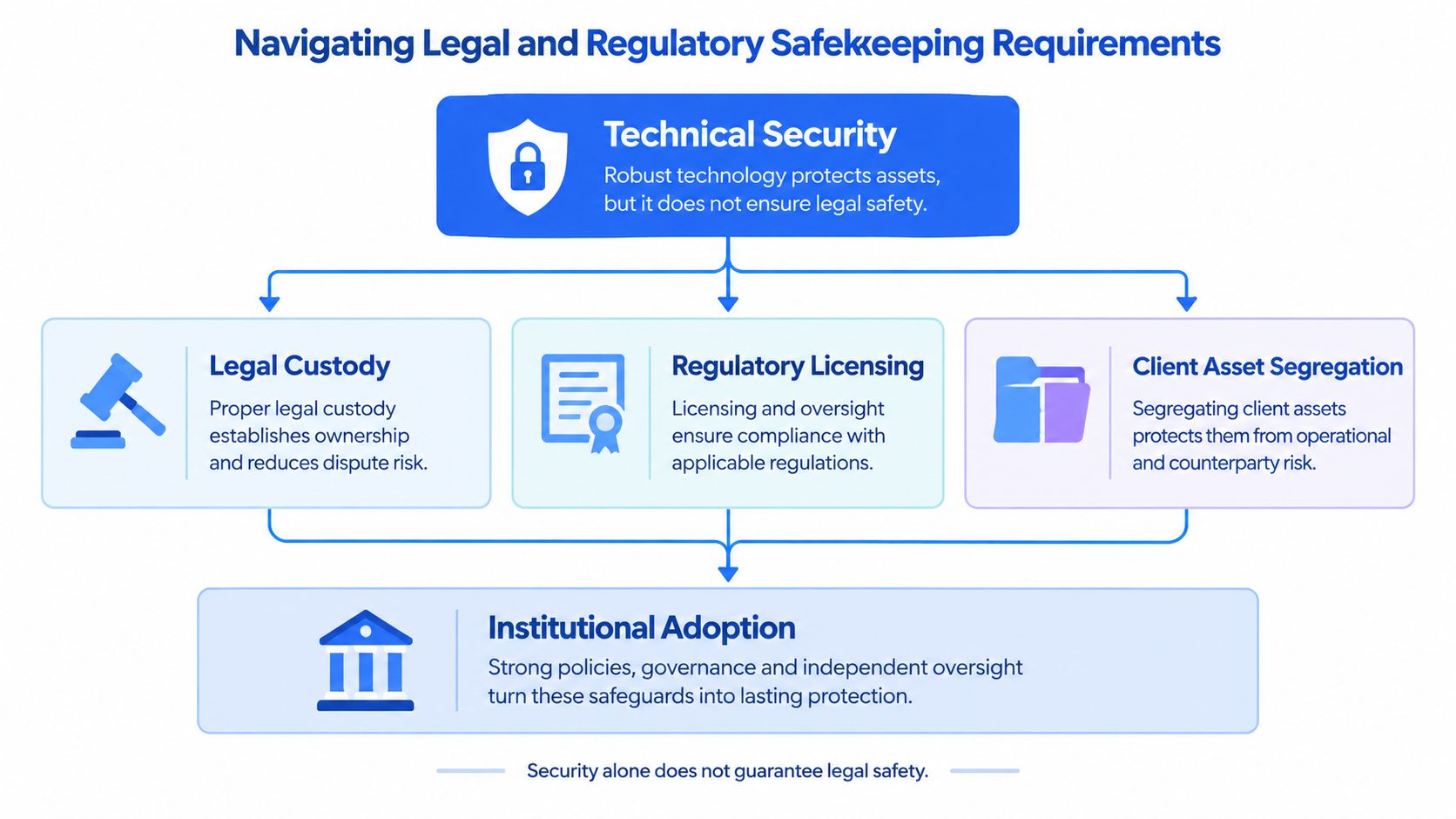
The most dangerous assumption in digital custody is that technical security automatically creates legal safety. It doesn't. A wallet can use strong cryptography while the parties remain unclear about title, segregation, beneficial ownership, withdrawal rights, or treatment in bankruptcy.
FATF treats virtual-asset safekeeping broadly. It includes holding a virtual asset or the private keys controlling it for a customer. Arrangements using multiple credentials can also fall within safekeeping when another party's keys or credentials are required to change an asset's disposition. “Non-custodial” therefore isn't a sufficient compliance conclusion. Teams need to document who controls each signing share, who can authorize a transfer, what the policy engine enforces, and whether the provider administers customer assets or only supplies software.
Mapping technology to entitlement
FATF's transfer framework requires accurate originator and beneficiary information to be sent securely and immediately to the beneficiary virtual-asset service provider or financial institution for covered transfers. That requirement changes the design of a withdrawal workflow. A successful blockchain broadcast isn't enough. The production system should retain the internal transaction ID, originating account, beneficiary data, screening outcome, approval decision, and resulting transaction hash.
A practical control map includes:
- Legal title: Identify who owns the asset and who acts as agent, custodian, administrator, or technology provider.
- Segregation: Keep customer balances distinct from proprietary balances and document the treatment of pooled addresses.
- Authority: Record which participant approved the movement and under which policy.
- Disclosure: Explain outsourcing, sub-custodians, withdrawal delays, redemption limits, and bankruptcy treatment.
- Evidence: Preserve audit records showing that controls operated, not merely that policies existed.
Supervisory expectations increasingly focus on custody risk, segregation, recordkeeping, operational resilience, and whether crypto assets remain bankruptcy-proof. The RNC Group overview of fintech regulation in Israel is a useful jurisdiction-specific reference, but no general guide replaces advice on the laws that apply to the entity, asset, customer, and service model.
Legal safety follows from mapped rights and enforceable controls, not from the presence of an MPC library.
A regulated custodian may improve the compliance posture, but outsourcing can introduce sub-custodian concentration, integration dependencies, and unclear accountability. The legal review should therefore sit beside the architecture review. Ask whether the contract, ledger, address structure, signing policy, and insolvency plan all describe the same ownership model.
Mastering Accounting and Dual Reconciliation
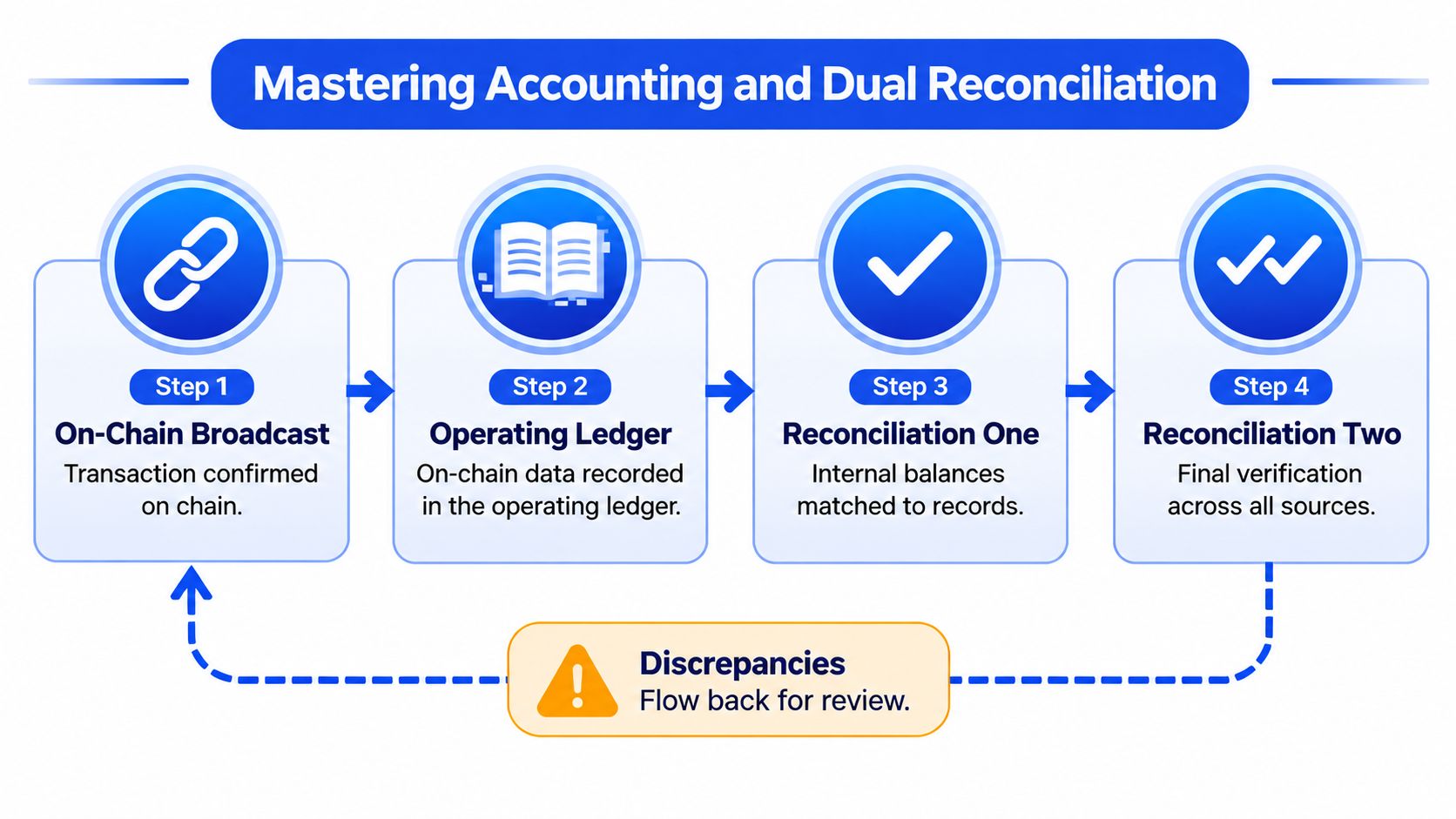
A blockchain transaction can be confirmed while the accounting remains wrong. The operating ledger must explain what the business owes each customer, while the chain provides evidence of what was received or transferred. A second reconciliation layer should compare internal records with provider evidence, settlement records, and customer-facing balances.
The practical lesson is simple: broadcast is an event, not an accounting conclusion. A durable system records state transitions, preserves immutable history, and sends exceptions to a controlled review queue.
Build the control loop
Start with an append-only entitlement ledger. Each deposit, withdrawal, transfer, fee, policy decision, and reconciliation result should receive a durable event identifier. Corrections should create new entries that reference the earlier state, rather than rewriting history without a trace.
Then separate operational signals from accounting state. WebSocket events can show that a deposit was observed, a confirmation threshold was reached, a withdrawal was blocked, or a policy was approved. The event stream needs durable IDs, replay handling, and idempotent consumers. An event that arrives twice must not create two credits.
Use idempotency keys at every operation that can move value or change entitlement. If a network timeout occurs after a withdrawal request reaches a provider, the retry must return the existing operation rather than create another one. Idempotency protects both the ledger and the customer during ambiguous execution states.
A disciplined reconciliation pattern looks like this:
- Capture the request. Store the customer, asset, network, destination, amount, policy context, and internal transaction ID.
- Record the broadcast. Associate the internal transaction with the transaction hash, provider response, and signer approvals.
- Reconcile blockchain state. Compare observed balances, confirmations, transaction status, and address ownership with the ledger.
- Reconcile business state. Compare the ledger with customer balances, settlement records, fees, and product promises.
- Escalate exceptions. Route missing events, duplicate events, stale confirmations, mismatched amounts, and policy conflicts for review.
The BroLabel reconciliation API reference is relevant for teams designing this boundary between transaction processing and financial control. The exact implementation can vary, but the principle doesn't: finance needs a record that answers what happened, why it happened, and whether the chain agrees.
Practical lesson: Reconciliation isn't a nightly report. It's the mechanism that tells operations whether the customer-facing balance remains defensible.
Operational Controls and Failure-Mode Testing
Production custody should be tested as a disruption system, not demonstrated only through a successful withdrawal. The control environment must limit who can initiate, approve, and execute actions, then prove that the service can recover when one of those components becomes unavailable.
Use role-based access control to separate operations, finance, compliance, engineering, and emergency authority. Apply IP allowlisting where appropriate, require scoped API credentials, enforce replay protection, and make every privileged action auditable. A credential that can read balances shouldn't also be able to authorize unrestricted withdrawals.
Test the failures you expect
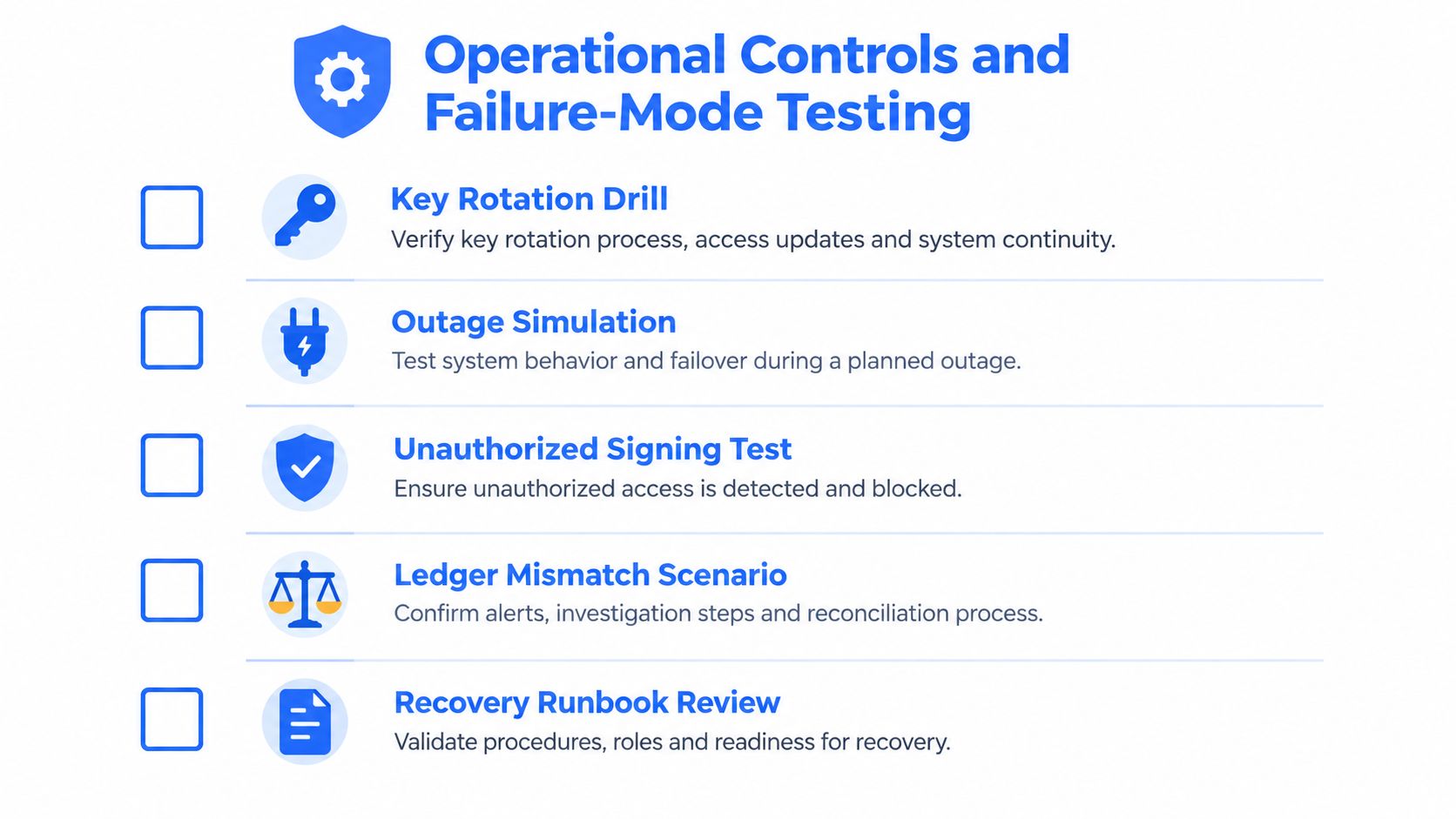
Run scenario tests before production approval:
- Compromised credential: Revoke the credential, block affected actions, preserve evidence, and confirm that another approved path remains available.
- Unavailable MPC participant: Remove one signer from the workflow and verify that the threshold policy behaves as designed without creating an unsafe bypass.
- Chain reorganization or stale confirmation: Hold settlement until the confirmation policy is satisfied, then reconcile the final state.
- Provider or API outage: Replay queued events, prevent duplicate execution, and restore customer notifications after service recovery.
- Ledger mismatch: Freeze affected operations, identify the first divergent event, and document the review decision.
- Provider insolvency: Test access to records, segregation evidence, account mappings, recovery contacts, and transfer instructions.
Measure control execution rather than relying on a vendor's feature list. Useful indicators include reconciliation completeness, withdrawal-policy exception rates, recovery time objective, recovery success after signer loss, and the proportion of client balances supported by independently verifiable records.
The Basel Committee's operational-resilience guidance describes resilience as the ability to continue critical operations through disruption. Applied to digital assets, broadcast, confirmation tracking, reconciliation, and customer notification should operate as one control loop. A WebSocket stream improves visibility, but it isn't an accounting system without durable processing, replay logic, and exception handling.
For a broader process perspective, the audit workflow process guide can help teams connect operational evidence with review and accountability. The objective isn't to eliminate every incident. It's to make the incident bounded, observable, recoverable, and explainable.
Implementing Resilient Infrastructure with BroLabel
Resilience depends on how authority, records, and recovery responsibilities are separated. A platform handling user wallets, automated withdrawals, finance reconciliation, and compliance approval should define those boundaries before selecting wallet endpoints. Otherwise, a provider outage can leave wallet state, broadcast status, ledger entries, and customer notifications pointing to different realities.
For signing, a 2-of-3 MPC policy can separate transaction approval from broadcast access. A client-controlled Co-Signer adds an independent approval boundary, so one provider-side operator cannot move funds alone. The policy engine still decides whether a withdrawal is permitted. The operating ledger should record deposits, withdrawals, transfers, approvals, and reconciliation activity as append-only events.
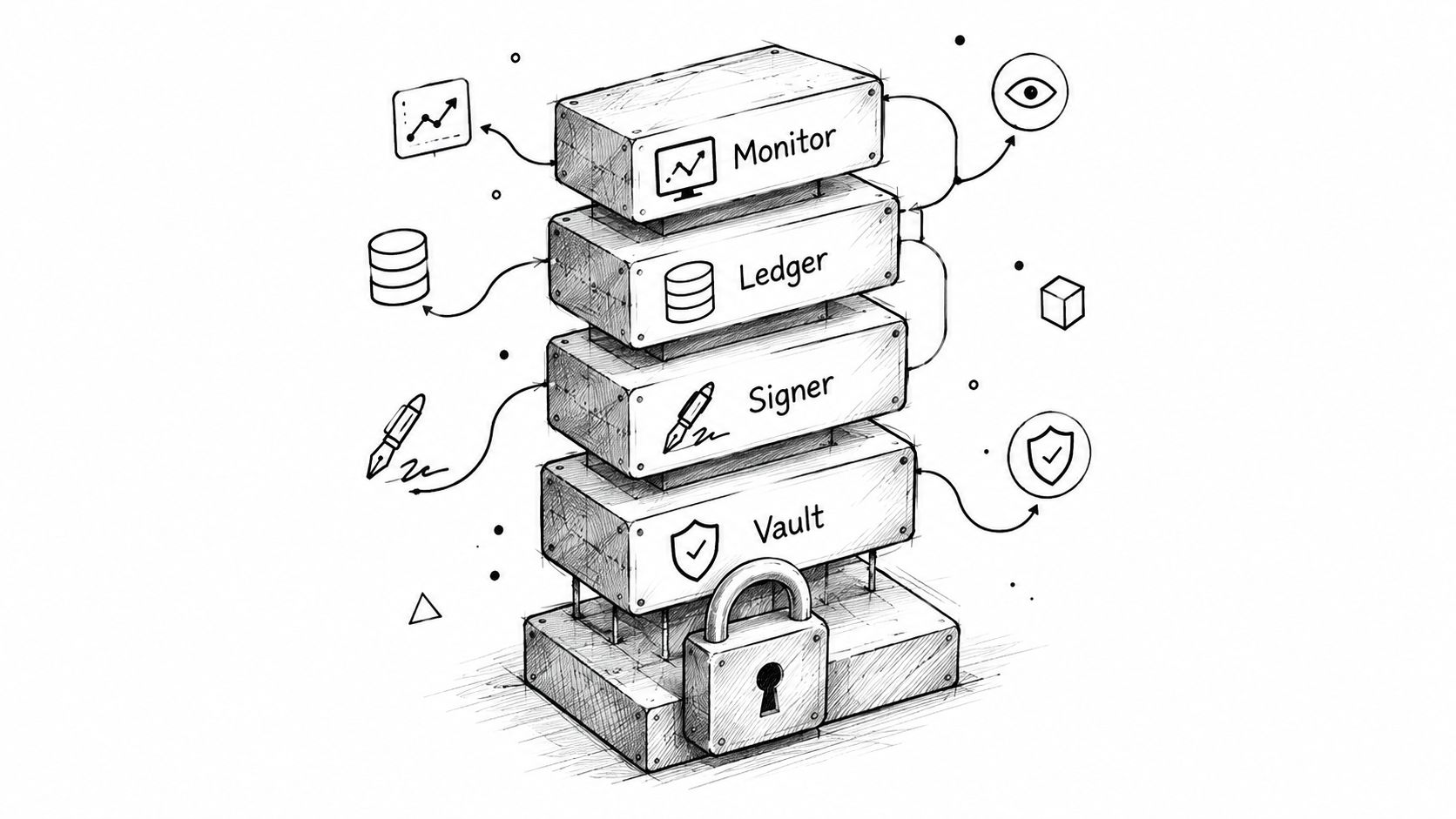
Event delivery needs its own controls. WebSocket messages can signal deposits, confirmations, withdrawals, and policy outcomes, while durable processing and replay logic protect workflow state. The ledger remains the accounting authority. REST and OpenAPI support integration; Ed25519 authentication, IP allowlisting, scoped credentials, and replay protection limit avoidable API exposure.
BroLabel can fit this model where a team needs wallet operations across Telegram, web, or mobile flows. BroWallet may support exchange and fiat-related functions, while AI Agent Wallets can keep agent permissions and audit trails separate from broader treasury authority. For iGaming, TRC20 deposit addresses can be assigned per player, with deposit-observed and deposit-confirmed events feeding operator checks before payout signing.
The operating decision is not whether one product covers every function. It is whether product, infrastructure, finance, and compliance teams share the same event definitions, ledger records, approval boundaries, and recovery procedures. That shared model makes failures easier to contain and explain.
Frequently Asked Questions About Digital Custody
Does MPC make assets in custody legally protected?
No. MPC distributes signing authority and can reduce unilateral movement, but it doesn't establish legal segregation, customer entitlement, or bankruptcy protection. Those depend on contracts, records, account structures, applicable law, and evidence that the controls operate.
What should an AI Agent Wallet be allowed to do?
Give each agent a narrowly scoped wallet and permission set. Separate balance visibility, transaction construction, policy evaluation, and signing approval. An agent should not receive unrestricted withdrawal authority just because it can generate a valid transaction request.
How should a TRC20 deposit flow work for iGaming?
Assign a deposit address to the player or account, observe the transaction, wait for the platform's confirmation policy, reconcile the amount and token, and credit the operating ledger only after the required checks pass. Payout signing should remain subject to customer, risk, and compliance rules rather than relying only on an on-chain transfer.
How do withdrawal policies work before payout signing?
The system should bind the withdrawal request to the customer, destination, amount, screening result, risk decision, and approval history. The policy engine can block or route exceptions before the MPC threshold is invoked. The final signing record should identify who approved the transaction, which rule permitted it, and which key shares participated.
Is an append-only ledger enough?
No. Immutability preserves history, but teams still need reconciliation against blockchain balances, provider records, customer entitlements, and settlement obligations. A complete control environment combines the ledger with event durability, idempotency, exception handling, access controls, and recovery testing.
How should a buyer assess a sub-custodian?
Review legal title, segregation, insolvency treatment, outsourced functions, withdrawal dependencies, reconciliation evidence, incident escalation, and transfer procedures. The sub-custodian's brand and reported assets in custody shouldn't substitute for this evidence.
BroLabel provides embedded MPC wallets, an append-only operating ledger, network broadcast, WebSocket events, compliance workflows, and related financial infrastructure for teams building custody-sensitive products. Visit BroLabel to evaluate an architecture that connects signing policy, reconciliation, and operational observability before your platform handles production customer assets.