
A payments operations lead at an early-stage fintech starts the week by reconciling weekend withdrawals. The wallet provider shows one balance, the broadcast service shows another, and the internal dashboard reports a third. None of the three systems shares a complete record of the customer's deposit, approval, signing decision, network transaction, and final settlement.
That's vendor fragmentation. Wallets, broadcast, ledger, cards, and fiat rails run on separate tools, each with its own identifiers, events, retry logic, and failure modes. Signing keys held in one place create a single point of failure. Missing append-only records and incomplete event streams leave finance and compliance teams with gaps they can't close after the fact.
The practical lesson is simple: decide the ledger and event model before choosing the signing vendor. Then compare providers against the controls that matter in production, including the MPC signing model, fiat rails, card issuing, ledger and event coverage, pricing model, and fit by business type. Pricing below is described as public, credit-based, or quote-only where that information is supplied, without invented figures.
This comparison separates full-stack infrastructure, custody and wallet platforms, and developer or compliance layers. The best crypto API for a developer tool isn't necessarily the right foundation for an exchange, payment gateway, treasury operation, or iGaming platform.
Table of Contents
- 1. BroLabel API overview and API Reference
- 2. Fireblocks
- 3. BitGo
- 4. Circle
- 5. Alchemy
- 6. Infura by ConsenSys
- 7. QuickNode
- 8. Blockdaemon
- 9. Tatum
- 10. Chainalysis
- Top 10 Crypto API Comparison
- Matching Each Provider to Your Operating Model
1. BroLabel API overview and API Reference
BroLabel's API overview closes the largest control gap first: fragmented operating infrastructure. Its API-first platform brings multi-chain wallets, network broadcast, signing, payments, cards, fiat integrations, an append-only operating ledger, and real-time observability into one REST and WebSocket surface.
The stack supports 10+ mainnets, including BTC, ETH, SOL, BNB, TRX, POL, BASE, and ARB. BroSettlement handles DKG and MPC 2-of-3 signing with a client-controlled Co-Signer, while BroWallet supports embedded user, agent, and player wallet models. WebSocket events cover deposits, confirmations, withdrawals, and policy outcomes, giving operations teams a live event layer instead of forcing them to infer state from periodic balance queries.
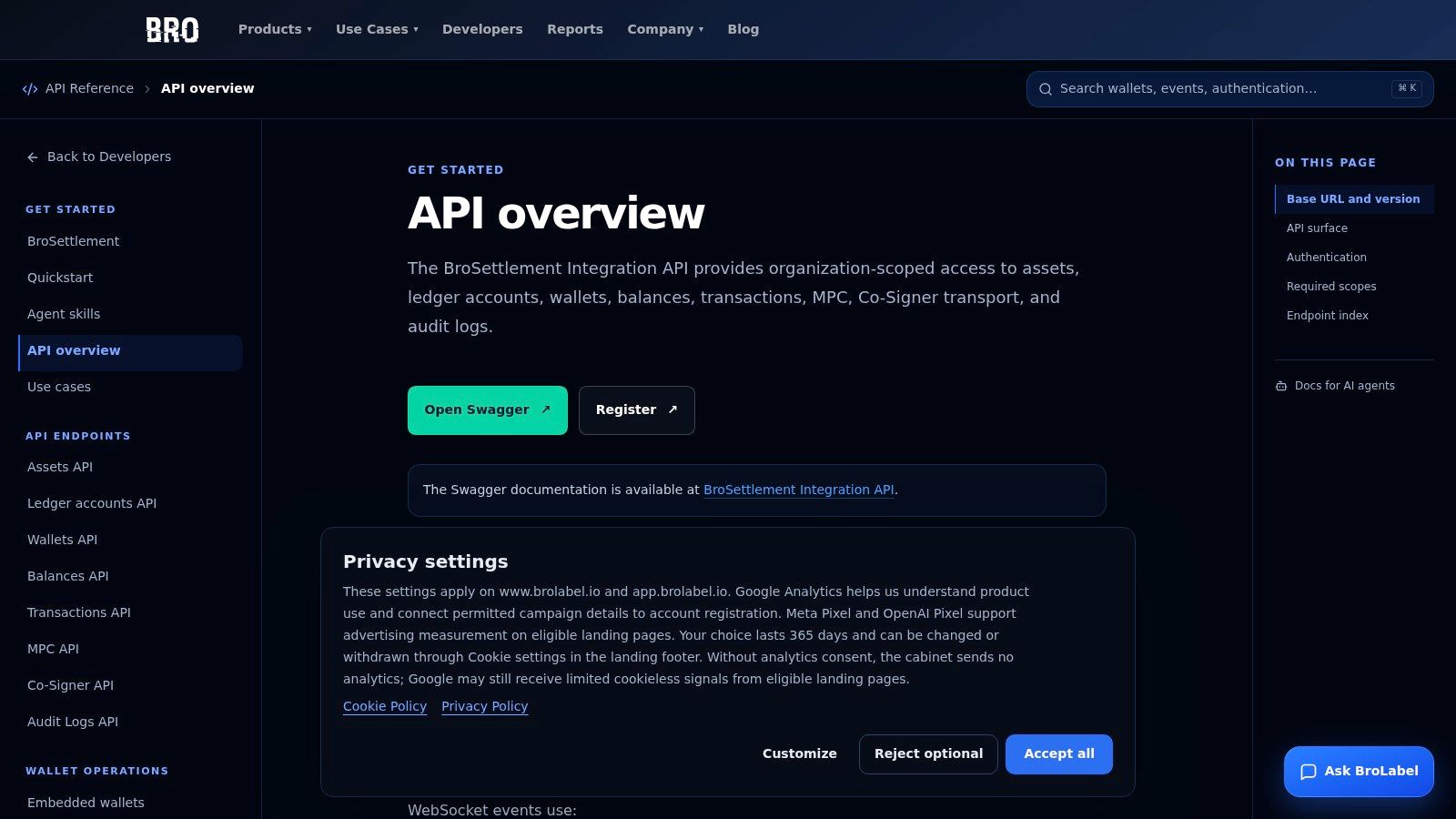
The control gap it closes
BroLabel's strongest distinction is the connection between signing, accounting, and observability. An immutable ledger preserves the operating record, while WebSocket events expose deposit observations, confirmations, withdrawal progress, and policy decisions. That combination gives finance, risk, and compliance teams a basis for reconciliation rather than a collection of vendor-specific status pages.
Security controls include Ed25519 request authentication, scoped API keys, IP allowlists, replay protection, and defined signing policies. OpenAPI and Swagger documentation, a sandbox, and hands-on onboarding support the path from testing to production. AI Agent Wallets add per-agent wallets, role-based access control, and audit trails for teams building automated workflows.
Practical rule: Treat the Co-Signer as an operational control, not merely a cryptographic component. Define who controls it, which transactions require approval, and how policy outcomes enter the ledger before production.
BroLabel's limitation is equally clear. It isn't a fully self-hosted custody solution, and teams needing every niche network may find coverage constraints. MPC policy setup, fee-engine calibration, AML workflows, and reconciliation still require hands-on integration. Its commercial approach is aligned with uncertain early-stage volume rather than fixed minimums, but buyers should validate the precise operating and pricing terms directly.
Best fit: early-stage fintechs, payment gateways, exchanges, iGaming operators, and product teams that need wallets, settlement, ledgering, cards, and fiat without assembling a long vendor chain.
2. Fireblocks
Fireblocks is built for one operational requirement: no transaction should move without a documented approval path. Its MPC-based Vault wallets and policy engine support institutional transaction governance, while REST APIs, webhooks, and connectivity to exchanges and networks connect those controls to execution.
Its policy engine can apply approval workflows to transaction activity, and embedded or dynamic wallets support different product designs. External venue connectivity adds orchestration around custody and settlement. For exchanges, fintechs, payment service providers, and treasury teams, that combination reduces the need to coordinate approvals through disconnected tools.
Where it fits and where it stops
Fireblocks is a custody and wallet platform first. Its console, transaction engine, API documentation, and network connections support institutional implementation, but they do not replace an operating ledger, card stack, fiat rails, analytics system, or compliance layer. Buyers comparing providers should separate custody controls from those adjacent functions, as outlined in this guide to best crypto custody solutions.
Enterprise-oriented pricing is typically less approachable for developer-first teams, and some capabilities require onboarding before buyers can assess the complete workflow. The platform therefore fits organizations that can support formal implementation and policy configuration, rather than teams seeking a lightweight wallet API.
Best fit: institutional exchanges, established fintechs, PSPs, and treasury teams that prioritize approval-based custody and transaction orchestration over one unified product surface.
3. BitGo
BitGo suits teams that cannot commit to one custody model. It offers self-custody and qualified custody side by side, with hot and cold workflows under one policy layer. Its platform also includes Wallet-as-a-Service, policy enforcement, trading integrations, staking, and FIX connectivity.
For an exchange or fintech, Wallet-as-a-Service can provide embedded receive addresses for end users while BitGo manages wallet and transaction workflows underneath. Multi-signature and MPC wallet types, webhooks, and enterprise policies separate customer-facing product flows from approval controls.
BitGo supports custody and staking for over 1,000 assets, which can remove much of the network-specific integration work for an exchange listing long-tail tokens. Trading integrations and FIX APIs also serve teams that need execution connectivity alongside wallet management. These capabilities position BitGo as a custody and wallet platform, rather than a general blockchain infrastructure layer.
Why institutions consider it
Its limitation is the feature depth that makes it suitable for larger operations. Pricing isn't fully public and follows an enterprise sales motion, so smaller teams may struggle to compare total cost before a detailed conversation. Integration work can also lengthen initial setup for a product team that needs only basic wallet issuance or transaction broadcasting.
BitGo does not replace an operating ledger or a card and fiat stack. Buyers should test how wallet events map to internal records, how rejected and retried transfers remain auditable, and which reconciliation interfaces are available. The relevant comparison is the control layer it provides, not chain count or RPC speed.
Best fit: exchanges, fintechs, and institutions that need enterprise wallet operations, custody choices, trading connectivity, and compliance-grade controls.
4. Circle
Circle is the pick when a product is built around USDC movement. Its Wallets APIs connect end-user and developer-controlled wallets with transaction signing, balance management, payments, payouts, gas sponsorship, treasury flows, and cross-chain services on supported networks.
That makes Circle relevant to fintechs and payment applications that need stablecoin transfers tied to operational payment workflows. The developer console and enterprise governance provide a managed environment for configuring these services, rather than requiring each transfer flow to be built as a separate blockchain integration.
The stablecoin qualification
Circle's main limitation is asset scope. Some services are USDC-centric, so businesses pursuing broader multi-asset coverage may need separate wallet, settlement, or market infrastructure. Circle does not publish a unified price list. Confirm per-service pricing in the console or with sales before modelling total cost.
Buyers should also test how transaction states, policy decisions, and payout evidence feed the internal ledger. Payment rails do not automatically provide complete accounting or reconciliation.
Stablecoin regulation affects API design and operating controls. Reserve transparency, licensing, sanctions screening, transaction monitoring, Travel Rule processes, and handling for blocked or escalated transfers can all shape wallet and payout workflows. The stablecoin payment infrastructure guide offers context for comparing payment functionality with the controls built around it.
Best fit: stablecoin payment apps, fintechs, treasury teams, and businesses whose product strategy depends closely on USDC payments and payouts.
5. Alchemy
Alchemy is best understood as an on-chain application and developer tooling layer, not a custody provider. It closes the control gap around node access, chain interaction, event delivery, and developer productivity through JSON-RPC, WebSockets, tracing, debugging, enhanced transfer and NFT APIs, pricing and portfolio endpoints, and webhooks.
Its Smart Wallet stack supports ERC-4337 bundlers and paymasters, including gas sponsorship workflows on supported chains. That makes Alchemy useful for product teams building wallets or applications that need a smoother transaction experience without operating their own node infrastructure.
The missing operating layer
Alchemy's documentation and quick starts support fast time to first call. Portfolio, NFT, Prices, and Transfers APIs can reduce the amount of indexing and event-processing code a developer must build. Webhooks help applications react to on-chain activity, but teams must still decide how those events become durable internal records.
The limitation is important for buyers using “best crypto API” as a broad search term. Alchemy doesn't provide institutional custody, MPC policy governance, or a complete operating ledger. Enhanced features can also be metered by compute units, so finance and engineering teams need to model usage against actual workloads rather than comparing only headline plan labels.
Use Alchemy when your application needs reliable blockchain access and developer tooling. Pair it with a signing, ledger, compliance, or payment layer when the product holds customer value or must produce audit-ready transaction evidence.
Best fit: developer teams, wallets, decentralized applications, analytics products, and AI agents that need RPC, WebSockets, smart-wallet infrastructure, and webhooks without institutional custody.
6. Infura by ConsenSys
Infura is a managed-EVM incumbent offering HTTPS and WSS RPC, IPFS gateways, and Infura Transactions for teams that do not want to operate a node fleet. Its transaction service supports relay workflows and dynamic gas handling, while the broader platform provides network connectivity for Ethereum and other supported networks.
Wallets, decentralized applications, and exchanges can use Infura to connect to supported chains without maintaining that infrastructure themselves. WebSockets suit applications that need event-driven behavior, and managed endpoints reduce the operational work associated with node availability and network access.
A useful boundary for buyers
Infura belongs in the infrastructure layer. It is not a custody or wallet platform, and it does not provide an MPC operating model. Teams that already control signing keys, policy governance, ledgering, compliance, and reconciliation can evaluate Infura as the connectivity component of a wider stack.
Its usage model is credit-based, with daily credit allowances per plan. Model the allowance against peak RPC methods, request patterns, WebSocket activity, and transaction-management requirements before committing. ITX and other advanced features are gated to higher tiers, so a traffic spike or a new workflow can require a mid-contract upgrade.
Infura fits applications that need managed EVM access while retaining ownership of key management and financial controls. Buyers seeking a complete wallet, settlement, or audit system will need additional components.
Best fit: wallets, dapps, exchanges, and engineering teams that need managed EVM infrastructure and transaction access without custody services.
7. QuickNode
QuickNode wins on delivery. Streams can filter events server-side and push them into S3, Kafka, or Postgres, reducing the event-processing code an application must maintain. Its RPC and WebSocket endpoints, Webhooks, and push-based pipelines suit exchanges, analytics providers, and applications that need timely blockchain events.
Multiple transports, including WSS and gRPC for Solana and EVM use cases, give engineering teams options for event ingestion and operational monitoring. That flexibility makes QuickNode a strong fit for teams whose main problem is moving on-chain data into existing systems, rather than managing custody or financial controls.
Delivery is not settlement
QuickNode offers operational flexibility, delivery options, and transparent public pricing. Its boundary is clear: it doesn't provide institutional custody or MPC. Advanced Streams usage also requires cost modeling based on blocks processed, not only request volume.
A webhook should trigger workflow state changes, not serve as final settlement; production systems still need idempotency, replay handling, and reconciliation against network evidence.
The 2026 independent benchmark of crypto data APIs found p50 price-feed head lag ranging from approximately 707 milliseconds to more than 12 seconds, with material differences by chain and a reported 7.9× gap on Solana. That benchmark supports measuring p50, p95, and p99 event-to-consumer latency by chain instead of choosing from feature checklists alone.
Best fit: data-intensive applications, exchanges, analytics teams, and engineering groups that need event pipelines and RPC while already operating signing, custody, ledger, and compliance controls.
8. Blockdaemon
Blockdaemon combines wallet workflows, node access, and DeFi data in a single provider. Its Wallet Transact REST APIs support wallet management, transaction creation and broadcasting, and notifications. MPC Wallets and Vaults address institutional key management, while node services and the DeFi API extend the platform beyond wallet operations.
Breadth with configuration responsibility
Blockdaemon's broad coverage can reduce the number of separate infrastructure providers in a wallet or fintech stack. Centralized developer documentation and clearly organized product experiences help teams move through the wallet, node, and data surfaces.
The limitation is that breadth doesn't automatically create one accounting truth. Pricing details can be opaque, feature tiers vary, and a team seeking only RPC may find the platform requires more configuration than a pure node provider. A buyer should establish which system owns balances, how transaction notifications are replayed, and whether wallet events can be reconciled with an internal append-only ledger.
Blockdaemon is best compared with custody and wallet platforms when the requirement includes transaction workflows and key management. It's better compared with infrastructure providers when the requirement is node access or unified on-chain data. Mixing those categories can make a broad feature list appear more complete than the actual operating model.
Best fit: fintechs and platforms that want wallets, transaction workflows, nodes, and DeFi data from one provider, with a team able to manage configuration and integration depth.
9. Tatum
Tatum is designed for fast multi-chain product development. Its unified REST APIs and SDKs cover wallet and portfolio data, tokens, DeFi, NFTs, and Smart Wallets with MPC signing and recovery workflows. An optional self-hosted KMS can sign locally while the application continues using Tatum APIs for other functions.
That KMS option gives technical teams a meaningful architectural choice. They can use hosted functionality for speed or keep signing operations closer to their own environment, depending on their risk model and operational capacity. Developer tooling, a CLI, and quick prototyping features support teams validating a product before building a larger platform.
Speed versus institutional depth
Tatum offers clear public pricing tiers and developer-friendly SDKs. That makes it easier for a small product team to begin evaluation than a quote-only enterprise platform. The limitation is that enterprise controls and policy workflows may be lighter than those of top-tier custodians, and advanced chain features can require custom work.
A team choosing Tatum should separate prototype success from production readiness. Test recovery, policy enforcement, audit records, rate limits, webhook replay, and reconciliation before allowing customer value to move through the system. A quick wallet integration isn't the same as a complete financial operating control.
Best fit: developers and early product teams that need multi-chain prototyping, optional self-hosted signing, and a public pricing path before moving into deeper institutional controls.
10. Chainalysis
Chainalysis is not infrastructure. It is a compliance overlay that helps determine whether a transfer should proceed. Its KYT APIs support transfer registration, risk scoring, alerts, counterparty assessment, and investigation workflows. Production and test environments, token-based authentication, stablecoin integrations, and data feeds allow compliance teams to work alongside wallet, payment, or custody systems.
Compliance must attach to the transfer
The platform does not provide a wallet, ledger, or signing service. A team must connect each risk result to the customer, wallet address, transaction identifier, approval decision, and settlement record. Rejected transfers should remain visible in the operational history, with the decision and supporting evidence available for review.
In the United States, a business that accepts and transmits convertible virtual currency, or buys and sells it as a business, may be treated as a money transmitter under FinCEN's guidance on administering and exchanging virtual currency. Covered money transmitters must address registration, risk-based AML programs, recordkeeping, monitoring, and required reporting. Compliance ownership therefore belongs in the architecture and operating model, not only in a vendor checklist. For a comparison of screening tooling, see these AML screening solutions.
Chainalysis pricing is quote-only and typically not public, and some documentation and training is restricted to customers. Buyers should ask how policy outcomes are exported, how alerts are retained, whether another compliance vendor can replace it, and how Travel Rule information attaches to each transfer.
Best fit: exchanges, PSPs, stablecoin businesses, and compliance teams adding KYT monitoring to an existing wallet, payment, or treasury stack. Teams comparing Glentorion on selecting consultants should separate advisory responsibility from the API's enforcement and evidence capabilities.
Top 10 Crypto API Comparison
| Product | Core features | Quality ★ | Value 💰 | Target 👥 | Unique strengths ✨ |
|---|---|---|---|---|---|
| API overview · API Reference | BroLabel 🏆 | Unified API: multi‑chain wallets, MPC 2‑of‑3, append‑only ledger, WebSocket events, cards & fiat | ★★★★★ Security-first (Ed25519, RBAC), production-ready sandbox | 💰 Startup-friendly, modular pricing; pay-as-you-grow | 👥 Startups, iGaming, fintechs needing non‑custodial controls | ✨ Client‑controlled Co‑Signer, integrated cards+fiat, per‑player USDT flows |
| Fireblocks | MPC Vaults, policy engine, automation, exchange/network connectivity | ★★★★☆ Enterprise-grade security & high uptime | 💰 Enterprise pricing; higher TCO | 👥 Exchanges, treasuries, PSPs, fintechs | ✨ Mature MPC, rich ops tooling, strong SLAs |
| BitGo | Wallet-as-a-Service, multi‑sig/MPC, trading/staking, FIX API | ★★★★☆ Institutional footprint, broad asset support | 💰 Quote-based enterprise pricing | 👥 Exchanges, institutions, fintechs | ✨ Qualified custody options, trading integrations |
| Circle | Wallets API, USDC rails, payouts, gas/paymaster features | ★★★★☆ Payments & treasury focused | 💰 Product-dependent pricing; often console/sales | 👥 Fintechs, payment apps, USDC-native products | ✨ Deep USDC on/off-ramps, treasury tooling |
| Alchemy | Multi-chain RPC, enhanced APIs (transfers/NFTs), webhooks, ERC‑4337 stack | ★★★★☆ Developer-first, fast time-to-first-call | 💰 Flexible dev plans; metered enhanced features | 👥 Web3 developers, dapps | ✨ Rich dev tooling, ERC‑4337 smart wallet support |
| Infura (ConsenSys) | Managed RPC (HTTP/WSS), ITX, IPFS gateways | ★★★★☆ Stable, battle-tested EVM infra | 💰 Credit-based plans with tiered allowances | 👥 dApps, wallets, exchanges | ✨ Reliable RPC & ITX relayer, IPFS access |
| QuickNode | High-performance RPC/WebSockets, Streams, Webhooks, push pipelines | ★★★★☆ Low-latency, strong operational performance | 💰 Public, transparent pricing; flexible tiers | 👥 Exchanges, analytics, low-latency apps | ✨ Streams→S3/Kafka/Postgres, multi-transport |
| Blockdaemon | Wallet Transact APIs, MPC wallets, node access, DeFi API | ★★★★☆ Broad product coverage across many chains | 💰 Quote-based; tiered by service | 👥 Builders needing nodes + wallets, institutions | ✨ Combined node + wallet + DeFi data in one vendor |
| Tatum | REST APIs & SDKs, Smart Wallets (MPC), optional self-hosted KMS | ★★★☆☆ Fast prototyping, developer SDKs | 💰 Clear public tiers; cost-effective for prototyping | 👥 Startups, dev teams, prototype builders | ✨ Optional self-hosted KMS, SDKs & CLI for quick starts |
| Chainalysis | KYT APIs, risk scoring, alerts, investigation tooling | ★★★★☆ Market-leading compliance & scaling | 💰 Enterprise, quote-based pricing | 👥 Compliance teams, exchanges, PSPs | ✨ Industry-standard AML/KYT, regulator-recognized tooling |
Matching Each Provider to Your Operating Model
The right provider depends on the control gap your business needs to close. Early-stage fintechs should decide whether they need a full-stack operating layer or only a component. BroLabel is designed for teams that need wallets, MPC signing, network broadcast, an append-only ledger, WebSocket events, cards, and fiat integrations in one coherent API. Tatum can suit rapid multi-chain prototyping, while Alchemy, Infura, and QuickNode fit teams that own the wallet and accounting layers but need blockchain access.
Exchanges and PSPs usually need stronger separation of duties. Fireblocks and BitGo are suited to institutional custody, wallet governance, and transaction policy. Blockdaemon can be relevant when node access and wallet workflows belong together. BroLabel is better aligned with teams that want the Co-Signer, signing policies, ledger, settlement events, cards, and fiat operations coordinated in one stack.
Stablecoin payment applications should examine more than USDC transfer support. Circle is a logical candidate for USDC-centered payment and treasury flows, but buyers must verify how compliance decisions, payout states, and reconciliation evidence enter their own records. BroLabel's broader settlement, card, fiat, and ledger scope may fit products that need to connect stablecoin movement to customer or player operations.
Developer teams that need RPC and WebSockets but not custody should compare Alchemy, Infura, and QuickNode by chain coverage, event delivery, usage model, and measured latency. QuickNode's Streams and Webhooks emphasize push-based delivery, Infura uses a credit-based model, and Alchemy's enhanced features require compute-unit modeling. None of them should be treated as the ledger or signing authority by default.
Compliance teams adding KYT monitoring to an existing stack should evaluate Chainalysis as an overlay. FinCEN guidance states that covered virtual-currency transactions subject to the Funds Travel Rule require identifying information about the originator and beneficiary, and businesses must be able to track virtual currency through different transactions. That means the compliance result must remain connected to the transaction, counterparty, approval, signing, broadcast, and settlement record, not sit in a separate alert queue.
Risk and control decisions before go-live
The Co-Signer role needs a named owner, a documented recovery process, and clear limits. Decide who can approve signing, which transactions require additional review, how policy exceptions work, and how the business handles a lost or unavailable signer.
Use scoped API keys and IP allowlists for every service boundary. Separate sandbox credentials from live credentials, apply replay protection, and test idempotency with duplicate requests, delayed webhooks, reconnects, and out-of-order events. A successful API call proves that a request was accepted. It doesn't prove that the customer's balance, internal ledger, and network state now agree.
Reconciliation should compare the append-only operating ledger with provider events and network evidence. Record deposit observation, confirmation, withdrawal request, screening, policy approval, signing, broadcast, and settlement as separate states. FinCEN's virtual-currency guidance also describes monitoring, recordkeeping, suspicious-activity reporting, and related obligations, so preserve the evidence needed to reconstruct who initiated the transfer, which decision allowed it, and when the network confirmed it.
Finally, create a vendor exit plan before the first production transaction. Define how you'll export wallet addresses, transaction histories, ledger records, policy outcomes, compliance decisions, and customer identifiers. A provider that supports fewer networks but offers durable event delivery, append-only accounting, and transparent reconciliation may be safer than one with a broader chain list and weak recovery evidence. Recent infrastructure coverage has described exchange availability incidents connected to cloud-region failures, including an October 2025 AWS us-east-1 disruption affecting Coinbase and other financial platforms, which reinforces the need to assess provider resilience rather than assume availability.
Frequently asked buyer questions
Does MPC remove custody risk?
No. MPC reduces the risk created by concentrating a private key in one place, but it doesn't remove operational or regulatory responsibility. The business still needs to define the Co-Signer role, signing policies, approvals, access controls, audit trails, recovery procedures, and compliance ownership.
Can a node or RPC provider handle signing?
An RPC provider can read blockchain state and submit transactions, but it isn't automatically a wallet or signing authority. Infura, QuickNode, and Alchemy are primarily infrastructure and developer layers. If your product handles customer value, you'll need a deliberate signing, policy, ledger, and reconciliation design around the RPC connection.
How should teams compare quote-based vendors?
Ask each provider to map the same workflow, from wallet creation through screening, approval, signing, broadcast, confirmation, reconciliation, and support escalation. Compare what's included, which capabilities require onboarding, how pricing changes with usage, how data is exported, and what happens during delayed, duplicated, or partially failed events. Quote-only pricing isn't better or worse than public pricing, but it makes a controlled evaluation more important.
What onboarding is required before go-live?
Expect to configure wallets, signing policies, the Co-Signer, API authentication, scoped keys, IP allowlists, AML workflows, fee handling, WebSocket consumers, and reconciliation rules. Run sandbox-to-live tests that include failed requests, duplicate events, network delays, reconnect recovery, rejected transfers, and policy escalations. Production readiness comes from proving recovery and accounting behavior, not only from receiving a successful test transaction.
What's the difference between a crypto API and an operating layer?
A crypto API may provide market data, RPC, wallet information, compliance signals, or transaction submission. An operating layer connects those functions to durable accounting, policy decisions, event observability, customer workflows, and reconciliation. The distinction matters most for exchanges, payment platforms, treasury teams, and iGaming operators, where a missing or duplicated event can create a financial and compliance exception.
The best crypto API is therefore the one that closes the control gap your operating model can't safely absorb. Map signing, ledger, event, payment, card, fiat, and compliance responsibilities first. Then shortlist providers that close those gaps, and validate their recovery and reconciliation behavior before you move customer value.
For teams building before transaction volume is predictable, BroLabel combines embedded MPC wallets, a client-controlled Co-Signer, settlement, an append-only operating ledger, WebSocket events, cards, fiat integrations, and compliance workflows in a modular API-first stack. Visit BroLabel to assess whether its control model fits your wallet, payment, exchange, treasury, or iGaming architecture.