The popular advice is to choose the fastest chain and let transaction volume prove product-market fit. That's the wrong starting point for a financial product. Blockchain digital infrastructure succeeds when every on-chain event can be classified, authorized, reconciled, and explained later, even when several networks, stablecoins, wallets, cards, and fiat rails operate together.
The central enemy is unobservable movement of value. A transaction can be confirmed on-chain and still be unusable for finance because nobody can prove whether it was a customer deposit, an internal transfer, a treasury movement, a fee, or a payout. Speed matters, but an untraceable fast transaction creates operational risk faster than a slow, well-controlled one.
A reliable stack therefore separates the concerns that teams often combine too early: wallet and key management, policy approval, transaction routing, event ingestion, ledgering, reconciliation, and reporting. That separation gives engineering teams flexibility without forcing finance and compliance to trust a black box.
Table of Contents
- The Measurement Gap in Blockchain Adoption
- Core Modules of a Modern Crypto Stack
- Building Durable Event Pipelines and Ledgers
- Navigating Consensus and Finality Trade-offs
- Turning Compliance into an Operational Advantage
- Selecting and Scaling Your Infrastructure Provider
- Frequently Asked Questions by Engineering Teams
The Measurement Gap in Blockchain Adoption
Raw on-chain volume is not the same thing as commercial payment activity. A chain can record substantial movement caused by trading, MEV, protocol operations, arbitrage, internal transfers, or automated contract behavior without creating a corresponding customer payment that finance can reconcile.
That distinction matters because a product team usually needs business meaning, not just protocol activity. A deposit must map to a customer and asset. A payout must map to an approved obligation. A treasury movement must have an owner, purpose, and authorization trail. Without those links, a dashboard can look active while the operating ledger remains incomplete.
Artemis and partner researchers identified $94.2 billion in attributable stablecoin payments from January 2023 through February 2025, with an annualized run rate of about $72.3 billion by February 2025. Those figures are materially different from headline metrics that also count trading, MEV, protocol transfers, and other non-payment activity. The distinction is documented in the analysis of attributable stablecoin payments.
Classify the business event
A useful payment record should answer more than “what transaction hash appeared?” It should preserve the relationship between the chain event and the internal event:
- Customer deposit: Which customer, wallet, asset, network, and account received value?
- Internal transfer: Was value moved between controlled wallets, and why?
- Treasury movement: Which policy and operator authorized the transfer?
- Fee: Was the fee charged to the customer, absorbed by the business, or booked against treasury?
- Payout: Which approved withdrawal request created the broadcast transaction?
This is accounting semantics applied to blockchain operations. The chain supplies an authoritative record of what happened at the protocol level. Your operating ledger supplies the context needed to explain why the event mattered to the business.
Practical rule: Never let raw transaction volume become a substitute for classified, reconcilable payment activity.
Design for observability before throughput
Observability means more than logs and charts. It means retaining the evidence needed to reconstruct a decision after the fact, including the source event, enrichment data, policy result, signing decision, transaction state, and final ledger mutation.
That model works across exchanges, payment service providers, iGaming platforms, treasury products, and embedded-wallet applications. It also prevents a common product mistake: treating every incoming transfer as immediately spendable customer balance. A transaction may be visible, included, replaced, reorganized, or later determined to belong to the wrong asset or destination.
The practical lesson is direct. Measure business events first and chain events second. Once the product can reliably distinguish deposits, payouts, internal movements, and fees, network performance becomes a meaningful input to operations rather than a vanity metric.
Core Modules of a Modern Crypto Stack
Blockchain infrastructure has moved from a niche peer-to-peer payment concept into a global transaction and settlement layer supporting multi-network connectivity, exchange settlement, stablecoin transfers, institutional market access, and consumer payment interfaces, as described in the global crypto adoption analysis. That evolution makes a single-purpose wallet or RPC connection inadequate for serious financial operations.
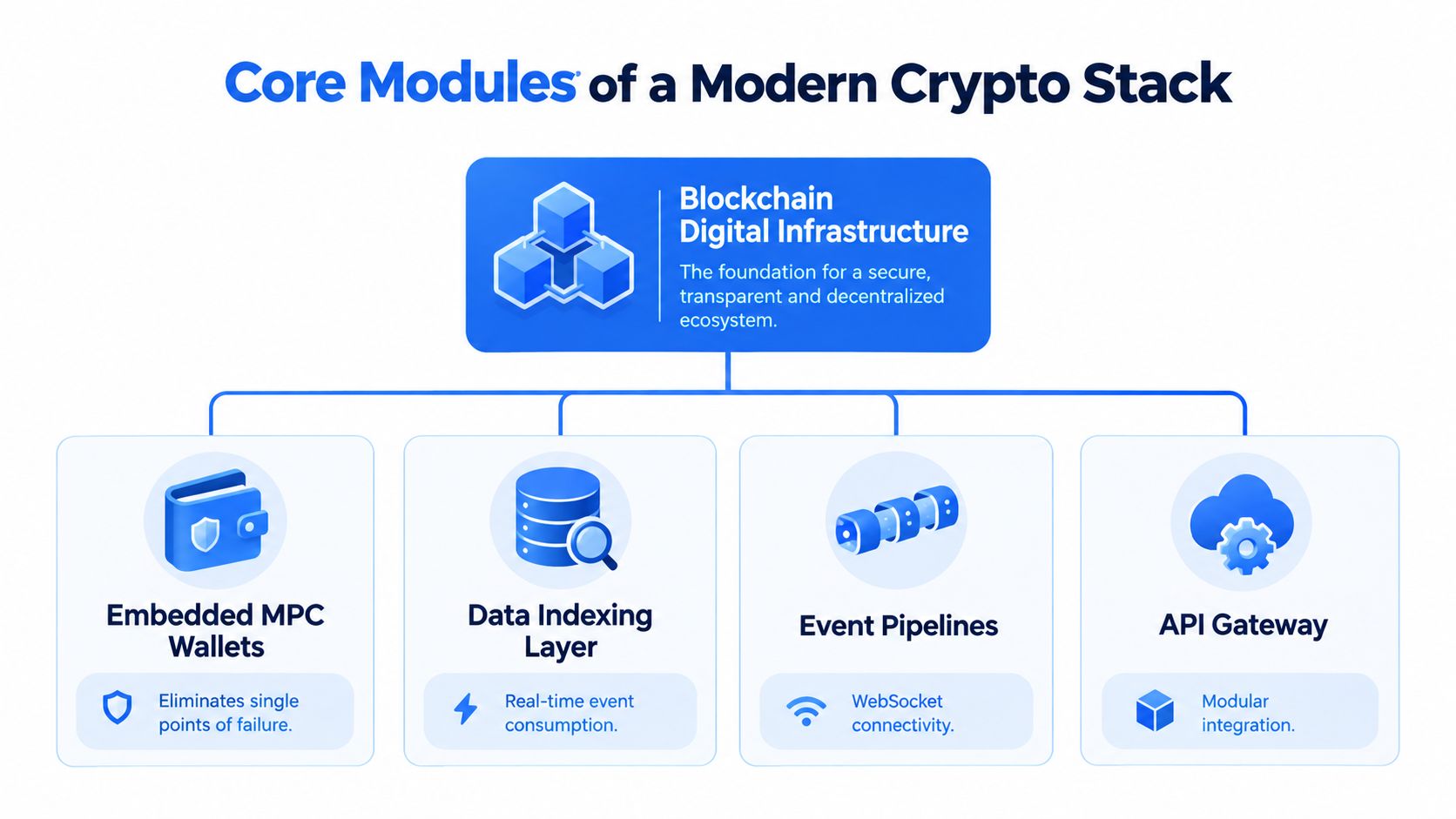
A modern stack should separate the modules that control value from the modules that observe, route, and account for it.
Key management and wallet control
An embedded wallet is an operational boundary, not merely an address generator. MPC and threshold signing distribute authority so that one compromised service, employee credential, or infrastructure component doesn't automatically control the asset.
The design still needs clear ownership and policy. A client-controlled Co-Signer can keep an approval point outside the infrastructure provider, while role-based controls determine which users or services may request, approve, or execute a transaction. AI Agent Wallets need the same discipline. Each agent should have a bounded wallet, defined permissions, and a durable record of every action.
BroSettlement provides DKG/MPC 2-of-3 signing, a client-controlled Co-Signer, and broadcast across supported networks. It can be used as a modular component rather than forcing a team to replace its entire application.
Broadcast and network adaptation
The broadcast layer should understand that networks differ. It needs chain-specific fee estimation, nonce or sequence handling, gas policy, confirmation thresholds, replacement behavior, and retry controls. A generic “send transaction” abstraction hides the differences that create failed withdrawals and confusing support tickets.
This layer should also separate signing from broadcasting. The signing service determines whether policy permits the action. The broadcast service submits the authorized transaction and reports its lifecycle. That division makes it easier to investigate whether a failure came from authorization, signing, fee estimation, transport, or chain inclusion.
Operating ledger and reconciliation
The ledger sits above the chain and records business truth in an append-only structure. It should capture deposits, withdrawals, transfers, fees, policy decisions, reconciliation outcomes, and links to external transaction identifiers.
This isn't a replacement for the blockchain. It's the system that lets finance reconcile the blockchain with customer accounts, fiat movements, card balances, and internal ownership. The ledger should support replay and correction through new entries rather than silent mutation of old records.
Data and API access
An indexing and event layer turns chain activity into usable application signals. The API gateway then exposes those signals through stable contracts, authentication, rate controls, scoped permissions, and environment separation.
The strongest architecture keeps these boundaries explicit:
- Wallets protect signing authority.
- Policies determine whether a requested action is allowed.
- Broadcast services adapt the transaction to a network.
- Event pipelines report state transitions.
- The operating ledger records business consequences.
- APIs expose controlled access to product teams and partners.
That structure supports a per-player wallet in iGaming, a per-user embedded wallet in fintech, or a treasury workflow without rebuilding accounting and security logic for every use case.
Building Durable Event Pipelines and Ledgers
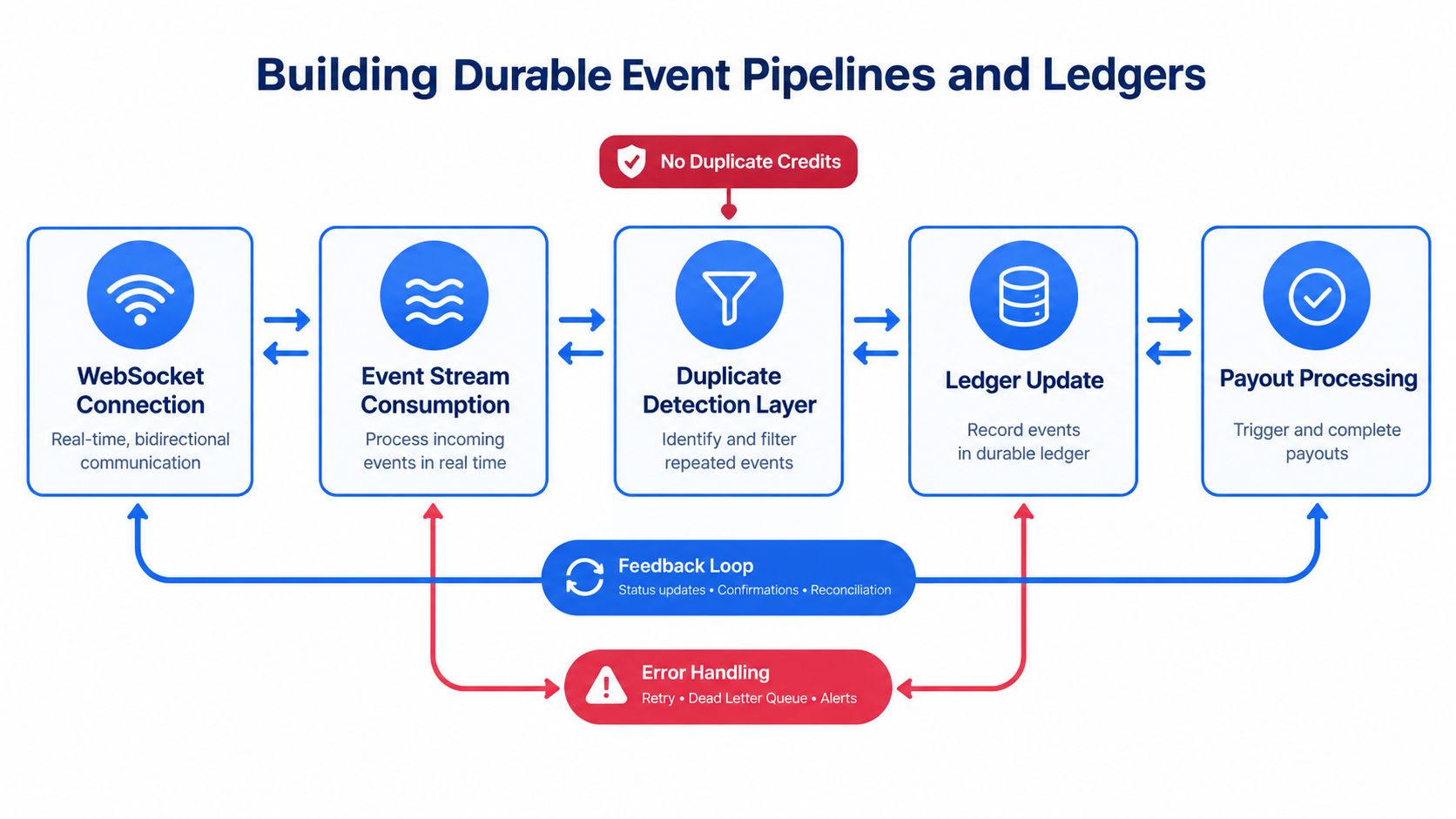
Real-time events don't create reliable finance records by themselves. A WebSocket can tell your system that a transaction became visible, but it can't guarantee that the message arrived exactly once, contained complete transaction data, or represented final settlement.
Ethereum-compatible networks expose real-time subscriptions through eth_subscribe. Applications can receive new block headers, pending transactions, and contract logs, but the stream is connection-scoped and should be treated as a state-transition signal rather than the sole accounting source. The events API documentation is useful when mapping those signals into deposit and withdrawal workflows.
Preserve the transport event
Start by storing the raw notification before enriching it. A pending transaction may contain only a hash, while a later RPC request supplies the sender, recipient, value, gas, and calldata. Keeping both records makes investigation possible when the transaction is replaced, dropped, or confirmed with different details.
A durable event record should include:
- Stable identifiers: Chain, transaction hash, block height, transaction index, log index, and subscription context where available.
- Raw payload: The exact notification received from the transport.
- Enrichment result: The transaction object, receipt, token metadata, and relevant contract logs.
- Processing state: Observed, enriched, validated, confirmed, finalized, reconciled, or rejected.
- Business reference: Customer, withdrawal request, treasury instruction, or internal transfer.
Make handlers idempotent
A reconnect can create overlapping coverage. A node can send the same notification again. A worker can crash after writing a ledger entry but before acknowledging the event. Your handler must produce the same financial result when it processes the same event repeatedly.
Use a stable deduplication key and enforce uniqueness at the persistence layer. Don't rely only on an in-memory cache. A deposit handler should first determine whether the transaction and asset movement already exist, then update the existing state instead of creating a second credit.
A notification is an input to a state machine, not permission to mutate a balance.
The ledger mutation should happen only after validation of chain identity, token contract, destination address, amount, ownership, policy status, and required confirmation state. Idempotency protects customers from duplicate credits and protects operations from duplicate payouts.
Model confirmation as state
A binary success flag hides operational risk. Use chain-specific states such as:
- Observed, the event or hash is visible.
- Included, the transaction appears in a block or receipt.
- Sufficiently confirmed, the configured risk threshold is met.
- Finalized, the network's finality rule supports irreversible treatment.
- Reconciled, the chain record and internal business record agree.
A deposit may become visible before it is creditable. A withdrawal may be approved before it is signed, signed before it is broadcast, and broadcast before it is final. Persist each transition with a timestamp, source, and decision so finance and compliance can reconstruct the lifecycle.
Reconnection logic should use bounded backoff, checkpoint durable processing, and periodically compare internal records with receipts and indexed chain state. WebSockets improve timeliness, but completeness comes from replay-safe storage and reconciliation.
Navigating Consensus and Finality Trade-offs
Treating every blockchain as the same performance category creates unsafe payout policies. Consensus affects energy cost, validator economics, confirmation behavior, failure recovery, and the meaning of “settled.”
Peer-reviewed research comparing proof-of-work and proof-of-stake found that Bitcoin's energy consumption was at least two orders of magnitude higher than every proof-of-stake system examined. Under the study's most favorable assumptions, Bitcoin's energy use per transaction was at least three orders of magnitude higher than that of the highest-consuming proof-of-stake network. The comparative analysis of blockchain energy use also found that permissioned distributed-ledger systems with smaller validator sets can combine low energy demand with high throughput.
Those differences are infrastructure concerns, not ideological talking points. A proof-of-work workflow may require deeper confirmation policies, explicit fee management, and greater tolerance for probabilistic settlement. A proof-of-stake or permissioned network may reduce operating overhead while introducing different assumptions about validator concentration, staking penalties, or governance.
Compare the settlement model
| Consensus Model | Finality Type | Infrastructure Requirement |
|---|---|---|
| Proof of work | Probabilistic confirmation | Track confirmation depth, reorganization risk, fee conditions, and replacement behavior |
| Proof of stake | Protocol-specific finality, often paired with confirmation states | Track attestations or protocol finality, validator assumptions, penalties, and chain-specific thresholds |
| Permissioned distributed ledger | Configuration-dependent finality | Validate validator governance, membership controls, failure handling, and audit authority |
Ethereum's proof-of-stake design illustrates why the distinction matters. A block becomes finalized only after validators representing at least two-thirds of the total staked ETH attest to it, and reverting finalized history would require destroying at least one-third of the stake, according to Ethereum's explanation of finality. That is materially different from probabilistic confirmation on proof-of-work chains.
Put policy above transport
A broadcast service shouldn't decide when a business obligation is settled. The product's withdrawal policy should define the required state for each asset, network, amount, counterparty risk, and use case.
For example, a low-risk internal movement may use one threshold, while a customer payout or treasury transfer may require finality plus policy approval. The system should record why the threshold was met, not merely expose a green status indicator.
Teams evaluating network behavior can also use high-performance blockchain infrastructure guidance as a reference point, but the decision should remain tied to settlement requirements. The fastest chain isn't automatically the safest payout rail. The useful question is whether the chain's consensus behavior can be represented accurately in your ledger and explained to finance.
Turning Compliance into an Operational Advantage
Compliance becomes stronger when it is part of the transaction lifecycle rather than a final screening call. A production system should be able to prove who requested an action, which role approved it, which policy allowed it, what risk checks ran, which signer participated, and what happened after broadcast.
A 2025 survey of roughly 300 banks, payment companies, fintechs, and other institutions found that 85% viewed new rules and standards as enabling adoption. The same survey reported that 41% ranked fast and reliable payouts as the most important infrastructure-provider criterion, while 34% selected compliance. Those findings are reported in the 2025 stablecoin payments infrastructure survey.
Build authorization into the workflow
Non-custodial control doesn't mean uncontrolled execution. A client-controlled Co-Signer can provide an independent approval boundary, while MPC threshold signing prevents one key component from becoming a complete source of authority.
Use role-based access controls for distinct responsibilities. A support user may view status. An operations user may prepare a withdrawal. A risk user may approve an exception. A signing service may execute only after the required policy result exists. Scoped API keys should limit each integration to the wallets, actions, environments, and data it needs.
The audit record should connect:
- Actor identity: User, service, agent, or system process.
- Requested action: Asset, amount, destination, network, and business reason.
- Policy evaluation: Screening result, approval path, limits, and exception status.
- Signing evidence: Co-Signer participation, signer policy, and request integrity.
- Settlement evidence: Broadcast result, confirmations, finality, and reconciliation.
For security teams integrating operational records into monitoring, SIEM integration with Vision offers useful context on structuring audit logs for investigation and control review. The objective isn't to produce more logs. It's to produce evidence that a reviewer can follow from customer intent to settled ledger entry.
Treat compliance as a reliability control
A screening service that runs outside the transaction state machine can create ambiguous outcomes. The system may know that an address was screened, but not whether the screening result applied to the exact network, asset, destination, or version of the policy used at signing.
An event-driven workflow closes that gap. A policy outcome becomes a durable event. A risk change can pause a pending payout. A failed Co-Signer approval can stop signing without losing the original request. The audit workflow process should preserve these decisions as append-only evidence rather than relying on chat messages or mutable dashboard fields.
That approach turns compliance into an operational advantage because it helps teams resolve exceptions, answer reviews, and contain unauthorized actions without stopping every legitimate transaction.
Selecting and Scaling Your Infrastructure Provider
Infrastructure selection should begin with architecture, not a feature checklist. A provider may offer wallets, APIs, or chain connectivity, but buyers need to understand how those components behave when volume is unpredictable, a network changes, an event stream disconnects, or finance finds a reconciliation gap.
A modular, API-first provider lets a team launch with the controls it needs and add capabilities as the product matures. That matters for an exchange, fintech wallet, PSP, or iGaming platform that may later add cards, fiat withdrawals, AI Agent Wallets, or additional networks.
Evaluate the operating model
Ask providers to demonstrate the full lifecycle, not just a successful API response.
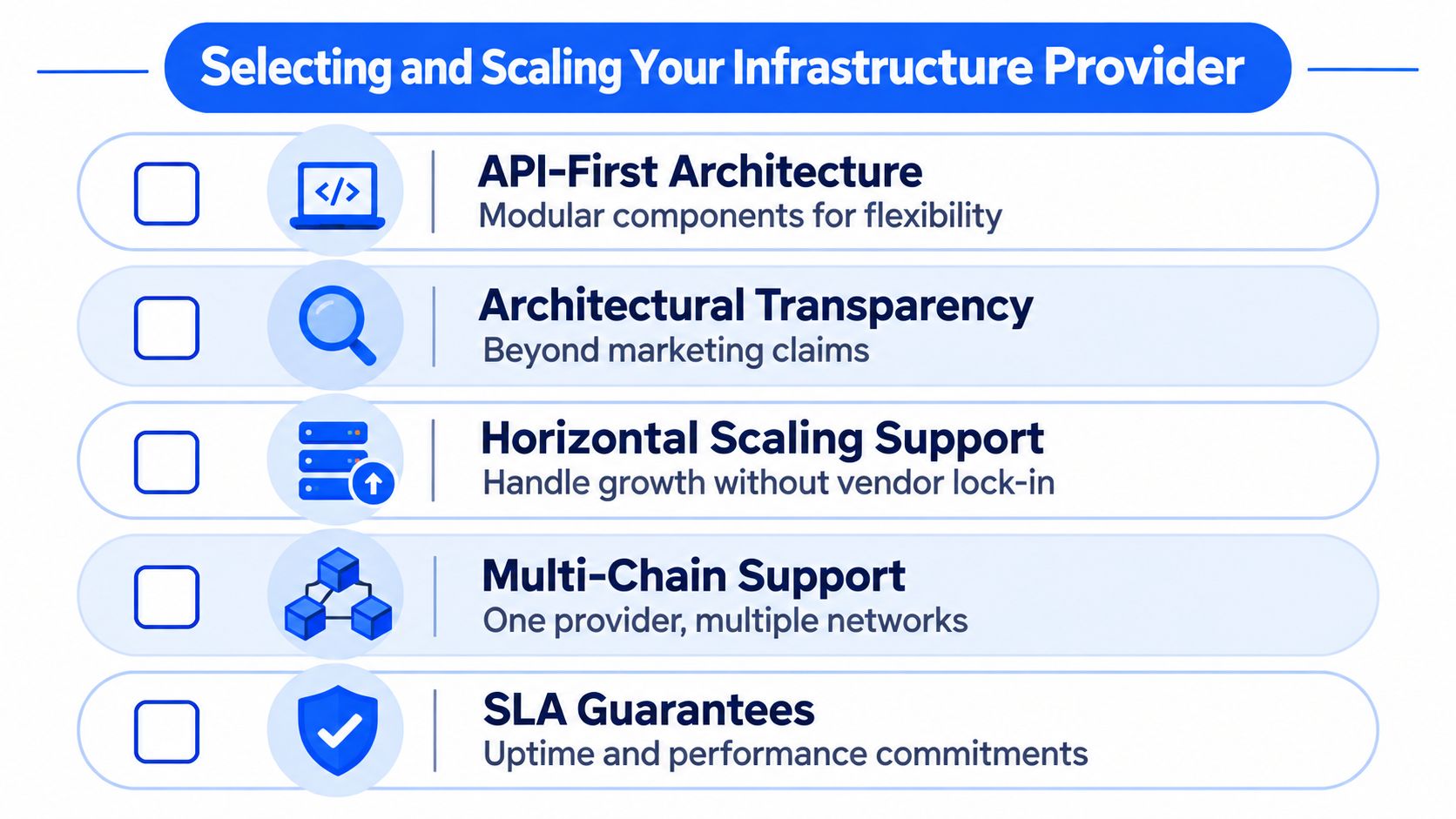
- API-first architecture: Can wallets, settlement, ledger, events, cards, and fiat integrations be adopted independently?
- Architectural transparency: Can the provider explain key locations, signing boundaries, retry behavior, reconciliation, and failure states?
- Horizontal scaling support: Can workers, event consumers, and ledger services scale without forcing a vendor replacement?
- Multi-chain support: Does one operating model handle different fee engines, confirmation states, assets, and transaction formats?
- SLA guarantees: Are uptime, event delivery, incident handling, and performance commitments defined clearly?
The sandbox should mirror production semantics. Test duplicate events, delayed receipts, replaced transactions, rejected policies, failed signatures, disconnected WebSockets, and ledger replay. A clean happy-path demo proves very little.
Prefer fewer operational seams
Fragmented vendor chains create handoff risk. One provider may control wallet generation, another broadcasting, another ledgering, and another card balances. Each boundary requires identifiers, retries, reconciliation rules, access policies, and an incident owner.
A coherent provider can reduce those seams when it exposes the modules through a consistent API. BroLabel offers embedded MPC wallets, network broadcast, an immutable operating ledger, WebSocket events, card issuing, and fiat integrations as modular infrastructure. Teams can also use REST and OpenAPI tooling, Ed25519 authentication, IP allowlisting, replay protection, and a sandbox during integration.
Internal engineering capacity still matters. If a team needs additional backend support for the integration, hire developers from Latin America can be a practical resourcing path, provided the engineers understand event-driven financial systems and not just blockchain SDKs.
The right provider should make production behavior more explicit, not hide it behind a simplified endpoint. Review fee calibration, key ownership, Co-Signer operation, API-key scope, event replay, ledger exports, and the path from sandbox approval to go-live before signing a long-term commitment.
Frequently Asked Questions by Engineering Teams
How should webhook or WebSocket deliveries be made idempotent?
Persist the raw event, derive a stable deduplication key, and enforce uniqueness in durable storage. Process the event through a state transition so repeated delivery updates one record instead of creating another credit or payout.
Should a pending transaction create a customer balance?
Usually, no. A pending notification can contain only a transaction hash, and the transaction may later be replaced or dropped. Enrich the hash, validate the chain, asset, destination, and ownership, then apply the configured confirmation policy before crediting an available balance.
How should gas fees be handled for sponsored transactions?
Separate the customer-facing amount from the network execution cost. Record who pays the fee, which policy authorized sponsorship, the estimated amount, the actual amount, and the ledger entry that reconciles the difference.
Can fiat off-ramps reconcile with an on-chain ledger?
Yes, if the off-ramp instruction and the blockchain payout share a durable business reference. Keep the fiat request, policy result, transaction hash, settlement state, and final fiat outcome linked so finance can reconcile both rails without treating either one as the complete record.
What should an AI Agent Wallet be allowed to do?
Give each agent a bounded wallet, scoped API key, role-based permissions, transaction limits, destination policies, and a human or service approval path for exceptions. The agent should generate requests, not obtain unrestricted signing authority without oversight.
BroLabel provides embedded MPC wallets, controlled settlement, WebSocket lifecycle events, an immutable operating ledger, cards, and fiat integrations for teams building multi-chain financial products. Visit BroLabel to review the API-first stack and start with a sandbox workflow designed around reconciliation, policy control, and auditability.