
Your fintech team has launched payouts in several countries. The API accepts requests, the customer sees a “processing” status, and the treasury team expects the beneficiary to receive funds soon. Then one transfer pauses during screening, another arrives with a different FX amount, and a third appears settled at the provider but remains unmatched in your internal ledger.
The immediate temptation is to negotiate lower fees or add another payment provider. Those changes can help, but they don't solve the deeper failure. The enemy is fragmented state, where banks, wallets, FX providers, compliance systems, and internal ledgers each hold a partial version of what happened.
A reliable cross border payments solution should work like an operating system for value movement. It coordinates rails, currency conversion, routing, settlement evidence, signing policies, events, and reconciliation in one controlled flow. This guide is for founders, CTOs, product leaders, operations teams, finance teams, and compliance owners who need to turn that idea into an implementable architecture.
Table of Contents
- Introduction Why Cross Border Payments Still Break Products
- What a Cross Border Payments Solution Actually Is
- How Money Moves Across Borders Rails FX and Settlement
- Cost Latency and Reliability Tradeoffs You Must Design For
- Architecture and Integration Patterns for Fintech Teams
- Compliance AML and Risk Controls Before You Go Live
- Putting It Together With an API First Stack and Next Steps
Introduction Why Cross Border Payments Still Break Products
A payment doesn't become complete when your application creates a transfer record. It becomes operationally complete when the right amount moves through an approved route, the recipient bank or wallet receives it, the relevant controls are satisfied, and your ledger can prove each transition.
That distinction matters because international flows cross multiple institutional boundaries. A payout may begin in one currency, pass through an FX conversion, travel over a correspondent or local rail, undergo sanctions and AML screening, and depend on a beneficiary institution to post the final credit. Each participant can produce a different status, reference, timestamp, and balance effect.
The enemy is fragmented ledgers
A fragmented ledger isn't only a finance inconvenience. It creates product uncertainty. Customer support can't confidently answer whether funds are blocked, released, in transit, or delivered. Treasury can't calculate available liquidity from incomplete records. Engineering can't safely retry a request if it doesn't know whether the first attempt created an obligation.
The BIS analysis of fragmented ledgers explains why separate ledgers make reconciliation difficult: they don't guarantee a unique common underlying state. In practical terms, two systems can both say a transaction is valid while disagreeing about its latest state.
Practical rule: Treat every payment status as an evidence-backed state transition, not as a label returned by a single vendor.
Why the operating model matters
Cross-border payments are embedded in trade, treasury, remittances, and financial markets. An IMF working paper on cross-border payments estimated that the combined traditional and crypto market approached about $1 quadrillion in 2024. The same analysis found that U.S. dollar transactions represented 53.4% of financial-institution flows and 55.1% of customer flows in 2024, while the dollar and euro together accounted for over 70% of financial-institution payments and more than 80% of customer payments.
Those figures don't mean every product needs every currency or rail. They do show why teams need deliberate corridor design, currency controls, and clear settlement records. The practical lesson is simple: choose infrastructure that can explain where money is, why it took a route, who approved it, and how the final balance was reconciled.
What a Cross Border Payments Solution Actually Is
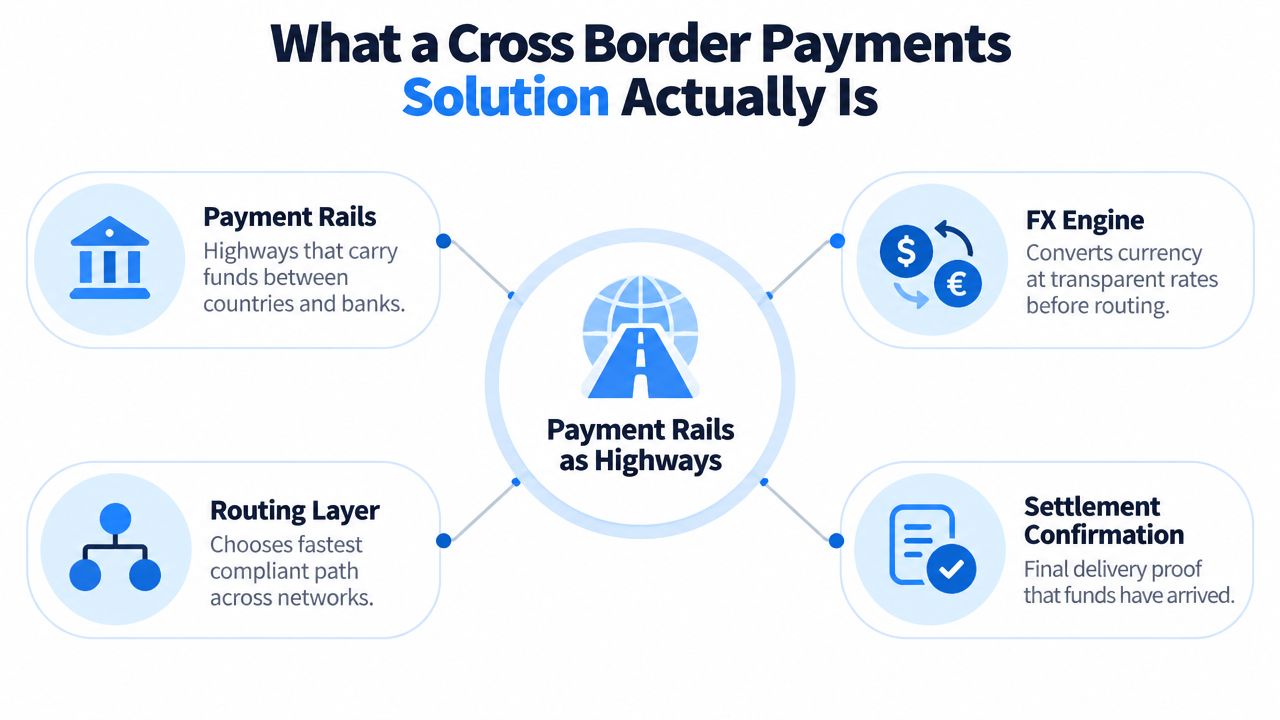
Think of payment rails as highways. A bank wire, local clearing network, card connector, stablecoin network, and wallet transfer are different roads with different entry rules, speed limits, tolls, and delivery evidence. Your application shouldn't expose every road detail to the customer, but it must understand those differences internally.
A modern cross border payments solution coordinates four jobs:
- Initiation, where the payer submits amount, currency, beneficiary, purpose, and reference data.
- Conversion, where the system calculates or locks the FX rate and records fees.
- Routing, where orchestration chooses an eligible path based on corridor, currency, compliance, liquidity, and timing.
- Settlement confirmation, where the system records evidence that the beneficiary received funds or that the designated settlement condition was met.
Messaging isn't clearing or settlement
These terms often get blended together:
- Messaging carries payment instructions and status information between participants.
- Clearing calculates obligations between institutions and prepares them for exchange.
- Settlement is the transfer of value that discharges the obligation.
A message saying “sent” isn't proof that the beneficiary has usable funds. A provider dashboard showing “complete” may mean that its own leg has finished, while your customer-facing obligation still requires beneficiary-bank confirmation or a defined finality rule.
Currency also changes the design. Retail payments often prioritize user experience, local availability, and predictable amounts. Wholesale flows can involve larger balances, treasury liquidity, institutional counterparties, and more formal settlement controls. A team evaluating payment decisions for agents should apply the same discipline to autonomous payment activity, especially around authorization, limits, and evidence.
The right evaluation question isn't “Can this provider send money internationally?” Ask instead: Which rails are available for each corridor, how is FX recorded, what event proves delivery, and how does the system reconcile that event to the ledger?
How Money Moves Across Borders Rails FX and Settlement
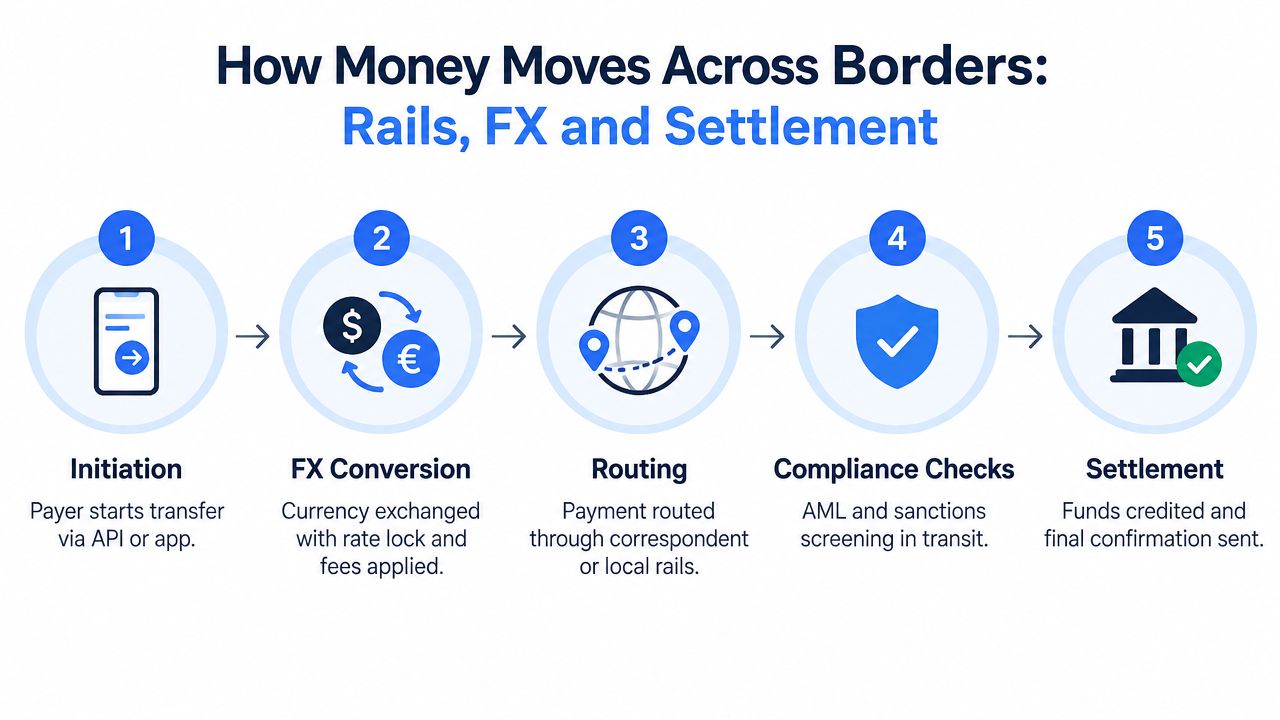
A cross-border payment can look complete in a dashboard while the beneficiary still cannot use the funds. The path has several state changes, and each one needs a clear event, owner, and ledger record.
The process starts with an instruction containing the source account, beneficiary details, amount, currency, and purpose. An orchestration layer validates those fields before sending anything downstream. It checks account permissions, available balance, corridor eligibility, required data, and policy rules. This gate should also create an immutable payment intent, so retries do not become duplicate transfers.
FX creates another state to control. The system can convert before routing, ask a provider to convert, or spend a wallet or treasury balance already held in the destination currency. Each choice requires a record of the rate, spread or fee, source amount, destination amount, and the time when the rate became binding. Reconciliation then compares provider events with internal ledger entries, much like matching a shipping scan to an order record.
Routing is only one part of speed
A fast rail cannot remove delays outside the network. Compliance screening, FX availability, beneficiary-bank processing, cut-off times, liquidity controls, and data repair can all pause a payment after acceptance.
The FSB annual progress report records different outcomes at different stages. In its 2024 progress data, 50.6% of Swift payments credited funds within one hour and 92% within one business day. Swift separately reported that 90% of international payments sent over its network reached the beneficiary bank in under an hour. These measures cover different stages and populations, so they should not become interchangeable customer guarantees.
The G20 target calls for 75% of cross-border payments to be credited within one hour by 2027. ISO 20022 supports richer interoperability, but structured messages only help when upstream systems provide complete, accurate fields.
Data quality now affects release
From November 2026, unstructured postal addresses are scheduled to be removed for CBPR+ messages, according to Swift's migration notice. Town and country must appear in designated fields. Payment layers therefore need schema validation, field normalization, and address enrichment before release, rather than relying on an intermediary to repair incomplete data.
For each corridor, map initiation, authorization, routing, FX, screening, posting, and final credit. Record the owner, input data, expected event, fallback route, and reconciliation artifact. API-first event handling and threshold signing keep approvals, retries, and ledger state aligned. The result is a clearer answer to what “real-time” means: fast instruction delivery, beneficiary-bank credit, or usable funds. For a broader view of payment methods across product flows, see this guide to the form of payment.
Cost Latency and Reliability Tradeoffs You Must Design For
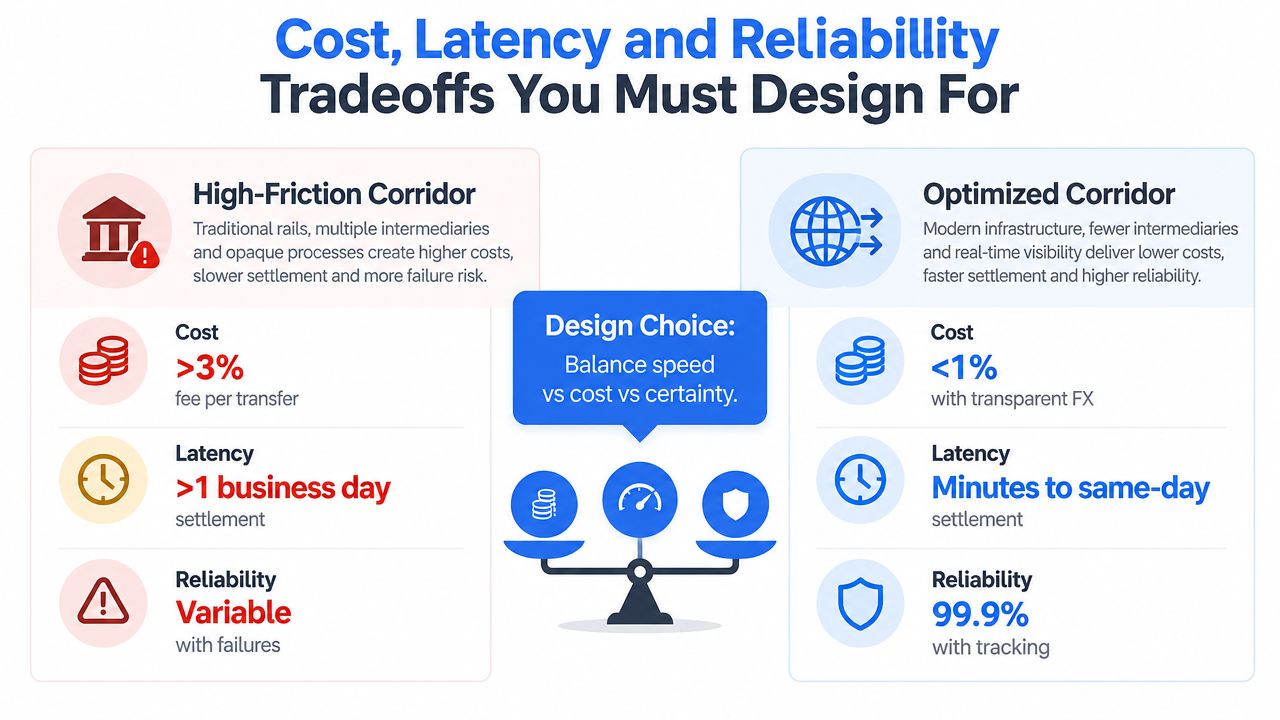
A payment can be cheap, fast, or highly predictable, but a corridor rarely delivers all three at once. Product teams need a service level that matches the use case, then encode that choice in ledgers, events, and controls rather than presenting fees as the whole decision.
The ECB reported that nearly one-quarter of global payment corridors cost more than 3%, while one-third of retail cross-border payments took more than one business day to settle in 2024. The ECB's 2025 remarks on cross-border payments also describe uneven results by use case. More than two-thirds of P2P payments settled within one business day, while B2B and B2P payments were below 45%.
Those differences should shape customer promises. A consumer transfer may use a faster local rail. A business payout may wait for compliance review, treasury approval, invoice validation, or beneficiary-bank posting. Each step should emit a usable event, so “sent,” “approved,” and “settled” do not collapse into one ambiguous status.
Corridor Performance and Rail Choice Matrix
| Use Case | Typical Settlement | Cost Pressure | Design Implication |
|---|---|---|---|
| P2P transfer | Often within one business day, depending on corridor | Consumer sensitivity to visible fees and FX | Prioritize clear estimates, status tracking, and fallback routing |
| B2B payment | Can require additional validation and institutional processing | Treasury and intermediary charges can affect total cost | Preserve purpose data, approval evidence, and reconciliation references |
| B2P payout | Often slower than consumer flows | Payroll, compliance, and beneficiary accuracy matter | Build pre-validation, exception handling, and explicit release controls |
| Digital-asset settlement | Depends on network confirmation and policy review | Network fees and conversion costs vary | Separate observed, confirmed, approved, and paid states |
Stablecoin rails need a narrow description. They are growing, but remain small relative to retail cross-border payments. FXC Intelligence data cited by the ECB estimated that stablecoins represented 0.31% of the $44.3 trillion retail cross-border market in 2025, although volume grew 64% year over year. They therefore fit selected flows, not every bank or local-network payment.
FX adds another state-management risk. The BIS discussion of FX settlement risk emphasizes transparent, accurate, real-time FX processing. Connect rate locking, liquidity-aware routing, conversion, and reconciliation so the quoted rate, booked amount, and final settlement remain traceable.
Before launch, create a corridor decision record. Define the customer outcome, maximum delay, fee display, fallback route, and event that changes the payment to settled. A gateway can handle part of the movement, as described in this payment gateway solution, while your ledger preserves the full operational history. Use API-first reconciliation to compare provider events with ledger state, and require threshold signing when an approval, amount, or risk condition crosses policy limits.
Architecture and Integration Patterns for Fintech Teams
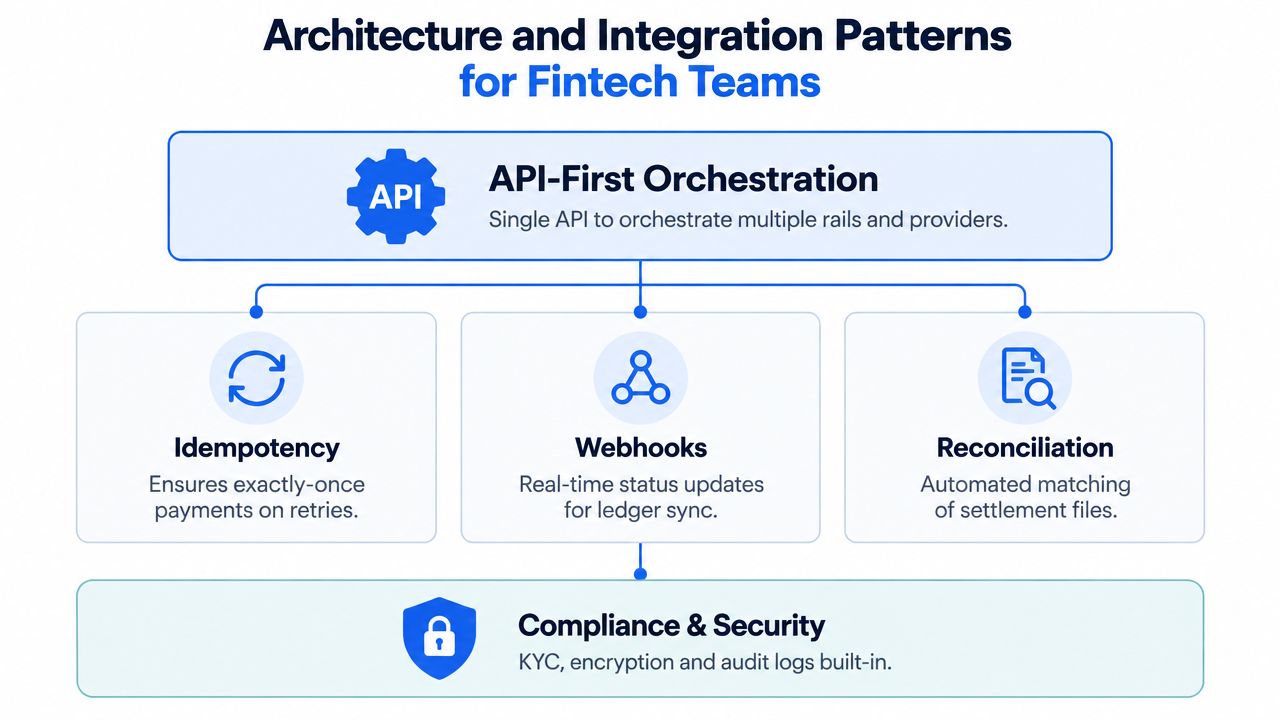
The most durable architecture puts an API-first orchestration layer between your product and external rails. Your product creates a payment intent once. The orchestration layer then applies policy, chooses a provider, sends the instruction, consumes events, and posts ledger entries without forcing every product team to understand each network's implementation.
Make retries safe
Network timeouts are normal. Duplicate obligations aren't. Every create-payment request should include a unique idempotency key, and the system should store that key with the payment record. The Formance cross-border payments API guidance describes the practical behavior: when the server sees the same key again, it should return the original result so a retry doesn't create a second payment.
A safe flow looks like this:
- Create intent: Store the request, beneficiary, amount, currency, and idempotency key.
- Validate policy: Check permissions, balance, corridor rules, and required compliance data.
- Submit once: Send the normalized instruction to the selected rail or provider.
- Consume events: Update state from authenticated status events, not repeated blind polling.
- Reconcile: Match provider references and settlement evidence to the internal ledger.
WebSocket events add operational visibility for deposits, confirmations, withdrawals, and policy outcomes. They let operations teams see state changes as they occur and give finance a usable stream for ledger synchronization. Webhooks can serve a similar role where supported, but your system must verify signatures, reject replayed events, and retain the original payload for audit.
Choose modularity deliberately
A modular approach lets a team add a wallet, FX provider, local rail, card connector, or ledger independently. That can be useful when existing systems already handle part of the flow. The downside is vendor-chain risk, because every handoff creates another identifier, event model, and reconciliation boundary.
A unified stack reduces those boundaries, but it still needs clear interfaces. Decide whether wallets belong to each end user, agent, player, treasury account, or operational role. For an iGaming product, per-player wallet identity can simplify attribution. For AI agents, separate wallets combined with RBAC and audit trails can limit what each agent is allowed to initiate.
The ledger should be append-only. Don't overwrite “pending” with “settled.” Add a new event, preserve the prior state, attach external references, and make the balance impact explainable. That design aligns engineering, finance, and compliance around one source of truth.
Compliance AML and Risk Controls Before You Go Live
A payout can be technically valid and still fail because its identity data, address fields, screening result, or approval record is incomplete. Compliance therefore belongs inside the payment path, not in a manual queue added after launch. Before release, the system should identify the parties, evaluate the transaction, apply policy, and write the decision to the ledger.
Structured address data shows why early validation matters. CBPR+ is scheduled to remove support for unstructured postal addresses from November 2026, so release flows should validate town and country in their designated fields before submission, as noted earlier. Catching the issue before transmission is cheaper than handling a rejected message, customer confusion, investigation work, and a second submission path.
Build a control chain
Treat each control as a checkpoint connected to the payment event:
- Identity and screening: Capture required payer and beneficiary data, run KYC or AML checks appropriate to the flow, and retain the result.
- Transaction policy: Apply corridor restrictions, amount limits, asset rules, velocity controls, and approval requirements.
- FX and liquidity: Record the quote, conversion instruction, source balance, destination amount, and any rate-lock condition.
- Signing authority: Require an authorized signer or policy decision before funds can move.
- Settlement evidence: Store network, provider, bank, or wallet references with the event proving the relevant completion state.
- Auditability: Preserve actor identity, role, timestamp, request hash, decision, and resulting ledger entry.
This chain turns compliance into an operating-system function for payments. The ledger records what happened, events show when state changed, and controls explain why the system allowed or stopped the next action. That structure also makes reconciliation possible without reconstructing decisions from scattered logs.
For non-custodial wallet security, threshold signing avoids dependence on one complete private key. MetaMask's embedded-wallet MPC documentation describes a 2-of-3 model with an authentication share, device share, and backup or 2FA share. A signature is possible only when the required threshold is met, so one party cannot reconstruct the full key.
BroSettlement can combine DKG/MPC 2-of-3 signing, a client-controlled Co-Signer, and broadcast across 10 chains within an API-first settlement workflow. BroWallet supports embedded user, agent, or player wallets. Scoped API keys, RBAC, IP allowlisting, Ed25519 authentication, replay protection, and audit trails restrict which actors can request each operation. Evaluate these controls against your governance model rather than treating them as a replacement for it.
Use a documented compliance management process with named control owners and escalation paths. Before launch, test rejected addresses, duplicate requests, failed screening, stale FX quotes, insufficient liquidity, signer refusal, delayed confirmations, and reconciliation breaks. A successful demo proves the happy path only. Operational readiness requires evidence that blocked and incomplete states are handled safely.
Putting It Together With an API First Stack and Next Steps
Consider an iGaming operator paying players in USDT. For each player, the product creates a wallet identity, receives a deposit, waits for the required confirmation, applies policy, and creates a payout request. Each step needs a distinct state. An observed deposit is not yet a confirmed deposit, and an approved payout is not the same as a signed, broadcast transaction.
An API-first stack keeps those distinctions in the infrastructure layer. BroWallet provides embedded wallet patterns. The operating ledger records append-only balance and policy events. WebSocket streams expose deposit and confirmation changes. BroSettlement coordinates DKG/MPC 2-of-3 signing with a client-controlled Co-Signer before broadcasting across supported chains. Together, these components make the payment flow an operating system of ledgers, events, and controls, rather than a collection of fee calculations.
A practical implementation sequence
Start with one corridor or asset flow. Configure the sandbox, define the fee engine, create scoped API keys, and establish the ledger event model before connecting production liquidity. Every state should be observable, with evidence showing which event, approval, or network reference caused the transition.
Then test the controls in order:
- Request integrity: Repeat the same payment request. Idempotency should return the original result instead of creating a duplicate obligation.
- Policy enforcement: Attempt a payout above a configured limit or without required screening data.
- Signing separation: Confirm that the application cannot release funds alone when the Co-Signer requires another approval.
- Event ordering: Send delayed, duplicated, and out-of-order WebSocket events. Balances should remain correct.
- Reconciliation: Match internal entries with provider, bank, or network references. Route unmatched records to an exception queue with an owner.
- Customer communication: Display “initiated,” “under review,” “submitted,” “confirmed,” and “settled” only when the underlying evidence supports each state.
BroLabel's infrastructure modules include BroSettlement, embedded MPC wallets, an immutable operating ledger, WebSocket events, BroWallet, fiat integrations, and card infrastructure. BroCard supports Mastercard virtual and physical cards with Apple Pay and Google Pay. AI Agent Wallets add per-agent wallets, RBAC, and audit trails. Teams can use the modules together or embed selected components into an existing application.
Questions buyers should answer
Which corridors should we support first? Start where customer demand is clear, beneficiary data is reliable, liquidity is available, and the settlement artifact is defined. A fast result in one corridor does not establish a universal SLA for another.
What counts as final settlement? Define the answer per rail. A submitted instruction, beneficiary-bank credit, blockchain confirmation, and reconciled ledger entry represent different milestones.
How should finance reconcile payments? Use an append-only internal ledger keyed to idempotency keys, provider references, network transaction identifiers, FX records, and settlement events. Assign ownership for unmatched records and document the exception workflow.
Can stablecoin rails replace bank rails? They can serve selected corridors and use cases, but the ECB-cited FXC Intelligence estimate indicates that stablecoins remain a small part of retail cross-border volume. Treat them as one controlled rail within a broader routing strategy.
Build the evidence trail before optimizing route, fee, or latency. Once the team can explain every balance change, event, approval, conversion, and settlement outcome, it can improve performance without losing control of fragmented state.
BroLabel provides API-first wallets, BroSettlement with non-custodial threshold signing, operating ledger and reconciliation support, WebSocket events, fiat and card infrastructure, and scoped production-access controls. Visit BroLabel to review the modules, start in the sandbox, and plan a corridor-specific path to go-live.