

Your team already committed to crypto payouts. Product has the UI mocked, finance expects a settlement report, compliance wants screening hooks, and engineering is staring at a vendor matrix that somehow includes wallets, custody, node providers, fiat partners, and a ledger vendor. A week before go live, the problem appears. No one can answer which system is the source of truth when a withdrawal is signed but never broadcasts, or when a deposit is seen on chain but not yet cleared for customer balance.
That's where most crypto launches go wrong. Not because the wallet API failed, but because the operating model was assembled as separate parts that don't agree under stress.
The enemy is brittle handoffs. One vendor creates addresses. Another signs. A third watches chains. Finance keeps an internal ledger. Compliance reviews alerts in a separate queue. When volume rises or an audit starts, the gaps between those systems become the failure surface. Silent transaction failures get discovered by customers first. Off chain ledger drift shows up during close. Hot wallet exposure grows because delayed sweeps become normal. Licensing and AML issues don't surface until someone asks for evidence, and the evidence lives in five places.
Crypto as a service is useful only if it removes those brittle handoffs. If it outsources them, you've bought packaging, not infrastructure.
Table of Contents
- The Operating Reality Behind Crypto as a Service
- What Crypto as a Service Actually Means
- Why MPC and a Client-Controlled Co-Signer Change the Custody Equation
- The Event-Driven Stack Wallets Ledger Broadcast and Fiat
- Matching the Stack to Your Use Case
- How to Evaluate a Crypto as a Service Vendor Without the Demo Theater
- Compliance and Operational Risks You Plan For Before Launch
- Bringing It Together and What to Ask Next
The Operating Reality Behind Crypto as a Service
A familiar pattern looks like this. A payments team wants stablecoin payouts by quarter end. They start with deposit address generation because that feels tangible. Then they bolt on a signing vendor, add a chain monitor, and defer ledger design because “finance can map it later.” By the time user acceptance testing starts, nobody can explain what happens when a transaction is policy approved, signed, and then dropped before broadcast.
That isn't an edge case. It's the normal place where first pass implementations break.
Where first pass stacks fail
The failures usually show up in four places:
- Silent transaction failure: a transaction can be signed successfully and still never settle if broadcast fails or replacement handling is weak.
- Ledger drift: internal balances move on request creation, while on chain state moves on confirmation. If those transitions aren't modeled separately, finance inherits cleanup work.
- Wallet exposure: delayed sweeps and unclear hot cold rules leave too much value sitting in operational wallets.
- Compliance gaps: review decisions, policy outcomes, and case evidence often sit outside the transaction lifecycle and can't be reconstructed cleanly.
Practical rule: If your finance team can't distinguish requested, signed, broadcast, confirmed, failed, and replaced states, you don't have production readiness. You have a demo.
The reason this compounds is simple. Every shortcut becomes a dependency. If you pick a hosted custody model early, key control and approval logic get embedded in one vendor's workflow. If you skip an append only ledger, reconciliation becomes a permanent custom project. If your event model is thin, downstream systems poll for truth and make conflicting assumptions.
Why architecture choices get expensive later
Replatforming crypto infrastructure is harder than replacing a normal SaaS tool. You're moving key material, policy controls, transaction history, operational procedures, and regulator facing evidence all at once. Teams usually underestimate that until they try to migrate.
What works better is a modular, event driven stack from day one. Wallet creation, signing, broadcast, ledgering, fiat movement, and compliance policy need to behave like one operating surface, even if you adopt them in phases. That's the only reliable way to reduce handoffs instead of relocating them.
What Crypto as a Service Actually Means
Crypto as a service is modular infrastructure delivered through APIs and SDKs so a product team can ship crypto features without building a full blockchain operations team in house. That sounds broad, so it helps to break it into the layers buyers integrate.
A useful mental model is six operating layers, each with a different job.
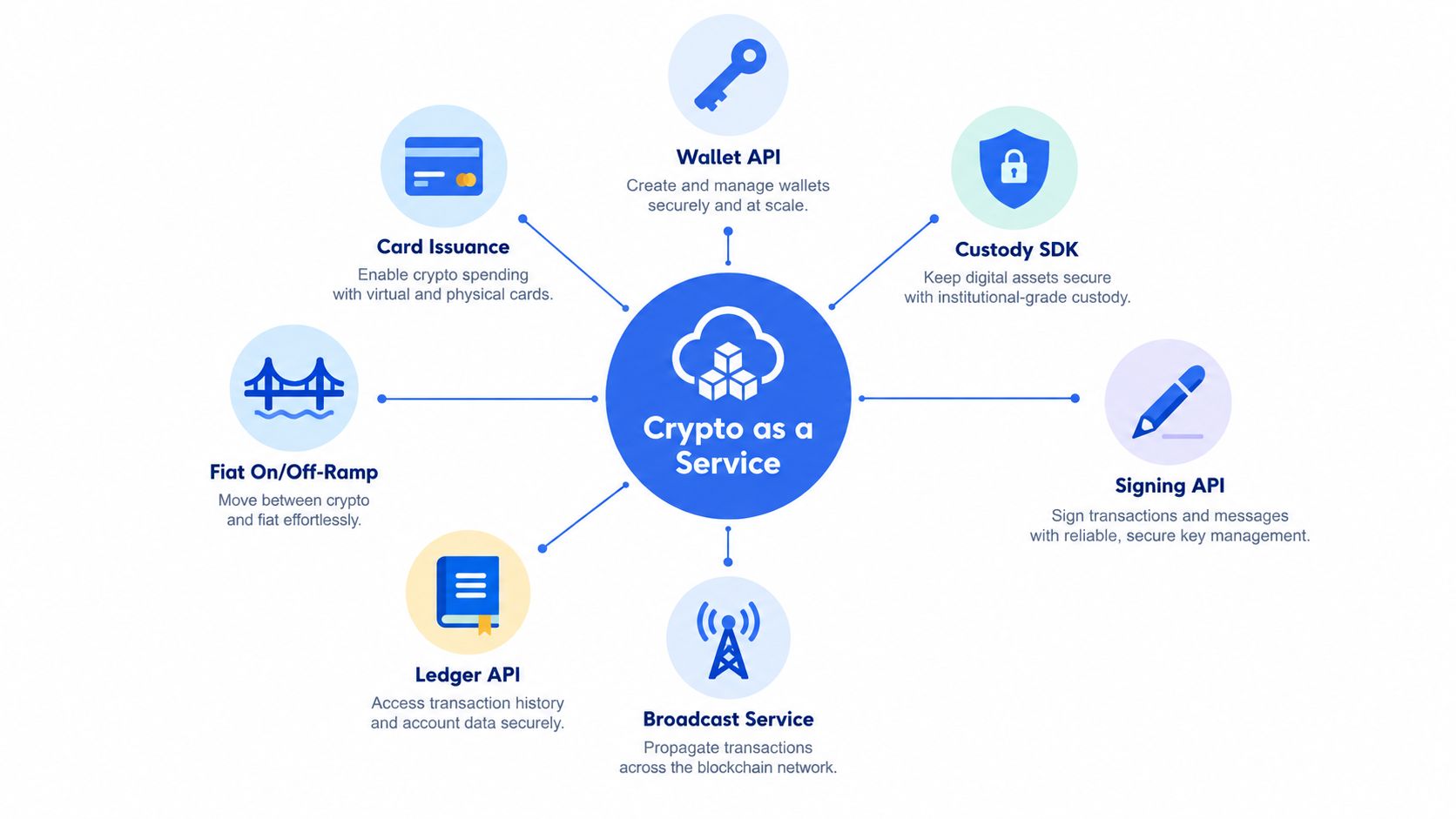
The six layers that matter
Wallets
This layer manages address lifecycle, deposits, withdrawal intent, account structure, and user or entity mapping. It answers basic but critical questions such as who owns an address and where an incoming transfer should land operationally.Signing protocols
Key usage is controlled. A good signing layer doesn't just produce signatures. It enforces policy, role approvals, allowlists, velocity limits, and operational separation before value moves.Broadcast
Signed transactions still need to be submitted, monitored, retried, or replaced. Broadcast is its own discipline because network conditions, mempool behavior, and transaction replacement rules affect whether a signed intent becomes a settled transfer.Ledger
The ledger is the accounting system for all state transitions. It shouldn't be confused with chain data. It records requested, approved, signed, broadcast, confirmed, reversed, and reconciled states in append only form so finance and ops can audit what happened.Fiat rails
Deposits, redemptions, payouts, and conversion flows sit here. Many teams don't need “crypto features” in isolation. They need value to move between bank accounts, cards, and blockchain balances without manual breaks.Cards
For some products, spend is the feature. Card issuance connects wallet or ledger balances to familiar payment rails and operational controls.
Why the modular model matters
Most buyers make a mistake in one of two directions. They either buy a monolith that hides control points, or they stitch together narrow tools that never become an operating system.
What works is composability with operational depth. You may not need every module on day one. A PSP may start with stablecoin settlement and ledgering. A neobank may care first about fiat movement and card spend. An exchange may keep its own ledger and swap in only wallets, signing, and broadcast.
The market context explains why this category has become infrastructure, not experiment. One industry summary estimates the global crypto payments market at about $1.8 billion in 2024 and projects it above $3.5 billion by 2030, implying a 14.2% CAGR over 2024 to 2030. The same summary says over 580 million people globally owned cryptocurrency in early 2026, U.S. merchant acceptance reached about 40%, on chain transaction volume reached $16 trillion in 2025, and the payment specific subset was about $2.1 trillion (crypto payments industry statistics). The point isn't hype. It's that outsourced rails now need to behave like real payment infrastructure.
Why MPC and a Client-Controlled Co-Signer Change the Custody Equation
Custody is where many institutional builds become strategically trapped. A hosted model can be operationally convenient at first, but if the provider controls the signing boundary, they also control migration friction, emergency procedures, and in practice a large part of your risk model.
Threshold MPC changes that equation because signing authority is split across parties. In a (t, n) threshold scheme, fewer than t signers can't produce a valid signature, while any t signers can (threshold wallet architecture research). In a production 2 of 3 design, two designated key shares must cooperate and one share alone can't sign (2-of-3 MPC wallet design).
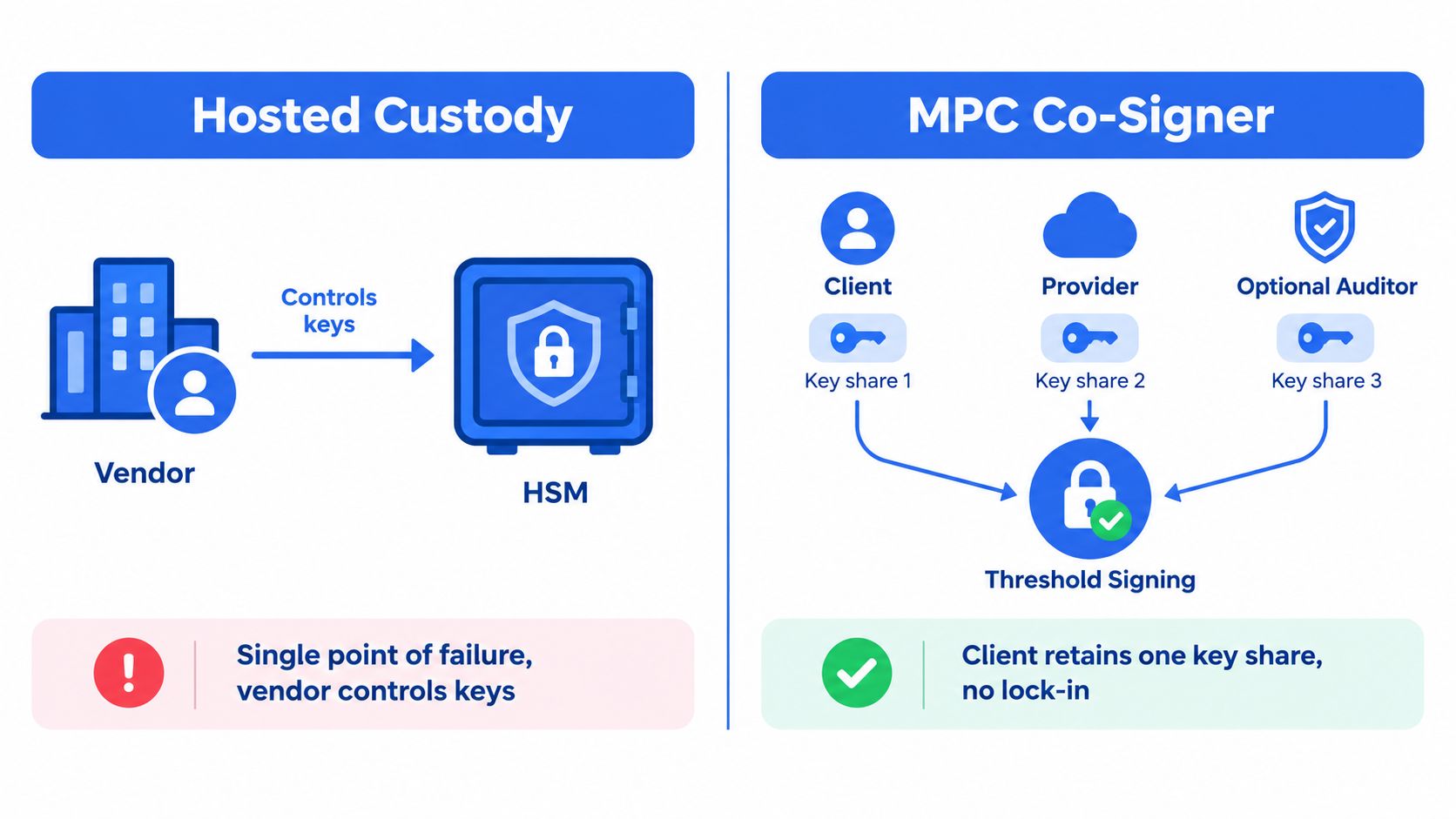
Why this is more than a security feature
A client controlled co signer means the provider can't move funds unilaterally. Just as important, the client doesn't have to run the full operational burden alone. That combination is what institutions need. Control without rebuilding the stack from scratch.
Independent guidance on MPC signing notes that a 2 of 3 threshold tolerates one faulty or offline node while still producing signatures, and the full private key is never reconstructed during signing (MPC security guidance). That's the key operational property. The system stays usable when one participant or service is unavailable, without collapsing into a single secret.
Hosted custody centralizes both convenience and failure. MPC separates them.
The common misconception is that MPC is only about key compromise. In practice, it's also where policy lives. If the signing layer supports scoped approvals, role separation, rate limits, and address controls, then governance happens before the signature exists. If it doesn't, the downstream stack is left trying to control transfers after the critical act already happened.
What buyers should compare
Three models dominate evaluation:
- Hosted custody: easiest to start, hardest to exit cleanly
- Pure self custody: highest direct control, highest operational burden
- MPC with client co signer: shared operations with retained approval authority
The engineering tradeoff in modern threshold systems isn't abstract mathematics. Recent work on threshold ECDSA focuses on lowering bandwidth and computation cost, with protocol variants aimed at reducing communication rounds and operational friction (threshold ECDSA performance research). That matters because if signing becomes slow or chatty, transaction throughput and user experience degrade.
For teams evaluating long term custody posture, it's also worth reviewing broader crypto custody regulation prediction data to understand how control models may be judged under changing regulatory expectations. And if you want a concrete reference for how one MPC-first implementation is structured, BroLabel's MPC wallet architecture is a useful example of the client co signer approach in practice.
The Event-Driven Stack Wallets Ledger Broadcast and Fiat
Once custody is solved, day to day operations shift to a simpler question. Can your stack tell every downstream system exactly what happened, in the right order, without forcing them to poll and guess?
That's where the event driven model earns its keep.
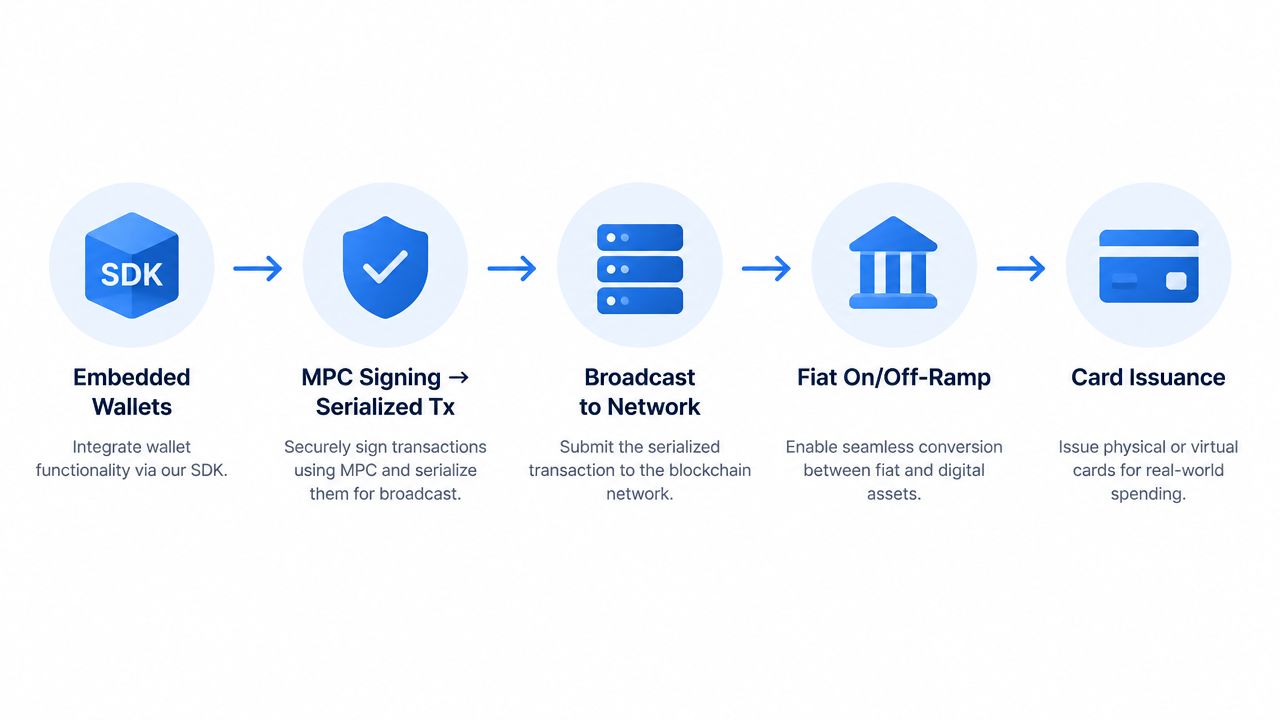
What finance and engineering actually need to see
Real time wallet operations are typically modeled as event streams such as deposit observed, deposit confirmed, withdrawal requested, policy evaluated, broadcast status, and final settlement status, with WebSocket delivery pushing these lifecycle changes immediately to downstream systems (wallet API event model). That's a better operating surface than polling a balance endpoint and hoping the state is final.
A practical production flow usually looks like this:
- Embedded wallet creation: user, treasury, merchant, or agent wallets are created through API or SDK.
- MPC signing: the system approves policy and returns a serialized transaction without exposing key material.
- Broadcast and monitoring: the transaction is submitted to the network and tracked through pending, replaced, failed, or confirmed states.
- Ledger write: each state transition is recorded append only.
- Fiat and card linkage: crypto and fiat movements reuse the same operational records so balances stay explainable.
Why the ledger must sit in the middle
Teams often treat the blockchain as the ledger. That's a category error. Chains record final state for a network. Your business still needs an internal accounting record for intent, approval, broadcast, settlement, reversals, fees, and customer mapping.
Operational reconciliation should compare blockchain events against internal ledger entries by matching asset, network, amount, transaction hash, block number, timestamps, confirmation status, and account mapping. A signed transaction that never broadcasts must not be treated the same as a settled withdrawal (wallet infrastructure reconciliation guidance).
If a finance close depends on querying chain explorers, the architecture is incomplete.
Idempotency matters here too. Deposits can be replayed by webhook delivery. Withdrawals can be retried after a timeout. Replacement transactions can appear to duplicate intent. Systems need request identifiers, operation identifiers, and safe replay semantics so retries don't mutate balances twice.
A practical implementation of this model is to keep wallets, signing, ledger, and event streaming tightly aligned, then add fiat pathways where needed. For teams building bank connected flows, fiat to crypto API infrastructure is the relevant boundary because it determines whether treasury and customer movements reconcile into one operational view.
Matching the Stack to Your Use Case
Not every buyer needs the same slice of the stack. The mistake is assuming “crypto as a service” means adopting everything at once. The better approach is to map modules to the operational constraint that blocks launch.
CaaS Module Adoption by Buyer Archetype
| Archetype | Core modules | Key constraint |
|---|---|---|
| Exchanges | Wallets, signing, broadcast | Need fine control over withdrawal flow, transaction routing, and wallet tiering while often keeping their own ledger |
| Neobanks | Ledger, fiat rails, cards | Must present crypto and fiat balances coherently to customers and finance teams |
| PSPs | Broadcast, ledger, lightweight wallets | Need merchant settlement flows that fit existing payment operations |
| iGaming | Wallets, broadcast, ledger, policy hooks | High throughput deposits and payouts with jurisdiction specific controls |
| Enterprise treasury and AI agents | Signing, ledger, event consumption | Need programmatic approvals, audit trails, and delegated authority without losing control |
What each buyer should optimize for
Exchanges usually care less about abstract wallet creation and more about withdrawal control under pressure. They need predictable signing, routing, reorg handling, and operational separation between hot and cold processes.
Neobanks tend to prioritize customer experience and reconciliation. They need fiat connected crypto flows, card attachment, and ledger states that align with close and support queues.
PSPs normally want stablecoin settlement as an extension of payment operations, not as a new business line. Thin wallet abstractions can be enough if the ledger and payout rails are strong.
iGaming operators need per player wallet isolation, fast deposit detection, and payout policy tied to jurisdiction and risk state. They often discover that anti fraud and anti abuse systems need to sit close to wallet activity, not just at account onboarding. For teams thinking through that layer, this guide to anti-abuse for financial platforms is useful because abuse control tends to overlap with wallet operations long before a pure compliance review catches it.
Enterprise treasury and AI agent use cases look different on the surface but share one requirement. The signing layer must support machine driven initiation with human bounded controls.
A modular provider can support that phased adoption model. For example, wallet as a service infrastructure is often the initial wedge for products that later add ledgering, payout automation, or fiat settlement once the first flow is stable.
How to Evaluate a Crypto as a Service Vendor Without the Demo Theater
A polished demo won't tell you what happens when transactions fail halfway through, events arrive out of order, or finance asks for a replayable audit trail from three weeks ago. Vendor evaluation needs to happen at the operating boundary, not the UI boundary.
Five checks that matter under load
- Policy control: Can you enforce allowlists, velocity limits, role based approvals, and signer separation, or are those controls hidden inside the vendor's custody workflow?
- Ledger design: Is it append only, idempotent, and detailed enough for close, dispute review, and recovery?
- Event fidelity: Can downstream systems subscribe once and rebuild state reliably, including retries and replays?
- Sandbox realism: Does the test environment include fault conditions, realistic latency, mocked fiat, and replacement or failure scenarios?
- Evidence posture: Will the vendor share security attestations, recovery procedures, and incident handling details?
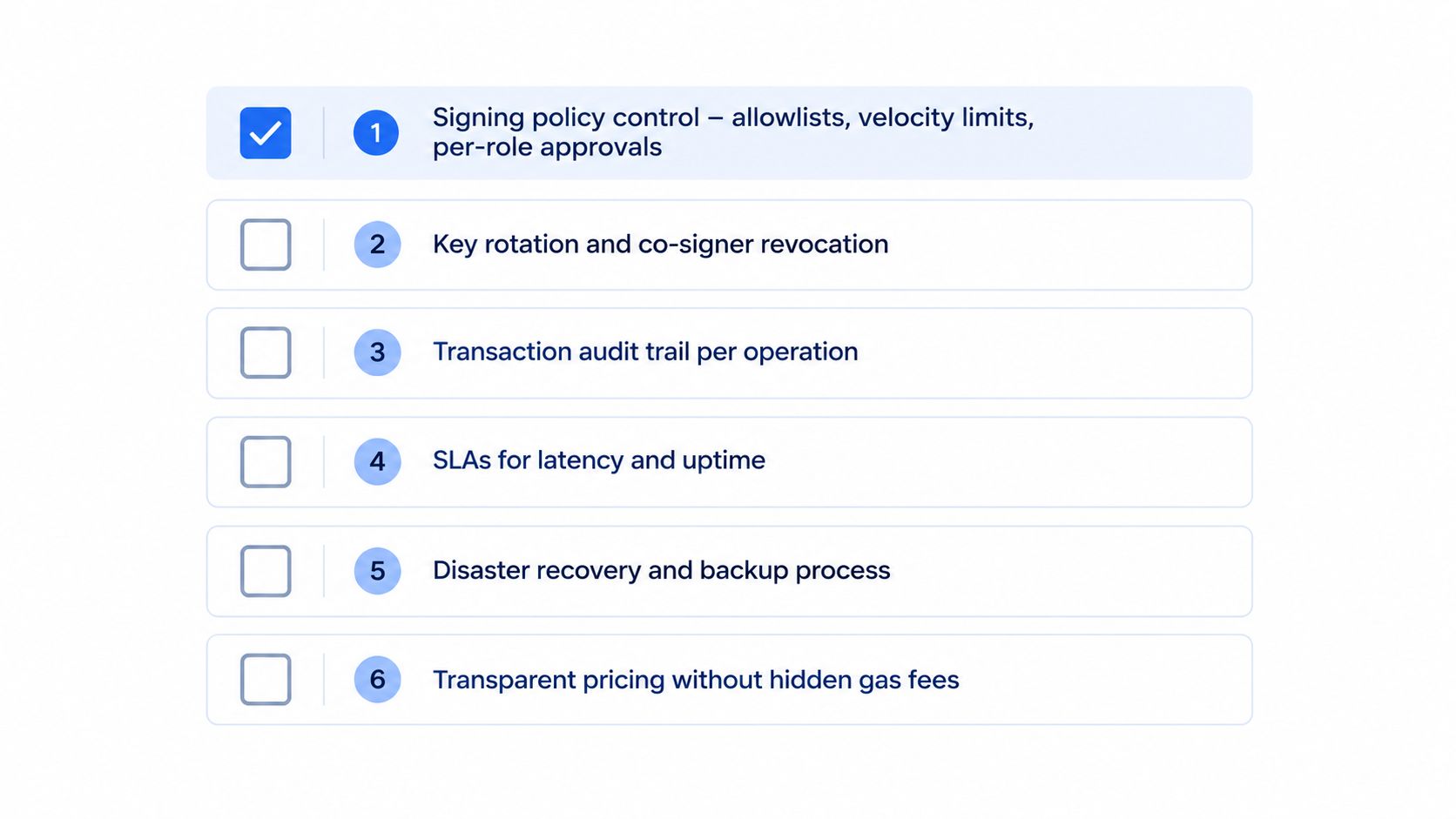
What a serious proof of concept looks like
Run a parallel proof of concept against two vendors. Don't score them on presentation quality. Score them on how much operational ambiguity remains after engineering and finance both test the system.
Ask engineering to simulate retries, dropped callbacks, partial failures, and signer unavailability. Ask finance to reconcile a day's worth of deposits, withdrawals, fee entries, and failed transactions without manual spreadsheet work. Ask compliance to trace who approved what and what policy fired.
A vendor that can't explain idempotency, replay handling, and failed broadcast state transitions during evaluation won't explain them better after signature.
Scoped API keys matter more than they first appear. Teams should be able to issue credentials per environment, service, and role, then combine them with IP restrictions, replay protection, and explicit operation scopes. That's what keeps a wallet service from becoming a universal skeleton key inside your own stack.
The practical lesson is simple. Buy evidence, not roadmap. A thin feature set with coherent controls is safer than a broad suite that only works in happy path demos.
Compliance and Operational Risks You Plan For Before Launch
Compliance isn't a legal wrapper around crypto infrastructure. It's part of the transaction system. If the controls don't exist inside the operating flow, teams end up making policy decisions after money has already moved.
The hardest operational problem usually isn't whether compliance applies. It's whether your team can run it at production speed without burying analysts in noise. A survey analysis of 412 compliance leaders across 38 countries found that 78% named false positive management in transaction monitoring as their top operational challenge, 71% cited cross jurisdictional regulatory divergence, and 64% cited Travel Rule complexity. The same analysis references a FATF update showing only 13 of 139 jurisdictions fully met the standard for preventive AML/CFT measures (crypto compliance survey analysis).
Compliance Risk Matrix by Module
| Module | Primary Risk | Mitigation Control |
|---|---|---|
| Wallets | Customer and entity mapping errors | Strong account mapping, role controls, and immutable audit trails |
| Signing | Unauthorized or weakly governed approvals | Segregation of duties, policy based approvals, co signer participation |
| Broadcast | Transaction sent despite policy or data mismatch | Pre broadcast validation, replacement handling, and status tracking |
| Ledger | Drift between operational state and chain state | Append only entries, reconciliation workflows, and idempotent posting |
| Fiat rails | Jurisdiction and counterparty mismatch | Corridor specific policies, beneficiary checks, and exception workflows |
| Cards | Spend against unclear backing balance | Shared ledger states and explicit settlement timing rules |
The controls buyers underweight
False positives are not just a compliance nuisance. They're a customer operations problem. If an analyst can't explain why a withdrawal was paused, the support team inherits that ambiguity.
Travel Rule workflows also break more than teams expect. Counterparties run different stacks, data fields get dropped, and retries happen outside the transaction lifecycle unless they're designed in from the start.
Cross border drift is the third trap. Data that satisfies one jurisdiction may not satisfy another, so transaction records need jurisdiction aware tagging and evidence retention from the beginning.
Operational controls sit beside regulatory controls:
- Key ceremony logging: record who participated, what was created, and where approvals were stored.
- Duty separation: keep policy authors, signers, custody operators, and finance operators distinct.
- Runbooks: rehearse chain reorgs, RPC outages, delayed confirmations, and stablecoin stress scenarios.
- Recovery commitments: get written recovery objectives per module before launch, not after the first incident.
What works is boring on purpose. Clear audit logs. Explainable policy. Recoverable state. No mystery transitions.
Bringing It Together and What to Ask Next
Institutional crypto stacks fail when they're treated as a wallet integration problem. They hold up when they're designed as an operating system for value movement. That means custody control at the signing boundary, event visibility throughout the transaction lifecycle, an append only ledger for accounting truth, and compliance controls that act on transactions before exceptions become incidents.
The modular model is practical because different teams lean on different parts of the system. Exchanges care about broadcast control and reorg handling. Neobanks care about fiat pathways and card linkage. PSPs care about settlement and reconciliation. iGaming operators care about player wallet isolation and policy by jurisdiction. Treasury teams and AI agents care about delegated signing with hard boundaries and durable audit logs.
Three questions that expose weak architecture
Ask every vendor these questions before any commercial discussion advances:
Where does the key material actually live?
If the answer is vague, the custody model is vague.How is reconciliation surfaced to finance systems?
If the answer depends on manual exports or explorer lookups, the ledger model is weak.What happens when a counterparty or dependency is offline?
If the answer is “we retry,” keep asking until replay semantics, state handling, and evidence retention are explicit.
One vendor option in this category is BroLabel, which offers API first wallets, MPC signing through BroSettlement, a client controlled Co-Signer, WebSocket events, an append only operating ledger, BROwallet, BROcard, AI agent wallets, and scoped API access within one modular stack. That kind of design is useful when a team wants to start with a narrow launch path and add modules without rebuilding control surfaces later.
Teams that get crisp answers ship. Teams that get architecture slides usually budget for migration.
Bro has your back when the priority is operational clarity, not feature theater.
FAQ
What is crypto as a service in practical terms
It's an API and SDK based operating layer for wallets, signing, transaction broadcast, ledgering, fiat movement, and sometimes card issuance. The practical value is that product teams can launch crypto flows without building every backend function internally.
Is crypto as a service only for exchanges
No. Exchanges use it, but so do neobanks, PSPs, iGaming operators, treasury teams, and products that need agent level wallets or stablecoin settlement.
Why is MPC better than hosted custody for many institutional teams
Because control is split. A provider can operate infrastructure, but can't sign alone when a client controlled share is required. That reduces lock in and improves governance.
What breaks most often after launch
Reconciliation, not address generation. The recurring problems are failed broadcasts, duplicated retries, unclear transaction states, and missing audit evidence across systems.
Do we need a separate ledger if the blockchain already records transactions
Yes. The blockchain records network state. Your business still needs internal records for intent, approvals, customer mapping, fees, failures, retries, and settlement states.
How should finance consume crypto transaction data
Through an append only ledger and event stream that distinguishes lifecycle states clearly. Finance shouldn't have to infer settlement truth from node responses or explorer data.
What should a compliance team inspect before approval
They should inspect transaction monitoring flow, false positive handling, Travel Rule readiness, case evidence, role separation, and immutable audit logs tied to the transaction lifecycle.
Can AI agents safely use crypto as a service
Yes, if each agent gets a bounded wallet model, scoped credentials, explicit approval policy, and full auditability. Autonomous initiation without bounded signing policy is not a safe production model.
BroLabel provides modular crypto infrastructure for teams that need wallets, MPC signing, broadcast, ledgering, fiat flows, cards, and agent wallets to work as one operating system instead of five disconnected tools. If you're evaluating crypto as a service before go live, visit BroLabel to review the stack and see how the control surfaces map to real production workflows.