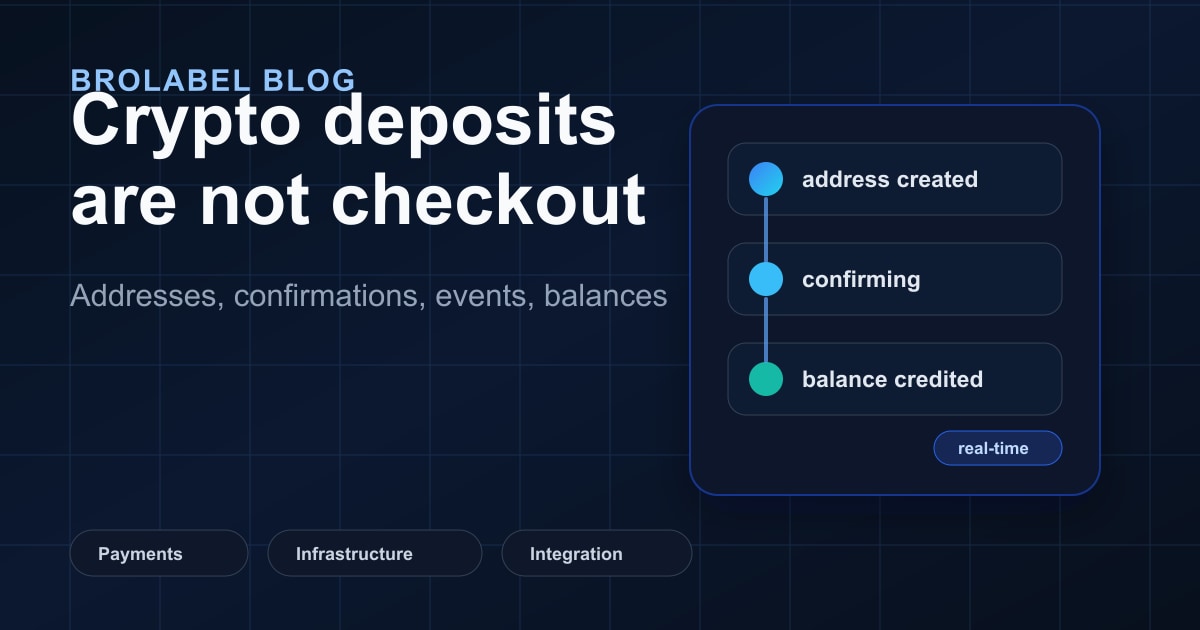
A deposit starts an operating state
iGaming crypto deposits are often described as another payment method. A player chooses USDT or USDC, receives an address, sends funds, and the product updates the balance. On the surface, this looks like checkout.
For a casino, sportsbook, or betting platform, though, a deposit does not end when the transaction appears on-chain. It starts an operating state inside the product: the address needs to map to a player, the transaction needs confirmation logic, the balance needs to update, the cashier needs to show a clear status, support needs to see the history, and finance needs to reconcile on-chain movement against the internal journal.
If a team treats deposits as one-off checkout, it optimizes the wrong layer. It asks, "can we accept crypto?" The stronger iGaming question is: "can we reliably operate deposit addresses, events, balances, and the withdrawal workflows that follow?"
That is where a standard gateway flow can become insufficient. It may accept payment, but it does not always give the operator control over the full wallet operations lifecycle.
Why an iGaming deposit is harder than ordinary payment
In classic checkout, the user pays for a product or access. Once the payment is confirmed, the main action is complete: the order is paid, the service is activated, or the ticket is issued.
In iGaming, a deposit behaves differently. It creates a balance that then participates in the product flow. The player may place a bet, receive a bonus, win, lose, request a withdrawal, contact support, or enter manual review. Each of those actions depends on whether the initial deposit was credited correctly and whether the team can explain its history.
An operator needs to know:
- who owns the deposit address;
- whether the address can be reused;
- how many confirmations are required for a specific network;
- when the balance becomes available;
- how underpayment or overpayment is handled;
- what happens with missing memo, wrong network, or suspicious source scenarios;
- which events the cashier, back office, and support team can see;
- how the deposit will reconcile against balance changes, fees, and treasury movement.
This is no longer just payment acceptance. It is operational infrastructure.
Addresses need to be part of product logic
A deposit address in iGaming is not just a string shown to a player. It is an entry point into the product's accounting model.
If the platform uses per-player addresses, each address needs a clear relationship to an account, asset, network, status, and transaction history. If the platform uses a pooled wallet or shared address model, the discipline needs to be even stronger around memo, reference, event mapping, and support visibility.
Problems start when addresses live in the gateway, balances live in an internal database, support looks at a separate panel, and finance receives a CSV at the end of the day. Each system has its own version of the truth. When everything runs smoothly, this is barely visible. When there is a disputed deposit, delayed confirmation, or network mistake, the team starts assembling the story manually.
For a live gaming product, that is expensive. The player is not judging the architecture. They see one thing: funds were sent, the balance did not update, and support cannot quickly explain the status.
Confirmation policy is a product decision
Blockchain confirmation policy can look like a technical parameter. In practice, it is a product and operations decision.
If the balance is credited too early, the operator accepts risk around network reorgs, fraud scenarios, or incorrect crediting. If the balance is credited too late, player experience gets weaker: the player has already sent funds, the cashier still shows waiting, support receives messages, and retention suffers because trust is reduced.
The right logic depends on the network, asset, amount, user profile, risk rules, and internal policy. Some deposits may be fine with a basic detected status. Others may need several confirmations, AML screening, or manual review before balance crediting.
That means deposit infrastructure needs statuses, not just a final callback. The team needs a flow: detected, confirming, review, credited, failed, ignored, or reversed. Without that, cashier and support teams only see a black box.
Real-time events reduce support load
In crypto deposits, delayed information can be almost as painful as delayed funds. If the product does not show status in real time, the player starts checking explorers, opening chat, and creating support tickets.
The cashier needs to know that a transaction was detected. Back office needs to know whether the deposit is waiting for confirmations or review. Support needs to see exactly what happened and what answer to give the player. Finance needs events that can later be reconciled against the journal.
Webhook or WebSocket events are not decorative integration work here. They are the nervous system of the deposit flow.
For iGaming, it is useful to have events for every step:
- address created;
- transaction detected;
- confirmation count updated;
- deposit waiting for review;
- balance credited;
- deposit rejected or marked as an exception;
- treasury movement completed or scheduled.
When these events are available to the product, support, and operations teams, the deposit stops being "waiting for the blockchain." It becomes a managed process.
Balances should be based on a journal
The weakest point in many deposit flows is the moment between the on-chain transaction and the internal balance. On-chain data shows that funds arrived. The product shows that a balance changed. But it is not always clear which event created the change, who confirmed it, whether there was a fee, whether there was a bonus credit, or whether manual adjustment happened later.
For iGaming, that is not enough. A player balance should be the result of a journal, not just a number in a table. Deposit, wager, win, bonus, reversal, withdrawal, and manual adjustment should leave a consistent trail.
This journal is not only for finance. It is for support, risk, operations, and product teams. If a player asks why the balance changed, the answer should come from events, not assumptions. If finance runs reconciliation, it needs the relationship between deposit address, transaction hash, balance entry, and treasury movement.
What the Head of Payments should check before launch
Before launching crypto deposits, it is worth walking through a short operational checklist.
First: how are deposit addresses created and mapped? The team should understand whether addresses are attached to the player, account, asset, and network, and what happens when a player sends a repeat deposit to an old address.
Second: which statuses does a deposit move through? If the system only has "pending" and "completed," that may not be enough for a live product.
Third: who can see the events? Cashier, support, back office, and finance need different levels of detail, but they should work from one logic.
Fourth: how is the balance updated? Balance changes should be based on a journal, not a separate side effect after a callback.
Fifth: how does the deposit connect to treasury and withdrawal workflows? If the deposit flow is isolated from withdrawals and reconciliation, the operator will eventually absorb manual work.
Where BroSettlement fits
BroSettlement should not be treated as another checkout layer. Its stronger context is API-first wallet, ledger, and settlement infrastructure for teams that need to operate crypto deposits, balances, events, treasury, and withdrawals as one operating layer.
For iGaming, this means a deposit does not get lost between a gateway callback, an internal table, and a support panel. It moves through wallet operations, real-time events, and a journal that can support back office and finance teams.
This does not mean every operator needs full wallet infrastructure on day one. If you accept occasional one-off payments, a gateway may be enough. But if crypto deposits become part of player balances, cashier UX, withdrawal trust, and reconciliation, the checkout model quickly becomes too small.
The practical step is simple: before launch, map more than the payment screen. Map the full deposit event flow - from address creation to balance crediting, support visibility, treasury movement, and finance reconciliation.