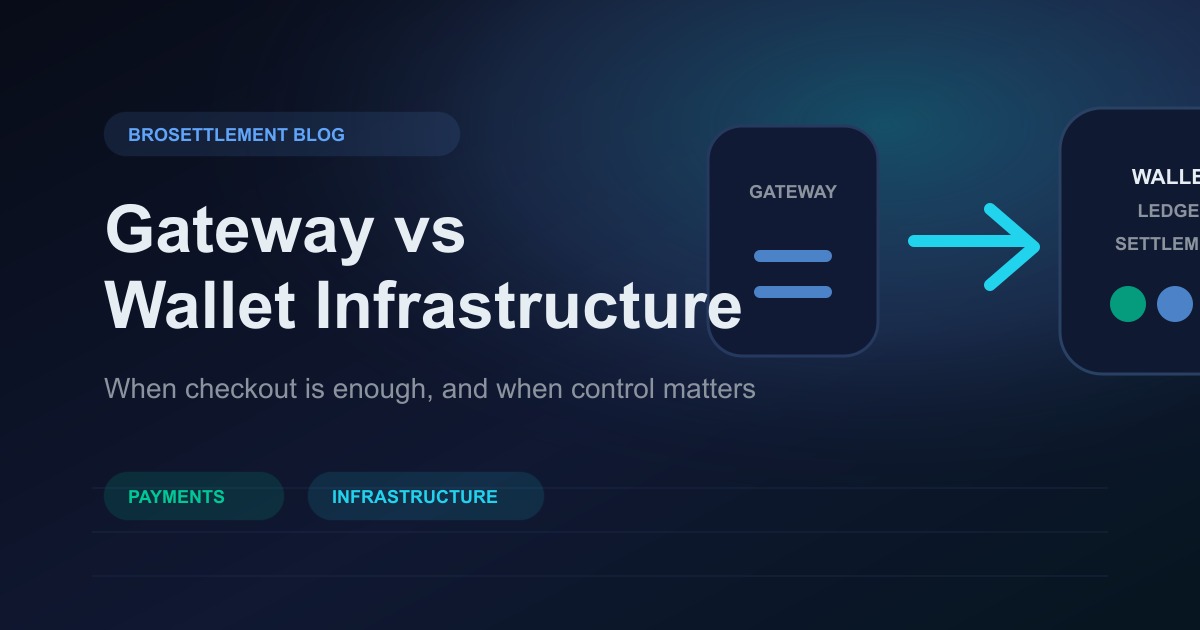
If you only need checkout, a gateway may be enough
A crypto payment gateway alternative is not just a naming question. For an iGaming operator, it is a control question: are you accepting a payment, or are you operating deposits, balances, withdrawals, treasury movement, and reconciliation?
A gateway can be the right choice when the scenario is simple. A user pays once, the provider confirms the transaction, the product grants access or delivers the service, and payment history has limited impact on daily operations.
In that case, the main questions are straightforward:
- which assets and networks are supported;
- how quickly payment status arrives;
- what the transaction costs;
- how refunds or errors are handled;
- whether webhook events are enough for checkout.
For some products, that is genuinely sufficient. Not every team needs to build wallet infrastructure. Not every crypto payment flow needs its own operating ledger.
The problem starts when an iGaming team calls something "checkout" even though it is really wallet operations.
iGaming rarely stops at payment acceptance
In a casino, sportsbook, or betting platform, a crypto deposit does not end when the on-chain transaction is confirmed. That is only the start of the internal operating cycle.
The system still needs to know:
- how the deposit connects to a player or account;
- when the balance can be updated;
- what the cashier sees;
- what support sees;
- how finance will reconcile later;
- whether suspicious activity needs manual review;
- how treasury will move assets;
- what happens if the player immediately requests a withdrawal.
This is no longer just a gateway problem. It is operational infrastructure.
If these pieces are split across a gateway, an internal database, manual spreadsheets, a support panel, and a few scripts, the team quickly gets a black-box flow. Each individual piece may work, but the full history of a deposit, balance update, withdrawal, and treasury movement does not come together into one trustworthy picture.
That is why the better iGaming question is not "which provider accepts crypto?" It is "who controls the wallet, ledger, and settlement layer?"
What a standard gateway usually does not solve
A crypto payment gateway often handles payment acceptance well. But an operator may need more.
Player-level deposit addresses
If addresses are created, reused, or mapped in opaque ways, support and finance can quickly lose context. In iGaming, it is important to know not only that a transaction arrived, but who it belongs to and which internal balance it should change.
Operating records
A player balance should not be just a number in a table. It should be the result of a sequence of events: deposit, bonus, adjustment, wager, settlement, reversal, withdrawal. Without an operating journal, the team sees the current state but cannot always explain how it got there.
Withdrawals and approval logic
A withdrawal is not the mirror image of a deposit. It needs limits, roles, manual review, statuses, treasury checks, and an audit trail. If the withdrawal flow lives separately from deposits and balances, the team creates a risk zone.
Real-time events
Cashier, back office, and support teams cannot wait for manual reconciliation. They need events for deposit detected, confirmations, credited balance, withdrawal requested, withdrawal approved, sent, and failed. Without this, the product can feel unstable even when the on-chain part works.
Reconciliation
Finance needs to connect on-chain movement, internal balances, fee logic, treasury transfers, and payout history. If these data points live in different systems, reconciliation becomes manual work instead of operational discipline.
When a gateway is enough
A gateway may be enough if your team:
- accepts one-off payments instead of maintaining player wallet balances;
- does not need its own journal of balance changes;
- does not run complex withdrawals;
- does not have treasury workflows above deposits;
- can work with a limited set of statuses;
- does not need deep reconciliation between on-chain transactions and internal balances.
In this scenario, a gateway gives speed. It helps the team test demand, reduce integration work, and avoid building an unnecessary operating layer.
That is a valid choice when the business model is truly simple.
When wallet infrastructure is needed
Wallet infrastructure becomes necessary when crypto payments become part of the product and finance core.
The signs are clear:
- You maintain balances at player or account level.
- Deposits need to update internal product state.
- Withdrawals need controls, approval flows, and statuses.
- Support needs to see the full operation history.
- Finance needs regular reconciliation.
- Treasury needs to manage assets after deposit.
- Product needs real-time events.
- The CTO does not want to stitch wallet operations together with temporary scripts.
At that point, the gateway is no longer the center of the system. It may remain part of the payment flow, but operational control belongs in infrastructure: wallets, ledger, settlement, events, roles, and audit trail.
Where BroSettlement fits
BroSettlement is built for teams that need control over crypto operations, not just a button that accepts payment.
It should be viewed as API-first wallet, ledger, and settlement infrastructure for iGaming and crypto-native SMB teams that want to launch deposits, withdrawals, balances, and reconciliation without building the whole operating layer from scratch.
This does not mean gateways are always wrong. If all you need is checkout, a gateway may be the simplest path. But if you are responsible for player funds, statuses, support operations, treasury, and financial history, you need a different category of tool.
The right pre-launch question is: "are we just accepting crypto, or are we responsible for wallet operations?"
Practical checklist
Before choosing a crypto payment gateway alternative, walk through this checklist.
- Does the product have a player balance?
- Do you need to assign a deposit address to a player or account?
- Does support need to see the full operation status?
- Are there rules for withdrawals and manual review?
- Do you need real-time WebSocket or API events?
- Does finance need regular reconciliation?
- Is there treasury movement after deposit?
- Can you explain the balance history without a manual spreadsheet?
If most answers are "no," a gateway may be enough. If most answers are "yes," you are not looking for just a gateway. You are looking for wallet, ledger, and settlement infrastructure.
Compare your current gateway flow with a wallet + ledger + settlement flow before launch. At this stage, architecture is still easy to correct. After the first deposit spike, it stops being a UX issue and becomes an operating risk.