You're usually handed a crypto neobank stack when the surface looks simple and the operating reality is already messy. One team owns wallet logic, another owns card issuing, a third owns a spreadsheet for reconciliation, and compliance is still asking who approved yesterday's payout.
That's the wrong starting point. The question to ask is what the stack has to absorb, who can stop money moving, who can explain what happened later, and where the legal claim sits when something fails.
A useful mental model is to treat the whole system as infrastructure, not branding. That means looking at onboarding, funding, on-ramp, wallet control, event streams, cards, fiat rails, ledgering, and policy enforcement as one chain of custody. If you want a useful parallel for how teams think about elastic infrastructure, Beam's piece on scaling inference workloads automatically is a good reminder that orchestration only works when the control plane and execution layer are designed together.
Table of Contents
- Why Crypto Neobank Infrastructure Breaks Before It Scales
- Defining a Crypto Neobank Without the Marketing Spin
- Core Services Every Crypto Neobank Stack Has to Deliver
- MPC Wallets, Co-Signer, and the 2-of-3 Control Model
- Deposits, Events, and the Ledger That Reconciles Everything
- Compliance, Liability, and the Risks a Crypto Neobank Cannot Outsource
- Choosing Integration Paths for Builders and Operators
- Questions Buyers and Operators Ask Before Signing
Why Crypto Neobank Infrastructure Breaks Before It Scales
The common failure mode is vendor sprawl with no shared truth. A founder signs one wallet vendor, one issuer, one compliance tool, and one off-ramp provider, then discovers that none of them agree on what a “successful” payout means. Finance sees balances, compliance sees flags, and engineering sees events that don't line up with either.
That's why the market can have plenty of consumer apps and still have very few honest operating models. A crypto neobank is not just a mobile app with a stablecoin badge. It's a system that has to move value, preserve evidence, and survive audit without making operations manually stitch together every exception.
Practical rule: if you can't explain who owns the key, who screens the transfer, who updates the ledger, and who can freeze a session, the stack isn't ready for volume.
The reader should walk away with three things. First, a defensible definition of the stack. Second, the control points that matter under review. Third, a way to judge modular integration against full-stack integration without falling for feature checklists.
The best operators stop comparing glossy interfaces and start comparing failure paths. They ask what happens when an address is wrong, a chain is congested, an issuer is frozen, or a payout is approved by the wrong role. That's the level where infrastructure either holds together or falls apart.
Defining a Crypto Neobank Without the Marketing Spin
A crypto neobank is a digital-first financial application whose balances, transfers, and cards are denominated in or settled through crypto assets, most often stablecoins. That sounds simple until you separate the legal claims involved. A bank deposit, a payment stablecoin balance, a custodial crypto balance, and a self-custody wallet are not the same thing, and users shouldn't be left guessing which one they hold.
The operational point is straightforward.
The customer experience resembles digital banking, but the settlement rail is on-chain, and the redemption counterparty is rarely a deposit-insured institution.
That distinction matters because digital banking expectations already exist. There are more than 450 digital-only banks active worldwide, up from fewer than 150 in 2018, and the United States accounted for more than 27% of global neobank users in 2024, with over 45 million active customers (industry market report). Customers now expect remote onboarding, app-based account control, instant alerts, and card-linked spending as baseline behavior, not innovation.
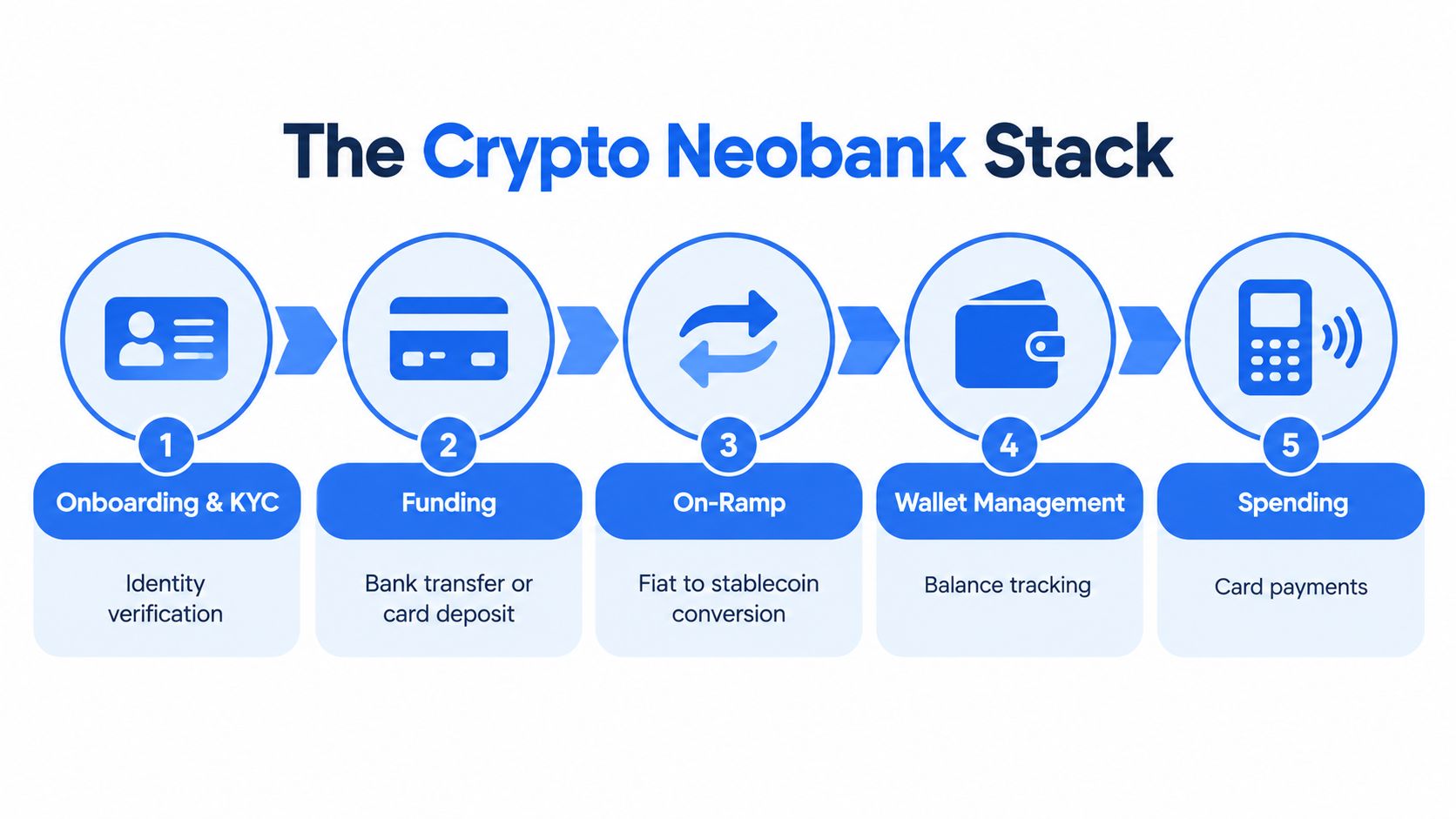
A clean definition also forces the right architecture conversation. If the user thinks they have one account, then onboarding, funding, on-ramp, wallet management, cards, and payout all need to behave like one pipeline internally. Finance, risk, and compliance can't be reading different books of record and pretending the customer experience is unified.
For teams evaluating a platform like BroLabel's neobank use case, that means the question is never just “does it support USDT?” The better question is whether the components that produce a customer balance also produce a defensible liability map.
Core Services Every Crypto Neobank Stack Has to Deliver
The stack only works when each stage has a control purpose, not just a product label. Onboarding and KYC establish identity. Funding brings value in through bank transfer or card. The on-ramp converts fiat into a stablecoin balance. Wallet management tracks ownership and available balance. Card issuing turns that balance into spendable payment power. Off-ramp returns value to fiat. Event streaming tells the rest of the business what just happened.
Treat every stage as a control surface
The on-ramp is not only a conversion service. It's a fiat-payment compliance boundary. The wallet address is not just a destination. It's a per-user or per-agent attribution point. The card authorization is not just a charge decision. It's also a sanctions, velocity, and balance check that has to reconcile later with the ledger.
That becomes non-optional at scale because stablecoins are no longer a niche rail. A 2024 industry report estimated that stablecoin transaction volume exceeded $450 billion per month, and that on-chain stablecoin payment volume reached approximately $1.87 trillion in Q4 2024, compared with Visa's $3.52 trillion for the same period (report). Those figures need context, because transaction volume can include transfers and trading-related activity, but the scale still explains why this can't be handled like a side feature.
What a vendor answer should include
- Key ownership: who controls the signing policy, and whether the customer, the company, or a co-signer enforces it.
- Screening responsibility: who screens deposits, withdrawals, and card activity at the asset-and-network layer.
- Ledger authority: where the operating ledger lives, and whether finance can reconcile it without CSV surgery.
- Revocation power: who can revoke a session, hold a payout, or quarantine an incoming transfer.
- Evidence trail: whether approvals, policy outcomes, and access changes are recorded in a way compliance can use.
A real stack answers those questions before anyone brings up supported tokens. For builders comparing infrastructure paths, the useful test is whether the platform can behave like one operating system across wallets, cards, fiat, and events, not whether it can display a balance in an app.
MPC Wallets, Co-Signer, and the 2-of-3 Control Model
Threshold signing is where a lot of vendors hide behind jargon. NIST's framing is cleaner: secure multiparty computation lets multiple parties jointly perform a computation while keeping private inputs undisclosed to one another (NIST threshold cryptography). Applied to wallets, that means the signing flow itself is distributed. It's not a glorified vault.
A Co-Signer pattern usually means two parties must approve a signature while the full private key is never reconstructed during normal operation. That changes the control discussion from “where is the key stored?” to “what policy decides whether a signature may happen?” NIST also distinguishes the participation threshold from the corruption threshold, which is the part teams often skip.
A 2-of-3 policy is only meaningful if both of these are explicit. One part says how many signers are required. The other says how many compromised participants the system is designed to tolerate (NIST threshold schemes). If those aren't written down, the policy is theater.
The practical signing flow needs more than math. It has to capture authenticated intent, role-based approval, velocity checks, balance checks, and a tamper-evident record of the decision. If the compliance team can't reconstruct who authorized a withdrawal and why it cleared, MPC hasn't solved the governance problem, it's just moved it into a more technical layer.
For teams exploring co-signer responsibilities, the takeaway is simple. Threshold signing is a control architecture. It reduces unilateral key compromise, but it does not remove the need for authorization policy, recovery rules, or auditability.
Deposits, Events, and the Ledger That Reconciles Everything
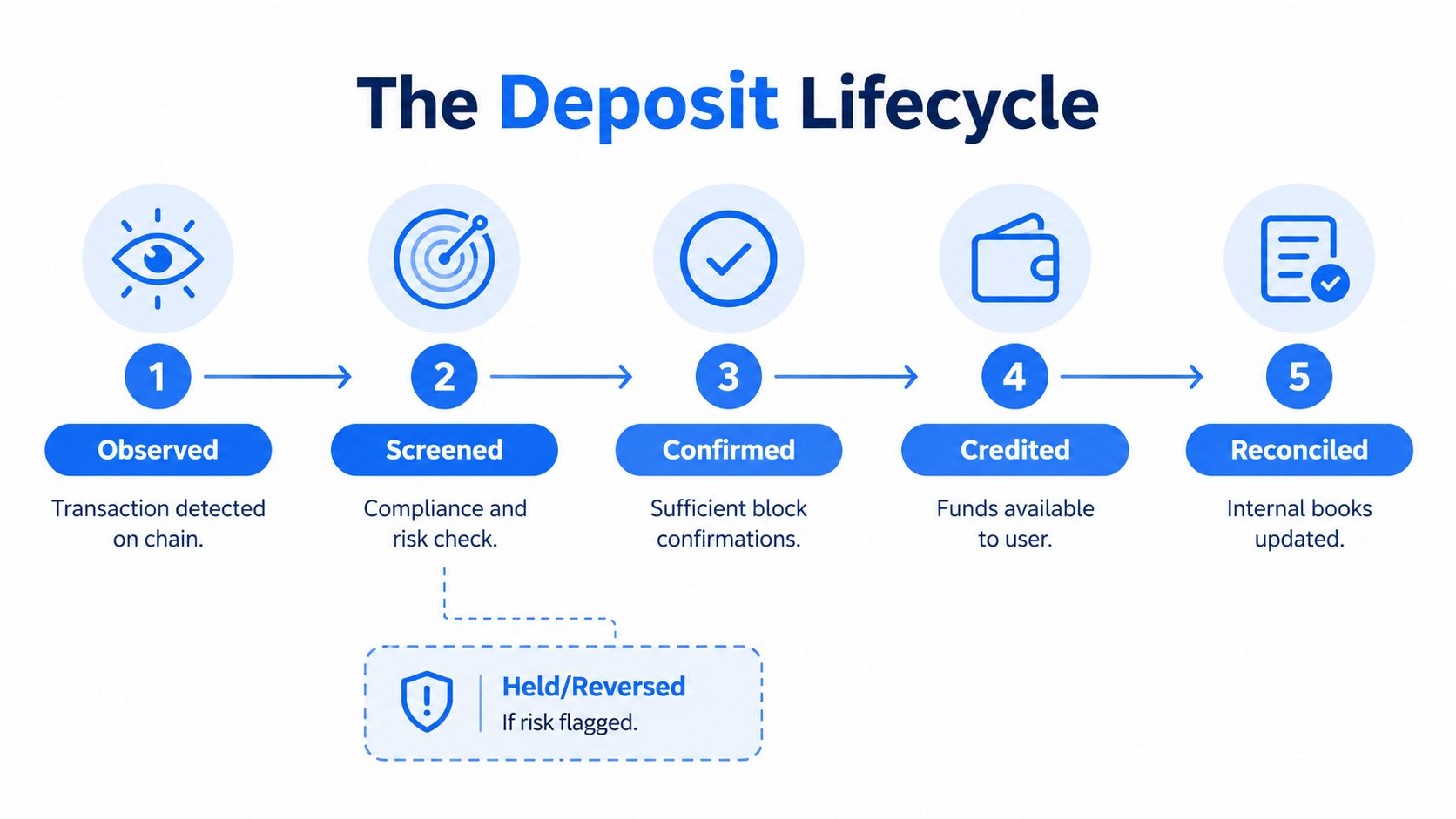
A deposit path needs to behave like a state machine, not a fire-and-forget alert. The transfer is observed, then screened, then confirmed, then credited, and only after that fully reconciled. If risk flags the transaction, the state can be held or reversed. That separation keeps the accounting ledger defensible.
Scale makes shortcuts expensive. Chainalysis measured USDT monthly transaction volume at roughly $703 billion between June 2024 and June 2025, with a peak of $1.01 trillion in June 2025 (Chainalysis). At that level, a loose deposit model turns into a reconciliation problem fast.
What each state needs to record
- Observed: transaction hash, network, asset contract, and timestamp.
- Screened: risk outcome, sanctions outcome, and any case link.
- Confirmed: block height and network-specific confirmation evidence.
- Credited: accounting posting and the balance made available to the user.
- Reconciled: internal ledger entry, exception status, and final audit trail.
Confirmation rules also vary by chain. Finality, reorg risk, fee behavior, and token-contract behavior are not the same across Bitcoin, Ethereum-compatible chains, Tron, and Solana. A deposit on one network may need a different trust threshold from the same asset on another, and the ledger has to preserve that distinction.
WebSocket feeds help because they cut polling latency, but event delivery still needs replay protection, sequence handling, and periodic chain-to-ledger reconciliation. A consumer that trusts one event and ignores the next can create phantom balance, duplicate credit, or missing hold logic quickly.
For operational use, the payout policy should also validate address ownership, token standard, memo requirements, and route eligibility before signing is even considered. The audit workflow process shows how those checks map to durable case records.
Compliance, Liability, and the Risks a Crypto Neobank Cannot Outsource
Wallet encryption and threshold signing don't solve the AML and financial-integrity obligations that come with permissionless settlement. The BIS notes that stablecoins circulate across permissionless blockchains, exchanges, and self-hosted wallets, and that pseudonymity and unhosted-wallet use can weaken KYC and AML/CFT controls (BIS). That means the control surface has to move down to the asset-and-network layer.
The screening model has to be wider than customer identity
Screening needs to evaluate source and destination addresses, exposure to sanctioned or high-risk entities, rapid layering patterns, peel chains, contract interactions, and cross-chain movement. Customer identity still matters, but it's not enough on its own. A clean KYC record doesn't make a suspicious wallet path safe.
The ledger model matters just as much. Observation and crediting should stay separate, and crediting should stay separate from payout authorization. That lets risk policy hold, reject, or escalate funds without corrupting the books. MPC can reduce unilateral key compromise, but it does not replace authorization policy or incident discipline.
PCI DSS gives a useful benchmark for evidence handling, since audit-log history must be retained for at least 12 months, with the most recent three months immediately available for analysis (PCI DSS v4.0). For a crypto neobank, that's the floor for a serious operating ledger and Co-Signer workflow, not a nice-to-have.
For teams hiring around this layer, the crypto compliance jobs guide is a practical reminder that policy work is now an operating function, not a side task. The people in that seat need case links, durable policy outcomes, and logs they can trust when something goes wrong.
The incident list is familiar, even if the rails are newer. Licensed-bank dependencies can fail. Stablecoins can depeg. Chains can congest. Issuers can freeze. Broadcasts can go out wrong. Durable controls turn those events into auditable states, not support tickets with no owner.
Choosing Integration Paths for Builders and Operators
There are two sane integration postures. The first is modular, where a team uses wallets now and adds ledger, cards, and fiat later. The second is full-stack, where wallets, broadcast, ledger, cards, and fiat sit under one API from day one.
Modular integration makes sense when the company already owns the ledger and reconciliation layer. That path keeps control where the engineering team can already see it, and it works well when multiple internal systems need to remain separate. The trade-off is that evidence lives in more places, so finance and compliance carry more integration burden.
Full-stack integration fits teams that can't afford reconciliation gaps or a second integration cycle. A client-controlled Co-Signer and unified operating ledger matter here because the operator wants fewer seams between policy, movement, and accounting. The trade-off is obvious, you accept more platform dependency in exchange for a cleaner control plane.
| Dimension | Modular integration | Full-stack integration |
|---|---|---|
| Control ownership | Split across internal systems and vendors | Centralized through one operating surface |
| Evidence burden | Higher, because reconciliation spans more tools | Lower, because events and ledger live together |
| Time-to-pilot | Often quicker if wallet logic already exists | Often quicker if the team wants one coherent path |
The decision rule is practical. Choose modular if ledger and reconciliation are already owned in-house. Choose full-stack if the priority is shipping before volume is predictable and avoiding an integration reset later. BroLabel is one option in that latter category, since it combines embedded MPC wallets, an operating ledger, real-time events, cards, and fiat integrations in one API surface.
Questions Buyers and Operators Ask Before Signing
What does the customer actually own?
That's the first question because it changes everything else. The customer might hold a deposit claim, a stablecoin redemption right against an issuer, or just an operational balance on a ledger. Those are different legal claims with different counterparties if something fails.
Stronger stablecoin reserve rules can improve payment safety without turning a crypto neobank into a deposit-insured bank. That's why the right diligence artifact is a liability map, not a marketing page. If insolvency, suspension, or a chain outage occurs, the buyer needs to know who owes redemption and under which regime.
Does on-chain finality mean customer finality?
No. On-chain settlement can be irreversible while the surrounding bank, compliance, or redemption path remains conditional. Licensed banks, money-transmission licensing, sanctions checks, and fiat off-ramp availability can all interrupt the customer experience even after a transaction has landed on-chain.
That's the failure pattern many teams underestimate. A payment can be technically confirmed and still be operationally incomplete. The vendor should be able to describe where the payout can fail, who sees it first, and who bears the loss when it does.
How is MPC custody different from self-custody?
MPC changes who can move funds, not whether the operator has responsibility. The customer still gets recovery options through policy, but the operator remains the entity that enforces approvals, records access changes, and answers to audit. That's why the signing workflow has to be auditable, not just cryptographically distributed.
Ask the vendor who can revoke a session, who can override a hold, and what evidence survives the override.
What should I ask about regulatory scope?
Ask how the platform handles MiCA in the EU and the separate, still-developing U.S. and U.K. approaches to stablecoins, issuers, and intermediaries. Those regimes aren't interchangeable. If a vendor can't explain the jurisdictional split in plain language, the diligence isn't done.
The final vendor call should leave you with one answer per risk. What is the customer claim, where can settlement fail, who can sign, who can freeze, and what proof survives the incident. If those answers are vague, the stack isn't ready.
BroLabel builds embedded MPC wallet infrastructure, an operating ledger, real-time events, card issuing, and fiat integrations for crypto neobanks that need controls before volume is predictable. If you're designing around wallets, reconciliation, and policy enforcement instead of just app screens, visit BroLabel and evaluate whether the stack fits your operating model.