A finance lead at a cross-border payroll company can have a successful engineering launch and still face a failed payment operation at month-end. Three confirmed transactions may not match the on-chain ledger, two customers may be credited twice after webhook replays, and an off-ramp may return only 92% of expected fiat without itemized reason codes. The checkout worked. The financial system did not.
That gap separates a sandbox integration from production infrastructure. A crypto payment API isn't merely an address generator or a checkout button. Once treasury funds move through it, the API becomes an event-driven ledger input responsible for custody decisions, settlement truth, compliance evidence, and operational recovery.
Stablecoin payments are already used in enterprise settlement, payroll, remittances, and cross-border business flows. McKinsey and Artemis estimate actual stablecoin payments at about $390 billion in 2025, with business-to-business transfers representing $226 billion, while actual payment volume more than doubled from 2024 to 2025. McKinsey's stablecoin payment analysis also places this activity at only 0.02% of global payments, which means the rail is meaningful but still operationally immature.
The enemy is demo thinking. It treats a successful HTTP response as proof that money moved correctly. This guide takes the opposite view, mapping the API surface to custody, event semantics, fee anatomy, chain routing, reconciliation, and provider controls. The practical lesson is simple: select the system that can explain every balance, callback, signature, and settlement outcome after launch, not the system with the most attractive sandbox.
Table of Contents
- The Reconciliation Gap That Breaks Crypto Payment Launches
- What a Crypto Payment API Actually Does in Production
- Custody Models and Why MPC Changes the Decision
- On-Ramp, Off-Ramp, and the Full Settlement Flow
- Webhooks, Idempotency, and the Append-Only Ledger
- Compliance Controls Built Into the API Surface
- How to Evaluate a Crypto Payment API Provider
- Institutional Checklist and What to Do Next
The Reconciliation Gap That Breaks Crypto Payment Launches
The finance lead in this scenario doesn't have a checkout problem. Customers paid, blockchain transactions exist, and the provider dashboard shows completed activity. The problem appears when the team tries to close the books and discovers that the customer record, provider report, bank statement, and on-chain ledger disagree.
An engineering team often builds the visible flow first:
- Create an order.
- Generate a payment address.
- Wait for confirmation.
- Mark the order paid.
- Withdraw funds.
That sequence looks complete until a webhook arrives twice, a transaction confirms after a timeout, a customer sends the right asset on the wrong network, or the off-ramp deducts costs that never appear in the original quote. Finance then has to reconstruct the truth from logs, explorer pages, provider exports, and bank entries.
Practical rule: A payment isn't reconciled because it reached “confirmed.” It's reconciled when the internal order, on-chain transaction, provider settlement, fees, and bank movement all match under one durable reference.
A production operating model needs a separate record for the expected amount, received amount, asset, network, transaction hash, confirmation timestamp, fee, settlement status, and internal order reference. The provider should expose those fields through a ledger or reconciliation surface, not leave finance to scrape a dashboard. The BroLabel reconciliation API reference illustrates the type of resource a technical and finance team should demand during evaluation.
The API also needs explicit treatment for refunds, expiries, partial payments, overpayments, stuck transactions, and reversed fiat settlements. These aren't exceptional edge cases once the system processes real business flows. They are states that require ownership, timestamps, reason codes, and a controlled next action.
The rest of the architecture follows from this gap. Custody determines who can move funds. Event semantics determine when the system changes state. Fee anatomy determines why the received amount differs from the quoted amount. Chain routing determines which networks and tokens the business can safely support. Provider evaluation determines whether those controls remain available when volume, scrutiny, and failure conditions increase.
What a Crypto Payment API Actually Does in Production
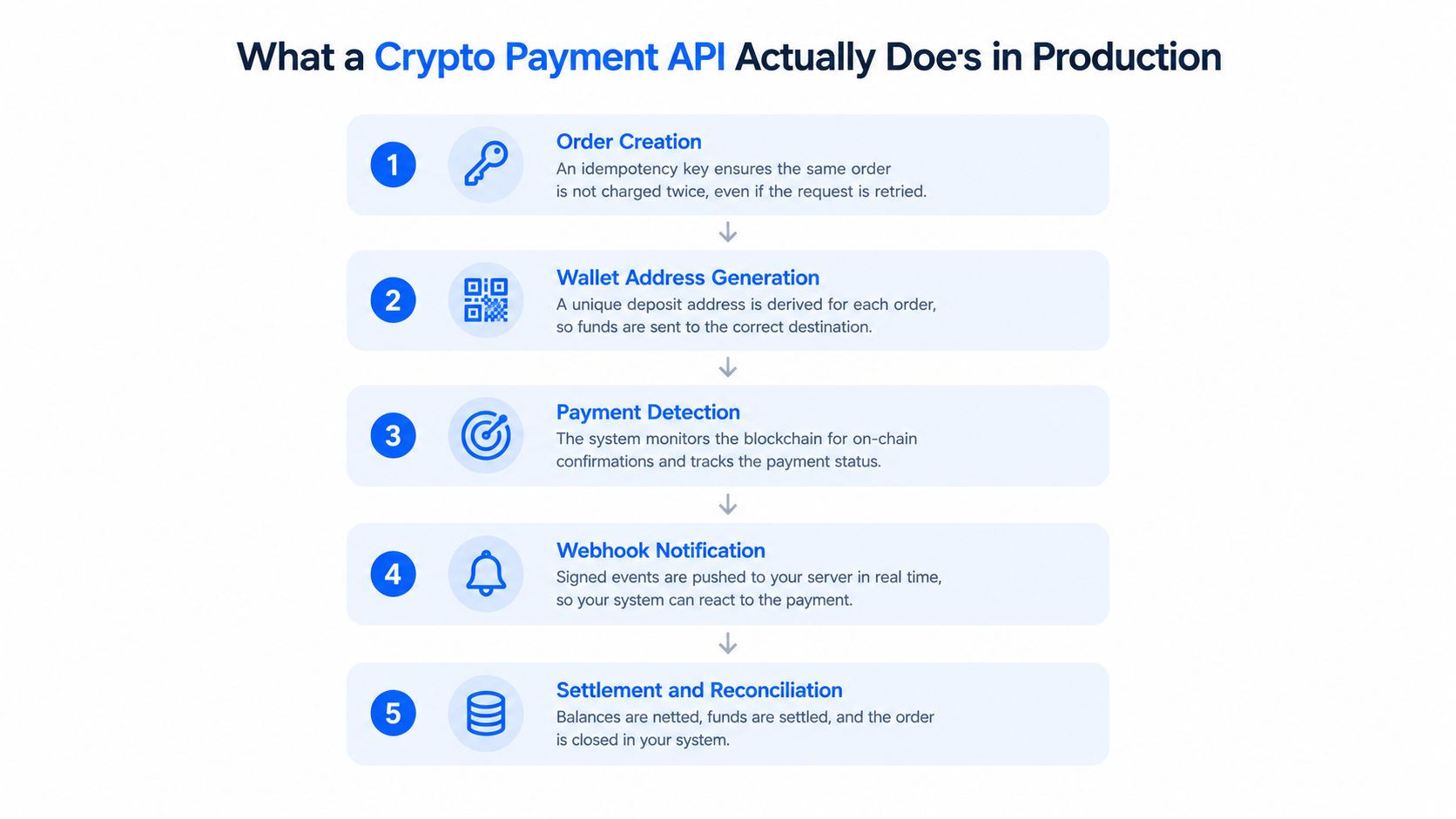
A production crypto payment API performs five connected operations. The synchronous request creates intent, but the chain and event stream establish what happened.
The five operational responsibilities
Order creation starts with a merchant order and an idempotency key. If the client retries because of a timeout, the provider must return the original order rather than create a second financial obligation.
Address or wallet generation creates a payment object tied to that order, customer, player, or agent. The address scope matters because shared addresses make attribution and reconciliation harder.
On-chain observation watches for the expected asset and network, detects the transaction, and tracks confirmation progress. The service must distinguish an observed transfer from a transfer that meets the merchant's settlement policy.
Event emission sends signed callbacks as the payment changes state. Webhooks should carry an event identifier, payment identifier, state, timestamp, and transaction reference so the merchant can verify and process the event deterministically.
Final settlement moves funds to a treasury, merchant wallet, or off-ramp destination. It also records the net amount and the fees that explain the difference between gross receipt and settled value.
Supporting endpoints complete the operating surface. Buyers should look for quote retrieval, fee estimation, refund issuance, transaction lookup, balance queries, settlement confirmations, and ledger exports. A provider that offers only invoice creation and address generation is exposing a checkout component, not a complete payment system.
The API should abstract technical complexity where abstraction is safe, including chain selection, gas estimation, token normalization, and confirmation policy. It shouldn't hide the evidence finance and compliance teams need to audit the result.
Treating the HTTP response as the source of truth creates orphaned orders and lost payments. The request says what the merchant intended. The event stream and ledger say what the network and settlement system really did.
Custody Models and Why MPC Changes the Decision
Custody is the first vendor question because it determines who controls the private key and who carries the consequences of compromise, insider theft, signing error, or regulatory failure.
| Dimension | Custodial | Non-Custodial (Single Key) | MPC / Threshold |
|---|---|---|---|
| Key control | Provider holds or controls signing authority | Operator holds a complete private key | Key material is split across parties or devices |
| Main failure risk | Counterparty failure, account restrictions, segregation risk | Single-key theft, loss, or insider misuse | Coordination failure, policy misconfiguration, or signer availability |
| Integration effort | Lower | Higher | Moderate, with API-managed signing flows |
| Governance | Provider policies dominate | Operator must build approval controls | Shared governance and policy-based signing |
| Compliance posture | Can align with a licensed custodian model | Operator carries direct control obligations | Supports institutional control with auditable approvals |
| Best fit | Teams prioritizing managed operations | Teams requiring direct sovereignty and strong internal controls | Teams needing controlled self-custody and operational separation |
A custodial API can shorten implementation, but the business must understand where funds are held, how assets are segregated, what happens during an account restriction, and which entity carries the relevant licensing responsibilities. A single-key design offers sovereignty but concentrates technical and operational risk in one secret.
MPC threshold signing changes that concentration. The complete key never exists in one place, while authorized parties or signing devices collaborate to approve a transaction. This supports a client-controlled Co-Signer, role-based approvals, allowlists, spending policies, and audit trails without handing the provider unilateral control.
Teams that need a practical primer can find crypto custody card guides before comparing provider architectures. The important question isn't whether a vendor uses the word MPC. Ask how many signing parties exist, who operates each one, where the Co-Signer runs, what happens when a signer is unavailable, and whether a policy decision is recorded before broadcast.
An institutional API can expose wallets, deposits, transfers, and balances over REST while retaining threshold signing underneath. Documentation for enterprise MPC wallet infrastructure shows support for signing across EVM, Tron, Bitcoin, and Solana, which matters when a payment stack requires both multi-chain acceptance and treasury movement. Enterprise MPC wallet infrastructure documentation provides a useful reference point for the capabilities buyers should inspect.
Custody constrains every downstream choice. It affects payout approvals, recovery procedures, compliance evidence, API permissions, and the degree to which finance can prove who authorized a movement of funds. For a deeper technical view, see the MPC wallet architecture overview.
On-Ramp, Off-Ramp, and the Full Settlement Flow
A usable crypto payment API must cover the full movement of value, not only the moment a token reaches a wallet. The cleanest architecture treats fiat entry, stablecoin movement, and fiat exit as one controlled settlement flow.
From customer fiat to merchant settlement
- Checkout begins. The customer pays by card or ACH, and the API creates an order with the currency, destination, expiry, and compliance context.
- The quote is locked or bounded. An on-ramp partner provides the conversion terms, including the asset, network, expected amount, spread, and applicable fees.
- Funds land in controlled custody. The resulting stablecoin balance reaches a custodial wallet or an MPC-held treasury wallet. The ledger records both the fiat instruction and the digital asset receipt.
- The merchant receives the asset. The API sends the stablecoin to a merchant address, using a chain route that matches the merchant's supported network and token policy.
- The business exits to fiat when needed. An off-ramp converts the balance and sends funds to a corporate bank account, while the API returns settlement status and itemized deductions.
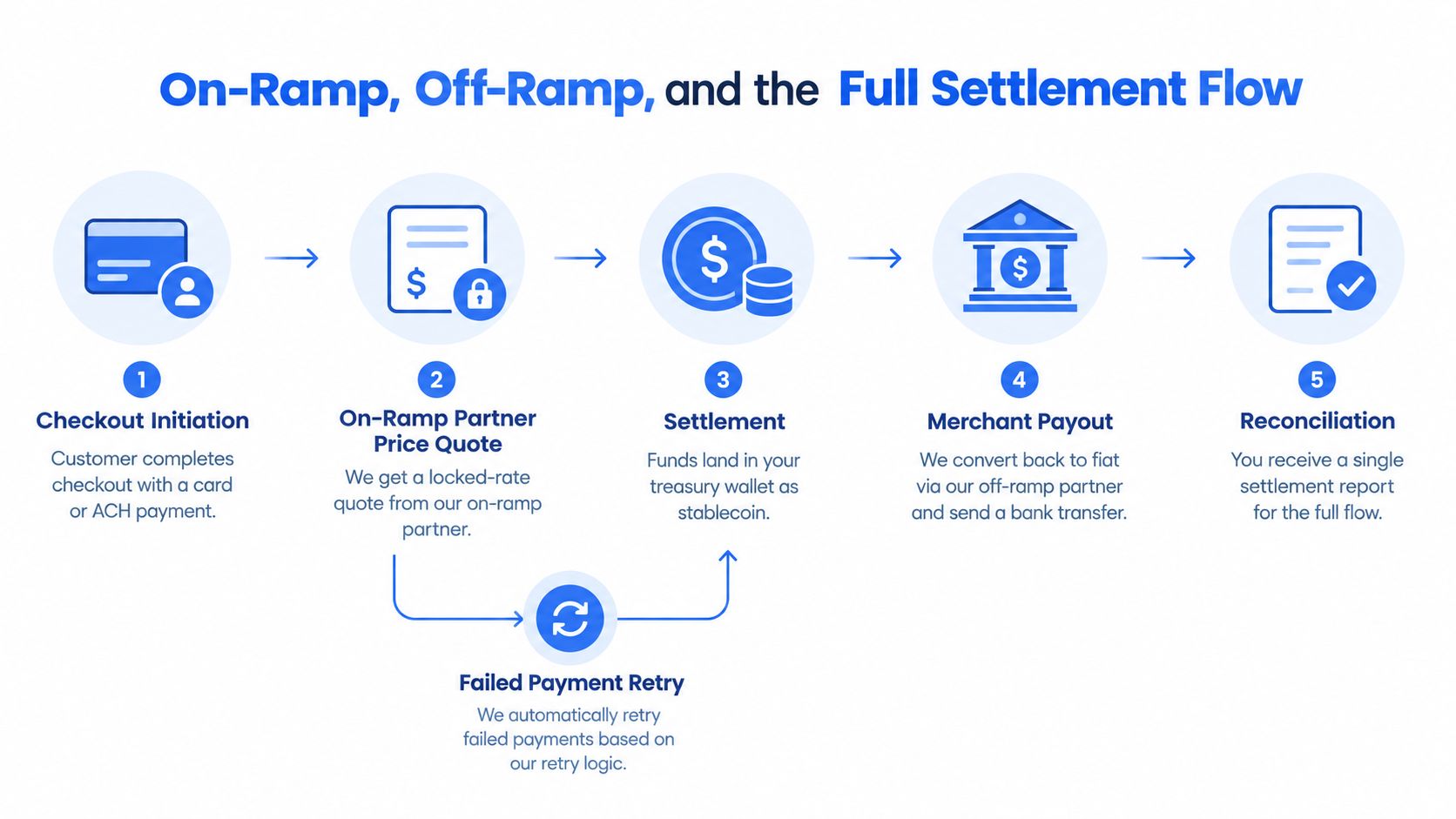
The provider should abstract chain selection and gas estimation, but it must expose the outcome. A finance lead needs to know whether the provider selected the intended network, whether gas was taken from the payment amount or a treasury balance, and whether slippage changed the net settlement. A failed card payment, expired quote, rejected address, or reversed off-ramp also needs a defined retry path.
The fiat-to-crypto API guide is relevant for teams designing this combined surface. Its value is not the label “on-ramp.” The value is connecting customer funding, wallet credit, token movement, payout, and reconciliation under one order reference.
A fragmented stack creates handoffs between the card processor, conversion provider, wallet service, blockchain broadcaster, bank partner, and accounting system. Each handoff introduces a new identifier and a new failure state. A unified API doesn't eliminate those counterparties, but it can normalize their events, preserve the transaction lineage, and return reason codes that support finance operations.
The hard problem is often the off-ramp, not acceptance. Industry analysis identifies the interoperability gap between wallet transfers and local fiat conversion as a central barrier, because conversion can involve several entities with separate KYB and AML obligations. Coverage of stablecoin payment interoperability and off-ramp complexity reinforces why buyers should evaluate settlement and reconciliation before adding another checkout option.
Webhooks, Idempotency, and the Append-Only Ledger
The payment state machine must be more reliable than the network connection between your application and the provider. A synchronous response can time out after the provider accepts a request. A webhook can arrive more than once. A chain can reorganize, a partner can pause withdrawals, and a customer can send an unexpected amount.
Make every state transition explicit
A useful state model separates:
- Pending, the order exists but no qualifying transfer has been observed.
- Paid, the expected transfer has been detected according to the provider's policy.
- Confirming, the transaction is progressing toward the required confirmation threshold.
- Confirmed, the network condition has been met.
- Settled, funds have moved to the configured treasury or payout destination.
- Reconciled, internal books, provider records, chain data, and bank movement agree.
- Refunded or expired, the order has ended without a normal settlement.
The merchant must not allow a late “pending” callback to overwrite “confirmed,” and it must not process the same payout twice because two identical events arrived. Every mutating request should carry an idempotency key generated from the merchant's durable business operation. Every webhook should carry a provider event identifier that the receiver stores before applying the state transition.
| Event | Payment State | Idempotency Key Source | Retry Policy |
|---|---|---|---|
payment.created |
Pending | Merchant order reference | Retry safely until accepted |
deposit.observed |
Paid or under review | Provider event ID plus transaction hash | Deduplicate, then reprocess if incomplete |
deposit.confirming |
Confirming | Provider event ID | Accept only forward state movement |
deposit.confirmed |
Confirmed | Provider event ID plus confirmation record | Retry until acknowledged |
settlement.completed |
Settled | Settlement instruction ID | Never create a second settlement |
payment.reconciled |
Reconciled | Reconciliation record ID | Reopen only through a controlled exception |
payment.refunded |
Refunded | Refund instruction ID | Permit one refund instruction per order |
Webhook signature verification comes before business processing. The handler should validate the signature, timestamp, event schema, and replay window, then write the raw event to durable storage. Only after that should it apply the transition and acknowledge delivery.
An append-only internal ledger preserves the sequence of facts. It shouldn't update one mutable balance and discard the underlying entries. Store the original event, the derived accounting entry, the transaction hash, fee components, and the person or policy that authorized any outgoing movement.
A webhook is an instruction to evaluate an event, not permission to trust an outcome without verification.
This design keeps reconciliation as a repeatable loop. The service compares expected orders with observed transfers, confirmed transactions with settlement instructions, and provider settlements with bank records. Polling can support recovery, but it shouldn't be the primary operating model.
Compliance Controls Built Into the API Surface
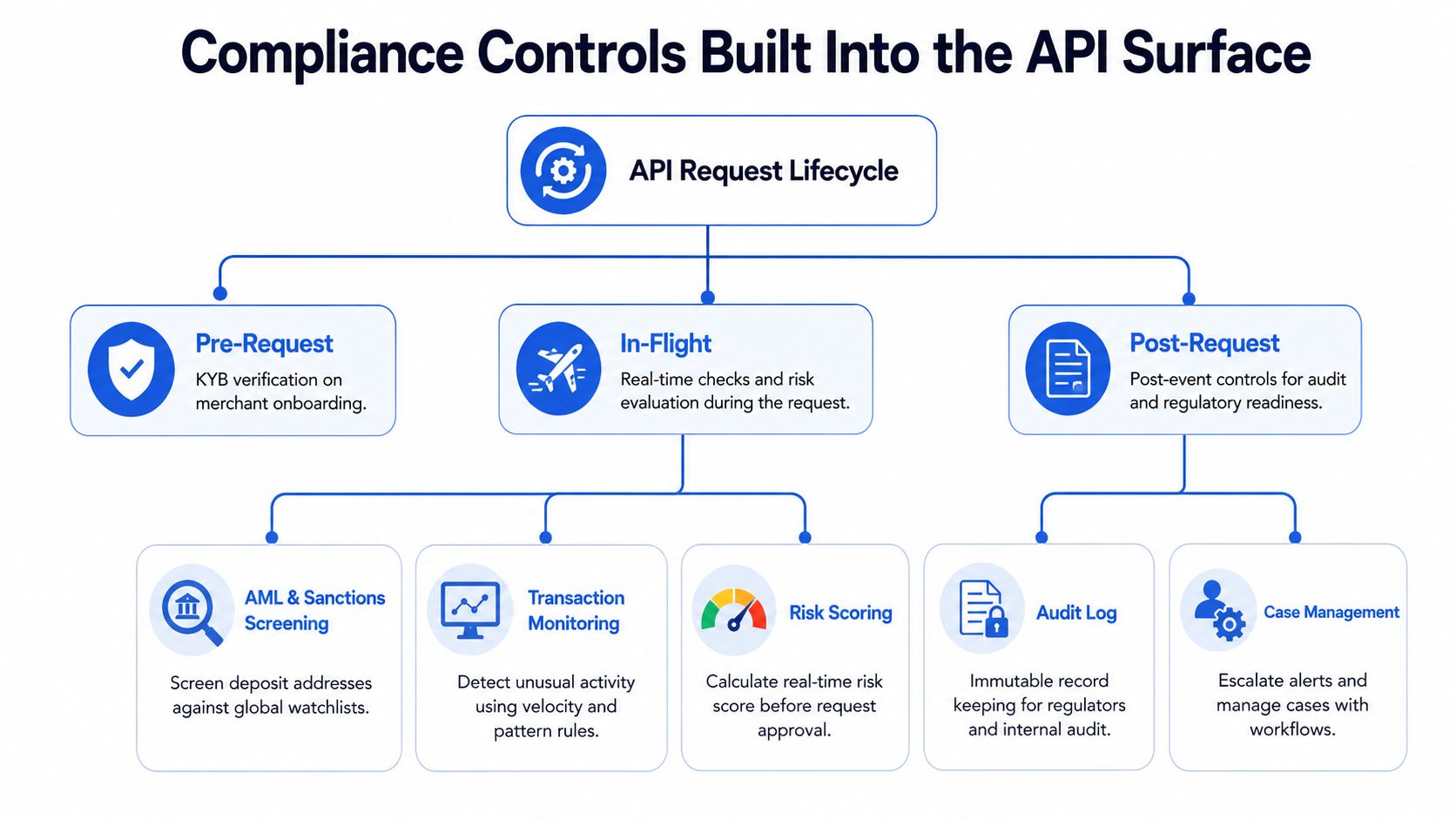
Compliance shouldn't sit in a PDF beside the API. It should appear in the request lifecycle, with an enforceable control at the point where risk enters or value moves.
Put controls at the decision points
Before the request, verify the merchant, user, beneficiary, geography, and permitted use case. KYB status should influence whether the API permits wallet creation, payout initiation, or settlement access.
During the request, screen deposit addresses and counterparties against sanctions and risk rules. Apply transaction monitoring to amount, velocity, destination, asset, network, and behavioral patterns. The policy engine should block or hold an instruction before a transaction reaches a signing queue.
At signing, require scoped permissions and approval policies. A read-only key shouldn't create withdrawals. A payout key shouldn't change an allowlist. A treasury transfer should require the appropriate role or Co-Signer, with the decision recorded for later review.
After broadcast, retain the signed payload, policy result, transaction hash, screening result, and event history. Post-request controls should create a case when an event fails reconciliation or a transaction enters an exception state.
Scoped API keys, RBAC, IP allowlists, replay protection, and Ed25519 request authentication reduce the blast radius of compromised application credentials. They don't replace transaction monitoring. They make it harder for a compromised integration to perform actions outside its intended role.
Travel Rule data belongs in the transfer payload and its associated case record, not in an unrelated manual process. The API should define sender, beneficiary, originating institution, destination institution, and status fields where the applicable jurisdiction requires them. Geo-fencing should be enforced at the endpoint or policy layer, so a blocked region can't be bypassed by calling a different product route.
Custody determines which controls are technically enforceable. A provider that holds unilateral signing authority can contractually promise a policy, but the customer may have limited ability to verify or enforce it. MPC with a client-controlled Co-Signer can make approval separation and allowlists part of the transaction path.
Legal interpretation still needs qualified counsel. Teams assessing the legal effects of GENIUS on stablecoins can use that resource to frame questions about issuer, custody, and payment-service responsibilities. The API should then translate the approved obligations into keys, fields, policies, and audit records.
How to Evaluate a Crypto Payment API Provider
Don't select a provider from a feature checklist. Score the operational evidence behind each feature.
Start with a weighted review. Give greater weight to chain support and reconciliation than to headline throughput claims. A system that processes requests quickly but can't explain a missing settlement will create more work for finance, support, and compliance.
| Evaluation Axis | Weight | What to Verify | Score (1-5) |
|---|---|---|---|
| Chain and token coverage | High | Named mainnets, native versus wrapped assets, confirmation policy, wrong-network handling | |
| Reconciliation tooling | High | Append-only ledger, exports, settlement confirmations, matching keys, exception workflow | |
| Custody and signing | High | Key ownership, MPC design, Co-Signer, approval policies, recovery process | |
| Fee transparency | High | Network fee, conversion spread, platform fee, payout fee, failed-transaction treatment | |
| Fiat integrations | Medium | ACH, SEPA, Faster Payments, cards, bank payout coverage, return handling | |
| Event reliability | Medium | Webhook signatures, WebSocket events, delivery retries, ordering, replay protection | |
| Latency and availability | Medium | Median and p99 latency for order creation, address generation, and event delivery | |
| Card and payout programs | Contextual | Card issuing, virtual and physical cards, wallet linkage, bulk payouts |
Ask for evidence rather than adjectives. Request a sample ledger export, webhook contract, fee schedule, chain matrix, signing-policy diagram, and incident runbook. Test what happens when an order request is retried, a transaction is reorged, a destination address is blocked, or an off-ramp returns less than the quoted amount.
A finance lead and architect can complete the scorecard in an afternoon if the provider supplies test credentials and representative payloads. During the review, include the modules that will own the operating flow: BroSettlement for DKG/MPC 2-of-3 signing and network broadcast, BroWallet for wallet and fiat operations, AI Agent Wallets for per-agent controls, the client-controlled Co-Signer, MPC policy enforcement, and WebSocket events for real-time deposits, confirmations, withdrawals, and policy outcomes.
Ask these procurement questions directly:
- Who holds each signing share?
- What happens during a chain reorganization?
- How are orphan transactions reversed?
- Which fees appear before authorization?
- Does the SLA cover economic loss or only service availability?
- Can finance export the exact records needed for the general ledger?
- Can compliance place a hold before broadcast?
- Can the business change providers without losing ledger history?
The provider that answers these questions clearly is more valuable than one that leads with a large list of supported assets.
Institutional Checklist and What to Do Next
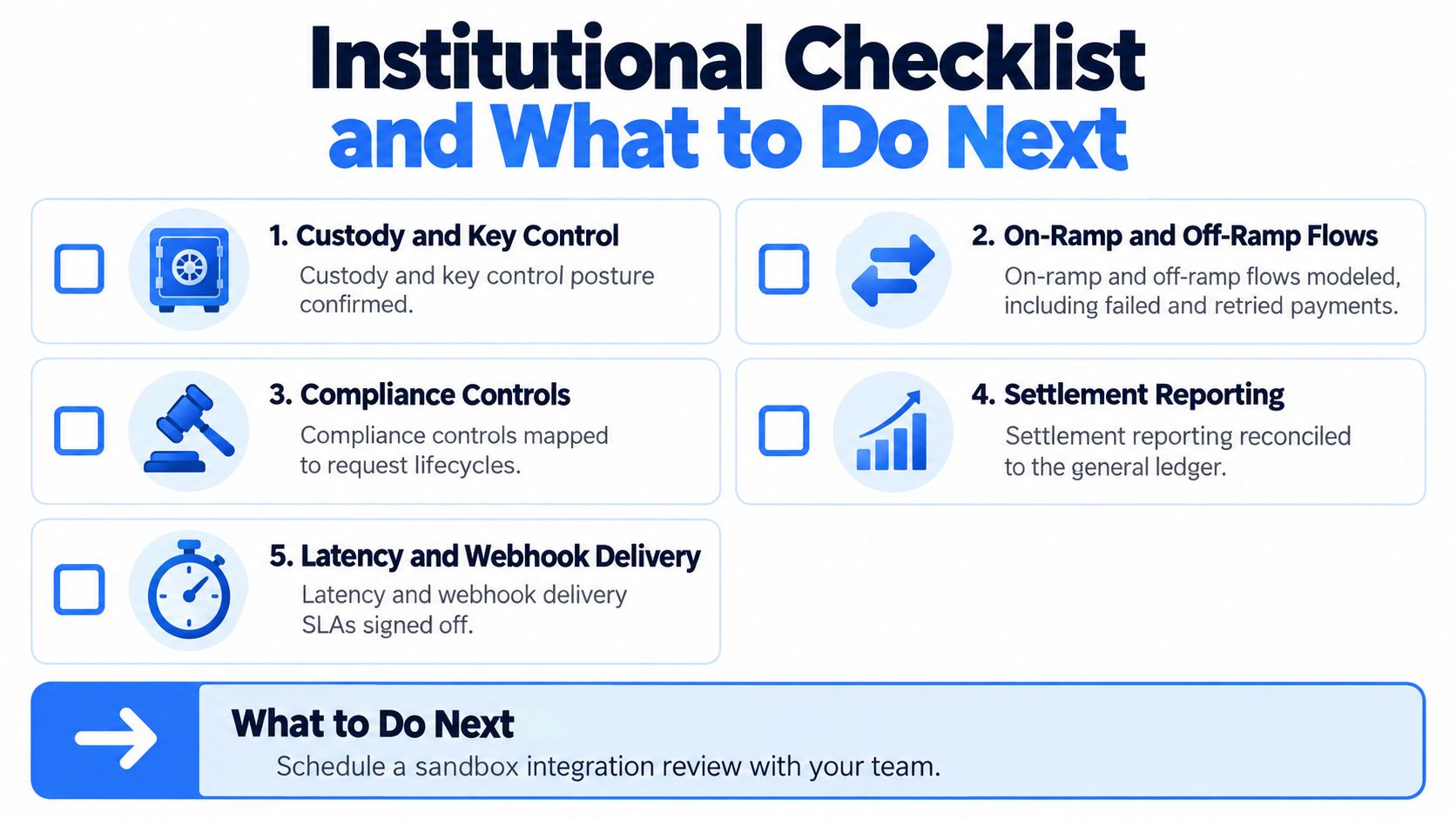
Before go-live, finance, engineering, product, operations, and compliance should sign off on the same control document. The checklist below is short by design, but each item should point to a test, owner, and recovery procedure.
- Confirm custody and key control: Document the custodial, single-key, or MPC design, identify every signing party, test the Co-Signer path, and record recovery responsibilities.
- Model the complete settlement flow: Test card or ACH funding, stablecoin conversion, wallet receipt, merchant transfer, off-ramp payout, failed payment, retry, expiry, return, and reversal.
- Enforce event safety: Verify webhook signatures, replay protection, event ordering, duplicate delivery behavior, and forward-only payment state transitions.
- Reconcile the operating ledger: Match append-only records against chain state, provider settlement reports, bank statements, fees, transaction hashes, and internal accounting references.
- Map compliance to requests: Integrate KYB, AML and sanctions screening, Travel Rule data, RBAC, allowlists, geo-fencing, audit trails, and escalation workflows at the API edge.
- Instrument operational visibility: Stream order, deposit, confirmation, withdrawal, settlement, policy, and webhook events into monitoring and support tooling.
- Prepare failure runbooks: Define owners and response steps for chain reorganizations, stuck transactions, gas spikes, provider outages, delayed webhooks, off-ramp returns, and ledger mismatches.
Stablecoin payment activity now includes high-frequency, small-value flows as well as enterprise settlement. Visa's 2026 economic insight report, cited in the stablecoin payments report, says retail-sized transaction volume rose from about $0.5 billion in 2019 to $69.8 billion in 2025, while transaction counts rose from roughly 4.7 million to about 1.3 billion. Retail-sized activity represented about 0.6% of adjusted stablecoin volume but 57% of transaction counts in 2025, a pattern that makes reliability, screening, and event visibility more important than a simple high-value settlement demo.
A similar implementation gap appears in enterprise demand. An EY survey reports that 54% of organizations had increased interest in stablecoins in the prior six to twelve months, while 36% would need major system changes to integrate them. EY's stablecoin survey supports a practical conclusion: adoption interest doesn't remove integration work. It makes architectural diligence more urgent.
Use the checklist to test the system before discussing commercial commitment. Request one technical session covering custody, reconciliation primitives, webhook contracts, chain routing, fee calculation, and exception handling. BroLabel offers embedded MPC wallets, settlement and broadcast, an append-only operating ledger, real-time WebSocket events, AI Agent Wallet controls, card and fiat integrations, and a client-controlled Co-Signer for teams that want these capabilities through a modular API surface.
Book a technical session with BroLabel to review your custody model, reconciliation requirements, and webhook contract before choosing a crypto payment API. Bring finance, engineering, and compliance to the same call, then test the sandbox against failed payments, duplicate events, signing policies, and settlement exceptions.