
You've shipped the login flow, created test wallets, and watched a transfer appear on a block explorer. Then production starts. Finance asks why the balance in the operating ledger doesn't match the wallet dashboard. Operations sees a payout marked successful while the downstream webhook is missing. Security wants to know who approved the transaction, which policy was active, and whether the signing quorum was available at the time.
That's the point at which a crypto wallet SDK stops being a developer convenience and becomes an infrastructure decision. The right evaluation isn't only about supported chains or how quickly a team can create an address. It's about whether wallet creation, authentication, signing, event delivery, reconciliation, and incident response share a state model your company can defend.
Table of Contents
- The Real Problem a Crypto Wallet SDK Has to Solve
- Custodial, SSS, and MPC Wallet Models Compared
- Picking the Right Wallet Topology per Business Case
- Integrating the Crypto Wallet SDK Step by Step
- Reconciliation, Idempotency, and WebSocket Events
- Signing Policies, Co-Signer Controls, and Production Risk
- Sandbox to Production Migration Checklist and FAQ
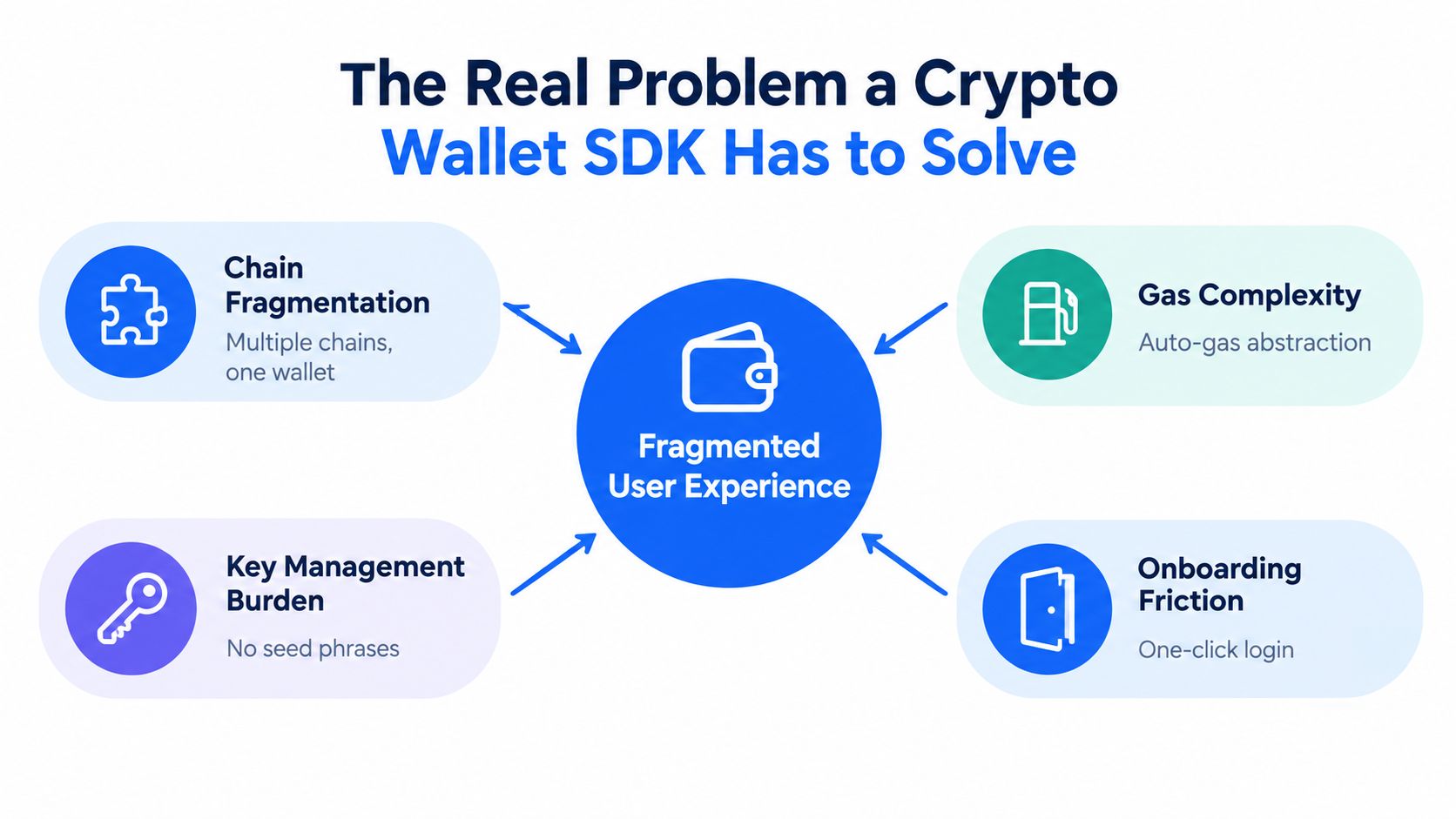
The Real Problem a Crypto Wallet SDK Has to Solve
The core issue is fragmented vendor plumbing. Teams often connect one provider for wallet creation, another for custody, another for broadcasting, and a separate service for ledger reporting. During normal operation, those integrations can look manageable. During an incident, engineers reconcile deposits across multiple dashboards, investigate signing mismatches between custody layers, and patch webhook handling after retries create duplicate internal records.
A wallet SDK should reduce that surface area. It needs to give product, engineering, finance, and compliance a coherent way to answer five questions:
- Who owns the funds? The answer should be visible in the account model and approval policy.
- Who can sign? The SDK should expose roles, quorum rules, and policy outcomes.
- What happened on-chain? Events should include enough identifiers for reconciliation.
- What did the business record? The operating ledger must remain authoritative for internal balances.
- What happens when something fails? Retries, timeouts, rejected policies, and unavailable co-signers need explicit states.
Developer adoption provides a useful historical signal. Alchemy's reported 2023 wallet SDK adoption data shows that Web3 wallet SDK installs grew 196% year over year in Q2 2023, reaching 11.1 million downloads. The same report described Ethereum activity as up 7% and wallet SDK installs as up 22% in that period. Those figures matter less as a market forecast than as evidence that wallet SDKs moved toward a mainstream integration layer for consumer applications, fintech products, and onchain experiences.
The operating model matters more than the feature list
Chain coverage still matters. So do gas abstraction, mobile support, smart-account compatibility, and recovery. But those features only create value when they fit a reliable operating loop.
A coherent stack connects wallet identity to an append-only ledger, signing policy to a human or service actor, and every asynchronous event to a reconciliation job. It also gives the on-call engineer one audit trail instead of a collection of partial provider logs.
Practical rule: Choose the SDK that makes a failed transfer explainable, not merely the SDK that makes a successful transfer easy.
The strongest architecture treats wallet creation, event streaming, settlement, and signing as one control plane. That's the standard BroLabel applies across BroSettlement, BroWallet, AI Agent wallets, Co-Signer controls, WebSocket events, and ledger reconciliation. The objective isn't to hide complexity. It's to place complexity where the business can monitor and control it.
Custodial, SSS, and MPC Wallet Models Compared
Custody architecture determines where your largest operational failure can occur. A custodial model gives a provider control of the complete private key. Shamir Secret Sharing, or SSS, divides key material into shares but reconstructs the key when signing. MPC non-custodial architecture distributes signing across parties so the complete private key isn't reconstructed during ordinary use.
That distinction changes the risk model. For a useful primer on the public and private key relationship behind wallet signing, review how asymmetric encryption works. The wallet SDK decision then becomes a question of exposure, latency, and availability rather than a label attached to a dashboard.
| Dimension | Custodial | SSS, Shamir Secret Sharing | MPC Non-Custodial |
|---|---|---|---|
| Key exposure | A third party holds the complete key | Shares exist and the key is reconstructed during signing | No complete key is reconstructed during signing |
| User experience | Usually the simplest operational flow | Can be smooth, but reconstruction adds a sensitive step | Embedded experience with threshold signing and policy controls |
| Main risk | Concentrated custody and provider dependency | Hot reconstruction window and share coordination | Quorum availability and interactive signing latency |
| Failure mode | Provider compromise, outage, or account restriction | Reconstruction failure, share loss, or coordination outage | Unavailable signing party, network delay, or quorum degradation |
| Best fit | Products prepared to outsource custody | Use cases with a controlled reconstruction model | Products that need non-custodial controls and institutional signing policy |
What changes under load
MPC signing has a real latency cost, but the cryptographic operation isn't the only factor. A technical guide from Portal explains that same-region MPC signing is typically around 1 to 2 seconds, while signers spread across continents can push signing to 3 to 10 seconds. Poor network conditions can stretch the flow to 10 to 30 seconds. These figures are implementation guidance, not a universal vendor benchmark, and the Portal MPC feature-flag guide ties the outcome to signer placement, quorum availability, and presignature use.
Presignatures help by pre-computing part of the signing protocol in the background. When a transaction arrives, the SDK consumes an available presignature and completes signing faster. If none is available, it falls back to normal signing. For high-throughput flows, cache presignatures for bursts, colocate signing parties where possible, and monitor quorum responsiveness as a service-level objective.
MetaMask describes threshold signing as a process where a specified quorum, commonly 2-of-n, produces a signature from partial contributions without reconstructing the full private key. Its MPC wallet documentation provides the core model. The MPC architecture guide also cautions that benchmark figures across vendors aren't directly comparable because protocol family, chain support, audits, and infrastructure ownership differ.
For production embedded wallets, the recommendation is clear: use threshold MPC with background presignature generation, region-aware signer placement, explicit quorum-health monitoring, and end-to-end latency measurement. Test signing plus broadcast, not signing in isolation. The BroLabel MPC wallet architecture is relevant when evaluating a client-controlled Co-Signer and non-custodial operating model.
Picking the Right Wallet Topology per Business Case
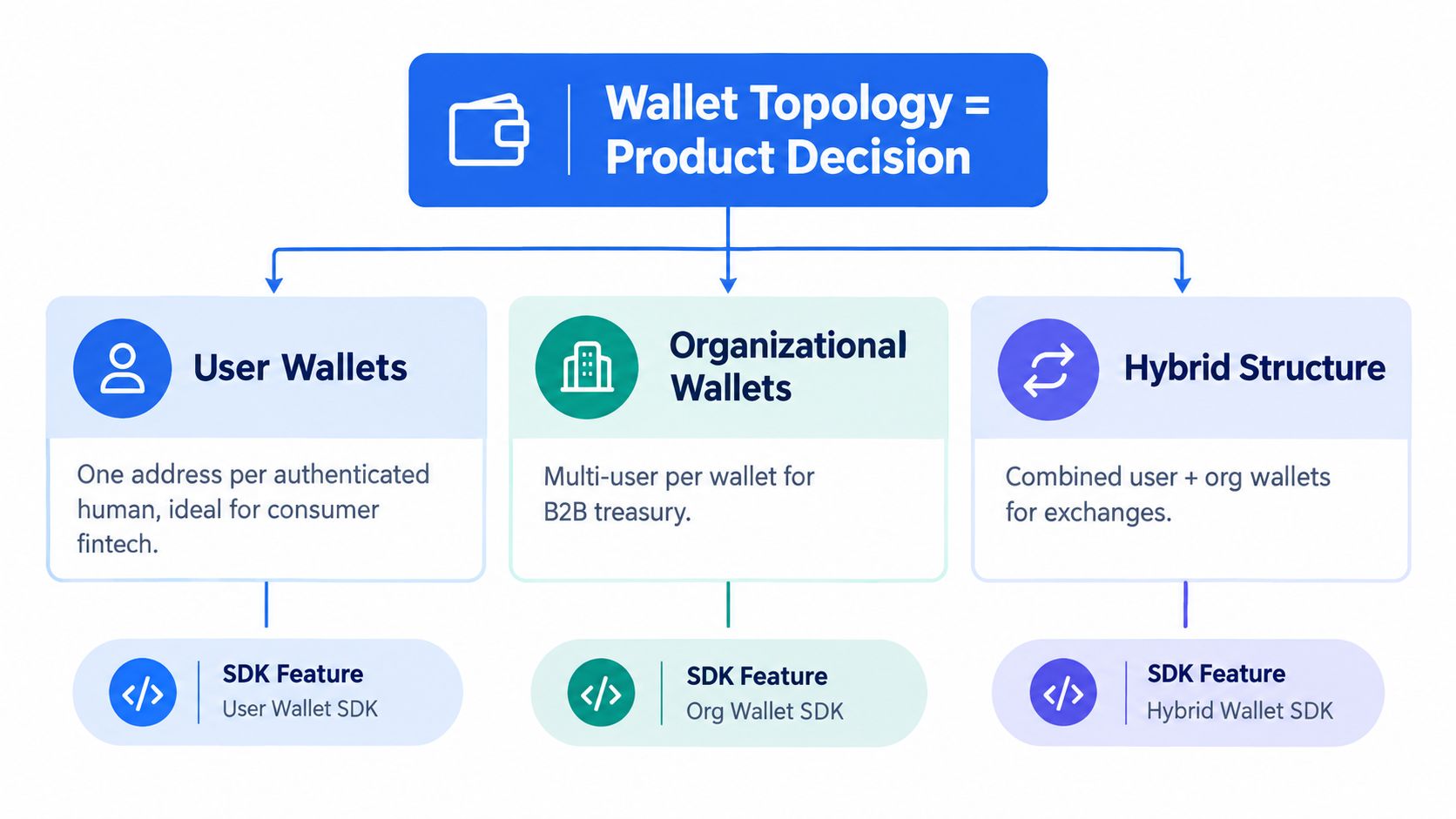
Wallet topology decides how your product assigns identity, responsibility, and blast radius. It should be selected before authentication is wired into the SDK because the same user session can map to very different wallet ownership models.
User wallets
Use a user wallet when one authenticated person should own and query the balance attached to one address. This fits consumer fintech, loyalty products, and applications where the brand owns the interface but the customer controls the asset relationship.
The identity binding should be explicit:
wallet = createWallet({
  ownerType: "user",
  ownerId: verifiedUserId,
  policy: "consumer-default"
})
The important design question is recovery. If the user loses access to the application, what process restores access without transferring custody to your operations team? The SDK should expose recovery state and policy outcomes so support staff can assist without gaining unrestricted signing authority.
Per-agent wallets
AI agents, treasury workers, and backend operators need separate signing identities. A per-agent wallet gives each actor its own address, permissions, spend cap, and audit row. That separation prevents one automation credential from representing every backend action.
agentWallet = createWallet({
  ownerType: "agent",
  ownerId: agentId,
  policy: "treasury-rebalance"
})
The agent should receive only the permissions required for its task. A read-only balance observer shouldn't share credentials with a payout executor, and neither should share credentials with a policy administrator.
Per-player and hybrid wallets
Gaming, marketplaces, and iGaming flows often need a disposable or session-linked wallet for each participant. A per-player model lets the business track deposits, fees, taxation, and settlement independently without treating every participant as a permanent consumer account.
sessionWallet = createWallet({
  ownerType: "player",
  sessionId: transferSessionId,
  policy: "player-payout"
})
Hybrid structures combine user and organizational ownership. A marketplace may maintain a user wallet for a participant while also assigning an organizational settlement wallet to the platform. Choose this model when both parties need clear balances and approval boundaries.
Before selecting a topology, answer three questions:
- Who owns the funds?
- Who needs balance and transaction visibility?
- What can the business tolerate if one wallet is compromised?
That decision determines your authentication subject, ledger keys, policy scope, and incident playbook. Wallet creation isn't a neutral implementation detail.
Integrating the Crypto Wallet SDK Step by Step
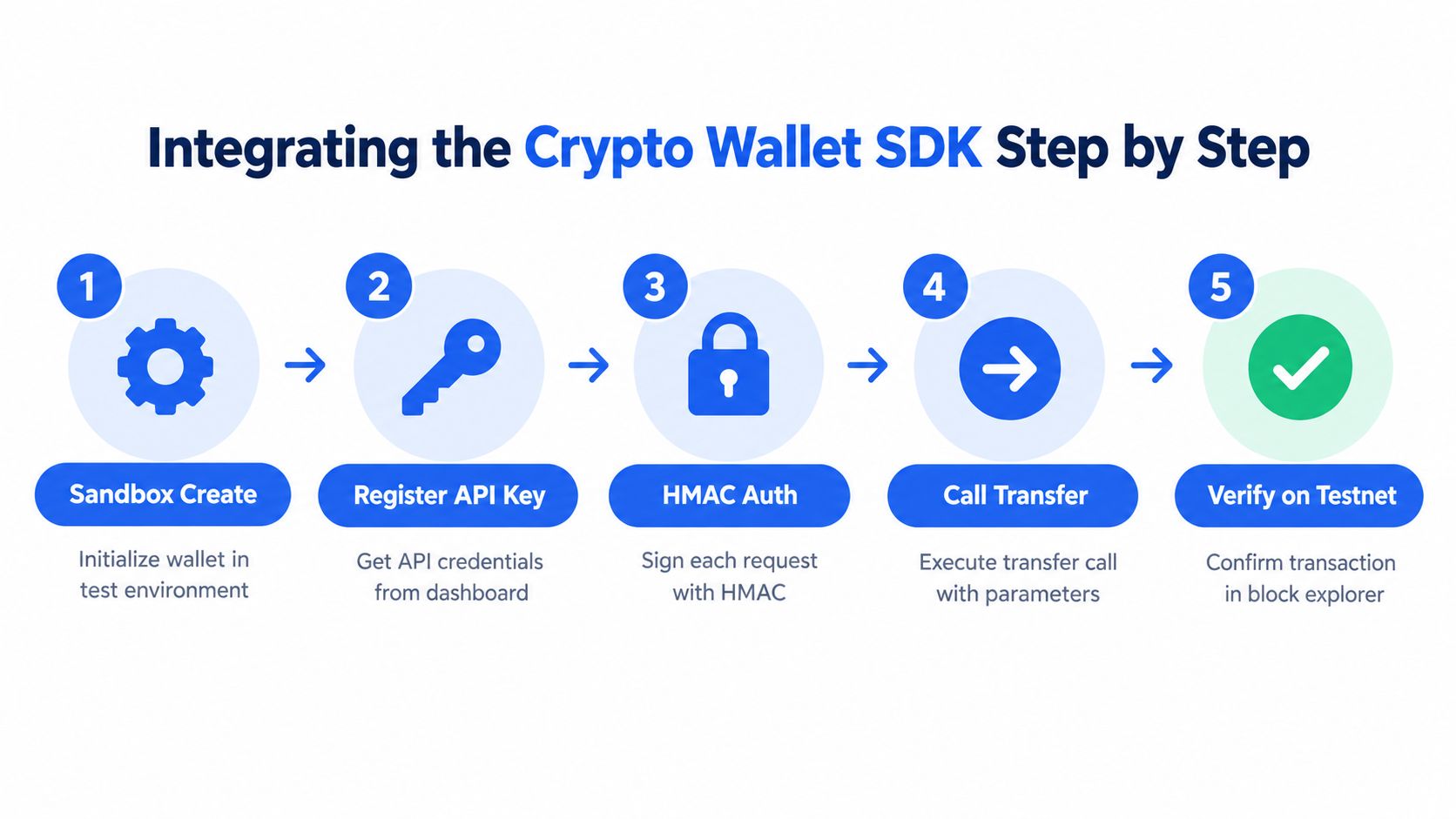
A production integration should move from controlled identity creation to authenticated, idempotent settlement. The sandbox is useful for validating payloads and policies, but it won't prove that your ledger, event store, retry logic, and on-call process behave correctly under operational pressure.
Start with a wallet and policy
Create the wallet with its topology and signing policy attached. Don't create an unrestricted wallet first and plan to add controls later. A policy attached at creation gives the internal ledger and audit stream a stable reference from the beginning.
const wallet = await client.wallets.create({
  ownerType: "agent",
  ownerId: agentId,
  chains: ["ETH", "BASE"],
  policyId: "treasury-standard"
});
Store the provider wallet identifier, topology, policy version, and internal owner identifier together. Your database should be able to answer which business object owns the wallet without querying a provider console.
Authenticate every request
Use scoped credentials and request signing. Financial API guidance commonly pairs HMAC authenticity checks with timestamp or nonce validation and rate limiting, so a captured request can't be reused without detection. The same control pattern appears in broader threat intelligence API SDK discussions, where scoped access and request integrity matter as much as endpoint availability.
const timestamp = Date.now().toString();
const bodyHash = sha256(JSON.stringify(payload));
const signature = hmac(
  secret,
  `${timestamp}.${method}.${path}.${bodyHash}`
);

const headers = {
  "X-API-Key": scopedKey,
  "X-Timestamp": timestamp,
  "X-Signature": signature
};
Give read-only keys access to wallet and event queries. Give transfer keys only the transfer operation and required wallet scope. Keep policy administration separate.
Make transfers retry-safe
A transfer request needs a client-generated idempotency key. Best-practice payment API designs use an Idempotency-Key header, store the first response server-side, and return that same result when the client retries within the retention window. The idempotency key architecture guidance describes retention windows commonly ranging from 24 to 72 hours.
const response = await fetch("/v1/transfers", {
  method: "POST",
  headers: {
    ...headers,
    "Content-Type": "application/json",
    "Idempotency-Key": clientRequestId
  },
  body: JSON.stringify({
    walletId,
    asset,
    amount,
    destination
  })
});

// Expected initial result: 202 Accepted
A 202 response means the system accepted the request for processing. It doesn't mean the transaction has reached final confirmation. Persist the request before sending it, then associate every later event with the same client request identifier.
Subscribe to events and persist before acting
WebSockets are useful for operational responsiveness, but they aren't a ledger. Subscribe to transfer lifecycle events, write each received event to an internal outbox, and let workers update business state from persisted records.
async function connect() {
  let delay = 1000;

  while (true) {
    try {
      const socket = await openWebSocket(
        "wss://api.example.com/events"
      );

      await socket.subscribe({
        walletId,
        events: [
          "transfer.created",
          "transfer.completed",
          "transfer.failed"
        ]
      });

      for await (const event of socket) {
        await outbox.insertIfNew(event.eventId, event);
      }

      delay = 1000;
    } catch (error) {
      await sleep(delay);
      delay = Math.min(delay * 2, 30000);
    }
  }
}
The outbox gives you replay, inspection, and controlled reprocessing. For a concrete API-oriented wallet integration reference, see BroLabel's crypto wallet API guide.
Troubleshoot the first failures
- 401 after a request: Check timestamp drift, signature construction, and whether the server expects the raw body or a body hash.
- 409 on a retry: Confirm that the same idempotency key isn't being reused for different payloads.
- 422 from the transfer endpoint: Treat it as a policy rejection, not a transport failure. Surface the policy version and failed rule.
- Dropped WebSocket frames: Assume idle timeout or reconnect gaps. Persist event identifiers and backfill from the provider's transfer history after reconnecting.
Reconciliation, Idempotency, and WebSocket Events
Reconciliation is the daily control that catches what an SDK missed. WebSocket delivery can accelerate state changes, but your operating ledger should remain append-only and should never depend on a single live connection.
Define an event taxonomy that maps directly to ledger transitions:
| Event | When Emitted | Ledger Action | Confirmation Required |
|---|---|---|---|
deposit.observed |
A deposit is detected | Create a pending deposit record | Yes |
deposit.confirmed |
Deposit reaches the configured confirmation state | Post one credit entry | Yes |
transfer.broadcast |
A transfer is submitted to the network | Record broadcast and transaction hash | No, continue monitoring |
transfer.confirmed |
Network confirmation is recorded | Mark settlement complete | Yes |
transfer.failed |
Provider or network processing fails | Move to exception review | No, investigate cause |
A deposit example
Suppose deposit.observed arrives with a transaction hash and 1 confirmation. Your worker should hold the customer credit until deposit.confirmed reaches 12 confirmations, then write one ledger entry keyed by (walletId, txHash, logIndex). The confirmation rule and event identifiers should be configurable by asset and policy, not embedded in ad hoc application code.
That composite key protects against replayed events and duplicate workers. It also creates a direct bridge between the chain record and the internal accounting record.
Outbound transfer controls
The outbound side needs the same discipline. If the same client_request_id arrives twice, the system must return the original transfer result rather than create two on-chain transactions. Never auto-retry a transfer after an ambiguous timeout until the system has checked its idempotency record and provider transfer history.
A nightly reconciliation worker should compare the confirmed internal ledger with the SDK's list_transfers result. Mismatches belong in a human-review queue. Automatic retries can create a second payment when the original transaction was accepted but its event was delayed.
WebSocket events tell operators what may have changed. Reconciliation proves what the system recorded.
Use an append-only operating ledger with immutable event references, then expose the exception workflow to finance and operations. The BroLabel reconciliation API reference is a useful benchmark for the fields and workflows buyers should expect from an infrastructure provider.
Signing Policies, Co-Signer Controls, and Production Risk
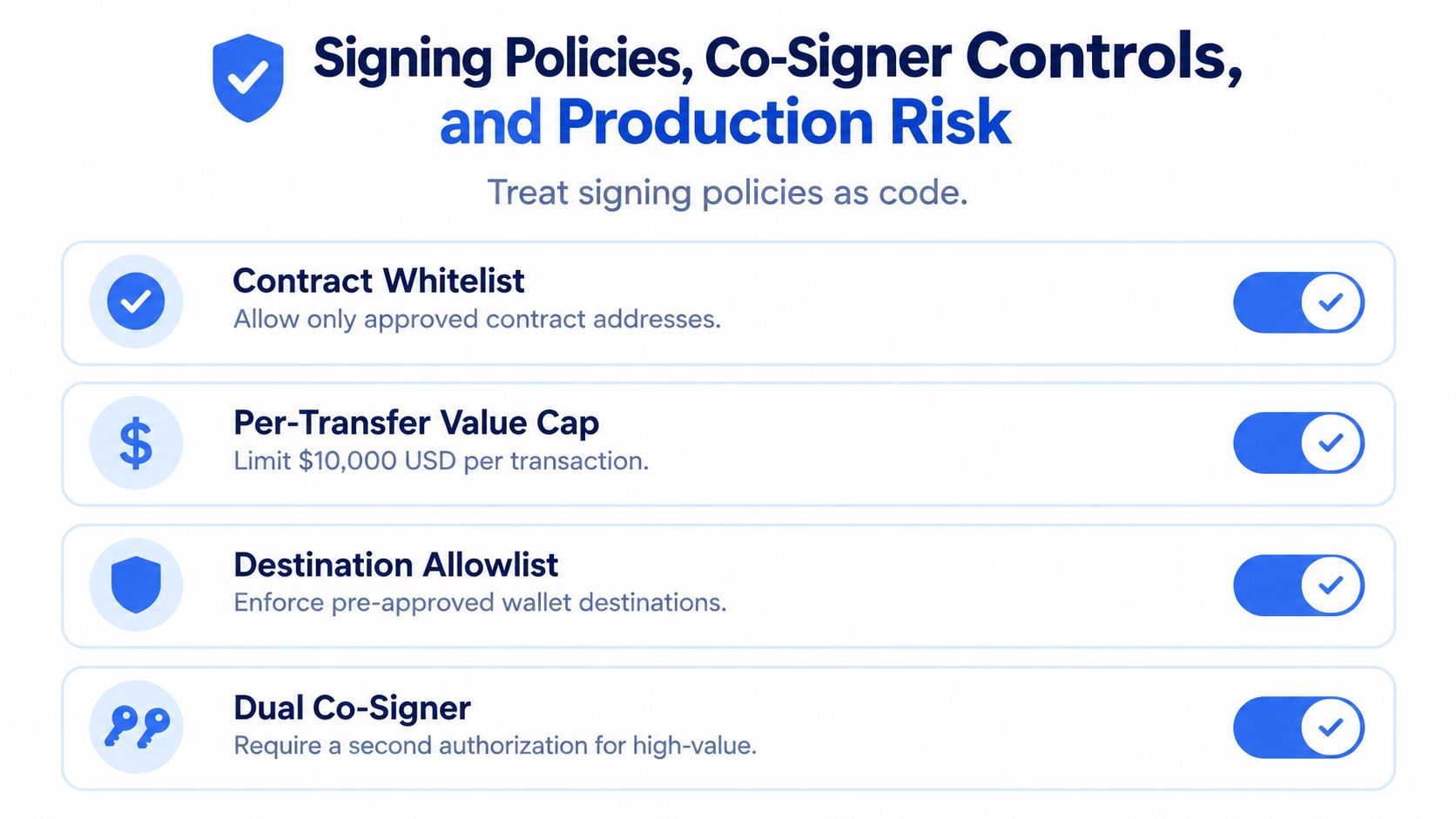
Signing policy should be treated as code, not a setting buried in a provider dashboard. A policy must be reviewable in version control, testable in CI, and attached to an audit record whenever it authorizes or rejects a transaction.
A representative policy object might look like this:
{
  "contractAllowlist": [
    "approved-contract-a",
    "approved-contract-b"
  ],
  "transferValueCapUsd": 10000,
  "destinationAllowlist": [
    "approved-destination-a"
  ],
  "dualApprovalAboveUsd": 5000
}
The values above are illustrative policy examples, not universal limits. Each business should set them through treasury, compliance, and risk review. The important property is that the rule is explicit, versioned, and evaluated before signing.
Put the Co-Signer where the risk requires
For automated, lower-risk flows, a second MPC share can run inside your VPC to reduce dependency on an external operator during routine signing. High-value transfers should take a different path. Route them through an operator-held share with explicit approval so one compromised application credential can't drain the wallet.
This is the central Co-Signer trade-off. More automation improves throughput and reduces manual work, but a separately controlled share creates a stronger barrier against application compromise and insider abuse.
Separate API capabilities
RBAC should divide at least these responsibilities:
- Read-only observer: Can inspect wallets, balances, events, and ledger status.
- Transfer executor: Can submit transfers within an already approved policy.
- Policy administrator: Can create, modify, publish, or roll back policy versions.
Don't let a transfer key edit its own policy. Don't let a policy administrator approve a transfer without an independent record of the request and quorum outcome.
Capture the audit trail
Every production signing attempt should record:
- Actor: Human, service, agent, or workflow that initiated the request.
- Policy version: The exact policy evaluated.
- Request payload hash: Evidence of what was signed without relying on mutable application logs.
- Co-Signer quorum result: Participating parties, approval state, and failure reason.
- Wallet and transaction identifiers: The link between internal records and the network event.
Skipping these fields creates concrete incident gaps. Without the actor, replayed approvals are harder to investigate. Without the policy version, silent policy edits can go unnoticed. Without the payload hash, an insider may dispute what was approved. Without quorum evidence, key rotation can produce unsigned or ambiguously signed transfers.
Sandbox to Production Migration Checklist and FAQ
A CTO-ready cutover requires more than a successful testnet transfer. Before production, verify that the reconciliation match rate is above 99.9%, signing policy tests have passed, RBAC roles are provisioned, and the on-call runbook is linked from the deployment record.
Go-live questions buyers ask
How long does MPC key generation take? It depends on the protocol, signer placement, network conditions, and provider implementation. Measure wallet creation and first-sign latency in an environment that resembles production.
Can WebSocket reconnection drop events? It can create a delivery gap if your client doesn't persist event identifiers and backfill after reconnecting. Treat WebSockets as a delivery channel, not the system of record.
What happens when a Co-Signer is offline during a payout? The transaction should remain pending or fail according to policy. It shouldn't bypass the quorum requirement.
Do sandbox balances reset? Confirm the provider's reset and test-funding rules before building reconciliation assumptions around test assets.
How do you roll back a bad policy push? Publish a previously approved policy version through a controlled deployment path, then verify the resulting version in audit records.
How does audit export map to SOC 2 evidence? Map actor, policy, payload, approval, and outcome fields to the control evidence your auditor requests. Don't assume a provider export is sufficient without testing the mapping.
Shipping a wallet SDK isn't feature delivery. It's shipping the reconciliation, signing, and incident response your team can defend on a Monday morning.
BroLabel provides API-first embedded MPC wallets, BroSettlement, BroWallet, client-controlled Co-Signer workflows, WebSocket events, and an append-only operating ledger for teams that need wallet operations connected to settlement and reconciliation. Visit BroLabel to evaluate the sandbox, scoped API access, and production controls against your own transfer and incident workflows.