
You're trying to launch a financial product, but the operating model already looks like a patchwork. One vendor handles custody, another issues cards, a third provides KYC, and finance closes reconciliation with a spreadsheet that's late and difficult to audit. Meanwhile, a critical custody key sits with one engineer, turning an infrastructure decision into a personnel risk.
A digital banking platform should remove that fragmentation, not hide it behind a polished dashboard. The buying decision is architectural: modular or full-stack adoption, the custody model, ledger discipline, event delivery, and the controls around regulated actions. This guide maps those decisions for founders, CTOs, product leaders, operations teams, finance owners, and compliance officers building exchanges, neobanks, payment products, and iGaming platforms.
Table of Contents
- The Real Problem Behind Buying a Digital Banking Platform
- What a Digital Banking Platform Actually Contains
- Modular Versus Full-Stack Adoption
- Core Infrastructure Controls That Decide Production Readiness
- Integration Patterns for Fintechs, Neobanks, and Operators
- Risk Controls and Compliance Surface Before You Sign
- An Evaluation Framework for Serious Buyers
The Real Problem Behind Buying a Digital Banking Platform
The enemy is fragmented financial infrastructure. Each isolated provider can appear reasonable during procurement, but the seams become your operational burden. Your product team owns identity mapping, your finance team owns reconciliation, your support team explains inconsistent transaction states, and your compliance team investigates whether a failed payment reflects a customer issue, a processor issue, or a ledger issue.
Start by mapping the money movement rather than the vendor catalogue. For every customer action, document:
- Identity: who is the user, business, player, or agent?
- Account structure: where is the balance represented?
- Authorization: who can initiate and approve the action?
- Execution: which rail, wallet, card, or processor moves value?
- Accounting: which immutable entries record the movement?
- Evidence: which events, approvals, and screening results support the decision?
That map exposes whether you need a complete digital banking platform or only selected infrastructure modules. An exchange with an established custody system may need an operating ledger, fiat rails, card issuing, and event delivery. A neobank entering a new market may need accounts, KYC, cards, payments, and accounting from one provider. An iGaming operator may need player-specific wallets, controlled deposits and withdrawals, and policy checks before payout execution.
Practical rule: Buy the smallest architecture that solves the whole operational flow, not the smallest collection of APIs.
The market context supports treating this as core infrastructure. Mordor Intelligence's digital banking platform market overview projects that more than half of the global population would use digital banking in 2026. It also estimates market growth from USD 13.79 billion in 2025 to USD 15.79 billion in 2026, with a projection of USD 31.08 billion by 2031, and identifies web access as holding 56.12% of access mode share in 2025, while mobile banking is projected to grow at a 17.02% CAGR through 2031. These projections describe a distribution layer that already carries serious banking activity, not a peripheral feature.
Buyers also need historical perspective. Bank of Scotland provided electronic home banking services in 1983, Stanford Credit Union launched a banking-services website in 1994, online banking exceeded 20 million unique users by 2001, and reached 54 million sole users in the United States by 2009, as documented in UBS's history of digital banking. The lesson is practical: remote access matured into operating infrastructure, so today's platform must be judged by controls and recoverability, not only by interface quality.
For terminology, a resource such as terms for digital bank review can help product, legal, and procurement teams align on what providers offer. Use it to clarify language, then return to the money-flow map before approving a purchase.
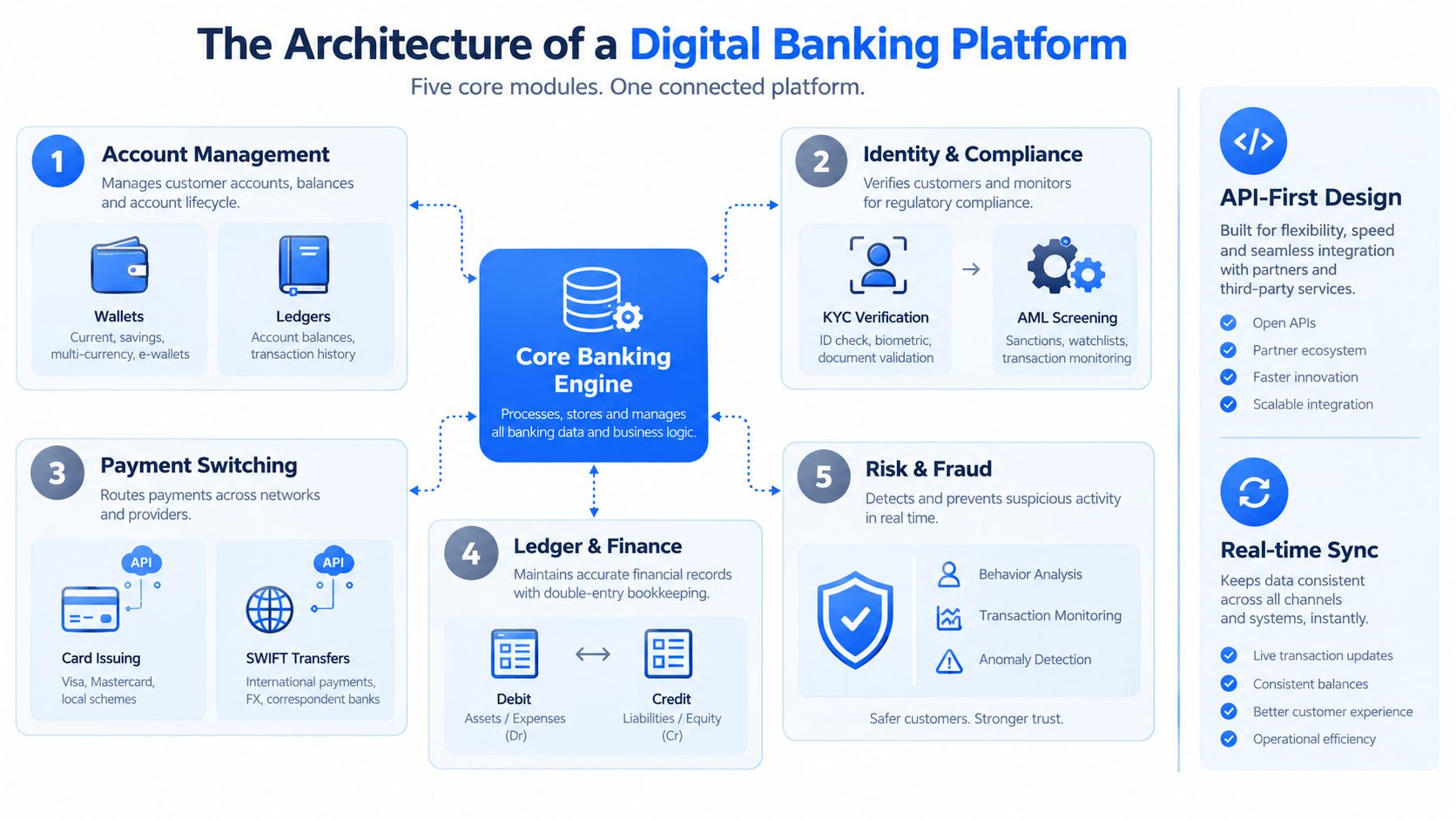
What a Digital Banking Platform Actually Contains
An exchange adding fiat balances, a neobank launching accounts, and an iGaming operator managing player funds need the same core discipline: separate account ownership, identity checks, payment execution, and ledger evidence. The platform is an operating system for money movement, not a branded dashboard.
Accounts and embedded wallets
The account layer assigns each customer, business, player, or agent a controlled place to hold or reference value. Your application should be able to create accounts or wallets, attach ownership and permissions, and retrieve balances and transaction history through query interfaces. Require distinct wallet models, such as user wallets, per-agent wallets, and per-player wallets. A single account pattern creates avoidable reconciliation and access-control problems.
Identity and compliance
KYC, AML screening, sanctions checks, and transaction monitoring govern access after account creation. Your server should initiate regulated actions, store provider decision identifiers, and consume status events. The compliance module must also define ownership for review queues, escalations, record retention, and regulatory reporting. A provider that supplies checks without operational workflows leaves your team with the difficult part.
Cards and payment rails
Card issuing covers virtual and physical card creation, lifecycle events, limits, authorization outcomes, and replacement or suspension flows. Payment infrastructure can include ACH, SEPA, Faster Payments, SWIFT, bank transfers, card funding, and digital-asset network settlement. Evaluate the complete execution path. Your system must initiate a payment, receive a deterministic status, handle failure, and post the result to the ledger.
Payment methods shape funding and usage flows differently. Use this digital banking payment-method overview when product and operations teams compare those flows.
Ledger and finance
Make the ledger an append-only, immutable double-entry record. It must represent debits, credits, fees, holds, reversals, and settlement outcomes while preventing an application retry from creating a second posting. Formance's engineering guidance on transaction reconciliation states that a retry on any payment-rail event must produce exactly one posting. Demand that behavior, together with idempotency keys, traceable event IDs, and clear correction entries.
APIs and events
REST or OpenAPI endpoints handle commands and queries. Webhooks and WebSocket streams communicate asynchronous changes, including KYC outcomes, card lifecycle events, deposits, confirmations, withdrawals, and policy decisions. Commands without state evidence force operators to infer what happened. Production infrastructure exposes both the action and the record that proves its outcome.
Modular Versus Full-Stack Adoption
The right choice depends on what your team already operates and what it must launch. A modular buyer retains selected systems and adds missing capabilities. A full-stack buyer accepts a broader operating boundary to reduce integration work and reach market sooner.
An exchange that already runs custody may choose a modular model. It can retain key management, add fiat accounts, card issuing, ledgering, and settlement, then connect those components to its existing trading and risk systems. A neobank launching in a new market may choose full-stack adoption, taking accounts, KYC, cards, payments, and ledger services from one coordinated provider while its internal team focuses on customer experience and distribution.
| Dimension | Modular | Full-Stack |
|---|---|---|
| Existing infrastructure | Keeps mature internal systems | Replaces or avoids several internal systems |
| Main advantage | Control over differentiated components | Faster assembly of a complete operating flow |
| Main cost | More integration ownership | Greater dependency on one provider |
| Best fit | Established exchange or payments team | New neobank or product entering a market quickly |
| Custody approach | Can preserve in-house custody | Can adopt provider-managed or non-custodial controls |
| Migration exposure | Lower replacement scope | Higher exit impact if schemas and workflows are proprietary |
| Operating burden | Internal team owns more failure boundaries | Provider owns more coordination between modules |
The boundary can change. A modular buyer may consolidate after discovering that separate event models create reconciliation work. A full-stack buyer may later replace card issuing or KYC while retaining wallets and ledger services. Avoid treating the initial decision as permanent, but make sure the contract supports component-level migration.
How to place your team
Choose modular adoption when your existing systems contain valuable risk logic, custody controls, licensing relationships, or customer data that you won't replace casually. Choose full-stack adoption when your internal team lacks the capacity to operate several regulated integrations and the provider gives you portable records, clear controls, and reliable sandbox parity.
The same discipline applies to AI and automation. Before deciding when to build AI in-house, decide whether the capability differentiates your product or merely supports an operational workflow. Don't build a ledger, custody layer, or screening orchestration engine internally just to preserve theoretical control. Build where your team has a defensible advantage, and buy where failure would create avoidable operational exposure.
Core Infrastructure Controls That Decide Production Readiness
A platform can pass a vendor demo and still fail in production. Test what happens after a timeout, duplicate request, delayed event, unauthorized action, or interrupted workflow. Those failure paths determine whether an exchange, neobank, or iGaming operator can operate safely at scale.
MPC and the signing boundary
Threshold signing prevents one person or compromised system from authorizing a transfer alone. In an (2,3)-style MPC/TSS quorum, three key shares exist and at least two must collaborate to produce a valid signature, as described in Ripple's MPC and TSS documentation. For institutional custody, document where the shares reside, who controls the client-controlled Co-Signer, which policies govern signing, and how the team rotates or revokes access.
MPC reduces the blast radius of a compromised key. It does not perform transaction screening, set withdrawal limits, manage approval workflows, or create audit logs. Treat signing security and operating controls as separate layers, then test the handoff between them.
Idempotency and double-entry posting
A payment request may be retried after a network timeout. Without database-enforced idempotency, the customer can receive duplicate credit or the operator can create duplicate payout obligations. Generate a stable idempotency key for each business action, store it with the request, and enforce uniqueness across both the ledger and payment orchestration layers.
The ledger must also represent holds, settlement, reversals, and fees explicitly. A balance should result from durable double-entry postings, not from mutable fields that operators adjust after an incident. Define which service may post, which service may reverse, and how finance reconciles each state.
WebSocket events and recovery
WebSocket streams can deliver timely updates for deposits, confirmations, withdrawals, and policy outcomes. They are delivery mechanisms, not the system of record. Persist event identifiers, handle reconnects, reject duplicates, and compare local state with an authoritative query endpoint after a connection gap.
Set recovery rules before launch. A consumer that cannot explain which events it processed, which it missed, and which it replayed will create stale balances and manual investigation work.
Scoped API keys
A leaked integration token should not grant every permission. Separate read access from money movement, assign roles to services, restrict sensitive actions to server-side workflows, and record key creation, rotation, and revocation. Add IP allowlists and replay protection where the operating environment supports them.
| Control | What It Does | Failure Mode It Prevents |
|---|---|---|
| MPC or TSS quorum | Requires multiple key shares for signing | Unilateral spending by one holder |
| Database-enforced idempotency | Maps one business action to one posting | Double debits, duplicate payouts, and ledger drift |
| Immutable double-entry ledger | Preserves an auditable record of value movement | Untraceable balance changes |
| WebSocket event stream | Delivers asynchronous operational state | Missed transfers and stale customer views |
| Scoped API keys | Limits permissions by service and role | Over-permissioned integrations after token leakage |
| Durable inbox and replay handling | Stores messages before deterministic processing | Loss of settlement or webhook events |
Research on event-driven banking architecture describes asynchronous messaging, immutable event records, outbox and inbox patterns, idempotent consumers, and durable brokers as reliability mechanisms. Verify each control through documentation, sandbox traffic, and incident postmortems. Vendors rarely show the failure paths that determine your support workload.
Integration Patterns for Fintechs, Neobanks, and Operators
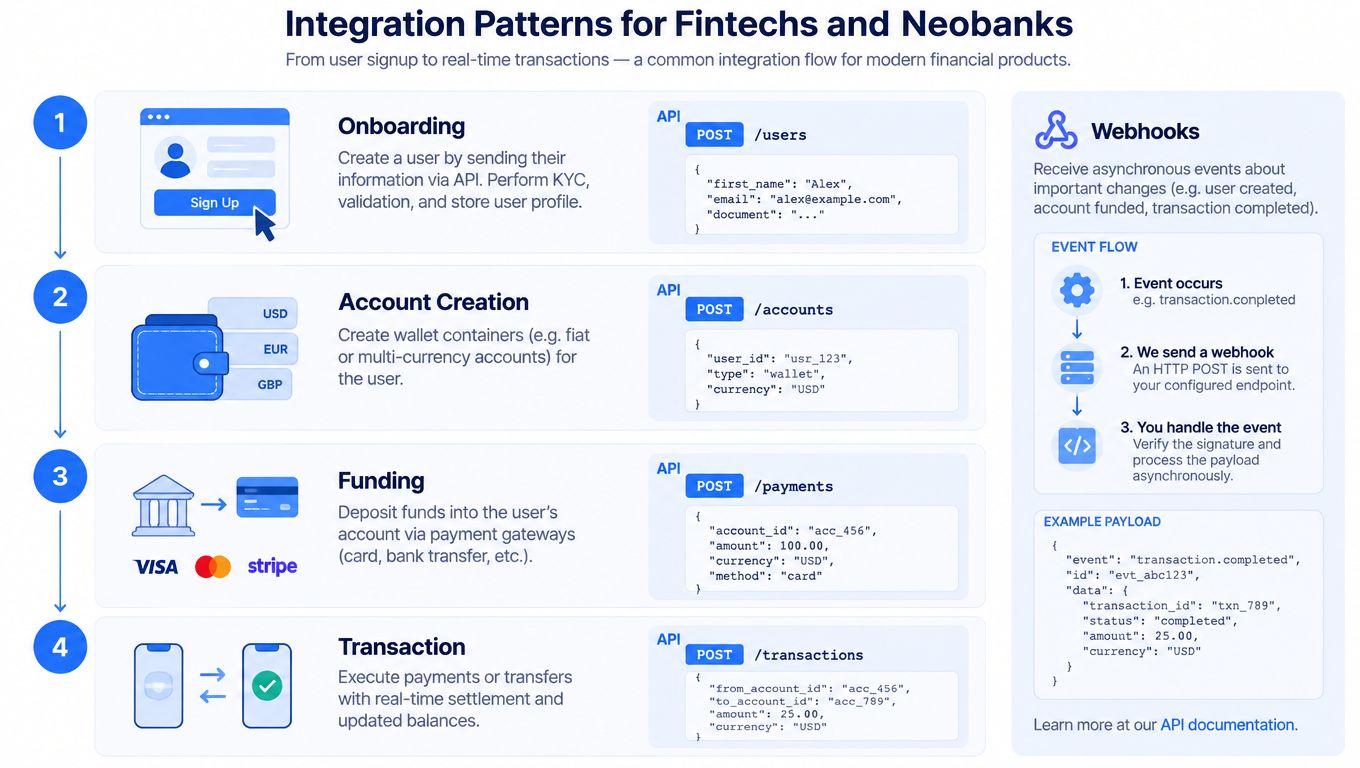
A useful integration starts with ownership. Your application should own customer experience, product policy, and internal authorization. The platform should execute the financial operation, expose its state, and preserve the evidence needed for finance and compliance.
Consumer neobank flow
A consumer neobank commonly starts with server-side onboarding through POST /users, followed by wallet-container creation through POST /accounts. Once the account passes the required identity and compliance checks, the product can call POST /cards/issue for virtual card provisioning and use GET /transactions to render statements.
The browser or mobile client should not receive broad financial permissions. It can display balances, transaction views, card status, and payment-capture screens, while your backend performs KYC initiation, card issuance, transfer creation, and policy evaluation.
Exchange and on-ramp flow
An exchange or crypto on-ramp needs a stronger connection between blockchain activity, fiat movement, and internal accounting. A transfer flow might use POST /wallets/{id}/transfers, then pair quote and execute endpoints for FX or conversion. Chain-confirmation subscriptions should feed a durable event consumer that matches observed and confirmed activity to ledger entries.
Reconciliation becomes operational rather than theoretical here. Guidance on payment-processor engineering explains that reconciliation compares internal records with external truth sources and resolves mismatches. APIs can be idempotent and records can still diverge, so your design needs an exception queue and an owner.
iGaming and operator flow
An operator may create a player-bound virtual account or wallet, expose hosted deposit and withdrawal experiences, and apply player-specific policy before payout signing. A per-session card can be useful where the product needs limited-purpose spending and a clear relationship between session, player, and payment instrument. Responsible-gaming controls should be evaluated before the withdrawal reaches the signing boundary, not after settlement.
Wallet-as-a-service architecture provides useful context for teams deciding whether wallets are the product, a supporting capability, or an infrastructure dependency. Across all three models, keep regulated orchestration on the server and embed only the views or capture flows that require direct customer interaction.
Risk Controls and Compliance Surface Before You Sign
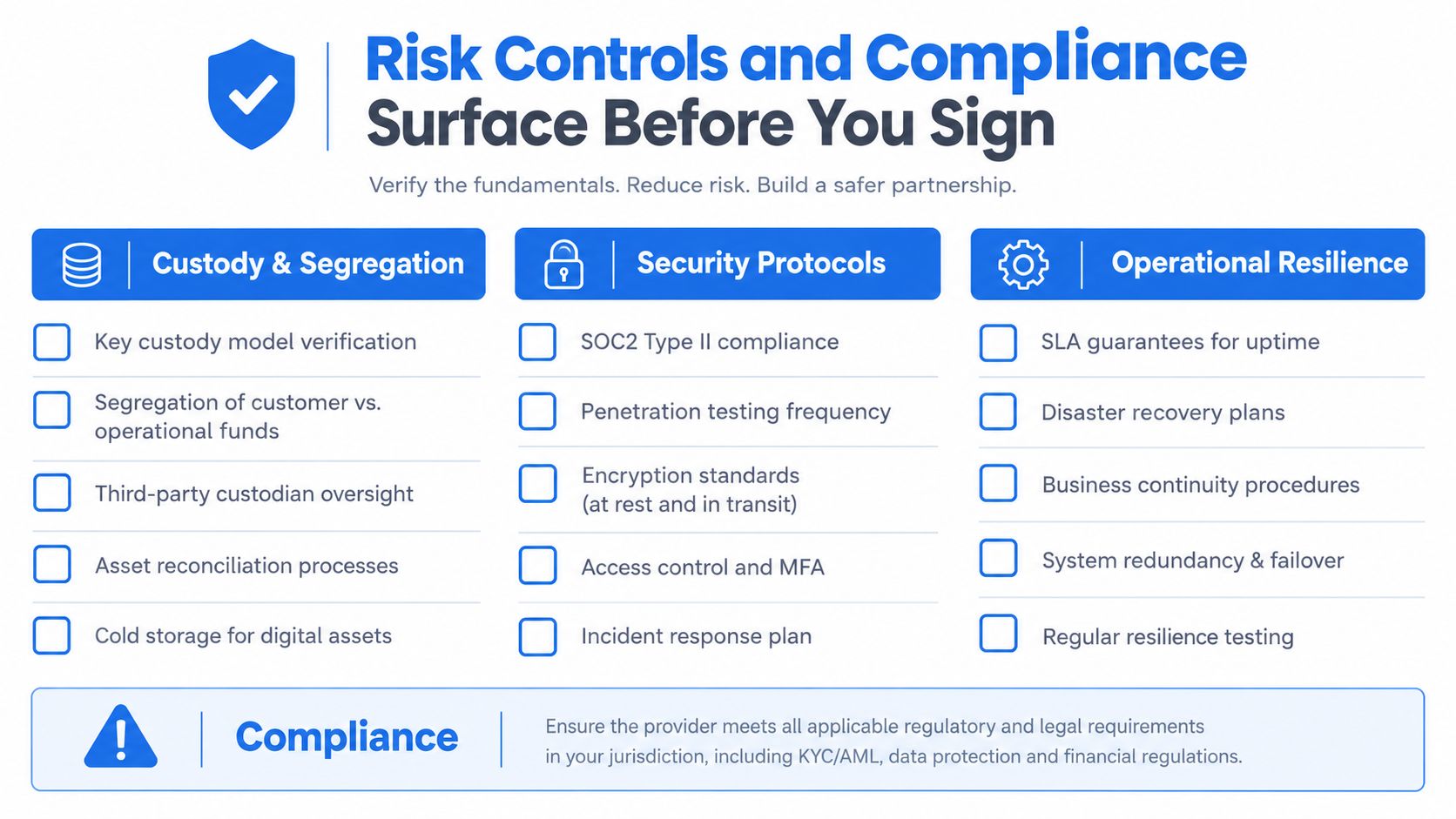
A platform contract should be reviewed as an operating-control document, not only as a pricing schedule. Ask each question in terms of evidence, ownership, and recovery.
Custody and segregation
Confirm the key custody model, signing quorum, Co-Signer responsibilities, and approval policy. Establish how customer funds are segregated from operational funds, where balances are represented, and what evidence supports reserves or safeguarding. If the provider offers attestations, specify the cadence, scope, responsible party, and delivery format in the contract.
AML ownership
Require a written control map for sanctions screening, transaction monitoring, threshold configuration, alert review, and suspicious-activity reporting workflows. The provider may supply screening technology, but your compliance team must know who investigates alerts, who files reports where applicable, and which records remain available for audit.
Reconciliation and settlement
Ask for daily settlement reports, ledger-to-bank matching procedures, stable identifiers, break-resolution service levels, and replay behavior. Payment-ledger architecture guidance recommends durable inbox processing and deterministic matching for settlement files, webhooks, and batch confirmations. Mismatches should enter an exception workflow rather than disappear into support tickets.
Operational resilience
Review key rotation, incident response, audit-log immutability, disaster recovery, access review, and change-management procedures. Test whether the sandbox produces the same event shapes, error semantics, and permission behavior as production. Ask for incident postmortems that show how the provider handles delayed messages, partial outages, duplicate requests, and reconciliation breaks.
The risk to flag before signing is vendor lock-in. Proprietary ledger schemas, closed card BIN sponsorship, undocumented event states, and bundled custody can make migration expensive even when the provider performs well. Make data portability, export formats, transition assistance, component-level termination, and exit clauses gating items. Don't leave them for renewal negotiations.
For a broader process view, compliance management process guidance can help teams structure ownership across product, operations, finance, and compliance. The contract should still name the accountable people and the evidence they must retain.
An Evaluation Framework for Serious Buyers
Score the platform against the failure you're trying to remove. The exchange from the opening needs controlled custody and signing. The neobank needs accounts, cards, fiat access, and compliance orchestration. The operator needs player-level wallet identity, reliable events, policy enforcement, and clean settlement records.
| Criterion | Weight | What to Verify in Sandbox |
|---|---|---|
| Custody and key management | Critical | Create a wallet, test approval policy, inspect signing roles, and simulate a rejected signer |
| Ledger and reconciliation | Critical | Execute a transfer, retry it, inspect double-entry postings, and test a mismatch workflow |
| Fiat and card coverage | High | Test account funding, card issuance, lifecycle events, limits, and withdrawal behavior |
| Compliance tooling | Critical | Run KYC and screening flows, inspect decision states, and verify audit evidence |
| Integration ergonomics | High | Review OpenAPI definitions, idempotency behavior, event identifiers, reconnect handling, and sandbox parity |
| Modularity and exit | High | Export records, identify replaceable components, and review migration support |
| Embedded crypto capability | Medium | Add wallet and settlement functions without replacing the core account and ledger model |
The weighting isn't universal. A licensed team with deep infrastructure capacity may place more weight on modularity and control. A smaller product team may value full-stack coordination, provided it can export data and retain operational visibility. Treat optional crypto modules as an architectural choice, not a marketing feature. They should fit the account, ledger, compliance, and event model rather than create a parallel financial universe.
The practical first step is a two-week sandbox integration spike. Exercise one wallet, one ledger transfer, and one KYC flow. Force a retry, reject an authorization, disconnect the event consumer, inspect the resulting records, and reconcile the external outcome against the internal ledger. If the provider can't make those paths clear in a controlled environment, commercial negotiations are premature.
BroLabel offers API-first embedded MPC wallets, an operating ledger, network broadcast, card issuing, fiat integrations, AI Agent Wallets, and real-time WebSocket events that can be adopted modularly or as a broader stack. Visit BroLabel to assess whether its wallet, settlement, ledger, and card infrastructure fits your sandbox spike and control requirements.