Most payment advice stops at a successful approval message. That's the wrong finish line. Approval tells you a rail accepted a request at one moment, not that funds have settled, your ledger balances, or you can safely release goods, credit a player balance, or close a treasury position. Operators who build on that assumption discover the hard part later, in reconciliation queues and disputes.
Table of Contents
- Redefining the Digital Payment Process for Modern Infrastructure
- Mapping the End-to-End Transaction State Machine
- Securing Initiation with MPC and Tokenization
- Achieving Operational Observability and Reconciliation
- Choosing Modular Infrastructure Over Fragmented Vendors
- Managing Risk and Authorized Scam Liability
- Executing the Integration and Go-Live Roadmap
Redefining the Digital Payment Process for Modern Infrastructure
The popular mental model is simple. A customer taps pay, a gateway encrypts card data, an issuer authorizes, and money moves. That model describes a checkout, not an operating system for money.
A production digital payment process starts earlier and ends later. It includes payer onboarding, wallet or account creation, funding across rails, authentication, authorization, routing, screening, signing, broadcast or submission, settlement, exception handling, and reconciliation. Each stage produces evidence that finance, risk, and compliance teams may need months later.
Scale Has Turned Payments Into Infrastructure
Digital payments aren't a niche add-on. The World Bank Global Findex 2021 executive summary reports that 64% of adults worldwide made or received at least one digital payment in 2021, including 95% in high-income economies and 57% in developing economies. In developing economies, use rose from 35% in 2014 to 57% in 2021.
That growth matters for architecture. Accounts increasingly get used for transactions, not just storage, so weak state handling becomes an operational cost at volume.
The Enemy Is Fragmentation
The clear enemy isn't cash or slow banks. It's fragmented vendor chains. Teams stitch together one provider for wallets, another for cards, another for fiat off-ramps, another for chain broadcast, and a spreadsheet to reconcile them all.
Each vendor brings its own identifiers, status meanings, cut-off times, webhook behavior, and support queue. When a payment sits in an ambiguous state, nobody owns the full answer.
Practical rule: If your team can't trace one payment intent from request to final ledger entry with a single identifier, you don't have a payment process. You have disconnected integrations.
Treating payments as unified infrastructure changes design decisions. You define one payment intent, one state model, one ledger of record, and one event stream, then attach rails to that core. BroSettlement, BroWallet, and related modules follow that logic when they're used as parts of a single stack rather than isolated features. The lesson carries regardless of vendor. Build the lifecycle first, then plug in rails.
Mapping the End-to-End Transaction State Machine
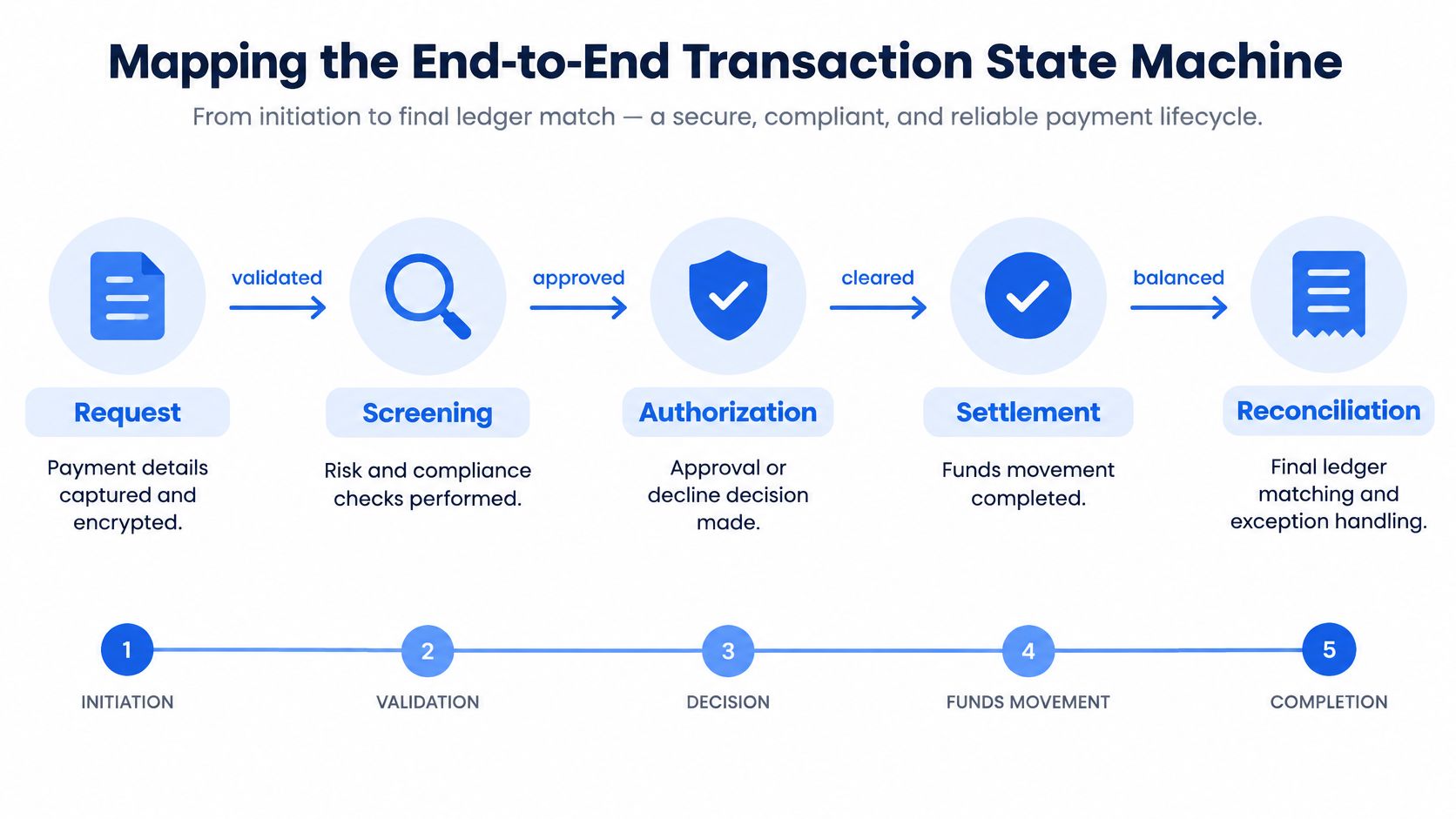
Authorization is one state, not the outcome. A reliable system models every transition a payment can take, including failure paths that product teams prefer not to think about during launch planning.
A useful baseline looks like this. Request captures the intent. Screening runs sanctions, AML, limit, and fraud checks. Authorization reserves or approves funds. Broadcast or submission sends the instruction to a chain, card network, or bank rail. Pending means the rail has it but finality hasn't arrived. Confirmed means network or counterparty confirmation meets your policy. Settled means value has moved. Reversed, failed, disputed, and reconciled close the loop.
Instant Experience Is Not Instant Finality
Customers see a spinner end. Your risk doesn't. Card payments can face disputes after authorization. Bank rails have cut-off times and return windows. Chain transactions can sit pending, drop, or reorganize before confirmation depth reaches your threshold.
Speed raises the stakes. The 2026 Federal Reserve Financial Services Risk Officer Survey reported that faster payments had the largest year-over-year increase in attempted fraud and losses among payment categories, while debit card fraud attempts affected 75% of surveyed financial institutions and represented an estimated 40% of their payment fraud losses. Faster rails compress the time you have to stop a bad release decision.
Define release rules per rail and per value tier before launch.
- Observed: Show pending status, don't release irreversible value.
- Confirmed: Apply your confirmation or settlement threshold.
- Safe to release: Combine settlement status, screening outcome, and account risk tier.
Idempotency and Duplicate Events
Retries are normal. Double credits aren't. Every create-payment call needs an idempotency key scoped to the client, so a retried request returns the original intent instead of creating a second withdrawal.
Event consumers need the same discipline. WebSocket and webhook delivery can duplicate or arrive out of order, so handlers should deduplicate by event ID and apply transitions only if the new state is valid from the current state. Store the raw event, the normalized state change, and the actor or system that caused it.
Legacy batch reconciliation asks what happened yesterday. Event-driven design asks what state this payment is in now, and what evidence supports that answer. That's the difference between discovering a break during month-end close and catching it while a recall or hold is still possible.
Securing Initiation with MPC and Tokenization
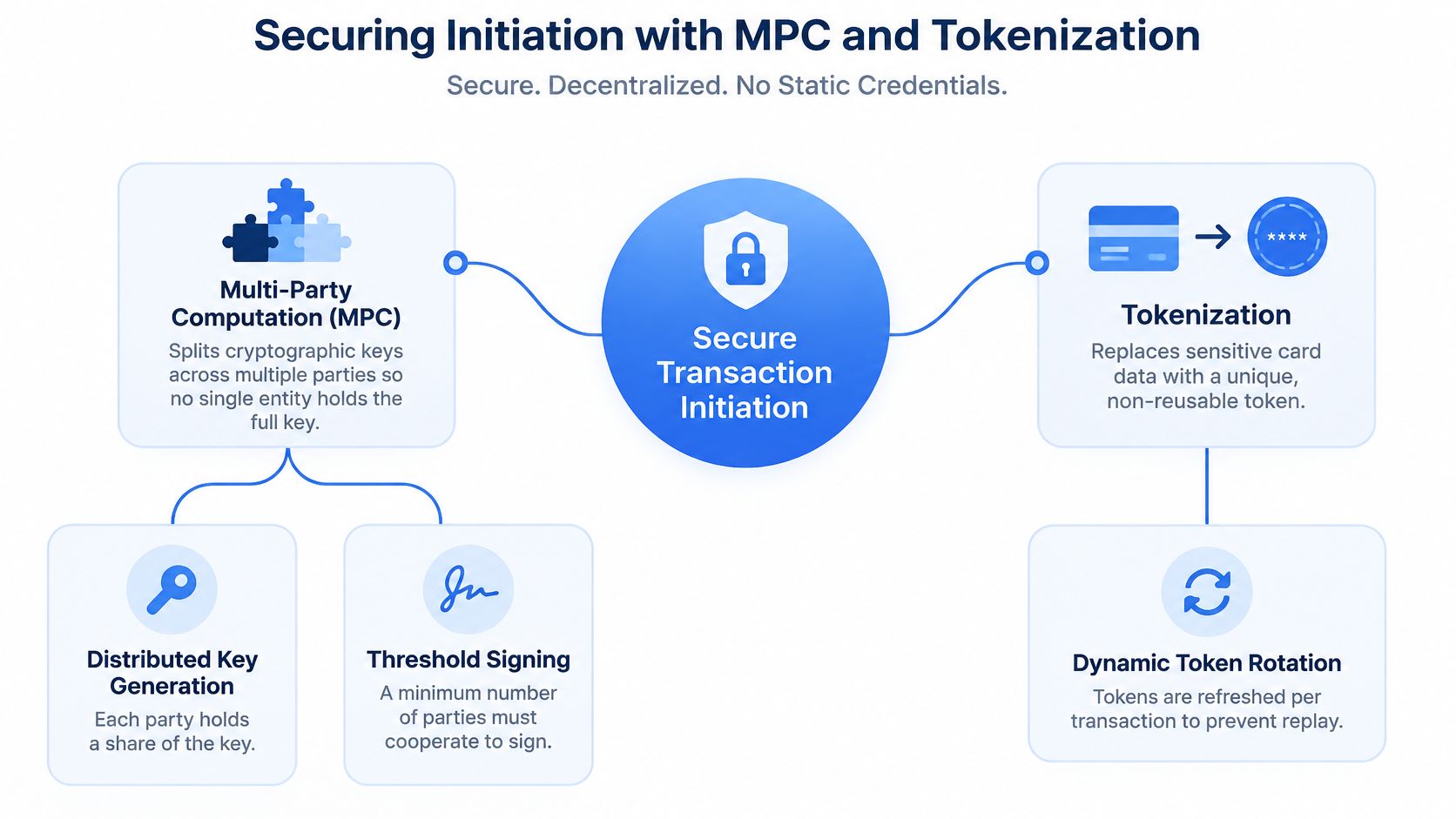
Initiation is where attackers gain the most advantage. If someone can create a valid instruction or steal a reusable credential, downstream monitoring becomes damage control.
Remove Single Points of Failure From Signing
Multi-Party Computation, or MPC, splits key material so no single server, employee, or vendor holds a complete private key. A 2-of-3 threshold policy requires two shares to cooperate before a signature exists. One share can sit with the platform, one with a client-controlled Co-Signer, and one in a recovery arrangement.
That structure changes incident outcomes. A compromised API server can't sign alone. A rogue insider can't sign alone. Your policy engine can also bind signing to conditions such as destination allowlists, amount limits, screening results, and human approval for unusual payouts. Our guide to MPC wallet architecture covers the wallet design choices behind this pattern.
Stop Moving Raw Card Numbers
Tokenization replaces a primary account number with a transaction-specific or device-linked token. The merchant or wallet stores and transmits the token, while token-service controls govern where and how it can be used. As EMVCo explains in its overview of EMV technologies, constraining tokens by domain, device, or transaction context reduces the reusable value of stolen data.
Tokenization isn't a standalone fraud control. Pair it with lifecycle handling for expired, suspended, or replaced cards, plus issuer authorization.
Add Risk Signals Before You Challenge
EMV 3-D Secure lets issuers assess card-not-present risk using payment, account, merchant, and device data. EMVCo notes its EMV 3-D Secure specification supports more than 100 data elements, which is why schema validation and field-level observability matter in implementation.
Send rich context, let low-risk payments pass through a frictionless flow, and reserve challenges for higher-risk cases. Challenges can use one-time passcodes, banking apps, WebAuthn, or Secure Payment Confirmation. Challenging every buyer hurts conversion and trains customers to abandon legitimate checkouts. Selective friction, tied to documented risk signals, works better.
Achieving Operational Observability and Reconciliation
Finance teams don't ask whether a payment API returned 200. They ask whether internal balances, bank balances, chain balances, and customer balances agree, and they ask it every day.
Stream Events Instead of Polling for Truth
Real-time WebSocket events for deposits, confirmations, withdrawals, and policy outcomes let your systems react as state changes. A deposit.observed event can start screening. A deposit.confirmed event can credit a balance according to policy. A policy.rejected event can route the case to review with the reason attached.
Polling multiple vendor APIs creates gaps and conflicting timestamps. One ordered event stream gives engineering, finance, and support the same sequence to investigate. When teams evaluate their internal workflow layer, it helps to compare orchestration tools against requirements for retries, durable state, and audit visibility rather than choosing on interface familiarity alone.
Make the Ledger Append Only
An immutable operating ledger records every balance-affecting entry as an append-only record. Corrections happen through compensating entries, never edits. That sounds strict, and it should. Auditors need to reconstruct what the system believed at the time, not what someone later wished it had believed.
Each ledger entry should reference the payment intent, external transaction identifier, rail, fee, and authorizing policy outcome. Reconciliation then becomes a comparison exercise with clear breaks.
- Ledger versus bank: Match settled fiat entries to statements and investigate timing differences by cut-off.
- Ledger versus chain: Match wallet movements to on-chain transaction hashes and confirmation states.
- Ledger versus customer balances: Prove that aggregate liabilities tie to segregated funds and wallet holdings.
Connect Fiat and Digital Currency Settlement
Cross-rail flows need explicit linkage. Payment-versus-payment style workflows can coordinate a fiat leg and a digital currency leg so neither side releases blindly, but they don't remove counterparty or reconciliation questions. You still need exception queues for one leg settling while the other fails.
That's where unified stablecoin and fiat handling earns its keep. The design considerations in our overview of stablecoin payment infrastructure apply directly here. One intent, linked legs, and a shared ledger beat two unrelated transfers that someone matches manually by amount and hope.
If reconciliation depends on matching amounts in a spreadsheet, equal-value payments will eventually produce a false match.
Choosing Modular Infrastructure Over Fragmented Vendors
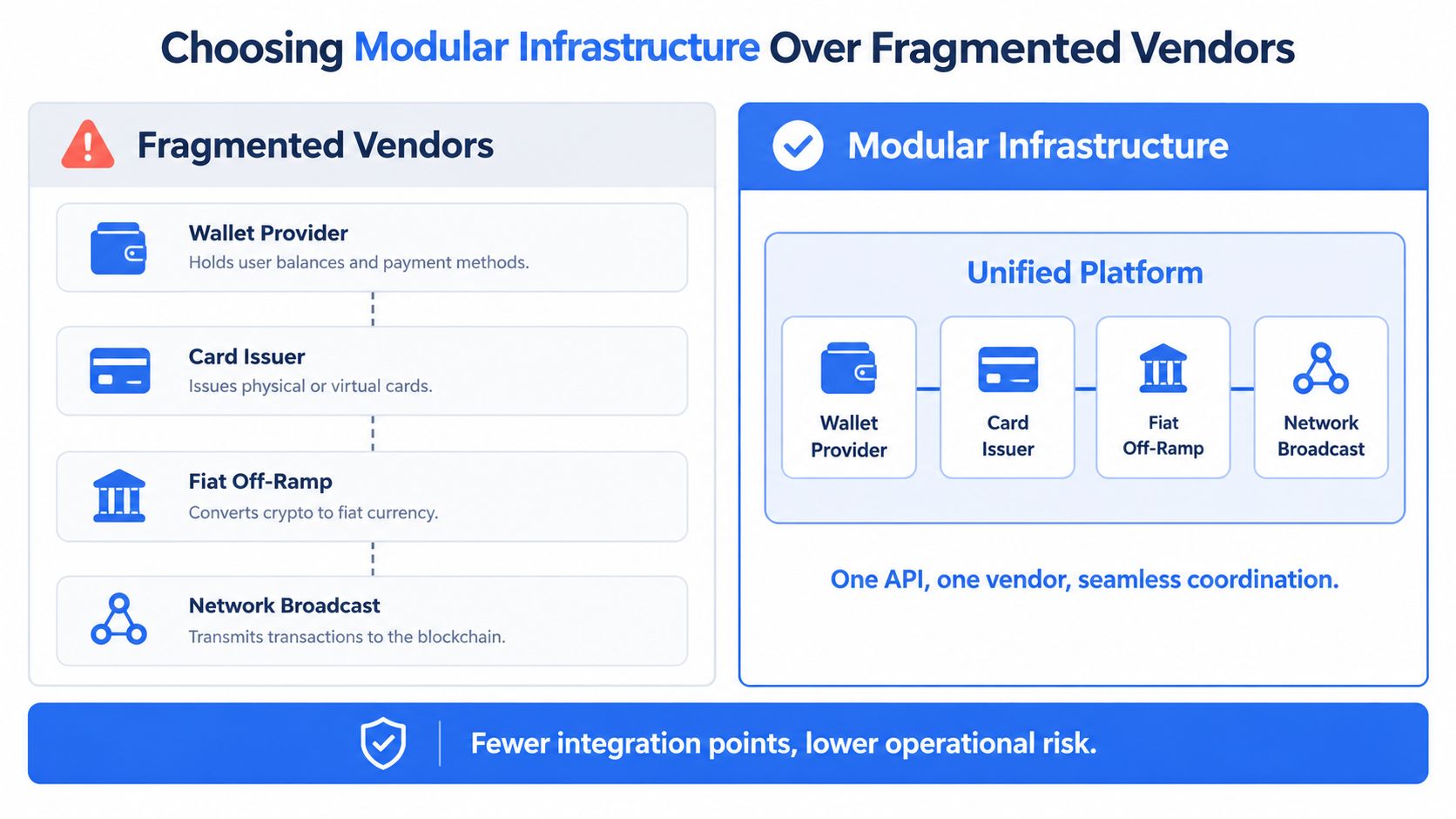
Buyers often compare vendors feature by feature. Wallet provider A wins on chains. Card issuer B wins on price. Off-ramp C wins on coverage. Six months later, the team owns four dashboards, four status models, and no single answer for a stuck customer payment.
Count Integration Points Honestly
| Cost area | Fragmented chain | Modular stack |
|---|---|---|
| Identity and keys | Separate credentials and permissions per vendor | Scoped API keys under one access model |
| Status handling | Custom mapping for every provider state | One state machine with rail adapters |
| Reconciliation | Multiple exports matched manually | One ledger and event stream |
| Incident response | Several support queues pointing at each other | One traceable payment intent |
Modular doesn't mean monolithic. It means components share identifiers, events, and ledger semantics while still letting you adopt pieces in sequence. A team can launch embedded wallets and settlement first, then add BROcard issuing linked to wallet balances, then expand fiat funding through BroWallet flows across Telegram, web, and mobile.
Match Commercial Terms to Uncertain Volume
Early volume is unpredictable. Fixed minimums punish teams for launching carefully, while per-component tiers aligned to actual usage let costs grow with revenue. Ask vendors what happens at low volume, what triggers a tier change, and which modules you can add without re-platforming wallets or changing deposit addresses.
Audience fit differs, but the test stays the same. A neobank needs wallet, card, and fiat coherence. An iGaming operator needs per-player deposit handling and payout policy. An enterprise treasury team needs approval policy and audit evidence. If a stack forces all three into unrelated vendor contracts, integration risk sits with you.
Our payment gateway solution breakdown details how gateway, wallet, and reconciliation functions fit together. Evaluate any provider against that full surface, not a demo of one successful transaction.
The practical lesson: Buy the operating model, not the feature list. Features that don't share state create work for your finance and support teams every single day.
Managing Risk and Authorized Scam Liability
Stronger login security hasn't ended consumer harm. Criminals adapted. Instead of breaking into accounts, many now persuade account holders to authorize transfers themselves, often through impersonation, fake investment offers, or urgent payment requests.
Unauthorized Fraud Is Not the Same Problem
In unauthorized fraud, a third party uses stolen credentials or card data without the customer's consent. Authentication, tokenization, device signals, and transaction monitoring address much of that risk, and liability frameworks often reflect the absence of consent.
Authorized scams break that logic. The genuine customer logs in, passes checks, and approves the payment under manipulation. Your systems see a valid actor giving a valid instruction. The control question shifts from identity to intent.
The scale is material. Visa identified nearly $1 billion in scam-related activity from July through December 2025, making scams the largest category of consumer payment fraud, while Consumer Reports found 61% of surveyed credit-card scam victims recovered money compared with 15% of peer-to-peer service users, according to figures summarized alongside Visa's Spring 2026 Biannual Threats Report announcement. Rail choice and dispute rights shape recovery long before your support team gets involved.
Controls Before the Customer Approves
Pre-payment controls must test intent, not just identity.
- Beneficiary verification: Flag name mismatches, new payees, and destinations linked to known scam reports.
- Transaction-intent confirmation: Ask what the payment is for and surface specific warnings tied to that answer.
- Cooling-off rules: Delay first payments to new high-risk beneficiaries above defined thresholds.
- Risk-based step-up: Require stronger confirmation when device, amount, payee, or behavior deviates from history.
Generic warnings don't work well. A prompt asking whether someone instructed the customer to move money to a safe account interrupts a script. A banner saying scams exist doesn't.
AI Agents and automated payout actors need the same discipline through AI Agent Wallets with per-agent limits, allowlisted destinations, and role-based permissions. An agent that can pay anyone any amount is an authorized-fraud channel waiting for a prompt or credential failure.
Controls After Approval
Speed decides whether recovery is plausible. Document rapid recall paths per rail, escalation contacts, evidence preservation steps, and customer communication deadlines before an incident forces improvisation. Preserve device data, authentication records, warning screens shown, customer responses, and beneficiary details in tamper-evident form.
Liability standard to design for: If the customer approved it, who bears the loss, and what evidence could change that answer?
Answer that contractually and operationally. Terms, product copy, warnings, and staff playbooks should align. Inconsistent statements create dispute exposure even when your technical controls performed exactly as designed.
Executing the Integration and Go-Live Roadmap
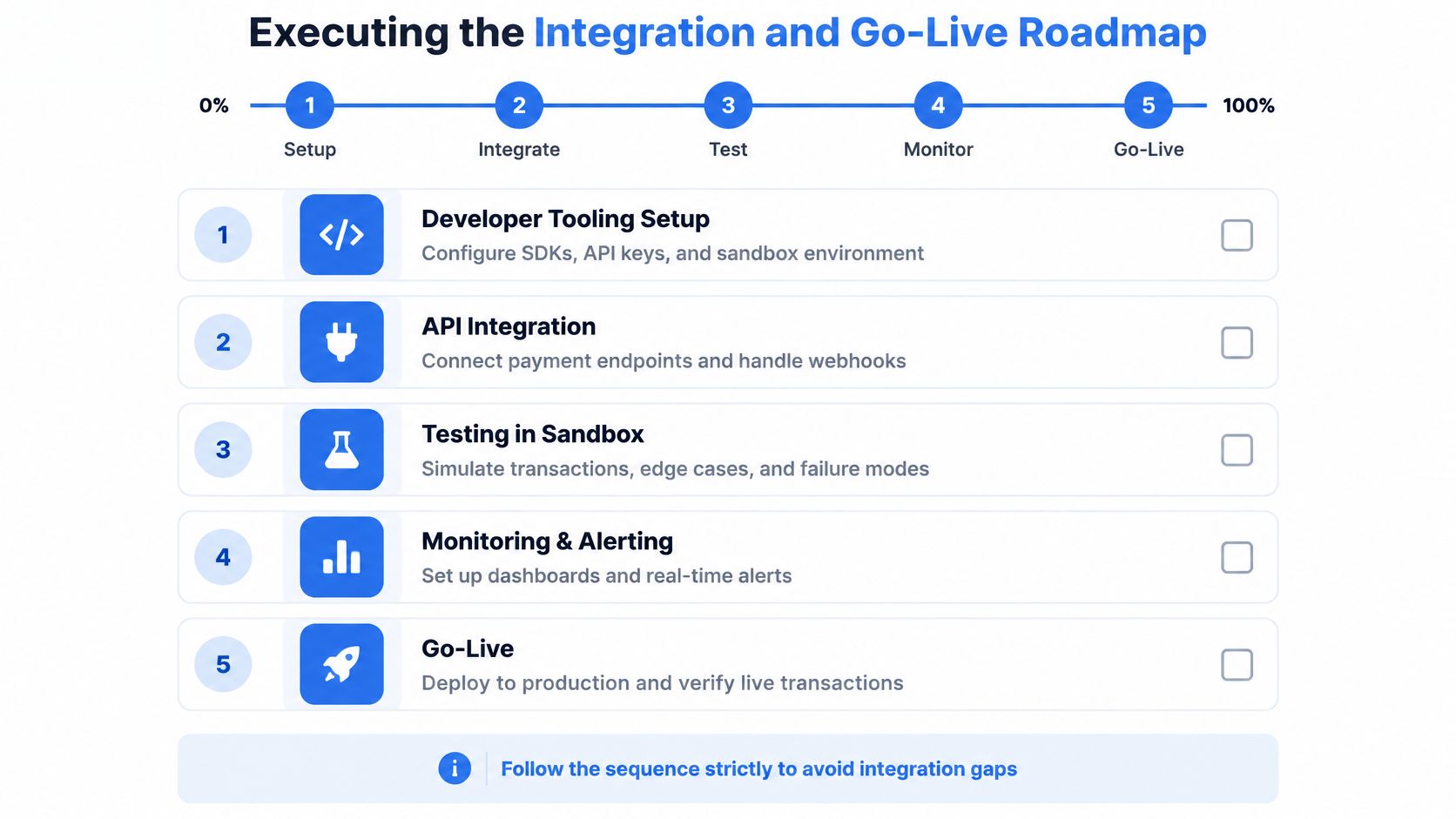
A disciplined rollout beats a fast one that skips failure testing. Work through these stages in order.
- Set up credentials safely. Configure REST access from the OpenAPI specification, Ed25519 authentication, IP allowlisting, and replay protection. Issue scoped API keys so a reporting service can't initiate withdrawals.
- Build the state machine first. Implement idempotent payment creation, event deduplication, and ledger posting before polishing user-facing status screens.
- Test failure modes in sandbox. Simulate declined authorization, delayed confirmation, duplicate events, policy rejection, reversal, and one-leg settlement failure.
- Calibrate money controls. Tune the fee engine, confirmation thresholds, release tiers, Co-Signer policy, and role-based access for operators and AI Agent Wallets.
- Run a controlled go-live. Start with capped amounts and allowlisted users, reconcile daily, and review every exception before raising limits.
Frequently Asked Questions
Which mainnets can we support at launch? Plan around the networks your customers fund from, then expand. BroSettlement supports 10+ mainnets including BTC, ETH, SOL, BNB, TRX, POL, BASE, and ARB, but each added chain needs its own confirmation and fee policy.
How do per-player USDT flows work for iGaming? Each player gets a dedicated deposit address, including TRC20 where required. Deposit events move from observed to confirmed, screening and operator policy run, and only then does balance credit or payout signing proceed.
Can we start with one module and add cards later? Yes, if wallet identity, ledger entries, and events stay consistent. Adding card issuing later should link spend to existing wallet balances, not create a parallel balance system.
What should we test before raising limits? Reconciliation breaks, duplicate submissions, delayed settlement, scam-warning flows, and manual review handoffs. Happy-path payments are the easiest part of the system.
If you're building a digital payment process that has to survive reconciliation, disputes, and real operating volume, Bro has your back with modular wallets, MPC settlement, cards, fiat flows, and an event-driven ledger under one API. Explore the infrastructure and talk through your launch architecture at BroLabel.