It's Monday morning. Finance has three processor exports open, a bank statement that arrived after the weekend, and a payout that appears in the product database but not in the settlement file. Product wants to add another payment method, while compliance is asking who approved a withdrawal during an incident last month. The sandbox showed successful payments, but it never demonstrated what happens when a webhook is delayed, a transaction is reversed, or a customer retries the same request.
That's the point at which digital payment solutions for businesses stop being a checkout decision and become an operating-system decision. The useful question isn't only how quickly a provider authorizes a payment or what its headline fee looks like. It's whether your team can follow money from intent to authorization, settlement, exception handling, reconciliation, and final approval without stitching together unreliable exports.
Table of Contents
- Why Businesses Rebuild Their Payment Stack
- The Five Categories That Make Up a Modern Payment Stack
- Selection Criteria That Separate Real Infrastructure from Demos
- Integration Approaches, APIs, and the Sandbox to Production Path
- Security, Compliance, and the Real Cost of Faster Settlement
- A Modular Event-Driven Reference Architecture
- Edge Cases, Fallbacks, and the Exception-First Mindset
Why Businesses Rebuild Their Payment Stack
A payment lead rarely starts a rebuild because the checkout button is visibly broken. More often, the failure appears in the gaps between systems. The gateway says a transaction succeeded, the bank reports a deposit later, the ledger records a different reference, and the customer support team sees a status that doesn't match any of them.
The finance team then performs archaeology. Someone maps processor IDs to internal order IDs in a spreadsheet. Someone else checks whether a refund was included in a later batch. The compliance lead searches chat messages for approval evidence, while engineering adds another webhook retry because the first integration didn't make event delivery durable. Each workaround solves a local symptom and increases the number of states nobody owns.
A product team can ship a new payment method quickly and still make the business less reliable. Fast integration without idempotency, explicit lifecycle states, role-based approvals, and an append-only ledger creates a system that looks responsive to customers but remains opaque to operators.
Practical rule: Evaluate a payment provider by the control surface it exposes, not by the speed of its front-end checkout.
A sound stack should answer straightforward questions without manual reconstruction:
- Who initiated the payment?
- Which authentication and policy checks passed?
- Which account, wallet, or merchant balance received the funds?
- What happened when confirmation arrived late or twice?
- Who approved a payout, under which policy, and with what evidence?
The broader market makes this operational discipline more important. The World Bank Global Findex reports that the share of adults worldwide with an account at a bank, regulated financial institution, or mobile-money provider rose from 51% in 2011 to 76% in 2021, a 25-percentage-point increase. In developing economies, the share of adults making or receiving digital payments rose from 35% in 2014 to 57% in 2021. More customers can pay digitally, but that doesn't mean every business has the controls to operate digital money safely.
The takeaway is simple: digital payment solutions for businesses are best evaluated by their operational control surface, not by front-end speed alone. The control surface includes the ledger, event stream, replay behavior, custody model, approval paths, compliance evidence, and reconciliation process.
For a useful overview of the technology field, see digital payment technology. The important distinction is that technology availability doesn't remove operational responsibility. It makes the quality of your operating model visible.
The Five Categories That Make Up a Modern Payment Stack
A modern stack is easier to evaluate when each component is tied to a business job. The categories overlap, but they don't solve the same problem.
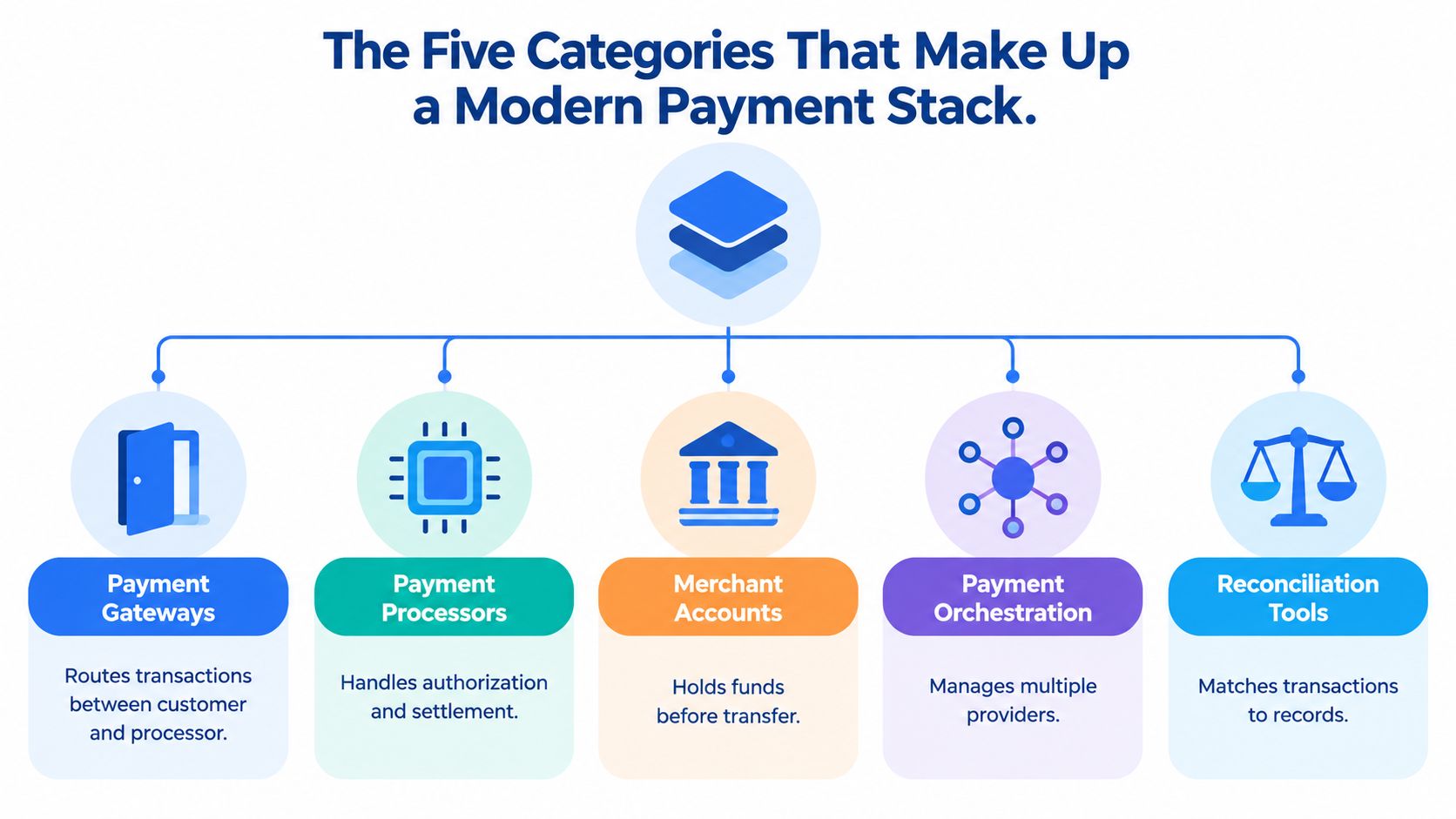
Payment gateways and processors
A payment gateway captures payment details, routes the request, and returns an authorization result. It supports checkout use cases, recurring billing, card acceptance, and alternative payment methods. A processor handles the underlying authorization and settlement relationship with financial networks.
The operational question isn't only whether the gateway accepts a payment. Ask whether it exposes clear statuses for authorization, submission, confirmation, failure, reversal, and dispute. Also check whether the provider's references remain stable across retries and settlement files.
Merchant accounts and orchestration
A merchant account holds funds before transfer to the business's bank account. That separation matters for settlement timing, reserves, refunds, and finance reporting. Payment orchestration sits above individual providers and routes transactions across multiple processors or rails according to rules such as geography, method, risk, availability, or cost.
Businesses comparing orchestration patterns may find see how MCA Pay handles orchestration useful because the central issue is provider coordination, not merely adding another checkout button.
Digital wallets and card issuing
A digital wallet maintains a balance, identity relationship, transaction history, and funding or withdrawal paths for an end user. It can support treasury top-ups, customer balances, agent wallets, and controlled payouts.
A card-issuing platform gives a product team the ability to create branded virtual or physical cards, apply spending controls, and connect card activity to a wallet or account balance. It's useful when a business needs controlled employee spending, customer cards, marketplace payouts, or a financial product embedded in its own interface.
ACH and account-to-account rails
ACH and other account-to-account rails serve bank-funded collections, domestic payouts, recurring transfers, and treasury movement. Instant account-to-account systems add a different operational requirement: the business must handle confirmation, fraud controls, reconciliation, and customer support continuously rather than assuming that bank processing happens in predictable batches.
Use cases determine whether a rail is appropriate. A marketplace may need bank payouts, while a treasury team may prioritize account funding and reconciliation. The right question is which rail produces the evidence and settlement behavior your finance process can support. For a broader view of payment-method selection, review forms of payment.
Embedded crypto rails
Embedded crypto payment rails connect wallets, blockchain networks, stablecoins, and fiat off-ramps to an existing product. They can support treasury transfers, international settlement, agent wallets, and customer deposits. They also introduce network selection, wallet ownership, chain confirmation, sanctions screening, wrong-network deposits, and liquidity management.
That makes crypto an additional control surface, not a shortcut around payment operations. A business should adopt it when the settlement or distribution problem justifies the operational work.
Selection Criteria That Separate Real Infrastructure from Demos
A demo can prove that a payment request returns quickly. It usually won't prove that a duplicate webhook leaves the ledger unchanged, that a payout requires the right approval, or that a finance user can reconcile a delayed confirmation without opening a support ticket.
Score providers against observable behavior. Ask for API documentation, event examples, failure states, sandbox scenarios, settlement reports, and evidence-retention rules. If the answer is a slide instead of a documented behavior, treat the capability as unverified.
The buyer's control matrix
| Category | Latency | Custody | Ledger Quality | Multi-Rail | Compliance Hooks | Event Depth |
|---|---|---|---|---|---|---|
| Payment gateway | Usually strong for authorization | Provider or merchant-account dependent | Often focused on transaction records | Cards and selected alternative methods | Authentication and transaction-risk integrations | Webhooks may be narrow |
| Digital wallet | Balance updates can be immediate | Provider, client, or shared model | Must support balance history and adjustments | Wallet funding and withdrawals | Identity, transaction monitoring, access controls | Balance, transfer, and withdrawal events |
| Card issuing | Authorization is designed for real-time decisions | Issuer and program dependent | Card ledger must connect to settlement records | Card network plus linked funding source | Spending rules, identity, program controls | Authorization, clearing, dispute, and card events |
| Account-to-account rails | Depends on domestic rail and confirmation model | Bank or payment-provider dependent | Reconciliation quality is decisive | Domestic and selected cross-border rails | Beneficiary checks, sanctions, fraud controls | Submission, confirmation, return, and exception events |
| Embedded crypto rails | Network and policy dependent | Non-custodial or provider-controlled | Requires chain and internal ledger correlation | Multiple supported networks and fiat paths | AML, sanctions, wallet screening, policy approval | Deposit, confirmation, withdrawal, and broadcast events |
A provider should explain authorization latency separately from confirmation latency. The first tells you how quickly a decision is returned. The second tells you when the system can treat funds as settled or available. Conflating them creates misleading customer statuses and unsafe payout logic.
Next, inspect the settlement model. Does the provider batch funds, settle continuously, or expose an intermediate state? Can the business distinguish reserved funds from confirmed funds? Are refunds, reversals, and disputes first-class ledger entries?
Ledger quality deserves its own review. An immutable or append-only operating ledger should preserve the original event, adjustments, policy decisions, and reconciliation references. It should also support a durable payment identifier that survives retries and asynchronous provider updates.
Finally, ask about custody and authority. Who controls signing keys? Can the client define approval policy? Can operators separate initiation from approval? For a practical view of gateway responsibilities and integration boundaries, see this payment gateway solution guide.
RFP test: Require a documented answer for every cell in the matrix, including failure behavior, evidence retention, and the process for correcting an exception.
Integration Approaches, APIs, and the Sandbox to Production Path
A production payment integration should feel boring. The request has a durable identifier, credentials have narrow scope, retries are safe, events are verifiable, and the ledger doesn't depend on the order in which webhooks happen to arrive.
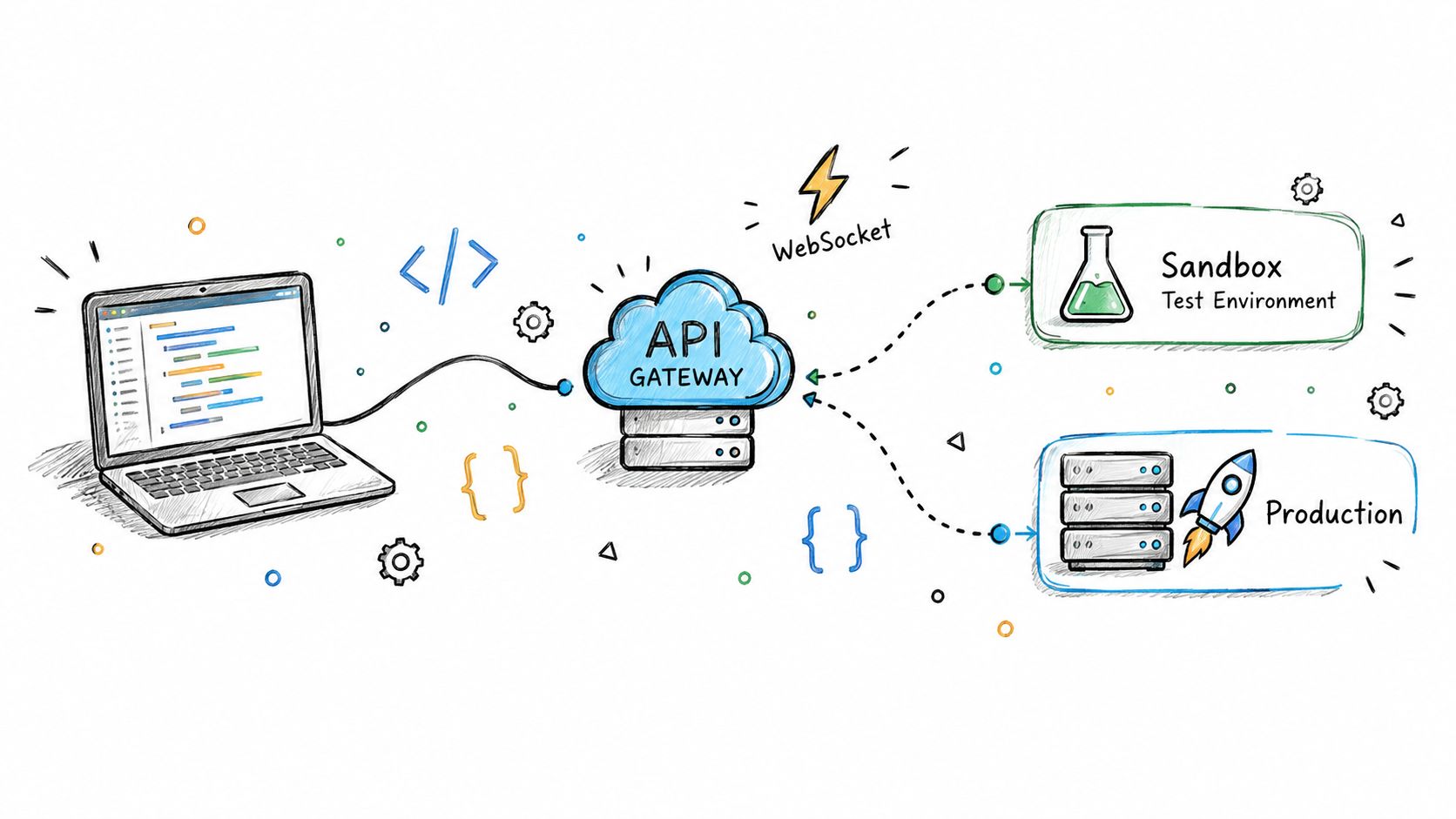
REST APIs usually handle commands such as creating a payment, provisioning a wallet, submitting a withdrawal, or requesting a card. WebSocket events provide a better fit for ongoing status changes, including deposits, confirmations, withdrawals, and policy outcomes. OpenAPI documentation makes the contract inspectable, while SDKs can reduce repetitive client-side work. Neither replaces a clear event model.
A safer request path
Use scoped API keys, not one shared secret copied across services. Add an IP allowlist where the deployment model supports it, use Ed25519 or an equivalent signing method where required, and reject replayed requests with timestamps, nonces, or provider-supported replay protection.
Idempotency belongs at the command boundary. A client that retries create_payment after a timeout must receive the original result or a controlled pending state, not create a second debit.
A durable flow looks like this:
- The application submits a payment request with a client-generated idempotency key and a durable internal reference.
- The API creates
payment.createdand returns the payment identifier. - Authentication and compliance checks produce
authentication.passedandcompliance.approved, or a controlled failure. - The system reserves funds and emits
funds.reserved. - The payment is submitted to the selected rail.
- A WebSocket event or webhook reports
payment.confirmed,payment.failed, or a later reversal. - The ledger reconciles the internal record with the provider or network settlement record.
A second request with the same idempotency key should return the existing payment state. A delayed webhook should update that payment, not create a new one. A production review should test duplicate requests, out-of-order events, expired credentials, rejected policy checks, delayed confirmations, and manual review.
Partner payouts add another layer because onboarding, connected accounts, verification, and payout permissions must align. A guide to partner payout onboarding can help teams compare the operational pieces before they commit to a provider pattern.
Security, Compliance, and the Real Cost of Faster Settlement
Faster settlement changes when fraud controls must act. The Federal Reserve identifies the trade-off clearly: less time between authorization and settlement leaves less time to scrutinize risk and can create additional fraud opportunities. The Federal Reserve analysis of risks in faster payments is useful because it treats speed as a design constraint, not a security feature.
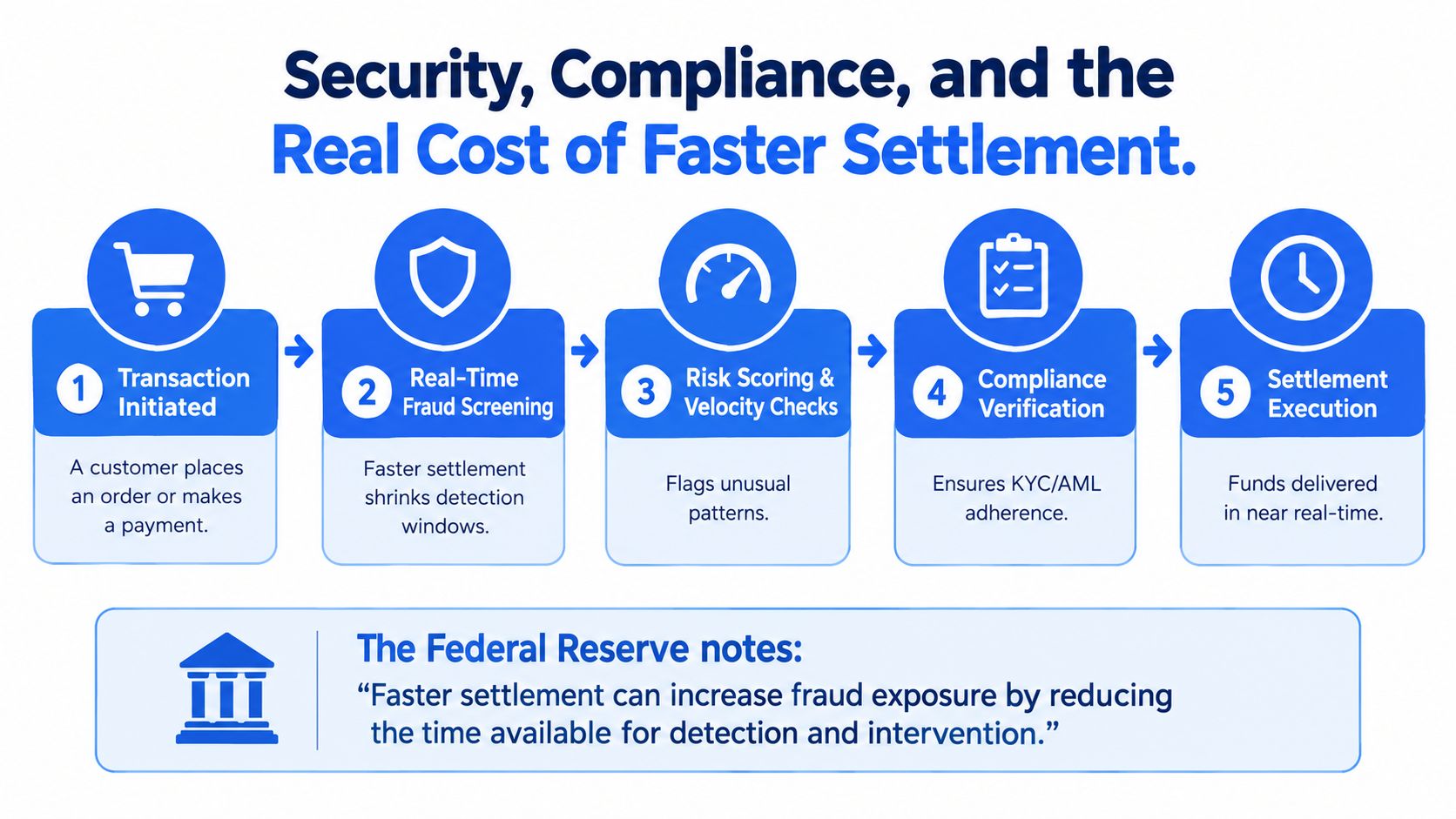
Post-transaction review can still support investigations, but it can't be the main defense when a transfer is difficult to reverse. Screening, beneficiary validation, velocity limits, device or account-risk scoring, and transaction-policy checks belong in the authorization path.
A layered control pattern combines:
- Authentication factors: Use knowledge, possession, and biometric factors where appropriate.
- Context signals: Evaluate device, behavior, beneficiary, amount, history, and transaction purpose.
- Step-up handling: Route higher-risk payments to additional verification, manual review, or delayed release.
- Role separation: Keep initiation, approval, signing, and reconciliation under distinct permissions.
- Evidence retention: Store the request identifier, policy version, actor, authentication result, risk outcome, and final disposition.
Authorized push-payment scams illustrate why credential authentication isn't enough. A user may approve a transfer after being manipulated, while the credentials remain valid. The system must evaluate the recipient and transaction context, not only whether the person entered the right factor.
Every state change should be idempotent, replay-protected, and auditable. That record supports dispute analysis, reconciliation, and regulator-facing review without asking engineers to reconstruct history from application logs.
Payment fraud remains a material operating concern. The Association for Financial Professionals reported that 79% of surveyed organizations experienced actual or attempted payments fraud in 2024, and business email compromise affected 63% of surveyed organizations, according to the 2025 AFP Payments Fraud Control Survey highlights. Those figures reinforce the architecture point: a digital payment is not controlled merely because it's electronic.
For commerce teams, chargebacks require their own operational path, including evidence capture, dispute status, and customer communication. A practical Shopify chargeback protection guide offers relevant context for teams designing those workflows.
A Modular Event-Driven Reference Architecture
The reference architecture starts with an event bus, not with a checkout form. Commands create durable records, state transitions emit events, and each downstream service consumes the events it needs without becoming the system of record for every other service.
At the center is an append-only operating ledger. It records payment intent, authorization decisions, reservations, submissions, confirmations, reversals, refunds, fees, and reconciliation adjustments. The ledger should correlate internal identifiers with provider references and network transaction IDs, while preserving the original event rather than overwriting it.
Control and settlement modules
BroSettlement handles DKG and MPC 2-of-3 signing with a client-controlled Co-Signer and a defined signing policy. The value is not the label “MPC.” The value is separating signing authority, making production approvals explicit, and avoiding a single centralized custody key.
BroWallet supports Telegram, web, and mobile flows for buying, selling, exchanging, bank and card funding, and fiat withdrawals. That gives product teams a user-facing wallet path without forcing every payment workflow into a single monolithic application.
AI Agent Wallets create per-agent, non-custodial wallets with RBAC and audit trails. A treasury agent, trading agent, or service agent can operate within a defined policy instead of sharing a general-purpose wallet with unrelated actors.
The event stream carries deposits, confirmations, withdrawals, broadcast results, and policy outcomes through WebSocket connections. Finance consumes those events for reconciliation. Risk consumes them for monitoring. Product consumes them for customer status. Each team sees the same lifecycle without polling several vendors independently.
Cards and developer access
BROcard adds Mastercard issuing with virtual and physical cards, plus Apple Pay and Google Pay. Card controls and wallet balances can remain linked within one operating flow, which is useful for businesses that need both on-chain balances and familiar spending instruments.
Developer access uses REST, OpenAPI, Ed25519 authentication, scoped API keys, IP allowlists, replay protection, and a sandbox. The design supports a staged path from test traffic to production operations, while allowing a business to embed only the modules it needs.
A PSP may use wallet provisioning, multi-rail settlement, card issuing, and reconciliation. An iGaming operator may create per-player USDT deposit addresses, consume deposit.observed and deposit.confirmed events, and apply operator policy before payout signing. An enterprise treasury team may use controlled wallets, fiat funding, network broadcast, ledger entries, and approval workflows without exposing signing authority to one service.
The Federal Reserve faster-payments progress report emphasizes safety, security, resiliency, identity management, and fraud-data sharing as separate requirements. That maps directly to the architecture. Event delivery doesn't replace access control, and MPC doesn't replace reconciliation.
Edge Cases, Fallbacks, and the Exception-First Mindset
A payment stack earns trust when the normal path is unremarkable and the abnormal path is explicit. Before launch, the team should be able to answer what happens when a confirmation arrives after the customer-facing request times out, when a refund follows a partial settlement, or when a provider reports success but the expected funds aren't visible in the settlement account.
Stablecoin flows make those questions more concrete. Determine which entities may legally pay or receive funds in each market, how wallet ownership is established, and how sanctions screening is applied. Define procedures for chain reorganizations, wrong-network deposits, stablecoin depegs, refund requests, and fiat off-ramp failures before customers encounter them.
The fallback state is part of the product
A solid fallback procedure is a documented state transition:
- Hold release: Keep funds unavailable when confirmation or policy evidence is incomplete.
- Classify the exception: Distinguish timeout, duplicate event, network issue, compliance concern, wrong network, and settlement mismatch.
- Escalate by authority: Route the case to the appropriate operations, risk, or compliance role.
- Use a secondary rail: Switch to an approved alternative only when policy permits it.
- Reconcile and close: Record the final outcome, supporting evidence, and ledger adjustment.
Cross-border payments add costs, processing delays, complex forms, and foreign-exchange controls. The EY-Parthenon stablecoin survey reports that more than 60% of surveyed SMEs faced high costs, long processing times, complex forms, or FX controls, while 54% paid at least 5% for cross-border transactions and 96% used workarounds. These findings appear in the EY-Parthenon stablecoin survey, and they point to a practical conclusion: settlement friction doesn't disappear when a business changes rails.
Stablecoin readiness also requires honest adoption analysis. In the same survey, 13% of corporates and financial institutions globally had already used stablecoins, 54% reported increased interest during the prior 6 to 12 months, and 36% said integration would require major system changes. Those numbers describe uneven momentum, not a reason to skip controls.
The better buyer question is not “How fast can money move?” It's “How safely can the business continue when money doesn't move as expected?” Evaluate the ledger, event stream, approvals, fallback states, and evidence before evaluating the headline settlement speed.
BroLabel provides modular infrastructure for embedded wallets, MPC settlement, network broadcast, cards, fiat integrations, WebSocket events, and an append-only operating ledger. Visit BroLabel to evaluate the modules against your reconciliation, custody, payout, and compliance requirements before committing to a production payment architecture.