Most advice about an electronic payment option starts in the wrong place. It treats the choice as a race between speed and fees, then ignores the part that breaks teams in production, what happens after an authorization, when a reversal lands late, or when a reconciliation row never shows up at all.
The better question is harder and more useful. Which rail gives you enough evidence, control, and recovery to run finance, compliance, and operations without guessing? That question matters because digital payments are now mainstream, but adoption is uneven, and access still does not guarantee actual use, with about 1 billion account-owning adults globally making no digital payment in 2021, according to the World Bank's Global Findex 2021 report.
The operational enemy is silent payment failure. A payment can be authorized and still not settle, a refund can fail to unwind, a duplicate webhook can create a false credit, or a payout can move before the evidence is complete. If you want a useful companion read on that broader problem, find hidden monitoring gaps before you trust a dashboard that only shows green states.
Practical rule: choose the rail that leaves a clean audit trail when the happy path breaks, not the one that looks fastest in a product deck.
A serious stack answers that with MPC signing, an append-only ledger, real-time events, and idempotent state changes. That combination doesn't remove risk, but it changes payment handling from hope into a sequence of recorded decisions.
Table of Contents
- The Real Enemy Is Silent Payment Failure
- The Five Core Electronic Payment Rails Explained
- How to Compare Electronic Payment Options Honestly
- What Actually Happens When a Payment Goes Wrong
- Building the Control Layer Around Every Payment
- Compliance, 3DS, and Treating Payment Data as Evidence
- Resilience, Fallback, and the Limits of Digital by Default
- A Practical Implementation Checklist and Buyer FAQ
The Real Enemy Is Silent Payment Failure
Teams typically ask which electronic payment option is cheapest or fastest. That's the wrong first filter. The main failure mode is a payment lifecycle that becomes invisible the moment it leaves the checkout page, which is how finance teams end up reconciling against guesswork instead of records.
Why authorization is not the same as completion
An authorization only tells you that a network accepted a request at a moment in time. It does not prove final settlement, and it certainly doesn't prove the transaction won't be challenged later. In card flows, bank transfers, wallets, and crypto rails, the status that matters for operations is the one that survives retries, reversals, and exceptions.
That's why infrastructure teams should care more about state transitions than about labels. A good payment system records the intent, the policy decision, the broadcast or submission, the confirmed result, and any reversal as separate events. If those states collapse into one “successful” flag, finance loses the ability to explain what happened when the money doesn't arrive where it should.
What the operator actually needs
The useful shortlist isn't “card or wallet or transfer.” It's whether the rail supports:
- Traceable evidence, so finance can reconstruct what happened.
- Clear settlement semantics, so nobody mistakes a temporary approval for finality.
- Repeat-safe processing, so retries don't create duplicate credits.
- Controlled release, so irreversible actions pass through policy before they happen.
The institutional pattern starts to matter here. MPC signing protects the custody layer, the ledger preserves accounting truth, and event streams tell downstream systems when to react. The rail still matters, but the control layer determines whether you can operate it safely at scale.
The Five Core Electronic Payment Rails Explained
A buyer paying a vendor across borders may see five different payment choices, but under the hood they solve different problems. Each one has a different answer for authorization, settlement, reversibility, and evidence.
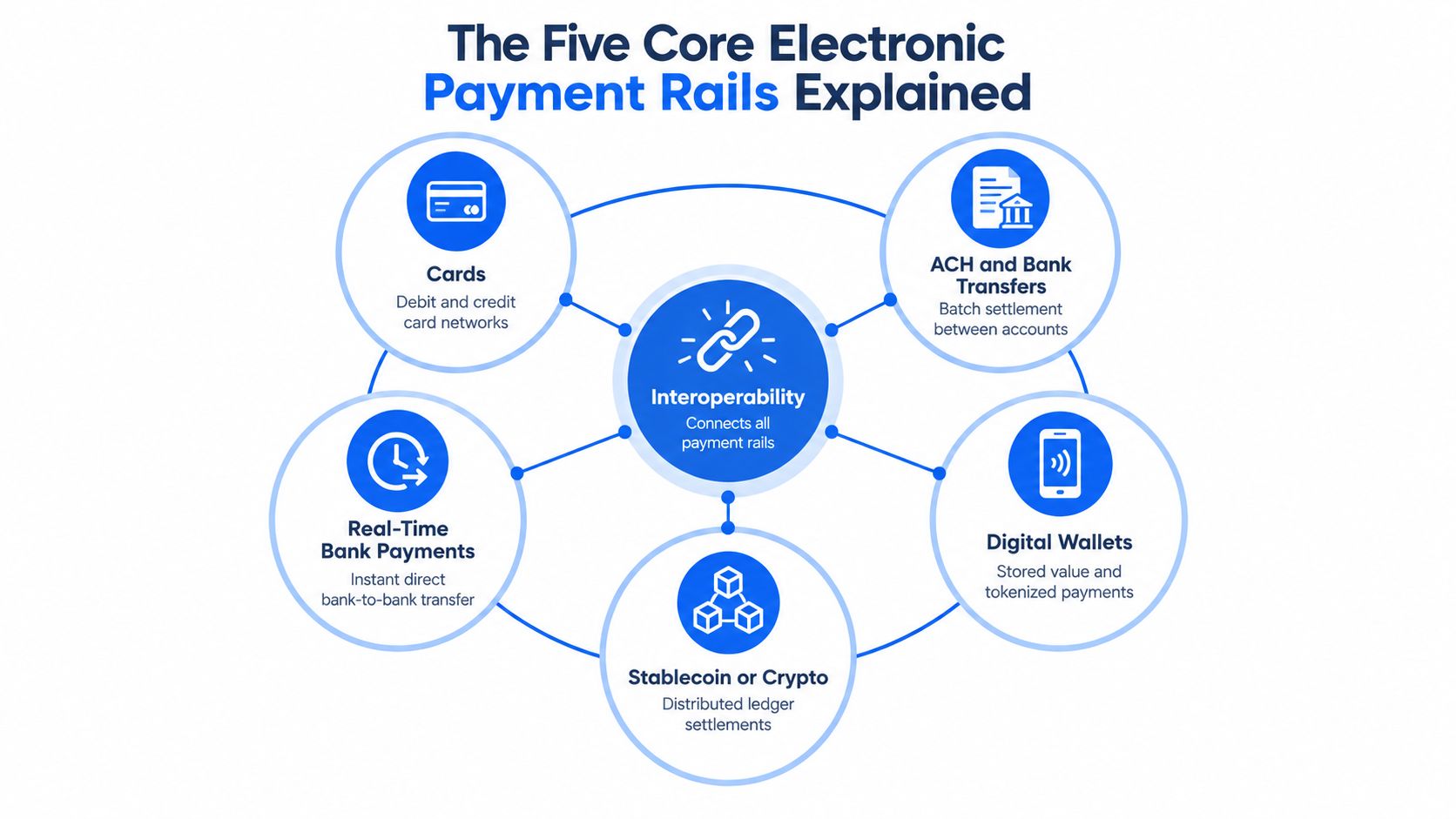
Cards and card-linked wallets
Cards are built around authorization first, settlement later. That makes them convenient for commerce, but it also means the initial approval is only one checkpoint in a longer lifecycle. EMV 3-D Secure adds risk-based authentication and can include extra data in the exchange, which helps issuers decide whether to approve or challenge a transaction EMVCo.
A wallet-linked card flow uses the same basic mechanics, but the user experience is cleaner because tokenization and stored credentials reduce friction. The trade-off is familiar to anyone who has worked payments for a while, cards can be easy to launch and hard to unwind after a dispute.
ACH and bank transfers
Bank transfers and ACH usually trade speed for operational predictability. They're good when the business can tolerate slower movement in exchange for familiar bank-account rails and broad merchant acceptance. They're also easier to understand when the main issue is account-to-account movement rather than customer authentication.
Their weak point is reversibility and timing. Batch-style processing can make a refund or recall feel like a separate project, which is why teams that rely on them often need stronger reconciliation discipline than they expect.
Real-time bank payments and digital wallets
Real-time bank payments push money quickly, but geographic reach and provider interoperability still limit where they work cleanly. Digital wallets add tokenization, device-linked authentication, and a better mobile flow. They're useful when the business wants a tighter user experience without forcing direct card entry every time.
The catch is that “wallet” describes the user interface, not the whole operating model. If the wallet doesn't expose clear status, funding source, and reversal logic, you just moved the complexity instead of removing it.
Stablecoin or crypto payments
Stablecoin or crypto flows can settle around the clock and leave a ledger trail that's useful for audit and automation. That makes them attractive for cross-border treasury, platform payouts, and agent-driven workflows. They also introduce different controls, including signing policy, compliance review, and network fee handling.
The payment rail is only as good as the evidence around it. That's why teams often pair this flow with an append-only ledger, policy checks before broadcast, and event streams that show observed, confirmed, and reversed states separately. For a broader product vocabulary around this choice, the form of payment guide is a useful internal reference.
The rail is not the architecture. The architecture is the part that survives exceptions.
How to Compare Electronic Payment Options Honestly
A practical comparison works only if every option is judged against the same criteria. Otherwise, teams end up picking the rail that sounds modern, then discovering too late that its reversibility, evidence trail, or operational load doesn't fit the business.
| Rail | Settlement finality | Reversibility | Evidence trail | Typical cost | Global reach |
|---|---|---|---|---|---|
| Cards | Moderate, with later settlement | Strong dispute and chargeback support | Good, especially with authentication data | Usually higher | Broad |
| ACH and bank transfers | Slower, not always immediate | Limited and procedure-driven | Strong bank record, but not always real-time | Usually lower | Broad, but uneven by market |
| Real-time bank payments | Fast once supported | Limited after release | Good transaction visibility | Varies by corridor | More limited than cards |
| Digital wallets | Depends on the funding rail | Depends on wallet rules | Good if the wallet exposes state | Varies | Broad for consumer use, uneven for B2B |
| Stablecoin or crypto | Fast once confirmed | Limited after broadcast | Strong on-chain evidence, but needs internal reconciliation | Network-dependent | Global where the asset and compliance model fit |
The right choice depends on the business objective. A merchant with high chargeback exposure may prefer cards because the dispute process is built in. A treasury team moving cross-border value may value stablecoin settlement because the operational trail is explicit and the transfer is easier to automate.
The trade-off is consistent across rails. Faster settlement often means weaker recourse, and cheaper rails often mean more work in reconciliation. If you want a second opinion on how gateway choices get compared in practice, how Resolut compares gateways is a useful adjacent read.
A scoring lens that actually works
Use the same five questions for every rail:
- Will the payment be final when I think it is?
- Can I reverse or recall it if something goes wrong?
- What evidence will finance have at audit time?
- How much operational work does each exception create?
- Can the rail reach the markets I care about?
That's a better shortlist than “fastest” or “cheapest.” For teams documenting the broader product architecture, digital payment technology belongs in the same planning file because the tech choice and the payment choice are tightly linked.
What Actually Happens When a Payment Goes Wrong
A vendor in one country sends an invoice, a customer in another country pays it, and the dashboard lights up as successful. Then the work begins. The card leg gets a chargeback notice, the bank transfer returns because the account is closed, the stablecoin payout pauses for compliance review, the wallet refund takes days to unwind, and a duplicate webhook threatens to credit the balance twice.
The happy path is not the important path
The happy path only proves the first state transition. It does not tell you whether the payment is truly settled, whether the merchant can use the funds, or whether the customer can dispute the charge later. In operations, the question is never “did the payment happen?” The question is “which state happened, and who owns that truth?”
That's where an append-only ledger earns its keep. It preserves the sequence of intent, authorization, confirmation, reversal, fee, and destination so finance can reconstruct the full story later. WebSocket events serve a different job, they tell downstream systems when something changed so they can react in near real time.
Failure modes that expose weak architecture
A few common problems reveal whether the stack is real or decorative:
- Chargeback on the card leg, which needs evidence and lifecycle tracking.
- Returned bank transfer, which should update both the ledger and the operator view.
- Compliance hold on a crypto payout, where the transfer must stop before release.
- Duplicate webhook, which should be ignored by idempotent consumers.
- Late refund, which can't be treated as resolved until the reversal is confirmed.
Each of those cases tests the same thing, whether your payment system distinguishes event occurrence from financial finality. If it doesn't, the business will overstate balances, understate risk, or both.
Operational truth: a payment platform is judged by the exceptions it records correctly, not by the approvals it celebrates.
Building the Control Layer Around Every Payment
The control layer is where an electronic payment option becomes safe enough for real operations. Without it, you get fast movement and weak governance. With it, you get state that finance can trust and engineering can replay.
Edge controls first
Start at the boundary. Use scoped API keys, IP allowlists, and replay protection so only the right systems can request a payment and each request can be processed once. Those controls don't slow the business down when they're designed well, they stop accidental duplication and reduce the blast radius of a compromised credential.
Then separate the kinds of truth you keep. The ledger should record what the system believes happened. The event stream should tell downstream systems when to react. Those are not the same thing, and treating them as the same thing is how teams lose accounting integrity.
Signing policy before irreversible action
Any irreversible movement of value should pass a policy gate before the signature is generated. That's where MPC, a client-controlled Co-Signer, and threshold-based approval matter. BroLabel's BroSettlement module is one concrete implementation of that model, while BroWallet packages the user-facing flow for wallet and payment operations.
A production withdrawal shouldn't be “broadcast and hope.” It should be requested, policy-checked, signed under threshold, and then tracked until the lifecycle confirms what settled. If the business uses AI agents, the same logic applies: each agent can propose or initiate, but scoped permissions and approval boundaries still need to govern execution.
A practical operating pattern
Keep these rules in place:
- Idempotency for every state change, so retries don't duplicate credits or payouts.
- Separate reservation from settlement, so finance doesn't spend unconfirmed funds.
- Event-driven status updates, so downstream systems don't poll blindly.
- Role-based exceptions, so one person can't override policy casually.
- Reconciliation against provider reports, so internal records and external reality stay aligned.
This is the part many product teams skip. They build the payment request and forget the operating model that makes the request safe to run every day.
Compliance, 3DS, and Treating Payment Data as Evidence
Payment data is operational evidence. A clean record makes it easier to reconcile risk decisions, justify exceptions, and explain why a transaction cleared, stalled, or failed.
Why the full state machine matters
EMV 3-D Secure pushes more context into the decision process, including transaction and device data, so the issuer can assess risk and decide whether to challenge the user EMVCo. If you only store “approved” or “declined,” you lose the trail that explains the outcome.
The same rule applies to transfer compliance. The UAE Virtual Assets Regulatory Authority rulebook requires specified originator and beneficiary information before initiating a transfer exceeding AED 3,500, and that information must be available to VARA or other appropriate authorities on request VARA rulebook. Identity, destination, and policy checks need to sit inside the payment workflow, not beside it.
Consumer-facing trust checks belong in the same evidence workflow as transaction records. A review of whether is Mega Panalo Casino legit may seem separate from payment processing, but the evidentiary pattern is the same, preserve the checks, the decision, and the reason they were made.
What to persist in the ledger
A serious payment integration should keep:
- Authentication identifiers such as the 3DS transaction references.
- Challenge or exemption outcomes, not just the final approval.
- Originator and beneficiary details where regulation requires them.
- Policy decision records, including holds and manual reviews.
- Settlement status and reversals, so finance can reconcile later.
For platforms that need a structured place to hold that evidence, the append-only ledger and event model in BroLabel's stack are built for that job. Persist the 3DS challenge outcome alongside the authorization result, so a chargeback response can be assembled from the ledger instead of reconstructed from memory.
Resilience, Fallback, and the Limits of Digital by Default
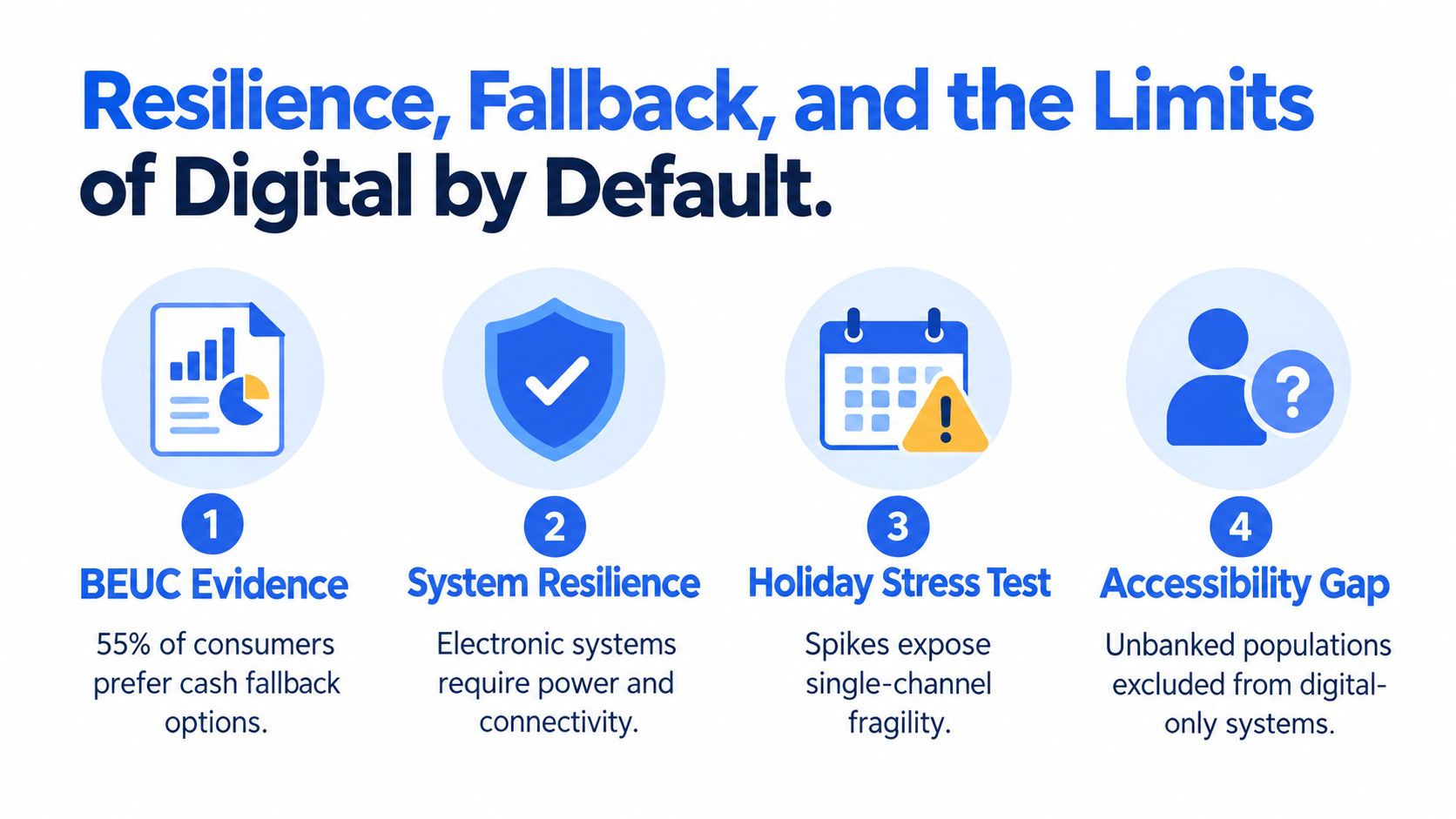
Digital payments are useful, but they're not frictionless. In the BEUC survey, 55% of existing digital-payment users reported difficulties ranging from technical errors to security concerns or lack of skills, and 86% were at least somewhat concerned about being unable to recover money lost to fraud or scams BEUC survey. That should change how buyers evaluate any payment stack.
What resilience really means
A resilient payment design answers uncomfortable questions before production does. What happens when the API is down, when the phone is lost, when the merchant and payer don't share a provider, or when sanctions screening has to pause a payout? If the answer is “the user waits,” the system isn't resilient, it's brittle.
Teams should design for idempotent retries, clear state exposure, and policy holds that can pause a release without losing the record of why it paused. Offline fallback matters too, especially for card-led flows and environments where connectivity can't be assumed. Resilience is a feature, not an afterthought.
A Practical Implementation Checklist and Buyer FAQ
Start with the evidence you need for each rail, then decide where the ledger of record lives. Separate authorization from settlement, enforce policy before signing, and expose every state change as an event. Then rehearse reversals, duplicate callbacks, and compliance holds before the first live payout.
For teams that want a modular implementation path, payment gateway solution is the right planning category, because gateway choice, wallet logic, and reconciliation design should be treated together, not as separate shopping decisions.
FAQ
How should I choose between stablecoin and bank transfer for cross-border B2B?
Pick the rail that matches your settlement, compliance, and reconciliation requirements. If you need rapid settlement with explicit lifecycle evidence, stablecoin flows can work well. If your operations are built around bank reporting and familiar treasury processes, bank transfer may be simpler.
What should I look for in an MPC vendor?
Check the threshold model, who controls each participant, how recovery works, and whether signing policy is enforced before a request reaches the signers. The security label matters less than the operating design around it.
When does a digital wallet reduce compliance burden?
When it centralizes authentication, controls, and status visibility instead of scattering them across disconnected systems. A wallet doesn't remove compliance work, but it can make the workflow easier to evidence and review.
How should I evaluate a card-plus-wallet flow for fintech or iGaming?
Look at authorization, settlement, reversals, ledger treatment, and policy controls as one chain. If those pieces don't reconcile cleanly, the flow will create finance and support issues later.
BroLabel builds the operating layer behind modern payment flows, including MPC wallets, an append-only ledger, event streams, and control-ready settlement. If you're comparing an electronic payment option for cross-border volume, wallet-linked cards, or agent-driven payouts, visit BroLabel and map your reconciliation and signing requirements against the stack before you ship.