
A bank transfer settles cleanly, the customer's balance updates, and the crypto leg remains stuck in review. Or worse, crypto is released twice because a payment event arrived through two delivery paths. Finance discovers the gap during close, compliance can't reconstruct the decision chain, and the operations team starts matching bank statements to blockchain transactions in a spreadsheet.
That isn't a payment-button problem. Fiat to crypto is a regulated, stateful transaction workflow connecting payment identity, beneficiary wallet data, risk decisions, settlement, signing, and reconciliation. The provider you evaluate must hold that entire chain together under normal traffic, retries, manual review, failed payments, and audit pressure.
The market makes the scale clear. Chainalysis found that Bitcoin attracted more than $4.6 trillion in fiat purchase volume on tracked centralized exchanges between July 2024 and June 2025, more than twice the approximately $3.8 trillion directed into Layer 1 assets excluding Bitcoin and Ethereum. Stablecoins accounted for about $1.3 trillion, while altcoins represented roughly $540 billion. These figures cover centralized exchanges, not over-the-counter transactions, informal cash markets, hawala networks, or crypto shops, so they measure only a portion of global activity. (Chainalysis data on global fiat-to-crypto activity)
Table of Contents
- The Real Problem Behind Fiat to Crypto
- Payment Rails and Operational Patterns
- KYC, AML, and the Travel Rule as Data Requirements
- Settlement Timing and the True Cost of Capture
- API Integration, Idempotency, and Event Streams
- MPC Signing Policy and Non-Custodial Controls
- Risk Controls and a Sandbox-to-Production Checklist
The Real Problem Behind Fiat to Crypto
The common assumption is that an on-ramp is a checkout component. A user chooses a currency, pays through a bank or card, and receives crypto. That model works only until the first mismatch appears.
A bank can show a settled transfer while the provider's payment processor remains pending. A blockchain transaction can be broadcast while the compliance record lacks the destination-owner information required for review. A retry can create a second credit because the application treats an event as an accounting entry rather than as a signal that needs controlled processing.
The operating standard should be stricter: one transaction record must connect the fiat funding event, verified identity, screening outcome, destination address, quote, approval state, and final blockchain transaction hash. FATF's guidance treats virtual asset service providers as subject to a modified Recommendation 16, commonly called the Travel Rule. For applicable transfers, originator and beneficiary information must be obtained, retained, and transmitted immediately and securely. (FATF guidance for virtual asset service providers)
Treat the on-ramp as a state machine
The transaction needs explicit states rather than a single “paid” flag:
- Payment received, the funding rail confirms the incoming value.
- Identity verified, the customer or business record passes the required checks.
- Wallet risk screened, the destination address receives a policy decision.
- Policy approved, the transaction is authorized for settlement.
- Settlement completed, the crypto leg is broadcast and observed on-chain.
This model matters because fiat and crypto settle through different systems. A bank transfer, a card authorization, a stablecoin redemption, and a blockchain confirmation don't share the same finality rules. If the system collapses them into one status, finance loses the ability to explain what the customer owns and compliance loses the ability to show who approved the release.
Practical rule: Never release crypto because money appears in an account. Release it only after payment finality, identity, screening, policy approval, and ledger state agree.
The historical record reinforces the point. Mt. Gox launched in 2010, became the world's largest Bitcoin exchange, and later collapsed into bankruptcy in 2014. Bitcoin exceeded $1,000 for the first time in 2013, then fell below that level and took more than three years to reclaim it. The episode showed that fiat liquidity doesn't guarantee solvency, operational resilience, custody integrity, or reliable withdrawals. (Reuters history of Bitcoin and Mt. Gox)
Payment Rails and Operational Patterns
At 09:00, treasury sees incoming funds, product sees a successful checkout, and ops wants to release crypto. That is how losses start. The rail is not a checkout choice. It is part of one operating system that has to carry identity, ledger state, reversal logic, and settlement evidence from the first fiat event to the final on-chain release.
A serious operator chooses rails by failure mode. SEPA Instant can work well for euro funding, but only if the bank reference maps cleanly to the customer record and wallet destination. PIX changes the problem. You need local account and payer data, local-currency reconciliation, and explicit handling for returns or reversals. Card funding buys speed at authorization, then hands you dispute and refund exposure. A USD stablecoin top-up shifts the concern again. Reserve quality, redemption mechanics, liquidity, and blockchain settlement matter more than checkout conversion.
These are different operating patterns with different audit trails.
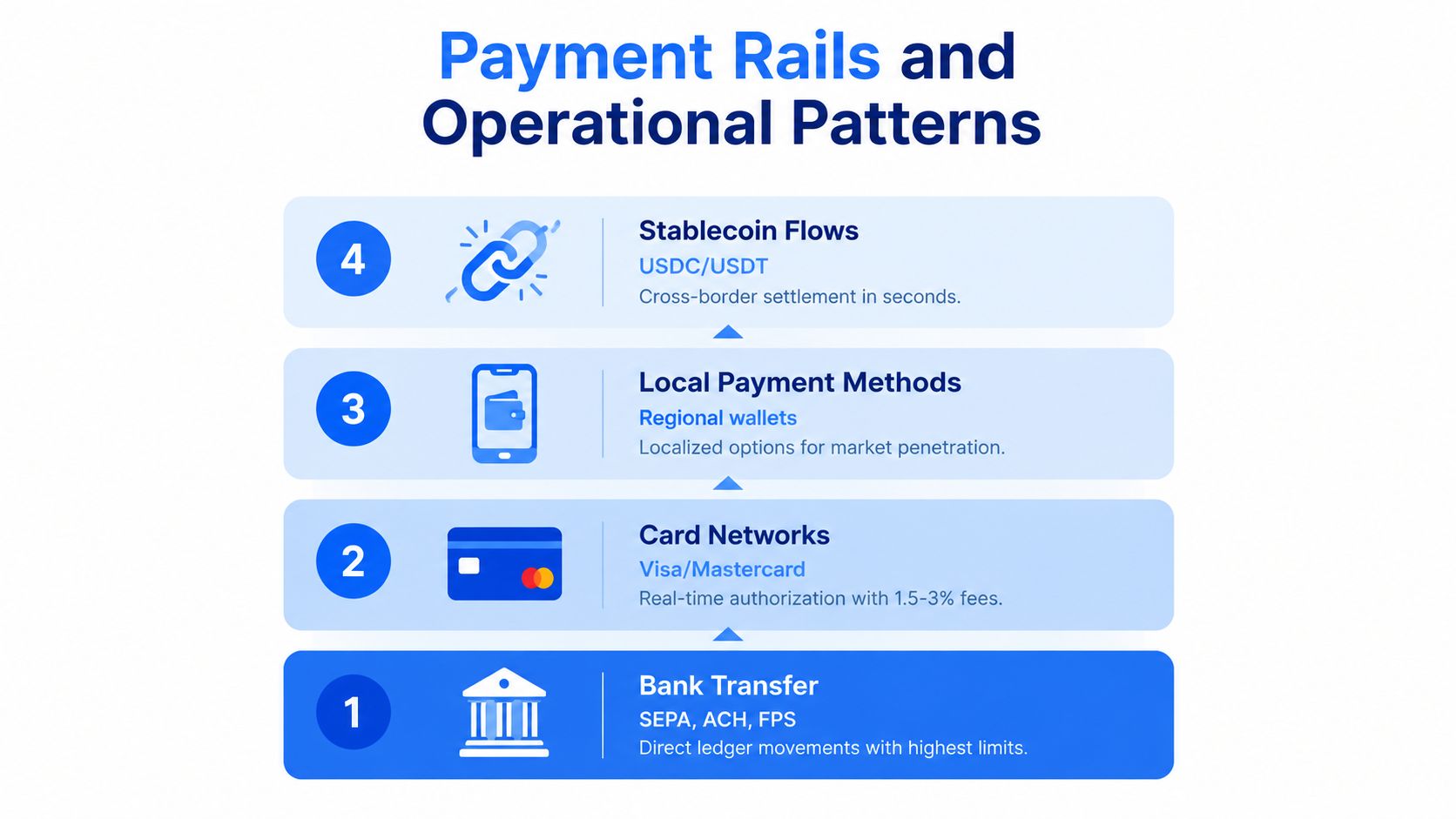
The useful comparison is not rail A versus rail B on headline fee. Compare them on total cost of capture. Ask what each rail demands from your KYC flow, your ledger, your idempotency model, your refund process, and your event stream.
| Rail | Typical settlement | Cost shape | Refund model | Best fit |
|---|---|---|---|---|
| Bank transfer | Bank-dependent, often slower than card authorization | Fixed rail costs, FX, spread, and provider fees | Returns and recalls follow bank rules | Larger purchases, treasury, lower chargeback exposure |
| Card networks | Authorization is fast, final settlement follows card processing | Provider fee, card-rail charge, FX, spread, and possible chargeback cost | Card refund and dispute workflows | Retail conversion where speed matters |
| Local payment methods | Depends on the regional wallet or instant-payment scheme | Local method fee, FX, provider spread, and support cost | Method-specific reversal and refund rules | Market penetration and domestic payment behavior |
| Stablecoin flows | Blockchain transfer can be rapid, but fiat and issuer settlement may differ | Conversion spread, network fee, liquidity cost, and redemption exposure | Redemption or transfer reversal may not resemble a bank refund | Cross-border treasury and crypto-native settlement |
That framing changes design decisions. Bank transfers usually reduce chargeback risk, but they demand stronger reconciliation because the payment reference becomes part of your control plane. Cards shorten time to authorization, but your ledger has to preserve the gap between authorization, capture, settlement, and refund. Local methods improve regional coverage, while increasing method-specific exception handling. Stablecoins can compress cross-border movement, but they do not erase issuer and redemption risk.
Stablecoins need separate accounting treatment. A platform should distinguish safeguarded fiat received, stablecoin inventory or mint entitlement, and customer crypto liability. Analysts at the BIS make the underlying point clearly in their BIS analysis of stablecoin settlement and par. If your system collapses those states, finance cannot explain balances and ops cannot explain release decisions.
This shows up fast in gaming and other high-frequency flows. The rail you pick affects onboarding, per-user deposit addressing, payout controls, refund handling, and support workload. Teams evaluating iGaming stacks should also examine the surrounding crypto casino software architecture, because the on-ramp only works if the wallet, cashier, risk controls, and ledger follow the same transaction model.
Use a simple rule set. Start with geography and funding currency. Match the rail to ticket size and required speed. Price reversals and support operations before launch, not after. Reconcile the fiat rail independently from the blockchain leg. Keep the customer flow simple, but keep the internal states separate and explicit.
A card works for a small retail buy. A bank transfer usually fits a larger treasury conversion better. A stablecoin flow can move quickly across borders, yet still leave you exposed if redemption capacity, reserves, or fiat finality are weak. Choose the rail that your controls can support under audit.
KYC, AML, and the Travel Rule as Data Requirements
A user passes KYC, the card debit settles, the wallet clears screening, and ops still cannot release funds. That failure usually has one cause. The on-ramp was assembled as separate tools instead of one transaction system. KYC, AML, ledger state, release approval, and Travel Rule data belong to the same workflow, because auditors will test whether one approved transfer can be reconstructed end to end.
The FATF frames the Travel Rule in exactly those terms. Virtual asset service providers and financial institutions must obtain, hold, and transmit specified originator and beneficiary information immediately and securely when applicable virtual-asset transfers occur. FATF also reported that 99 jurisdictions had passed or were in the process of passing legislation implementing the Travel Rule as of its 2024 targeted update. (FATF targeted update on virtual assets and VASPs)
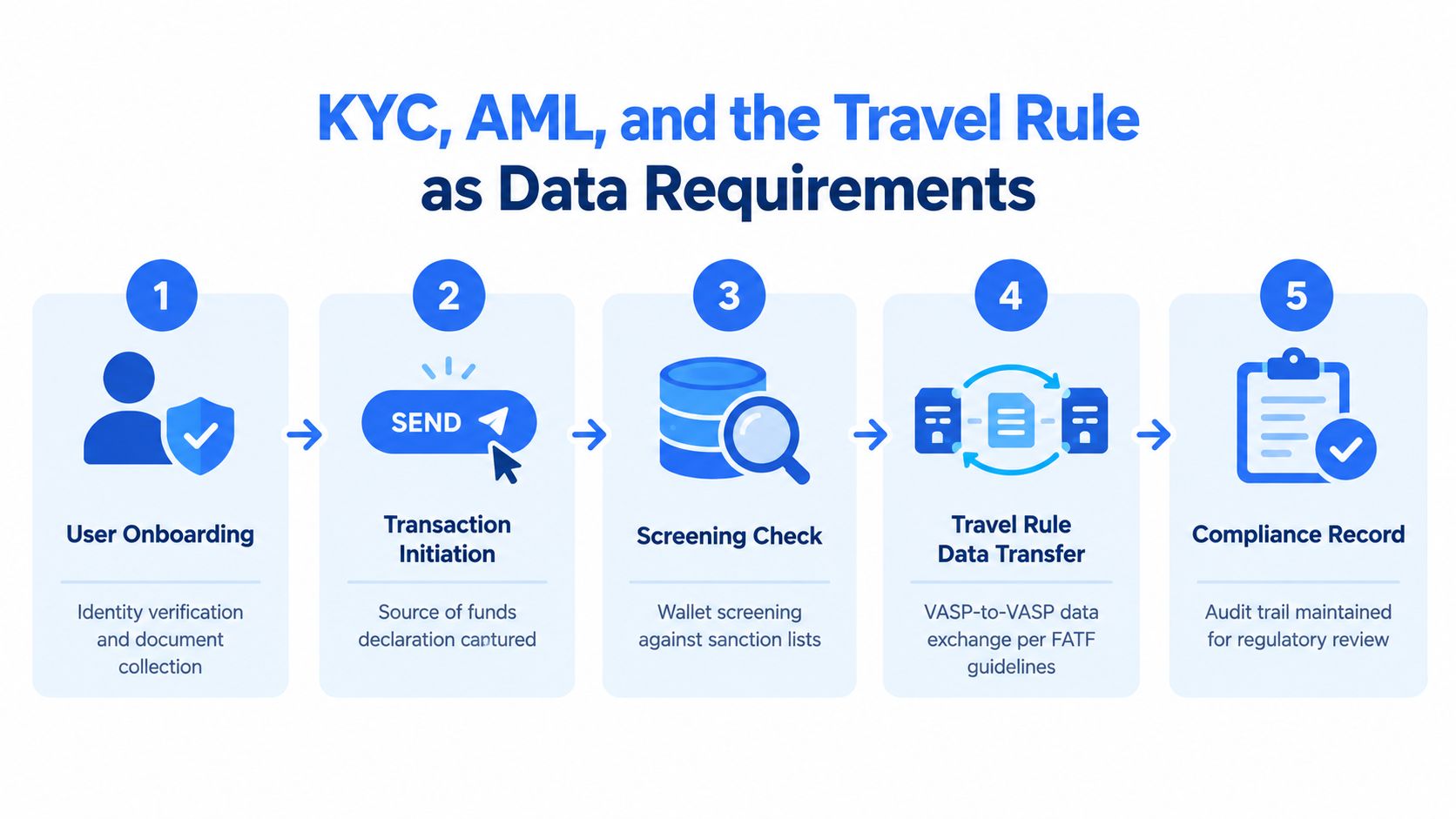
Start with the record, not the vendor queue. A remittance operator paying out in stablecoins may keep bank funding in one system, customer verification in another, wallet checks in a third, and the on-chain hash in a settlement store. Each component can be correct while the overall control fails. If you cannot prove that the verified customer, funded payment, screened destination, approval policy, and blockchain release all refer to the same transaction, you do not have an auditable on-ramp.
The transaction record should bind these fields together:
- Customer identity, including the verified customer or business identifier.
- Payment identity, including the originating account, payment method, and funding reference.
- Transaction purpose, source-of-funds information where required, and the quote used for conversion.
- Beneficiary data, including the destination address and relevant counterparty details.
- Screening results, with sanctions, AML, and policy outcomes recorded before release.
- Settlement evidence, including the final on-chain transaction hash, confirmation state, and any manual-review decision.
Make that record append-only, timestamped, and attributed to a user or service account. Screenshots do not satisfy this requirement. They fail on sequence, integrity, and traceability.
The release model matters just as much as the data model. If fiat is received but beneficiary fields are incomplete, record the funding event and hold the crypto liability. If wallet screening passes but payment finality has not, wait. If a rule sends the transfer to manual review, the reviewer decision, policy version, and release authorization should be written into the same history as the financial and blockchain events. That is what holds up under audit, and it also cuts total-cost-of-capture by reducing manual rework, duplicate investigations, and avoidable holds.
For teams evaluating the control layer, a reference implementation of an AML screening API with policy-controlled release is useful for scoping the right questions. Do not ask only whether a provider can screen an address. Ask whether it can preserve the input data, screening outcome, policy version, and authorization decision inside the same transaction record that carries funding, ledger, and settlement state.
Settlement Timing and the True Cost of Capture
At 09:00, a customer starts a buy. By 09:02, fiat has left their account. If the crypto is still pending at 09:20 because the payment rail, quote lock, ledger posting, and release path were treated as separate decisions, your fee table is already irrelevant. The buying metric that survives audit is total fiat debited divided by spendable crypto received, measured alongside settlement time.
A small purchase makes the point fast. A retail customer converting $200 through a card, bank transfer, or stablecoin-funded wallet can hit a different mix of provider fee, rail charge, FX conversion, spread, network fee, and withdrawal cost. Credit-card purchases may carry fees of roughly 1.5% to 5%, which is why headline provider pricing regularly understates what the customer pays. (Guide to low-fee fiat-to-crypto platforms)
Use one operating worksheet, not separate finance and product views. Put these fields in the same model and force every route comparison through them:
- Total fiat debited, including provider fee and payment-rail charge
- FX conversion, where funding currency and quoted currency differ
- Spread, measured against the reference price your business uses
- Network fee, with a clear rule for absorb versus pass-through
- Refund and failure cost, including reversals and manual recovery
- Support cost, including tickets created by pending or failed transactions
- Spendable crypto received, after every deduction
- Effective exchange rate and settlement time, shown as a pair, not in isolation
That structure changes procurement behavior. A route with a higher visible fee can still win if it settles faster, avoids a second FX conversion, reduces payment failure, or cuts support volume. CTOs should push for total-cost-of-capture reporting, because the on-ramp is one workflow. KYC state, payment finality, ledger movement, quote validity, and release policy all affect what the customer gets and when they can use it.
The same logic applies at remittance scale. A $2,000 transfer can dilute fixed costs that distort a small retail purchase, but it also increases exposure to FX movement, compliance review, liquidity constraints, and delayed settlement. A stablecoin-funded wallet may remove a card charge while adding issuer redemption and network-liquidity considerations.
Ledger design decides whether those trade-offs stay visible or disappear into exceptions. If you support multiple currencies, bank balances, customer liabilities, stablecoin inventory, and on-chain assets need separate reconciliation paths with one shared transaction history. For a practical reference, review how NAS Ledger handles multi-currency ledgers.
API Integration, Idempotency, and Event Streams
A fiat-to-crypto stack fails in production when teams buy KYC, payments, custody, and event delivery as separate vendor features, then try to stitch them together later. Treat the on-ramp as one operating system. Identity state, payment state, policy approval, ledger posting, and chain execution must move through one transaction model with one audit trail.
Design the backend around state transitions and ledger effects. Each write path needs scoped authorization, replay protection, deterministic idempotency, and a clear accounting outcome.
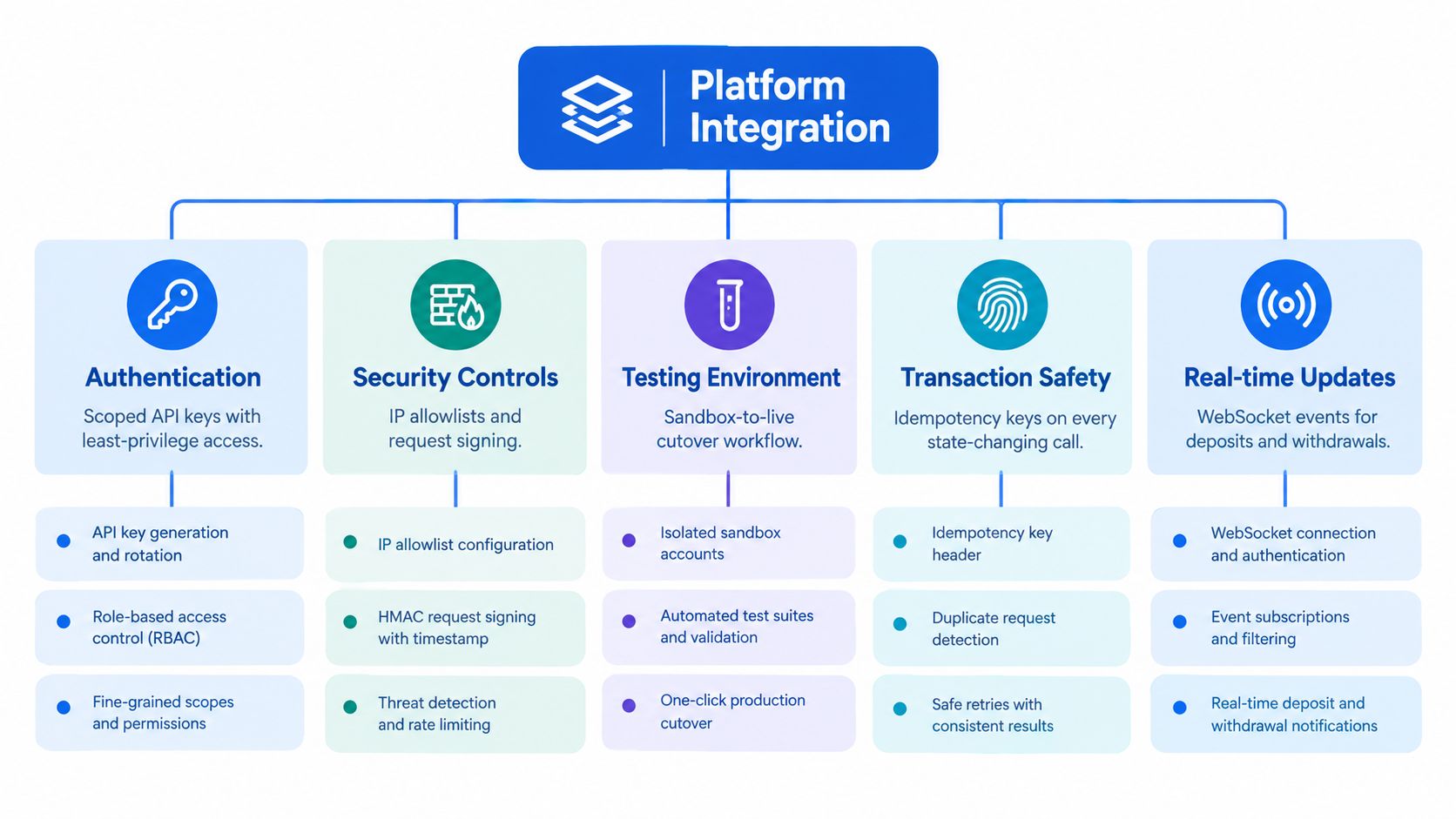
A practical integration surface includes:
- Scoped API keys, restricted by action and environment.
- IP allowlists and request signing, so accepted calls come from approved origins and carry verifiable integrity.
- Sandbox-to-live controls, with separate credentials, test fixtures, and an explicit production cutover.
- Idempotency keys, on every request that can create a payment, credit a balance, submit a withdrawal, or change policy state.
- WebSocket events, for deposits, confirmations, withdrawals, and policy decisions.
- Append-only ledger entries, used as the reconciliation source of truth instead of raw event delivery.
Make every transition safe to replay
Use a state sequence that reflects the full operating flow:
payment.intent.created → payment.received → identity.verified → risk.cleared → policy.approved → broadcast.submitted → confirmation.observed
Those events are delivery signals. They are not accounting entries by themselves.
Stripe documentation on idempotent usage recording shows the pattern that holds up under audit. The server recognizes retries by idempotency key and returns the original result for later requests with that same key. Stripe also describes storing an event-idempotency record with the key, event type, and processing timestamp, and notes that one logical event can arrive through multiple paths during a migration.
Apply that model to deposits and withdrawals. Validate the event first. Record the provider event ID or a deterministic operation key next. Post the ledger effect only once. A duplicate confirmation should be acknowledged without issuing a second credit. A repeated withdrawal event should never submit another instruction. An out-of-order policy result should not overwrite a later terminal state unless the transition table explicitly allows it.
For implementation detail, use a production reference for idempotent fiat-to-crypto API integration. The useful takeaway is architectural, not cosmetic. Authentication, event delivery, ledger state, and reconciliation need shared transaction identifiers from the first request through final settlement.
Test vendors with failure cases, not demos. Ask them to show a duplicate payment event, a retried withdrawal request, an out-of-order confirmation, and a failed blockchain broadcast. If they cannot produce the resulting ledger entries and final state without manual database repair, their headline fee does not matter. The total cost of capture will leak through exceptions, reversals, and support work.
MPC Signing Policy and Non-Custodial Controls
A fiat to crypto stack fails fast when signing policy sits outside the operating workflow. KYC decisions, ledger state, approval rights, and key control have to resolve into one authorization path. If those controls live in separate tools with separate operators, you get manual overrides, weak audit trails, and withdrawals that pass because nobody enforced the full policy chain.
MPC and threshold signing reduce that risk by distributing control of a private key instead of keeping the full secret in one operational location. NIST defines threshold cryptography as distributed computation with a private key secret-shared across multiple parties, and secure multiparty computation as joint computation without exposing private inputs to the other participants. (NIST overview of multiparty threshold schemes)
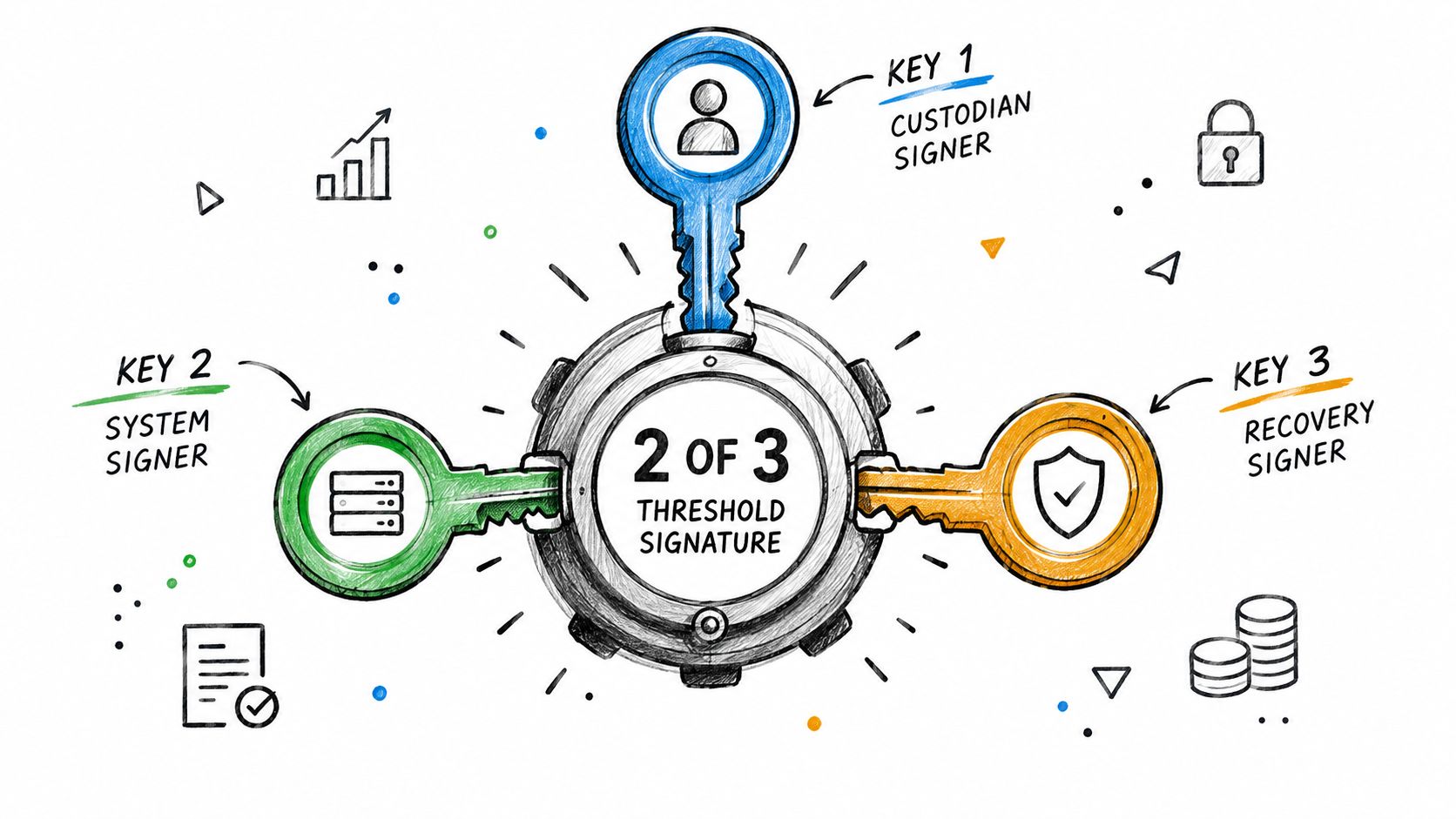
A 2-of-3 policy means two authorized participants must cooperate to produce a valid signature. One participant alone cannot authorize a withdrawal. That matters because the control is not the math. Actual control lies in who holds each role, which transaction states are allowed to request a signature, and which evidence must exist before approval.
Put policy above key-share mathematics
Use a role split that matches how your operation works:
- Infrastructure signer, for the platform-side signing operation.
- Client-controlled Co-Signer, held by the customer and required for defined production actions.
- Recovery or policy participant, reserved for controlled recovery and governance procedures.
Set policy at the workflow level. Define transaction limits, address allowlists, time locks, role-based approvals, and the audit record required before signing. what is least privilege access explains the access model. Apply it strictly. A service that creates deposit addresses should not inherit withdrawal rights. An operations user who approves refunds should not control treasury transfers.
BroSettlement provides DKG and MPC 2-of-3 signing, a client-controlled Co-Signer, and network broadcast as part of an infrastructure approach. Use how DKG/MPC 2-of-3 signing and client-controlled Co-Signer policy fit together to evaluate how wallet creation, signing, policy enforcement, and audit records connect.
MPC does not remove risk. A permissive Co-Signer, weak recovery-share storage, compromised policy credentials, or broad allowlists still create exposure. Ask direct questions: who can approve a transaction, which checks run before signature generation, how emergency recovery works, and whether every signature maps back to the originating transaction and ledger event.
Risk Controls and a Sandbox-to-Production Checklist
A launch usually fails after the demo succeeds. The API works in sandbox, cards authorize, wallets sign, and then production starts leaking money because the operating system behind the flow was never tested as one system.
Four failures cause most of the damage:
- Reconciliation gaps, where bank status, operating ledger, and blockchain state disagree.
- Missing compliance evidence, where the team cannot produce identity, beneficiary, screening, and approval records on demand.
- Overbroad signing policy, where the technical control authorizes more than the operating model requires.
- Stablecoin and FX exposure, where the operator treats fiat as final before bank settlement or credits balances without checking redemption capacity.
Stablecoin risk needs explicit limits. Stablecoins had combined market capitalization above $250 billion in 2025, about 99% were pegged to the U.S. dollar, fiat-backed stablecoins represented about 87% of circulating supply, and algorithmic stablecoins represented less than 0.2%. The category is large, but it is not equivalent to an insured bank deposit. Reserve structure, redemption terms, jurisdiction, and local-currency exit paths still need hard controls and documented approval rules. (Brookings analysis of stablecoins and regulation)
Week-one launch checklist
- Sandbox keys: test every payment, review, retry, reversal, and withdrawal state.
- Production access: issue scoped keys, enforce IP allowlists, and turn on replay protection.
- Fee engine: calibrate rail fees, FX, spread, network charges, and refund behavior.
- Ledger job: reconcile bank, provider, customer liability, stablecoin inventory, and on-chain balances.
- Evidence drill: run a tabletop Travel Rule review from fiat funding through the final transaction hash.
- Workflow control: confirm idempotency, event ordering, approval paths, and signing policy line up across KYC, ledger, and payout logic before production scope is fixed.
BroLabel offers modular infrastructure for fiat integrations, embedded MPC wallets, network broadcast, an immutable operating ledger, card flows, AI Agent Wallets, and real-time WebSocket events. Treat this checklist as the minimum bar before production scope is fixed.