
The popular advice for getting a private key is to open a wallet, reveal a secret, and copy it somewhere. That's a poor default for an operating team. A key you can export is also a key an attacker can export, and some wallet architectures deliberately provide signing capability without exposing a complete key.
The enemy isn't complicated cryptography. It's uncontrolled signing authority: nobody can prove who can authorize withdrawals, what happens when an approver disappears, or whether recovery bypasses production controls. Treat private-key access as a governance decision before treating it as a wallet feature.
Table of Contents
- Rethinking What Getting a Private Key Actually Means
- Legitimate Ways to Obtain a Private Key
- Self-Custody Export, Seed Recovery, and MPC Compared
- A Recovery Procedure That Actually Works in Production
- Verifying a Key Is Safe to Use After Recovery
- Why Extraction Is the Wrong Default for Operating Teams
- FAQ
Rethinking What Getting a Private Key Actually Means
Searching for how to get private key access can mean several different jobs. Confusing them leads teams to expose secrets when they only needed a signature, or request an export when they needed an exit plan.
Start by identifying the outcome you need.
| Job | Required outcome | Wrong shortcut |
|---|---|---|
| Create a wallet | Establish new signing authority | Inventing a memorable secret |
| Export an existing key | Move an authorized secret into another compatible system | Copying it through ordinary support channels |
| Recover access | Restore the ability to authorize transactions | Assuming every wallet has an export button |
| Establish operational control | Prove approval, recovery, and migration rights | Equating a visible key with ownership |
A private key and a recovery mechanism aren't the same thing. A conventional wallet may expose a key or recovery phrase. A managed service may instead provide an account-recovery process. A smart account requires operators to understand its configured authorization and recovery policy.
Ask who can authorize a transaction
Threshold or MPC designs distribute signing authority across shares, so there may be no complete private key available to display or export. The operational questions become who controls the signing policy, where recovery material resides, and which parties must cooperate, consistent with the governance approach in NIST's key-management recommendations.
For the underlying distinction between public identity and secret signing material, use this public and private key pair guide. Then ask your wallet provider to demonstrate the actual authorization boundary, not just describe its custody model.
Operating principle: Ask for proof of signing control and a tested recovery path, not merely a downloadable secret.
A serious operator wants provable control of signing authority and recovery that doesn't collapse distributed safeguards into an unprotected secret. Write those outcomes into procurement requirements. A provider should explain normal operation, employee departure, service outage, suspected compromise, and migration without substituting a marketing label for an answer.
Legitimate Ways to Obtain a Private Key
Use a supported generation, export, or recovery workflow. Don't obtain a production wallet secret from a website, a message, or someone claiming to have found an unused key.
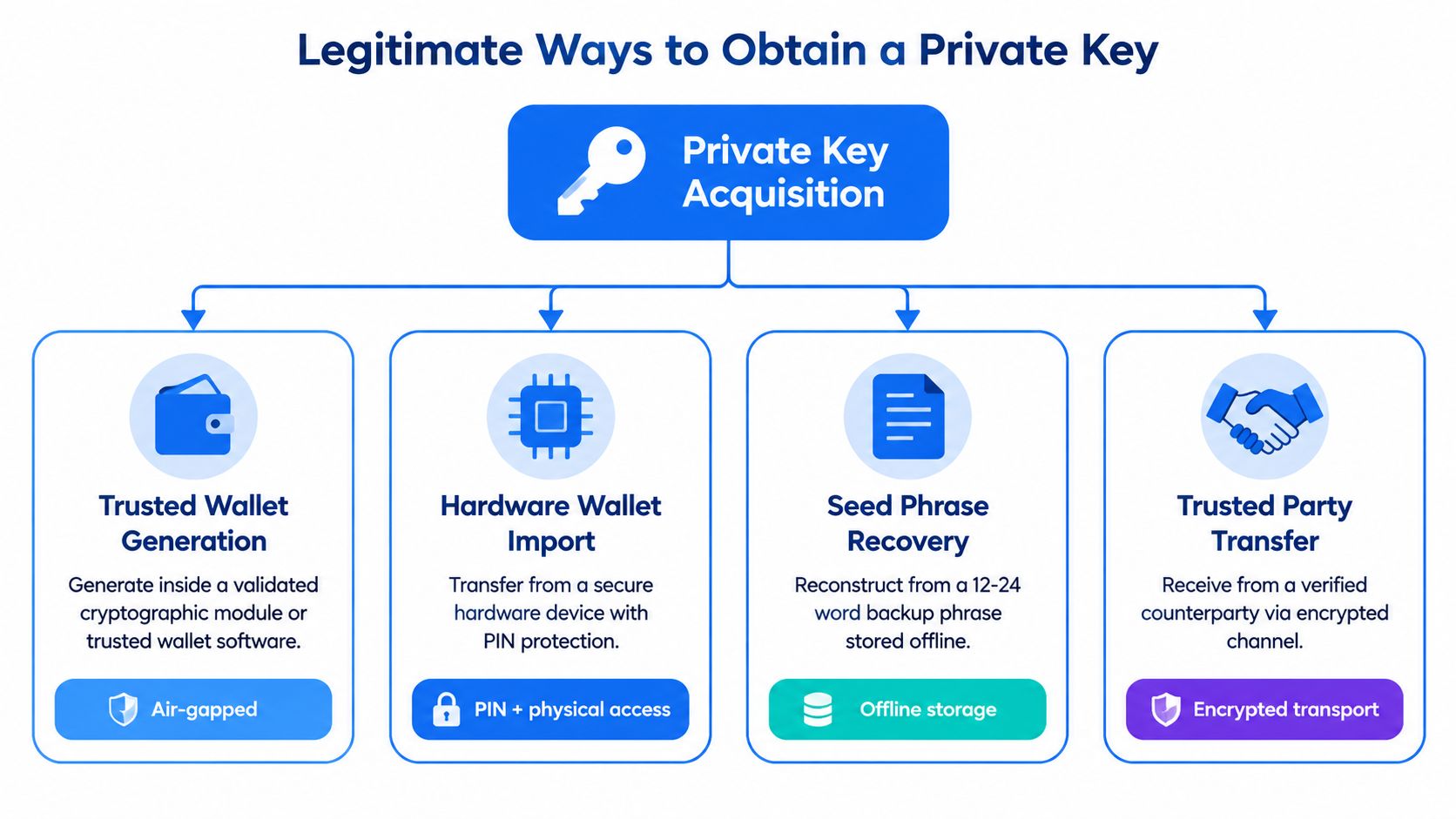
The acquisition routes above need an important qualification: secure transport doesn't establish exclusive ownership. Receiving an encrypted key from a counterparty doesn't prove that the counterparty destroyed every copy. Likewise, a hardware-wallet import shouldn't be interpreted as permission to extract a device's protected secret.
Choose the route by its preconditions
Generate new signing material. Use trusted wallet software, a hardware wallet, an operating-system cryptographic API, or a validated key-management system. Generation must use cryptographically secure randomness, not selected words or keyboard patterns; production generation and signing should occur inside an isolated module meeting at least FIPS 140-2 or FIPS 140-3 requirements, following OWASP's cryptographic storage guidance. The result is newly generated material. An untrusted generator invalidates the security assumption.
Use an authorized export workflow. This applies when the wallet supports exporting the required key and you control that wallet. The artifact is an individual secret in a compatible representation. Treat unexpected export prompts, unfamiliar extensions, or support-assisted secret collection as reasons to stop.
Restore from a recovery phrase. The precondition is authentic recovery material and the wallet's required parameters. Restoration reproduces the wallet's derived signing capability rather than necessarily producing an individual address key. Wrong parameters can make a valid recovery appear unsuccessful.
Recover authorization without extraction. Managed custody, MPC recovery, and smart-account recovery require the applicable approval process. The result may be restored signing capability, replacement authorization, or recovered shares rather than a portable private key.
Reject a route that changes the trust model
Before approving any method, record what artifact will exist afterward, who can access it, and how it will be retired. If a recovery service asks you to expose a secret that previously stayed inside protected hardware, it's proposing an architectural change, not merely helping you log in.
Prefer the narrowest operation that completes the job. If you need a transaction signed, don't export an entire wallet's authority.
Self-Custody Export, Seed Recovery, and MPC Compared
Choose a custody model by its failure conditions, not by how reassuring its setup screen looks. A portable secret, a recovery phrase, and a signing share create different responsibilities for the people operating them.
| Model | Who holds authority | Recovery artifact | Operational concern |
|---|---|---|---|
| Single-key self-custody | Whoever possesses the usable key | Individual private key or encrypted wallet backup | An unauthorized copy can enable spending |
| Seed-based self-custody | Whoever controls the required recovery material | Phrase plus applicable wallet parameters | A phrase photograph or misplaced passphrase undermines recovery |
| Threshold MPC | Parties meeting the authorization threshold | Shares and documented recovery arrangements | Missing shares or unclear approval roles can prevent operation |
Portability is a tradeoff, not an unconditional security benefit. An exported key can simplify compatibility, but it also creates a transferable spending credential. Seed recovery can restore a broader wallet, which makes its handling boundary especially important.
Evaluate the failure you can survive
In a 2-of-3 threshold design, any two authorized parties can approve a signature, while one compromised or unavailable party should not be sufficient to sign alone, as described by NIST's threshold-cryptography materials. That distinction supports a client-controlled Co-Signer, but only when operators define its approval responsibilities.
Consider an employee departure as a design test, not a hypothetical incident report. Can authorized staff replace the employee's operational role without collecting secrets in a shared document? Can they demonstrate that the former employee no longer participates in approval?
The MPC wallet operating model is useful when evaluating distributed authority, but the label alone doesn't answer those questions. Ask for share-location documentation, recovery dependencies, and a demonstration of the permitted signing workflow.
For a small team, straightforward recovery may dominate the decision. For an exchange, fintech, or treasury operation, separation of duties and evidentiary requirements deserve greater weight. Choose the model your team can operate under stress, including outside normal working hours, rather than the model with the easiest onboarding.
A Recovery Procedure That Actually Works in Production
A recovery runbook should let an authorized operator restore service without improvising custody policy. Give it an owner, require an approval record, and specify when the operator must stop.
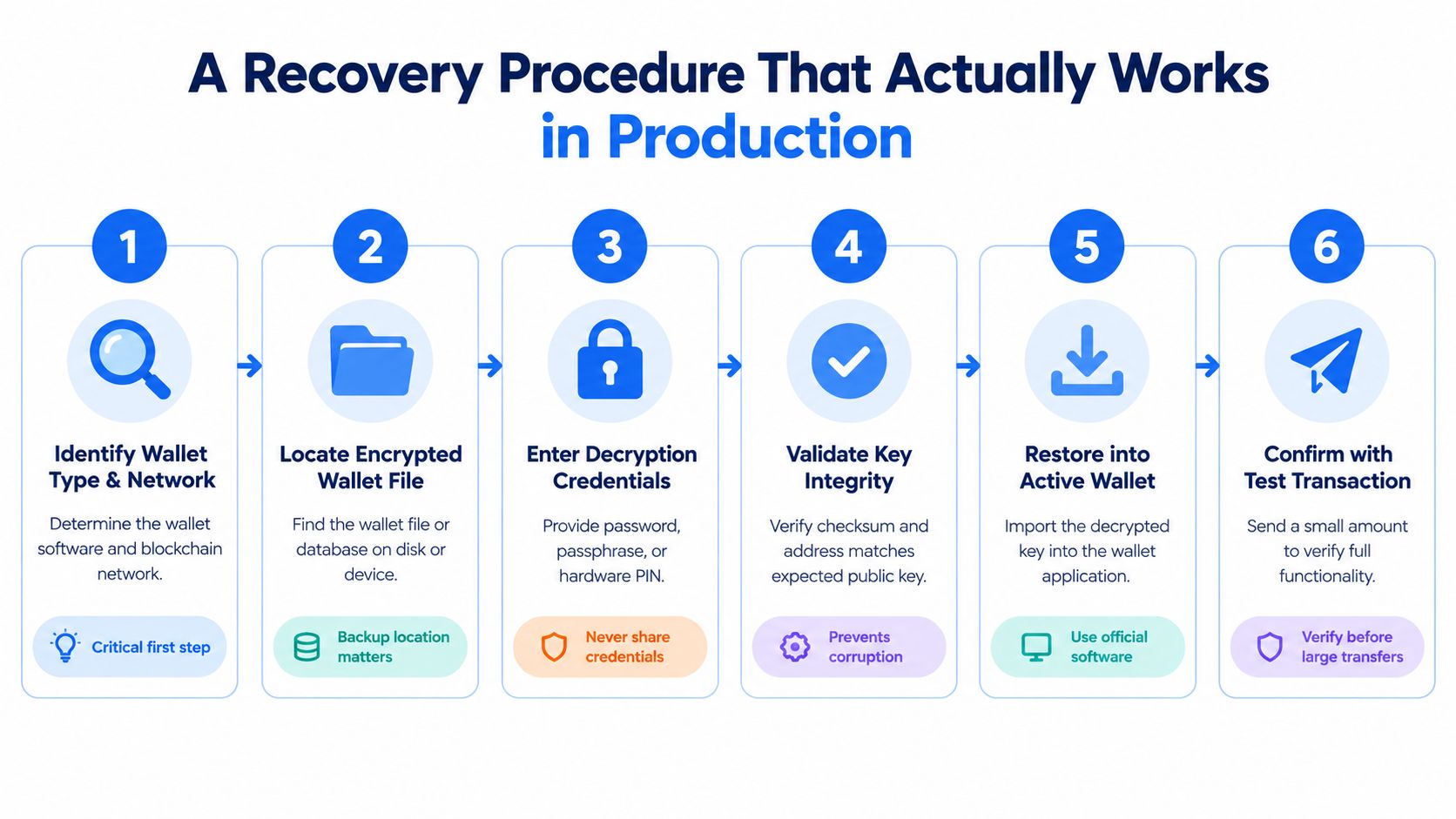
Execute the restoration in a controlled sequence
Identify the wallet and network. Establish whether you're restoring a single-key wallet, a hierarchical deterministic wallet, a multi-key policy, or an MPC deployment. Record the intended chain and expected addresses.
Locate authentic recovery material. Retrieve the original encrypted wallet file, phrase, hardware backup, or authorized share-recovery package. Don't substitute a recently discovered copy without checking its provenance.
Prepare a trusted recovery environment. For raw-key recovery, use an isolated device, verify software signatures, disconnect networking, and decrypt locally. Don't let routine application diagnostics capture the material.
Validate the wallet parameters. Check the derivation standard, account index, network, and expected address. Preserve the original spending policy, not just an address that looks familiar.
Export only if necessary. Require a documented application need. If the task can be completed within the protected signing environment, leave the raw key there.
Test before committing significant funds. Validate the restored destination and signing behavior with a small balance. After an unavoidable export, remove plaintext artifacts and return the recovery device to a known-clean state.
A recovery phrase, extended private key, and individual address key aren't interchangeable. Bitcoin's wallet documentation explains hierarchical derivation and exported-key representations, including WIF's role in reducing copying errors during import in the wallets chapter of Mastering Bitcoin.
Preserve the information needed to spend
Maintain at least two geographically separate, access-controlled backup copies, and store any optional passphrase separately. Preserve descriptors or extended public keys where the spending policy requires them, because a seed alone may not reconstruct the wallet's authorization conditions, as explained in Bitcoin Design's recovery guidance.
A backup isn't operational evidence until an authorized person has restored it under the documented policy.
For MPC deployments, extend the runbook with share custodians, approval roles, outage procedures, and transaction-policy boundaries. Conduct documented restore drills before launch. Record failures as control defects, not operator mistakes to work around next time.
Verifying a Key Is Safe to Use After Recovery
Consider a representative incident: an operator discovers a recovery phrase in an old support attachment. The wallet accepts it, displays the expected address, and shows a balance. The operator has established compatibility, not safety.
Successful import proves that software can interpret the material. It doesn't prove who created it, who copied it, or whether an attacker is waiting for the next deposit. Treat a phrase supplied with a device, or credentials entered on an untrusted computer, as a provenance problem rather than a successful onboarding shortcut.
Decide whether to retain or replace authority
Use an exposure-based decision tree:
- Known untrusted exposure. If someone entered the key into an untrusted device, website, or support conversation, assume compromise. Authorize migration to newly generated signing authority rather than reusing the recovered secret.
- Uncertain provenance. Don't fund a wallet merely because it imports successfully. Establish how the secret was generated and maintained before accepting it into production.
- Documented protected recovery. Validate the approved restoration procedure without funds first, then complete the operational checks before restoring service.
- Existing assets at risk. Coordinate asset movement with incident responders. Inspect delegated permissions and revoke token approvals where applicable; moving assets alone doesn't document or resolve every authorization issue.
Keep the old address in the monitoring inventory. Finance needs the historical relationship between the old and replacement wallet, while operations needs a record of unexpected activity.
For a broader asset-management review alongside this incident process, the CoinHub.pro digital asset management guide provides an additional resource. Don't treat any general guide as a substitute for your wallet-specific recovery evidence.
Close the incident at the organizational layer
Require an approved rotation record, independent review, audit evidence, and a decision about affected credentials. Recovery authorization and incident authorization should be explicit, especially when emergency access changes the normal separation of duties.
NIST's draft revision of its key-management recommendations is relevant background for reviewing key-lifecycle controls. For your own acceptance decision, use a stricter practical standard: can you explain why this signing authority remains trustworthy?
If you can't, replace it. Don't confuse restored access with restored confidence.
Why Extraction Is the Wrong Default for Operating Teams
Production applications need authorized operations, not routine access to raw wallet secrets. Keep signing behind a deliberate boundary and make exceptions visible.
OWASP's key-management guidance advises against plaintext key storage, source-repository inclusion, and embedding keys in binaries or container images. It also warns about environment-variable exposure and describes envelope encryption, where a separately protected key-encryption key protects the data-encryption key.
Put authorization inside the operating stack
BroSettlement combines MPC signing with a client-controlled Co-Signer, network broadcast, and an operating ledger. BroWallet supplies user-facing wallet flows, while AI Agents can use per-agent wallets with role-based controls and audit trails. Use these capabilities to separate transaction intent, policy approval, signing, broadcast, and accounting.
Keep the credential boundaries distinct:
- API authentication. Ed25519-authenticated REST requests establish the backend's request identity. That authentication key isn't the wallet's spending key.
- Scoped API access. Define permitted actions for each integration and verify enforcement during sandbox testing. Don't let an agent's request capability become unrestricted withdrawal authority.
- Idempotency. Require repeated submissions of the same business operation to resolve to the same recorded intent. Test retries after timeouts instead of assuming duplicate requests are harmless.
- Signing approval. Make the Co-Signer enforce the production transaction policy rather than approve every request automatically.
Use the digital asset custody guide to frame ownership boundaries. When a legacy integration requires extraction, include Cascoin's private key import verification tips in the migration review without treating successful import as security approval.
Separate observation from accounting
WebSocket notifications support event-driven processing, but applications must handle reconnects, duplicates, and reorganizations. Ethereum's WebSocket subscription guidance explains why an observed event must not be treated as irreversible settlement.
Use the ledger for deposit, withdrawal, fee, policy, and reconciliation records. Append corrections instead of overwriting history; the SEC's electronic-recordkeeping audit-trail model provides a useful reference for preserving originals, actor identity, and timestamps, not a blanket claim of regulatory compliance.
Release gate: Don't launch until a retried request, interrupted connection, and failed approval produce explainable records.
FAQ
Is recovering a seed phrase the same as exporting a private key?
No. Seed recovery restores derived wallet authority using the applicable wallet parameters. Exporting an individual key produces a narrower secret for a specific signing context.
For procurement, ask whether recovery restores the original accounts and spending policy, whether it requires the provider, and whether the destination supports the required wallet metadata. A recovery demonstration should prove the expected result, not merely show that software accepts the phrase.
What if a hardware wallet arrives with a prewritten phrase or suspicious packaging?
Don't fund it, and don't enter an existing phrase into it. A supplied phrase doesn't establish exclusive control, while unexplained packaging changes require investigation through an authenticated manufacturer channel.
If someone has already used the device, follow the exposure decision process above. Preserve relevant evidence without putting recovery material into a support ticket or incident chat.
Can we migrate a single-key wallet to MPC without losing address history?
Preserve address history in your ledger and monitoring systems regardless of how signing changes. Historical continuity and address continuity are different requirements.
Don't assume an MPC service can adopt the existing address. Require the provider to demonstrate supported migration behavior for your network and wallet type; otherwise, plan a transfer to new addresses with linked accounting records, updated deposit instructions, and continued monitoring of the old addresses.
What controls should buyers verify before launch?
Use capability demonstrations, not feature names, as acceptance criteria.
- Generation. Verify how BroSettlement establishes signing material and where protected operations occur.
- Storage. Inspect share custody, encrypted backups, and Co-Signer access boundaries.
- Signing. Test policy rejection, role separation, and constrained AI Agents access.
- Audit. Reconcile WebSocket events against the immutable operating ledger, including retries and corrections.
- Recovery. Demonstrate authorized restoration and confirm how BroWallet access relates to backend signing control.
The practical lesson is simple: buy recoverable, observable signing authority, not an export button. Make unresolved control questions launch blockers.
BroLabel offers embedded MPC wallets, a client-controlled Co-Signer, an operating ledger, and event-driven infrastructure for teams that need signing control without routine private-key extraction. Visit BroLabel to discuss your wallet architecture and bring a concrete recovery scenario to the sandbox review. Bro has your back!