Pick a platform, buy a fraction, wait for liquidity. That's the popular advice on how to invest in tokenization, and it's backwards. A platform decision made before you've verified the legal claim, the custody model, and the exit route isn't investing, it's onboarding. The enemy in this market isn't volatility, it's treating a token ticker or a projected market size as an investment thesis. Teams that survive here buy enforceable claims on real cash flows, held under controls they can explain to an auditor.
Table of Contents
- Understanding What Tokenized Investing Actually Means
- Choosing Which Tokenized Markets to Enter
- Running Due Diligence on a Tokenized Asset
- Setting Up Custody Settlement and Signing Controls
- Managing Compliance and Operational Risk
- Putting Your Tokenized Investment Plan Into Operation
- Frequently Asked Questions About Tokenized Investing
Understanding What Tokenized Investing Actually Means
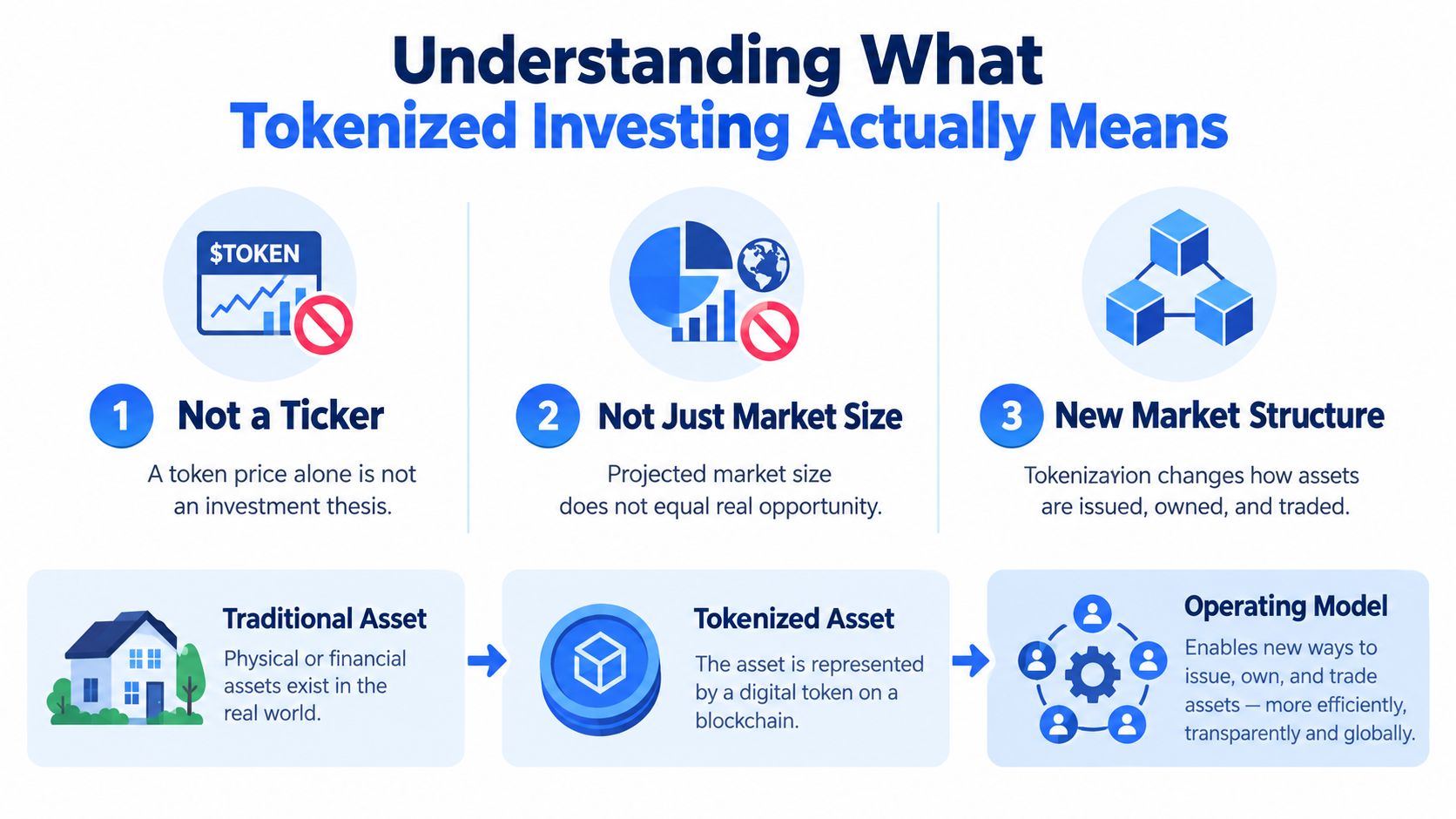
Tokenization isn't a single asset class. It's a change in market structure, in how ownership is recorded, transferred, settled, and enforced. A tokenized money-market fund and a tokenized private loan share a ledger technology, not a risk profile, a regulator, or a buyer base. Underwriting them as if they're one category called "tokenization" is where most first allocations go wrong.
What You're Actually Buying
Exposure comes in several distinct forms, and they don't substitute for each other. You can hold regulated tokenized funds and debt instruments directly. You can hold interests in private-market vehicles that use tokens as their ownership record. Or you can own equity in the infrastructure providers that handle issuance, custody, and settlement, which captures adoption without tying you to one asset's legal structure. Each route has a different counterparty, a different claim in insolvency, and a different path to exit. For readers newer to fractional structures, it's worth reviewing how property ownership through Pie Assets separates the legal interest from the digital record before comparing products.
Reading the Forecasts Honestly
The scale estimates are real but wide, and the width is the information. McKinsey projects tokenized financial assets, excluding cryptocurrencies and stablecoins, could reach approximately $2 trillion by 2030, within a scenario range of about $1 trillion to as much as $4 trillion, as set out in McKinsey's analysis of tokenized asset market capitalization by 2030. The same forecast assigns roughly $400 billion to mutual funds and ETFs, about $300 billion each to loans and securitization and to bonds and exchange-traded notes, and around $200 billion to alternative funds.
Practical lesson: Forecasts aren't realized returns. Size every position for the possibility that adoption arrives later, or in different asset classes, than the projection assumes.
That discipline matters because tokenization sits inside a banking and payments system that's still deciding how shared ledgers fit alongside existing rails, a tension explored in BroLabel's overview of blockchain in banking operations. Before any platform shortlist, write down in one sentence what you'd own, who owes you redemption, and where you'd sell. If you can't, you don't have a thesis yet.
Choosing Which Tokenized Markets to Enter
Start where issuance is live and servicing is boring. Tokenized money-market and mutual fund products are typically accessed through regulated fund distributors and custodians, they settle against familiar cash instruments, and what breaks first is usually redemption processing rather than asset quality. Tokenized bonds and exchange-traded notes sit close behind. Bonds were the most common focus of tokenization initiatives at the end of 2024, based on the Bank for International Settlements survey of tokenization activity across jurisdictions, which found entities in 48% of surveyed jurisdictions working on tokenization and issuance already completed in 38%.
Reading Maturity by Jurisdiction
Geography is an allocation decision, not a footnote. The same survey reports tokenization activity in 86% of advanced economies, including 12 with live cases, compared with about 32% of emerging-market jurisdictions, where most projects remain research or proof of concept and only five reported issued assets. Advanced markets generally offer stronger settlement and investor-protection infrastructure. Earlier-stage markets may offer growth, but you'll underwrite more regulatory and execution risk yourself.
Tokenized loans and securitization demand a different skill set, since value depends on servicing, collateral verification, and waterfall mechanics off chain. Alternative and private-market funds add valuation opacity and lockups that a token wrapper doesn't remove. Equity and complex structures carry the highest execution risk because transfer rules, shareholder registers, and secondary venues still have to agree with each other. Investors used to property underwriting will recognize the discipline. The way experienced buyers weigh risks in real estate investments, by separating the asset, the operator, and the exit, maps directly onto tokenized private markets.
| Tokenized market | Example instruments | Maturity today | Main risk to verify |
|---|---|---|---|
| Funds | Money-market, mutual funds | Most production-ready | Redemption processing and reserve controls |
| Debt | Bonds, exchange-traded notes | Live issuance in advanced markets | Settlement finality and custodian records |
| Credit | Loans, securitization | Growing, servicing-heavy | Collateral verification and cash-flow waterfall |
| Alternatives | Private funds, real assets | Mostly early-stage | Valuation, lockups, and exit depth |
| Infrastructure | Issuance and settlement providers | Builds ahead of asset volume | Adoption pace and vendor concentration |
Pick one entry point deliberately. A first allocation spread thinly across five immature markets teaches you nothing and multiplies your diligence burden.
Running Due Diligence on a Tokenized Asset
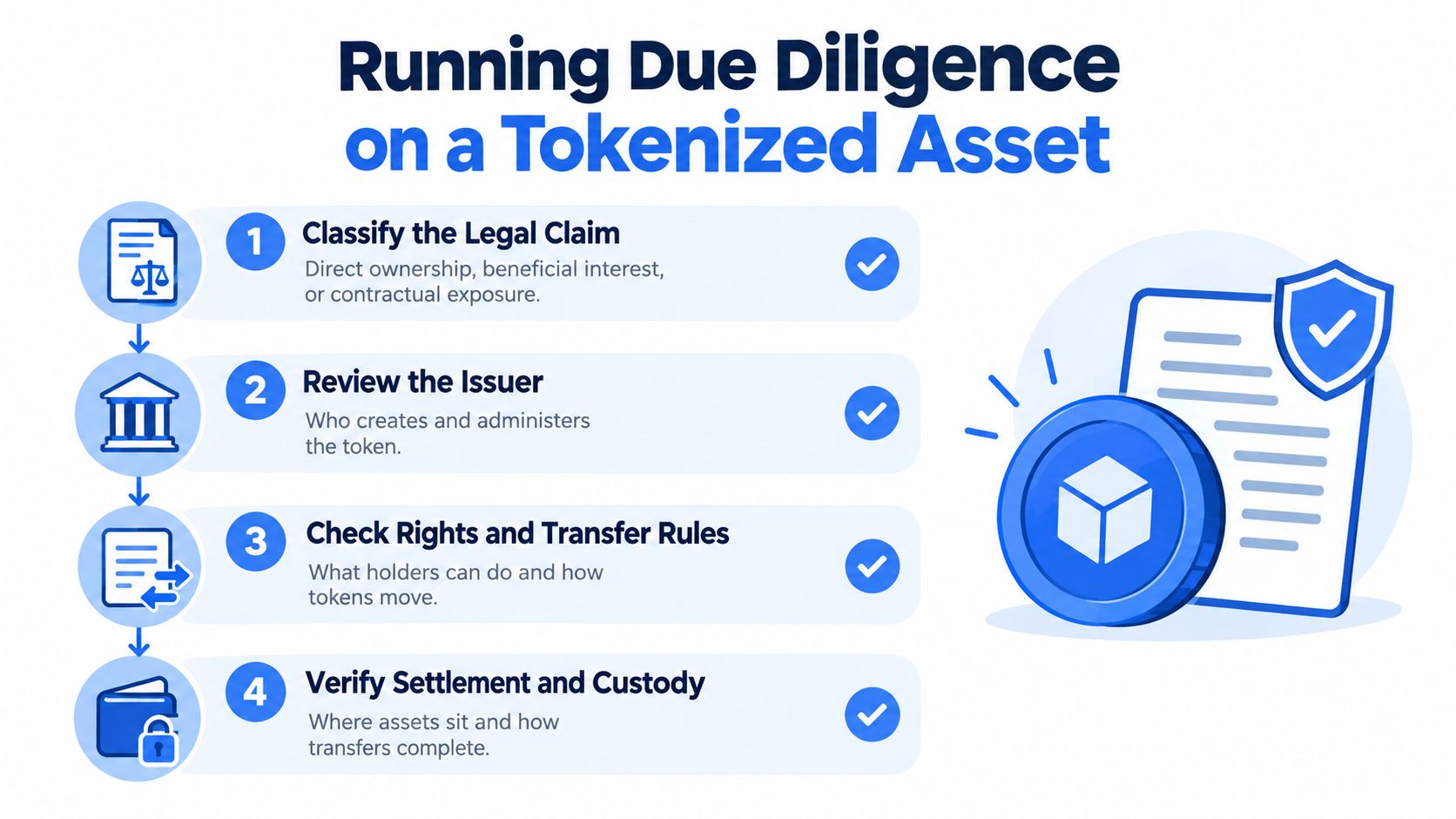
Run diligence as a sequence of verifiable checks, in order. Skipping to yield or platform reputation before the legal claim is verified wastes the rest of the work.
Step One Classify the Claim
Determine exactly what the token represents. It may be direct ownership of the underlying asset, a beneficial interest in a special-purpose vehicle, a debt claim on the issuer, or a token that merely references an asset's value. These aren't variations of the same thing. In a dispute or insolvency they produce completely different recoveries. The CFA Institute flags unresolved questions around investor protection, suitability, private-market liquidity restrictions, fees, time horizons, and performance measurement in the CFA Institute research announcement on tokenization, which is why the offering documents, not the token contract, are your primary source.
An immutable transaction record can't cure a weak legal claim, inaccurate disclosure, or collateral you can't reach.
Step Two Map Every Dependency
List the issuer, administrator, custodian, oracle, smart-contract auditor, and secondary venue as separate failure points. Ask who legally owns the underlying asset, which entity owes redemption, whether you can inspect audited reserves and transfer restrictions, and which jurisdiction's courts govern disputes. Then ask what happens if each party fails. IOSCO reports that 91% of surveyed jurisdictions had no or only very limited live tokenization use cases, according to the summary of IOSCO's final report on tokenization of financial assets, so most products you'll review are closer to pilots than proven markets. Price that accordingly.
Step Three Test the Economics
A token has to earn its complexity. Measure whether it delivers lower settlement friction, fractional access, or automated compliance after you count issuance, custody, broker, gas, legal, and exit costs. If the all-in cost matches the traditional equivalent and the only benefit is a smaller minimum, say so plainly in the investment memo.
Step Four Estimate Exit Liquidity
Technical tradability isn't liquidity. Liquidity requires independent buyers, market makers, compliant venues, and reliable redemption. A 2025 industry analysis found that lack of secondary-market liquidity can stall tokenized markets beyond primary issuance, particularly where market makers face unclear capital treatment, as detailed in the Baker McKenzie and Deutsche Bank whitepaper on tokenized markets. Score each candidate before allocating.
- Asset verified: Independent confirmation the underlying asset exists and is unencumbered
- Claim enforceable: Documented ownership or redemption right in a named jurisdiction
- Distribution regulated: A lawful pathway for your investor category to buy and resell
- Code and keys controlled: Audited contracts and documented key-recovery procedures
- Exit defined: Redemption windows, lockups, spreads, and holder concentration measured, not assumed
Reject two structures outright. Walk away from database-only ownership with no enforceable rights, and from yield that depends on incentive emissions rather than cash flows from the underlying asset.
Setting Up Custody Settlement and Signing Controls
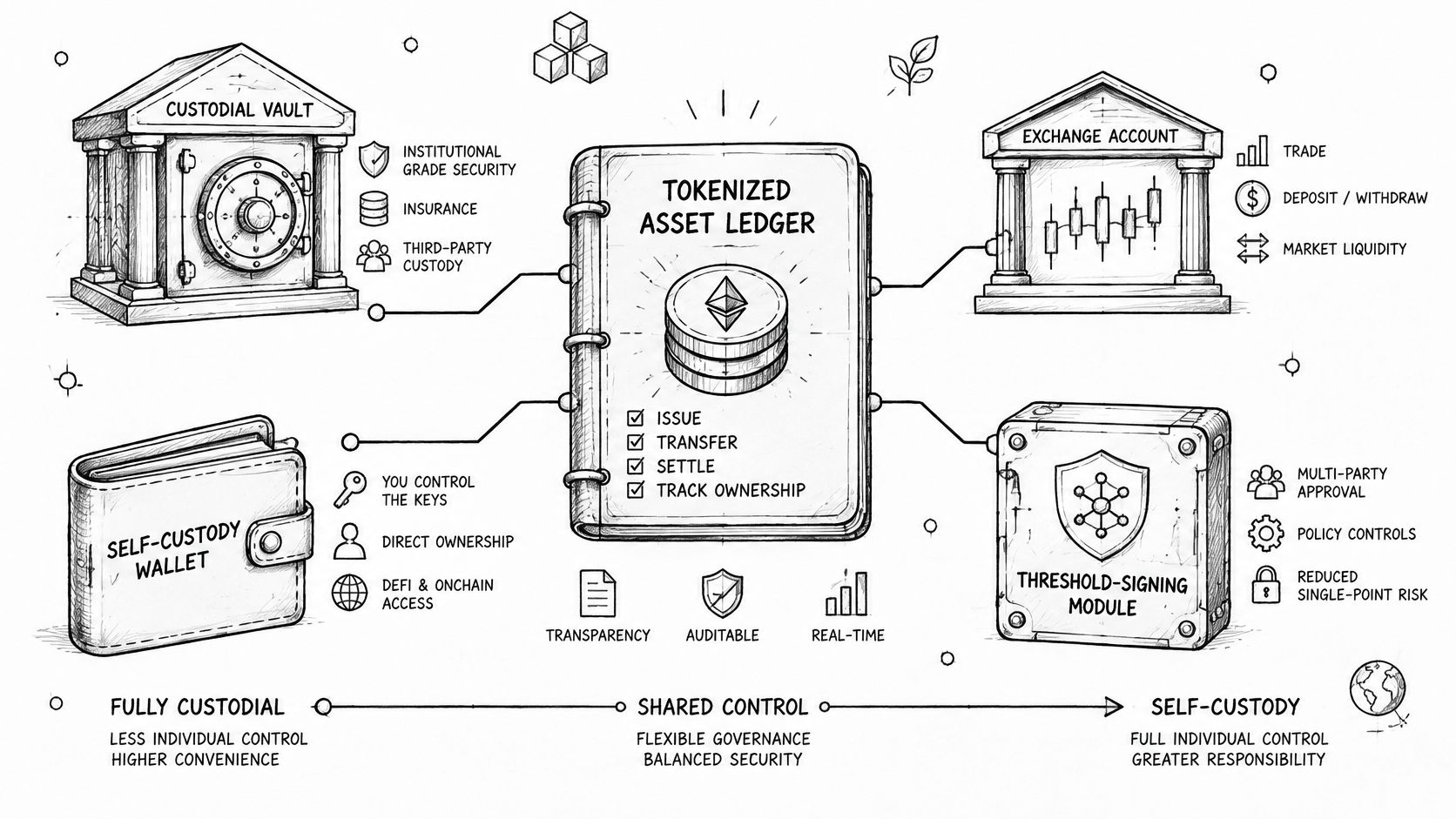
What you buy matters less than how you hold it. Custody is a decision about where signing authority sits, and that placement determines whether operations survive a compromised signer, a vendor outage, or a disputed transfer.
The Custody Spectrum
Fully custodial platforms keep keys and policy with the provider, which is simple and concentrates risk in one counterparty. Exchange accounts add trading convenience and commingling questions. Self-custody keeps control with you and puts key management, backups, and incident response entirely on your team. Threshold models split signing so no single key or person can move funds alone. Most institutional buyers land on threshold signing because it separates duties the way treasury policy already requires, a trade-off examined in BroLabel's guide to digital asset custody models.
The Settlement Finality Gap
An on-chain transfer can look complete before it's legally final. The Bank for International Settlements defines settlement finality as the point where a transfer becomes irrevocable and unconditional, not reversible because of a participant's insolvency, in the BIS paper on tokenisation in the context of money and other assets. Your operating ledger therefore needs three distinct states, transaction observed, operationally transferred, and legally final, and payouts should gate on the third. A transaction hash is evidence of broadcast, not proof of completion.
Implementing the Controls
This is the layer where infrastructure choices become concrete. MPC 2-of-3 signing ensures no single key share can authorize a movement. A client-controlled Co-Signer keeps policy approval with the operator, so a vendor can't sign outside your rules even if its systems are compromised. BroSettlement implements this pattern with threshold signing and multi-chain broadcast, while BroWallet gives end users a controlled interface into the same policy model.
Signing policy also has to resist replay. NIST defines replay resistance around nonces or challenges that prove transaction freshness, as specified in NIST Special Publication 800-63B-4 on digital identity authentication. In practice you bind each authorization to a unique request identifier, nonce, expiry, asset, amount, destination, and policy version, then reject duplicate identifiers server-side. That gives you idempotency, meaning a retried request after a timeout can't create a second withdrawal.
- Scoped API keys: Least-privilege credentials with role separation and Ed25519 request authentication
- WebSocket events: Machine-readable deposit, confirmation, withdrawal, and policy outcome signals for finance and risk systems
- Append-only ledger: Immutable records that let your team reconcile asset, cash, and token balances without manual chain inspection
For treasury teams evaluating products, these aren't feature checkboxes. They're the difference between an incident you can reconstruct and one you can only describe.
Managing Compliance and Operational Risk
Compliance failures in tokenized markets rarely start with bad intent. They start with a classification nobody wrote down.
Classify Before You Allocate
Whether an arrangement is regulated as a security depends on its economics, not its wrapper. The U.S. Securities and Exchange Commission applies the Howey test, which treats an arrangement as an investment contract when there's an investment of money in a common enterprise with a reasonable expectation of profits derived from the efforts of others, as explained in the SEC framework for investment contract analysis of digital assets. Document what purchasers receive, whether funds are pooled, how returns are generated, and whose managerial efforts drive expected profit. That classification memo then drives offering, disclosure, transfer, and recordkeeping requirements in each jurisdiction where you operate.
Eligibility and Transfer Controls
Investor eligibility has to be enforced at the transfer layer, not just at onboarding. Permissioning should match the product's restrictions so a token can't move to a wallet that hasn't cleared identity and suitability checks. This discipline is part of a broader control framework, and teams formalizing it can draw on BroLabel's walkthrough of the compliance management process when defining who approves policy changes and how exceptions are logged.
Cross-border transfers raise the bar further. FATF's revised Recommendation 16 requires standardized originator and beneficiary information, including name, address, and date of birth, for peer-to-peer cross-border payments above USD/EUR 1,000, with changes scheduled to take effect by the end of 2030, as described in FATF best practices on Travel Rule supervision. Travel Rule obligations in the virtual-asset context similarly require firms to obtain, hold, and transmit that data immediately and securely. Compliance metadata is becoming transaction infrastructure, not an after-the-fact review.
Controls Your Counterparty Must Evidence
- Data gating: Transfers stop or route to review when required originator or beneficiary data is missing
- Immutable audit trail: Every screening decision, policy outcome, and approval recorded for regulatory examination
- Role-based access: Automated agents and treasury workflows act under defined mandates, with AI Agents holding per-agent wallets rather than shared credentials
- Scoped keys: A compromised integration can only reach the functions and limits it was granted
Ask for evidence, not assurances. If a counterparty can't show you a screening decision log, a paused-transfer record, and a reconciliation report from production, the controls exist in a slide deck.
Putting Your Tokenized Investment Plan Into Operation
Convert everything above into a sequence you can run, with gates that stop you from scaling on enthusiasm. The benchmark is straightforward. Quantify your current process cost and settlement time, model the tokenized workflow against it, then stress-test interoperability, congestion, cyber risk, and smart-contract failure before comparing evidence with peer deployments. Among 300 financial institutions surveyed, 63% of custodians already offered tokenized-asset services and another 30% planned entry within two years, yet regulatory uncertainty, technology and security risk, and infrastructure limits remained leading obstacles, as documented in the OECD report on tokenisation of assets and distributed ledger technologies. Strategic interest is common. Production readiness isn't.
The Staged Operating Sequence
- Confirm the claim: Legal classification and enforceable redemption documented before any order is placed
- Cap initial exposure: Size the first position so a total loss doesn't change your operating plan
- Require a full cycle: At least one completed primary issuance and redemption before increasing allocation
- Verify the ledgers: Asset, cash, and token records reconciled, with pause and recovery controls tested, not described
- Monitor monthly: Track active holders, repeat trading volume, bid-ask spreads, failed transfers, settlement latency, redemption turnaround, reserve exceptions, and support incidents
Scaling rule: Expand only when usage is organic and liquidity persists after incentives fade.
Confusing a subsidized launch with a functioning market is the most expensive mistake in this category. Incentive-driven volume tells you the rewards work, not that buyers exist at your exit price. Wait for repeat volume from holders who aren't being paid to trade.
Teams building this layer themselves can study the settlement, embedded wallet, AI agent wallet, and developer documentation resources on brolabel.io to see how signing policy, events, and reconciliation fit together as one stack. The concrete next step is unglamorous and effective. Prototype the signing and reconciliation flow in a sandbox, run a redemption end to end, break something on purpose, and watch how the controls respond. Do that before capital moves, not after. Bro has your back!
Frequently Asked Questions About Tokenized Investing
How Much Should Go Into Tokenized Assets Initially
Cap the first allocation at an amount your portfolio or treasury can lose without changing its operating plan, then treat increases as earned. Scale only after you've observed a full issuance and redemption cycle, clean reconciliation, and secondary activity that doesn't depend on incentives. Reusable criterion: No allocation increase until redemption turnaround and transfer success are documented from production, not promised in onboarding.
What Happens if the Issuer or Platform Becomes Insolvent
Your recovery depends on the claim type you verified during diligence. Direct ownership or a properly segregated special-purpose vehicle interest can survive an operator's failure, while an unsecured debt claim on the issuer puts you in line with other creditors. The token record alone won't improve your position. Reusable criterion: If the insolvency treatment isn't spelled out in the offering documents, assume you're an unsecured creditor.
Do Tokenized Assets Legally Require a Qualified Custodian
It depends on the instrument's classification and the jurisdiction governing the offering, since custody obligations attach to regulated status rather than to the token format. Where a qualified custodian isn't mandated, MPC threshold signing with a client-controlled Co-Signer can deliver comparable separation of duties without surrendering key control. Reusable criterion: Match the custody model to the classification memo, and confirm who can move assets if the provider disappears.
How Does Buying a Tokenized Asset Differ From Investing in Infrastructure
Buying a tokenized asset ties your return to one underlying asset, one legal structure, and one exit market. Investing in tokenization infrastructure, the firms providing issuance, custody, signing, and settlement, spreads your exposure across many issuers and asset types. You trade asset-specific cash flows for adoption risk. Reusable criterion: Choose asset exposure for yield you can diligence, and infrastructure exposure when you believe in adoption but can't yet underwrite individual products.
If you're working out how to invest in tokenization without inheriting someone else's custody and reconciliation problems, BroLabel provides the operating layer to do it properly, with BroSettlement threshold signing, embedded wallets, real-time events, and an append-only ledger your finance and compliance teams can audit. Start in the sandbox, prove your signing and redemption flow under your own policy, and commit capital only when the controls have earned it.