Most advice about a multisig Bitcoin wallet starts with the wrong conclusion: more signers automatically mean better security. Multiple approvals do reduce the danger of a compromised private key, but they also create a coordination system that can fail through unavailable personnel, lost devices, unclear authority, or outdated policy. For an institution, the enemy isn't only key theft. It's the coordination bottleneck that turns a controlled payment into a delayed settlement or a recovery incident.
Bitcoin's multisig history shows why the primitive became important. BIP16 Pay-to-Script-Hash support took effect on April 1, 2012, creating the on-chain wrapper that made multisig outputs practical for broader wallet use, as recorded in the Bitcoin Improvement Proposals documentation. BitGo launched the first multisig wallet in August 2013, and multisig adoption moved from niche usage to meaningful scale during 2014, when the share of BTC secured with multisig rose from 0.02% at the beginning of the year to more than 5% by late 2014, while daily multisig transactions increased 79-fold, according to CoinDesk's account of multisig's 2014 milestone.
The practical lesson is simple: treat wallet authorization as an operating system for money. Cryptography supplies the threshold, but APIs, Co-Signers, event streams, ledgers, recovery playbooks, and access policies determine whether the system works under pressure.
Table of Contents
- The Operational Reality of Multisig Bitcoin Wallets
- Onchain M-of-N vs MPC Threshold Signing
- Designing the 2-of-3 Signing Flow
- Key Management and Recovery Playbooks
- Reconciliation and Audit Implications
- Risk Controls and Infrastructure Evaluation
- Frequently Asked Questions
The Operational Reality of Multisig Bitcoin Wallets
A multisig Bitcoin wallet is often sold as a pure security upgrade. That description is incomplete. The wallet prevents one keyholder from authorizing a spend alone, but it doesn't decide whether the other keyholders are available, whether the request matches policy, or whether finance can reconcile the resulting transaction.
The common 2-of-3 pattern illustrates the trade-off. Three keys exist, and any two can authorize a transaction, so one unavailable key doesn't necessarily block access. The usual arrangement gives one key to the user, one to a service, and one to a backup or independent control party. Trezor's explanation of Bitcoin multisig wallets describes the core operating rule: no single keyholder can move funds independently.
That protection shifts risk rather than eliminating it. A signer can leave the company. A hardware device can disappear. A legal entity can require an approval that another entity doesn't recognize. A treasury team may have signers distributed across time zones, with no defined response window for an urgent payout.
Practical rule: A threshold is a cryptographic setting. Availability, authority, and recovery are operational settings.
The real enemy is coordination failure
Adding signers can improve resistance to key compromise, but it can also increase the number of dependencies in every transaction. Teams that approve frequent settlements need a clear queue, ownership model, escalation path, and record of who authorized what. Without those controls, a wallet may be secure against unilateral theft while remaining unreliable for ordinary business.
Policy drift creates a similar problem. The original signer list may reflect an early team, while the product, treasury limit, or compliance process changes around it. If the wallet policy doesn't evolve with the organization, employees may use side channels, retain unnecessary signing rights, or delay transactions while someone interprets an old rule.
This is why institutional buyers should evaluate a multisig Bitcoin wallet as both a security primitive and a governance workflow. Payment gateways need predictable settlement. Neobanks need separation between product actions and treasury authority. Finance teams need evidence that every approval followed policy. An architecture that handles only the signature is unfinished.
Onchain M-of-N vs MPC Threshold Signing
Native Bitcoin multisig and MPC threshold signing solve related problems through different mechanisms. Onchain multisig encodes the approval threshold in Bitcoin's spending conditions. MPC creates signing authority through coordinated computation, while the policy and orchestration remain in the application and control layers.
Bitcoin's original standard multisig implementation, BIP11, explicitly described a 2-of-3 transaction involving a buyer, seller, and agent, and limited the standard form to n less than or equal to 3, as documented in the Bitcoin standards reference for BIP11. Later SegWit-era P2WSH constructions expanded the practical design space. Modern references describe native SegWit multisig as supporting up to 20 Co-Signers in an m-of-n script, according to this technical overview of Bitcoin multisig.
The distinction matters to a CTO because the blockchain sees these designs differently.
| Feature | Onchain Multisig P2WSH | MPC Threshold Signing |
|---|---|---|
| Policy location | Encoded in the Bitcoin script | Enforced through distributed signing and application policy |
| Onchain visibility | The multisig structure can be visible through the spending transaction | The chain generally sees a standard signature presentation |
| Operational flexibility | Changing signers or thresholds usually requires wallet migration | Signer roles and orchestration can be managed offchain, subject to the implementation |
| Recovery model | Depends on retaining enough valid keys and reconstructing the wallet correctly | Depends on share recovery, participant availability, and vendor or client controls |
| Integration style | Wallet and signing tools must coordinate transaction construction | API workflows can connect policy, co-signing, broadcast, and ledger events |
| Best fit | Transparent custody, treasury governance, and workflows that value script-level enforcement | Automated operations, high transaction frequency, multi-network products, and agent workflows |
A Distributed Key Generation, or DKG, process can create distributed signing material without placing a complete private key in one operational location. That can suit an API-first system where the client controls a Co-Signer and the application needs to apply role-based policy before signing.
Neither approach is universally safer. Onchain multisig provides an explicit, protocol-level threshold that auditors and counterparties can inspect. MPC can reduce address and script complexity while offering more adaptable orchestration, but the buyer must scrutinize participant independence, recovery procedures, policy enforcement, and event evidence.
For teams evaluating the application layer, BroLabel's guide to MPC wallets is relevant as a reference point for how distributed signing can fit into embedded wallet infrastructure. The decision should follow transaction patterns and control requirements, not the popularity of a label.
Designing the 2-of-3 Signing Flow
A production 2-of-3 flow should make the approval path explicit before any signature is produced. The three key positions are commonly split between a user-controlled share, a service-held share, and a client-controlled backup or Co-Signer. The exact custody arrangement varies, but the operating principle remains: one compromised component can't authorize a spend alone.
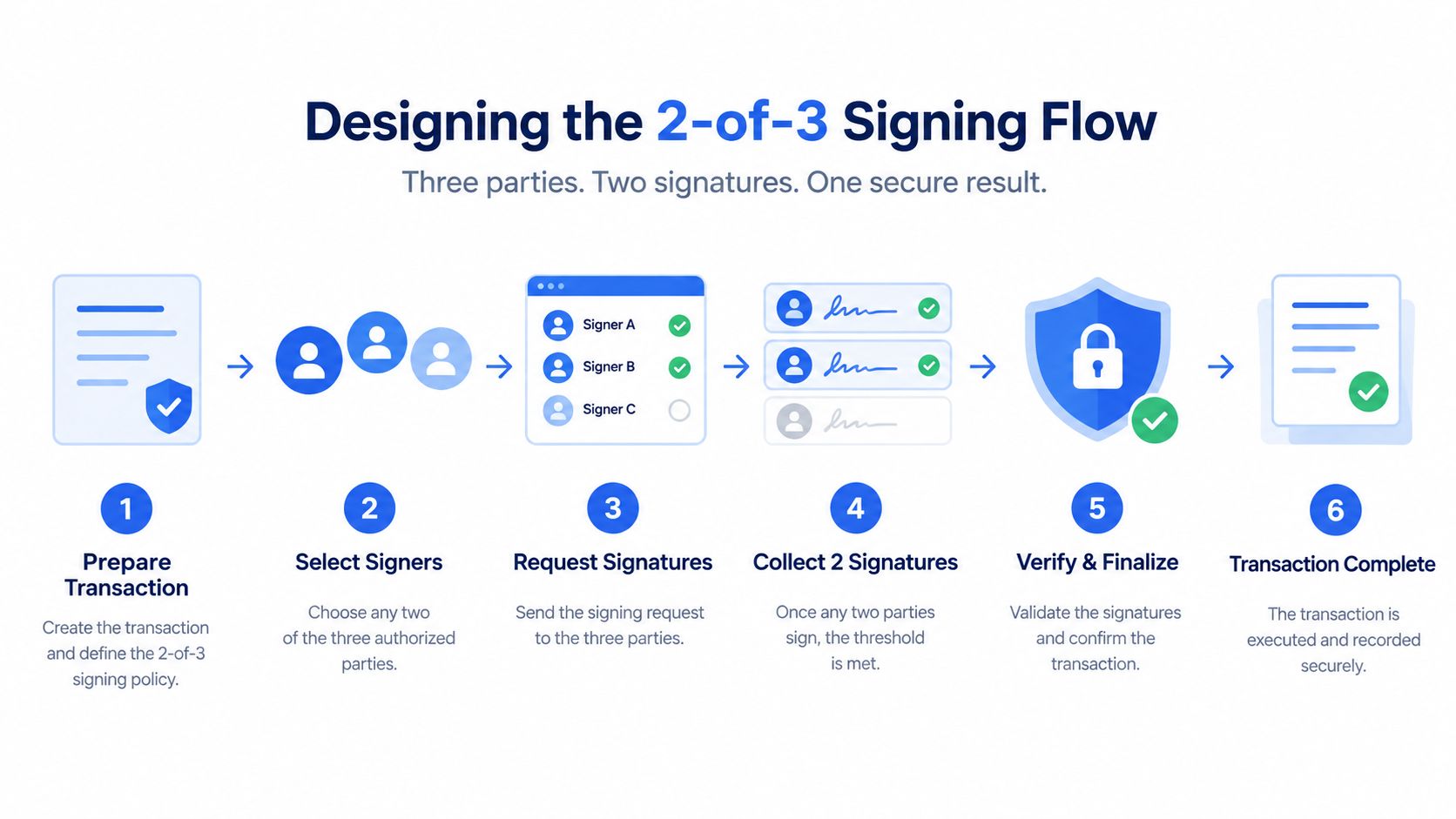
A treasury payout can follow this sequence:
- Create the request. The treasury service submits destination, asset, amount, purpose, and an idempotency key. It should reference a business object, such as a vendor invoice or settlement batch.
- Authenticate the caller. Use Ed25519 authentication, scoped API keys, and an IP allowlist so a valid credential can't be reused across unrelated functions or environments.
- Evaluate policy. The policy engine checks roles, limits, destination rules, AML screening status, and whether the request requires manual approval or an independent Co-Signer.
- Collect authorization. The client-controlled Co-Signer or designated approval service contributes the required signing participation. A service account shouldn't be able to bypass this step by calling a lower-level endpoint.
- Broadcast once. The system broadcasts only the approved transaction and records the resulting identifier. Idempotency prevents retries from creating duplicate business actions when a network response is delayed.
- Stream the outcome. WebSocket events report submission, confirmation, rejection, or policy failure to the ledger, operations dashboard, and reconciliation process.
This design is stronger than emailing a transaction hash to several executives. It gives operations a queue, gives compliance a decision record, and gives engineering a deterministic state machine. The non-custodial wallet model described by BroLabel is useful when the client needs control over a Co-Signer rather than placing all authorization with a provider.
The lesson is to keep signing authority separate from request initiation. The service that creates a payout shouldn't automatically possess the ability to complete it, and the system should reject an authorization that has changed after approval, such as a modified destination or amount.
Key Management and Recovery Playbooks
The most damaging custody incidents often begin with an ordinary operational event. A device is lost. An employee leaves. A signer is unreachable. A backup exists, but nobody has tested whether it can participate in the actual recovery process.
A recovery playbook must define who can declare an incident, which keys remain trusted, how replacement authority is approved, and where funds move during remediation. It should be written for the people who will execute it under stress, not only for the cryptography team.
Lost device or suspected compromise
If a signer device is lost or suspected to be compromised, the incident owner should first determine whether the remaining authorized participants still meet the threshold. The team should then freeze non-essential outgoing activity, review recent approvals and broadcasts, and begin signer replacement or wallet migration using unaffected authority.
A practical sequence looks like this:
- Contain: Disable the affected signer, API credential, or integration path without deleting forensic evidence.
- Verify: Confirm the current wallet balance, pending requests, recent destinations, and remaining signing capacity.
- Replace: Generate a new signing participant under an approved change record, then create and validate the replacement wallet or policy.
- Migrate: Move funds through a controlled transaction after a test transaction and independent review.
- Close: Retire the old participant only after recovery has been tested and the audit record is complete.
Unavailable signer and staff turnover
A 2-of-3 design tolerates one unavailable key, but only if the remaining two participants are genuinely independent and operationally ready. A backup key locked in an unknown location isn't resilience. It's an untested assumption.
Signer distribution should account for geography, employment status, legal authority, and time-zone coverage. Don't place all participants under one manager, in one office, or inside one vendor account. At the same time, excessive distribution can slow routine approvals and create ambiguity about escalation.
More signers can reduce the impact of one compromised key, but every signer also adds a coordination dependency.
Schedule signer reviews as part of access governance. Departures should trigger an immediate authority review, not a quarterly cleanup. New signers should complete a documented enrollment and recovery test. Policy changes should identify whether the existing wallet can support them or whether a controlled migration is required.
The hidden failure is often reconciliation. If the signing service, wallet interface, and finance ledger don't share real-time state, staff may approve a request that has already expired, been rejected, or been broadcast through another path. Recovery therefore needs both key procedures and event visibility.
Reconciliation and Audit Implications
A signed transaction is not the end of the financial process. Finance still needs to know who initiated it, which policy allowed it, which approvals were collected, when it was broadcast, what the network confirmed, and how the final movement maps to the internal ledger.
An append-only operating ledger should record the lifecycle without allowing a later status update to erase the earlier state. Useful records include the original request, policy evaluation, screening result, approval identities, signing participation, broadcast response, confirmation events, fee treatment, and reconciliation status.
Build one transaction narrative
The ledger needs stable identifiers that connect a customer action to a wallet transaction and then to an accounting entry. An idempotency key is essential for safe retries. Without it, a timeout can cause an application to submit the same business instruction again, leaving operations to determine whether two similar broadcasts represent one payout or two.
A strong event model separates observed facts from interpretations:
- Observed deposit: The network or provider detected an incoming transaction.
- Confirmed deposit: The transaction met the configured confirmation policy.
- Withdrawal requested: An authorized system created the business instruction.
- Withdrawal approved: The policy engine accepted the request and required approvals were collected.
- Withdrawal broadcast: The network submission returned a transaction identifier.
- Withdrawal reconciled: Finance matched the final movement to the internal record.
Real-time WebSocket events for deposits, confirmations, withdrawals, and policy outcomes reduce the gaps created by polling several disconnected vendors. They also let operations respond to exceptions while the context is still available. A ledger that receives only the final transaction hash can't explain why a payment was approved or rejected.
For a broader control framework, BroLabel's audit workflow process provides a useful internal reference for connecting evidence collection with operational review. The point isn't to create paperwork for its own sake. It's to make every material state change explainable to finance, risk, compliance, and an external auditor.
A reconciled balance should be a computed result of recorded events, not a value someone manually edits after checking a wallet explorer. That distinction becomes especially important when an institution manages multiple networks, customer wallets, treasury accounts, and automated agents.
Risk Controls and Infrastructure Evaluation
Vendor evaluation should begin with failure modes, not a feature checklist. Ask how the system behaves when a request is retried, a signer is offline, a policy changes during approval, a broadcast response times out, or a network event arrives out of order.
The following matrix turns those questions into controls:
| Risk | Control to require | Evidence to inspect |
|---|---|---|
| Duplicate payout after a timeout | Idempotency enforced at the business-request level | Retry tests and duplicate-submission behavior |
| Unauthorized API use | Scoped API keys, Ed25519 authentication, and IP allowlists | Permission model, credential lifecycle, access logs |
| Signing without policy approval | Policy evaluation before signing participation | Rejected-request records and approval trace |
| Client lock-in or centralized custody | Client-controlled Co-Signer and non-custodial threshold design | Key-flow documentation and recovery responsibilities |
| Silent reconciliation gap | Append-only ledger and real-time WebSocket events | Event schemas, replay behavior, and ledger exports |
| Unclear incident recovery | Tested signer replacement and migration playbook | Exercise records, runbooks, and role assignments |
| Uncontrolled production rollout | Sandbox with production-like policy and broadcast tests | Environment separation and test evidence |
| Unpredictable operating cost | Fee engine calibration and transparent commercial tiers | Fee behavior under changing transaction conditions |
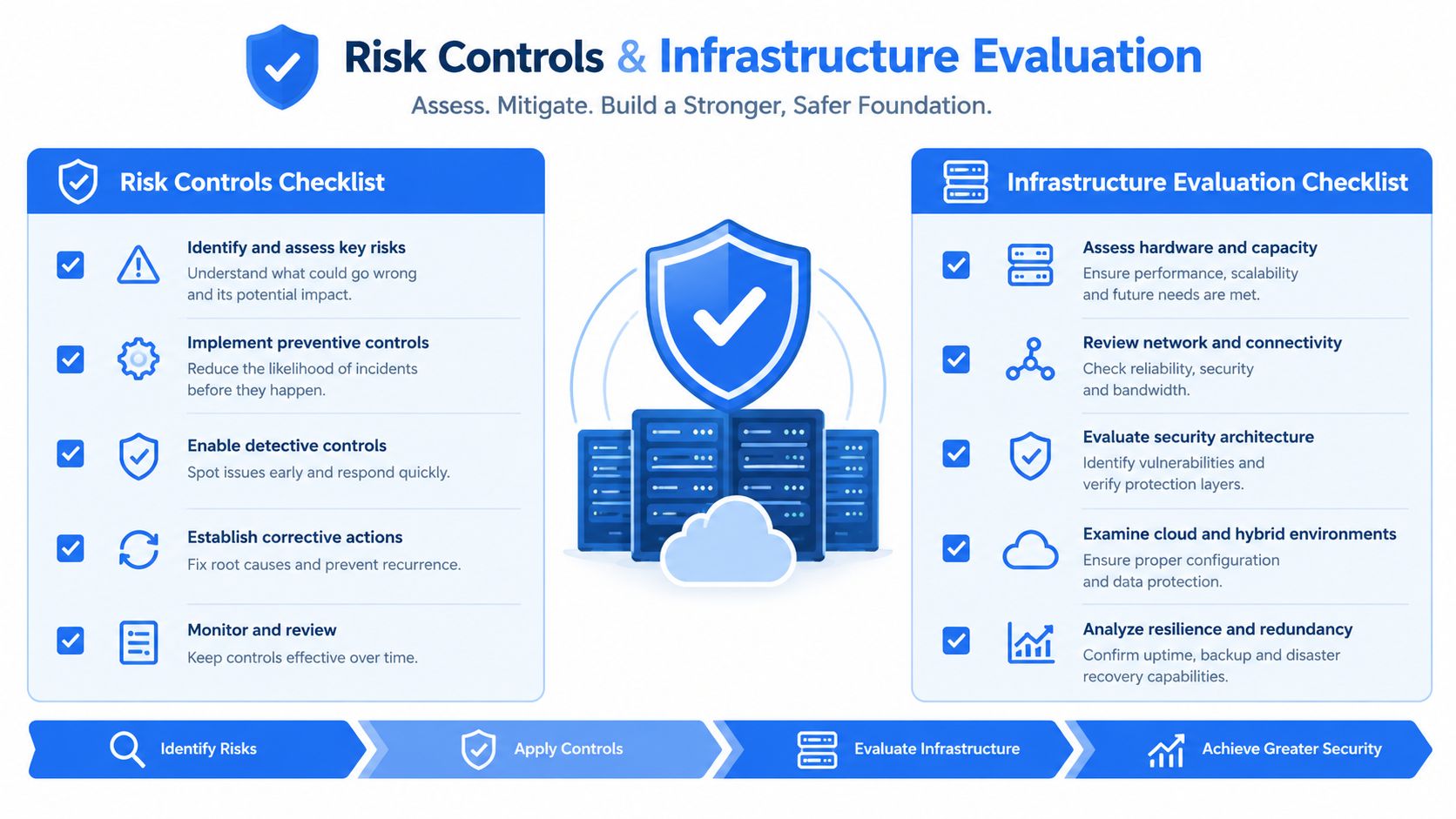
The buyer should also test operational boundaries. Can a compliance officer review a payout without receiving signing power? Can finance export a complete ledger trail? Can engineering subscribe to events rather than build fragile polling? Can the client control one signing participant independently of the provider?
For an API-first stack, BroLabel offers BroSettlement with DKG/MPC 2-of-3 signing, a client-controlled Co-Signer, and network broadcast, alongside embedded wallets, an append-only operating ledger, WebSocket events, and compliance workflows. Those capabilities should still be validated in a sandbox, with the buyer testing its own approval paths, recovery process, role model, and reconciliation exports.
The practical control is staged deployment. Start with a constrained wallet and narrow API permissions, validate the complete lifecycle, rehearse an unavailable signer scenario, and only then expand transaction scope. A provider that can't demonstrate this path is asking the buyer to discover its controls in production.
Frequently Asked Questions
Is a multisig Bitcoin wallet better than a hardware wallet
They solve different layers of the problem. A hardware wallet protects a signing device and its secret material, while a multisig Bitcoin wallet requires authorization from multiple participants. Institutions often combine hardware-backed controls with a threshold policy, but the result still needs signer ownership, recovery procedures, and an audit trail.
Should an institution choose onchain multisig or MPC
Choose native onchain multisig when transparent script-level enforcement and independently inspectable quorum rules are central requirements. Choose MPC threshold signing when the product needs API-driven orchestration, flexible participant management, high-frequency operations, or a consistent workflow across multiple networks. The key evaluation is not the acronym. It's whether the system preserves independent control and produces evidence for every decision.
How does an API Co-Signer differ from a personal wallet signer
A personal signer usually expects a human to review and approve a transaction through a wallet interface. An institutional API Co-Signer participates in a controlled workflow, where the application can enforce roles, destination rules, screening, limits, and escalation before signing occurs. That makes it suitable for treasury systems, payment gateways, and automated products, provided the client retains meaningful control and can test recovery.
Can AI agents use wallets safely
AI agents should receive scoped, non-custodial wallets rather than unrestricted treasury authority. An agent can propose or initiate a transaction, while RBAC, policy evaluation, AML screening, a human or service Co-Signer, and an append-only audit trail determine whether the transaction can proceed. The agent should never be the only component capable of authorizing value transfer.
How should an iGaming operator handle USDT TRC20 flows
Use a distinct deposit address or wallet context per player where the operating model requires it, then stream observed and confirmed deposit events into the player ledger. Payouts should pass operator policy and screening before signing, with idempotency protecting against repeated callbacks or retries. The operator should reconcile network activity against player balances and settlement records rather than relying on a wallet dashboard.
What should a CTO test before production
Test the full path from wallet creation and authentication through policy rejection, co-signing, broadcast, confirmation, reconciliation, and recovery. Include lost credentials, unavailable signers, duplicate requests, delayed network responses, and a controlled signer replacement. If the sandbox can't reproduce those conditions, it isn't proving production readiness.
BroLabel provides API-first embedded wallets, BroSettlement DKG/MPC 2-of-3 signing with a client-controlled Co-Signer, network broadcast, operating ledger, and real-time WebSocket events for institutional workflows. Review the architecture and start planning your multisig Bitcoin wallet operations with BroLabel.