A small business can start taking online payments with a link in an afternoon. The operational problems usually arrive later, when a customer retries after a timeout, the provider processes both attempts, and finance has to determine which charge belongs to which order. By month-end, refunds may have no clear approver, settlement reports may not match bank deposits, and nobody can say with confidence whether a missing payment is pending, failed, reversed, or unreconciled.
An online payment system for small business has to solve more than checkout. It needs payment rails, authorization and settlement states, fraud controls, reliable event handling, access policies, and an authoritative record of what happened. The enemy is fragmented, uncontrolled payment acceptance, because it creates duplicate charges, avoidable support work, lost cash-flow visibility, and customer distrust.
Table of Contents
- Why Small Businesses Outgrow Checkout Links
- How an Online Payment System Works
- The Real Cost of Payment Methods
- Choosing a System That Fits Your Business
- Integration Options From Hosted Checkout to Embedded Wallets
- Security Compliance and Operational Resilience
- Your Go-Live Implementation Checklist
- Frequently Asked Buyer Questions
Why Small Businesses Outgrow Checkout Links
A checkout link is useful when the business is validating demand. It gives a founder a fast way to accept a card or wallet payment without building a full payment experience. The trouble starts when that link becomes the operating system for orders, refunds, payouts, and accounting.
Consider a services firm that sends payment links after each completed job. A customer submits payment, sees a network error, and clicks again. The business receives two successful charges but has one invoice. Later, an employee issues a refund from a dashboard, while the owner assumes finance approved it. The provider's report shows processor statuses, the bank shows settlement batches, and the accounting system shows an invoice. None of those records explains the complete business event on its own.
Practical lesson: A payment attempt isn't the same thing as a completed sale, and a provider dashboard isn't an internal ledger.
The system should distinguish at least between authorization, capture, settlement, refund, reversal, dispute, and payout. Each state needs an owner, a permitted transition, and a record that finance and operations can reconcile later. Without those boundaries, teams often repair exceptions manually, which makes the next exception harder to diagnose.
An online payment stack generally contains:
- Customer-facing acceptance, such as cards, digital wallets, bank payments, or crypto rails.
- Provider services, which authorize transactions, apply risk rules, and settle funds.
- Internal controls, including scoped credentials, approval policies, and fraud review.
- Event delivery, through webhooks or WebSocket streams.
- An operating ledger, which records the business interpretation of every external event.
The practical decision isn't “Which checkout button is cheapest?” It's “Which combination of rails and controls lets this business accept money, know what happened, and recover when a provider or network behaves unexpectedly?”
How an Online Payment System Works
At go-live, the checkout may show “paid” while the provider has not settled funds and the order system still says “pending.” That gap is where payment operations fail. Authorization is a promise, settlement moves the money, and the ledger records the complete sequence.
A customer selects a card, wallet, ACH instruction, or another method and submits an order. The provider checks the request, applies authentication and risk controls, then returns an authorization or failure result. Authorization confirms that the operation can proceed at that point. It does not confirm that the merchant has received settled funds, which may arrive through a separate event on the provider's schedule.
The business should consume each meaningful state change rather than rely on one synchronous response. A transaction may move from initiated to authorized, captured, settled, refunded, reversed, or disputed. Preserve that sequence internally so an operator can explain the customer's balance, the company's cash position, and the reason for any exception.
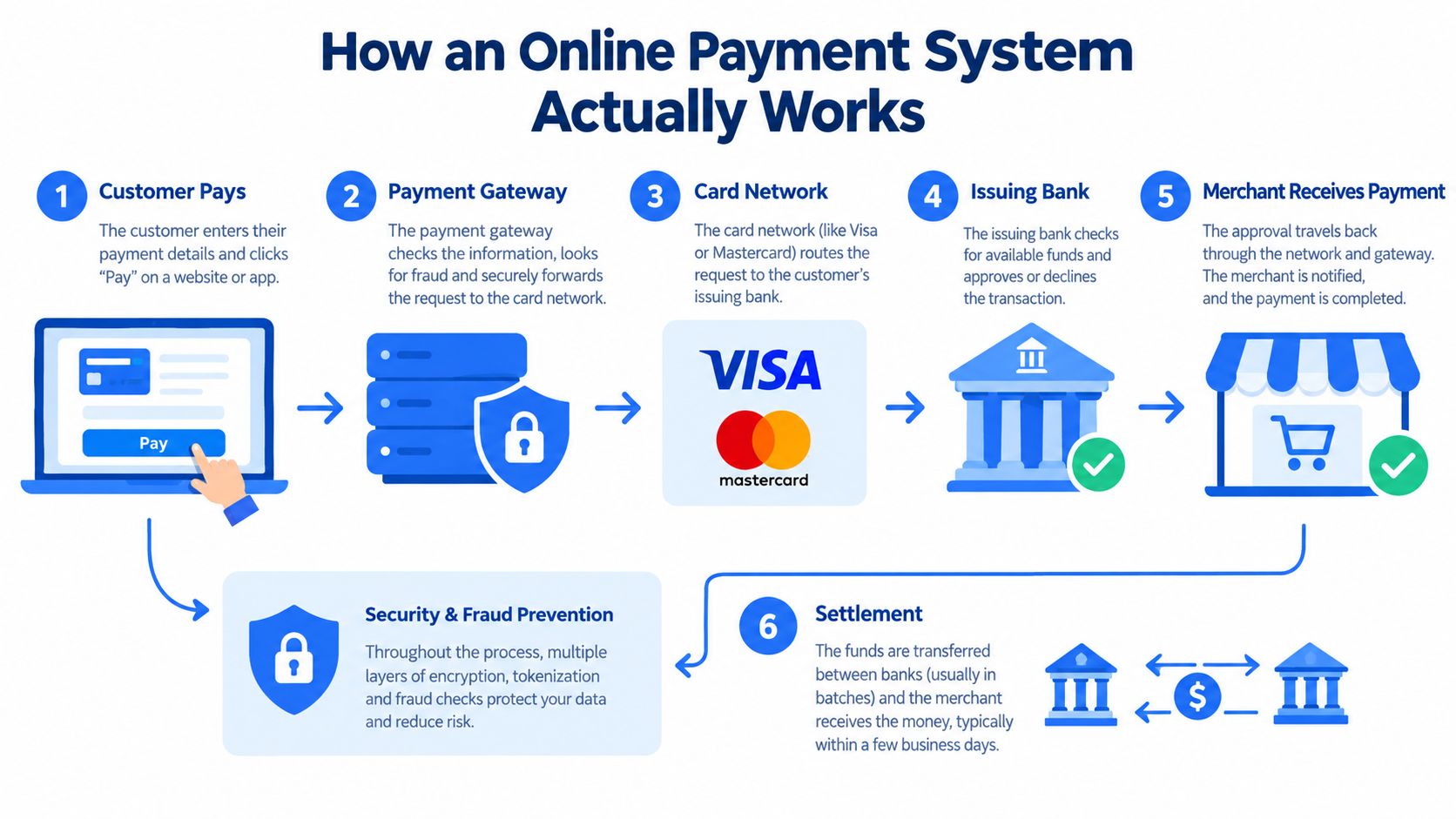
One transaction from checkout to settlement
- Selection: The customer chooses a payment method and submits an order.
- Authentication: The provider and relevant networks apply authentication and risk checks.
- Authorization: The provider confirms whether the requested operation can proceed.
- Capture and settlement: The transaction moves through capture and settlement according to the rail's rules.
- Event delivery: The provider emits status events for the business to consume.
- Ledger posting: The business maps the external event to an internal transaction, balance mutation, and audit record.
Cards and wallets suit many customer-facing purchases. ACH and other bank rails may fit invoices, suppliers, payroll, or recurring business-to-business flows. Crypto and stablecoin rails add wallet addresses, blockchain confirmations, signing policies, screening, and network fees. The right architecture is often multi-rail, with controls that reflect each method's failure modes and reconciliation requirements.
A practical reference for card acceptance mechanics is Sambapay's guide to card acceptance. Teams assessing broader infrastructure can also review digital payment technology as a connected system of acceptance, events, records, and controls.
Every external payment event must map to an internal record.
That rule addresses a common production failure: the provider marks a payment settled, but a delayed webhook leaves the order pending. The event consumer should be durable, signature-verified, idempotent, and safe to replay. The internal ledger then supports reconciliation against an authoritative record instead of forcing finance to assemble payment history from dashboards and spreadsheets.
The Real Cost of Payment Methods
Advertised processing rates are only one input. The economically relevant measure is cost per completed sale, which includes conversion, abandoned checkout, surcharge resistance, refunds, disputes, settlement timing, support work, and accounting labor.
Recent U.S. data shows that merchant-services providers processed 65% of small-business sales revenue in 2025, up from 62% in 2024. The same source reports that 34% of merchants added credit-card surcharges, while 41% of credit-card users said they had decided not to use a card after seeing a surcharge. Cards were accepted by 96% of surveyed small businesses, digital wallets by 90%, and BNPL by 52%, according to J.D. Power's 2025 merchant services study.
That creates a practical break-even question. If a surcharge lowers the nominal cost of a card transaction but causes a customer to abandon the purchase, the cheaper transaction may become the more expensive business outcome.
Payment Method Cost and Operations Comparison
| Payment Method | Adoption Among Small Businesses | Cost Behavior | Reconciliation Effort |
|---|---|---|---|
| Cards | 96% acceptance in the cited U.S. survey | Per-transaction processing cost, with possible surcharge and dispute exposure | Match authorization, capture, settlement, refunds, and disputes |
| Digital wallets | 90% acceptance in the cited U.S. survey | Often adds wallet-specific acceptance and token or device considerations | Tie wallet references to the underlying order and settlement batch |
| BNPL | 52% acceptance in the cited U.S. survey | Provider terms, settlement timing, refunds, and customer repayment events matter | Track provider settlement separately from customer order status |
| ACH and bank payments | Common for invoices and business transfers | Settlement can follow a different schedule from cards | Reconcile bank references, returns, pending states, and final settlement |
| Cash and checks | Still operationally significant for small firms | Handling, deposit, return, and administrative costs are less visible | Requires disciplined receipt, deposit, and exception records |
The model should use your own data. For each method, calculate:
- Completed-sale cost: provider cost plus support, accounting, refund, and dispute work.
- Conversion effect: completed orders divided by payment attempts for the relevant customer segment.
- Cash-flow effect: time between customer authorization, usable funds, and bank settlement.
- Failure cost: duplicate attempts, reversals, failed refunds, and manual investigation.
- Segment fit: method performance by customer type, order size, channel, and geography.
A small retailer may prefer wallets for fast mobile checkout, while an invoice-based consultancy may value ACH despite slower state transitions. A fee comparison tool such as Chartsy's payment fee comparison can help organize nominal pricing, but the final decision still needs your completed-sale and reconciliation data. The broader question of form of payment belongs in the operating model, not just the checkout design.
Choosing a System That Fits Your Business
The right system supports the rails your customers and counterparties use. Federal Reserve data from the 2024 Business Payments Study found that among U.S. small businesses, 67% used digital wallets, 63% credit cards, 61% debit cards, 60% next-day ACH, and 56% same-day ACH. Traditional methods remained active too, with 66% using cash and 78% using checks, as reported by the Federal Reserve's business payments research.
That mix changes the selection criteria. A system built only for card checkout may serve online customers while leaving supplier payments, payroll, invoice collection, and reconciliation outside the controlled workflow.
Compare the operating requirements
A services firm billing invoices needs clear invoice references, bank-payment support, recurring collection options, and reliable handling of returns or delayed settlement. Its priority is usually a clean receivables workflow rather than an elaborate consumer checkout.
A retailer selling online and in person needs consistent customer and order records across channels. Wallets and cards may drive checkout, while cash and bank deposits still need to enter the same accounting process. Offline procedures and staff permissions matter because a physical sale can continue during a connectivity incident.
A platform moving funds per user needs more than acceptance. It needs user-level balances, payout approvals, beneficiary controls, audit events, and a ledger that can distinguish platform funds from user funds. If crypto is involved, the platform also needs address management, screening, signing policy, and blockchain confirmation handling.
Use this checklist when comparing providers:
- Coverage: Can the system support the customer-facing and B2B rails you need?
- Settlement: Does the settlement schedule match payroll, suppliers, refunds, and working-capital needs?
- Records: Can finance export complete transaction, fee, refund, and payout data?
- Security scope: Does hosted capture or tokenization reduce sensitive-data exposure without creating false confidence?
- Integration: Can engineering consume events, retry safely, and enforce access policies?
- Commercial fit: Does pricing work while early volume remains unpredictable?
A payment gateway solution should be assessed as a control boundary, not merely as a route from a checkout form to a processor. The system earns its place when it makes money movement explainable to product, finance, operations, and compliance at the same time.
Integration Options From Hosted Checkout to Embedded Wallets
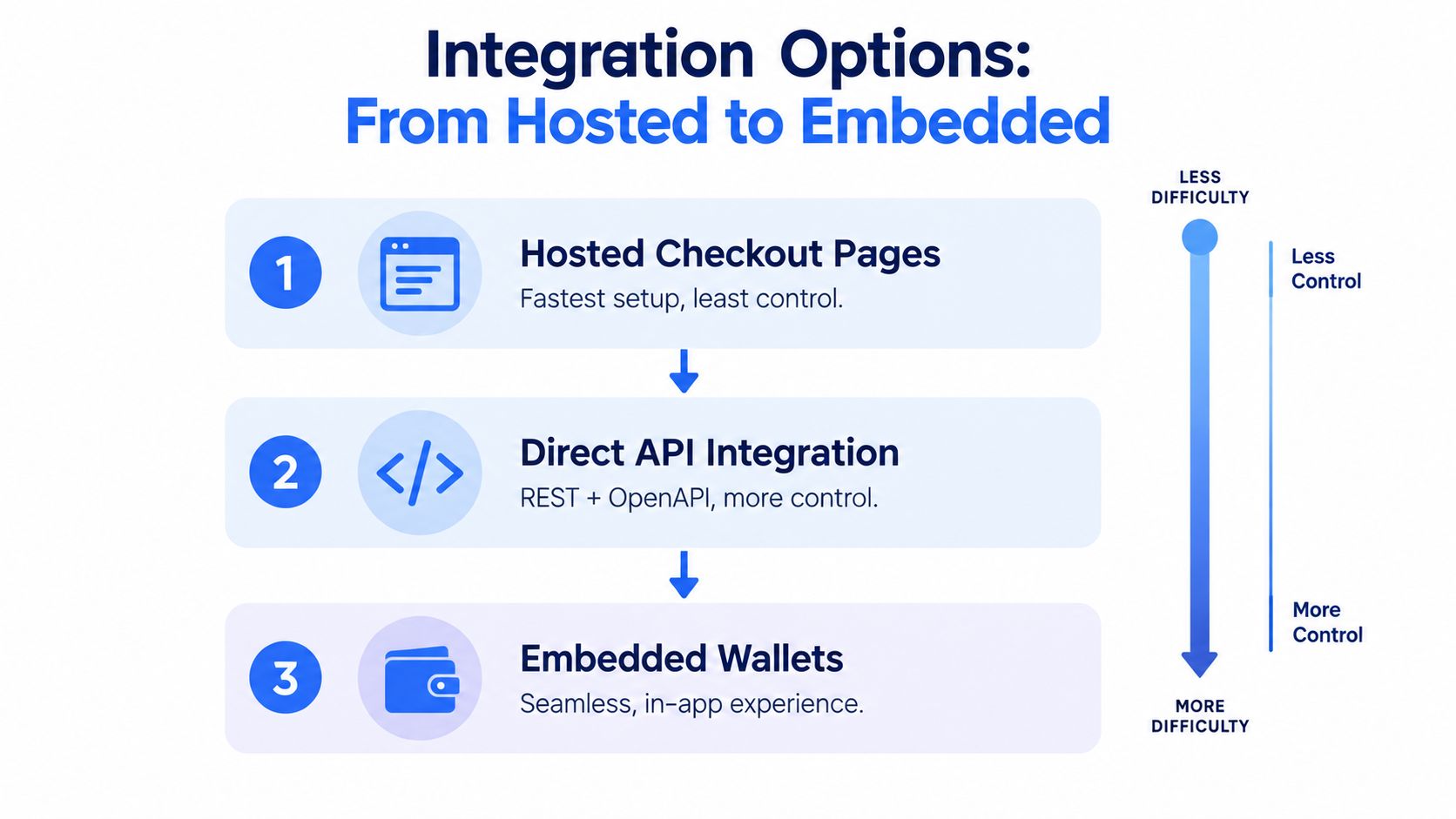
Integration depth determines who owns the failure modes and the operational cost of each completed sale.
Hosted checkout pages are usually the fastest route to launch. The provider owns more of the card-capture surface, while the business receives a redirect or event after payment. This reduces implementation work, but limits control over checkout behavior, payment states, and specialized flows.
Direct API integration gives the product team control over orders, payment intents, subscriptions, and internal workflows. REST and OpenAPI tooling can clarify the contract. The business then owns credential handling, retry behavior, event processing, permissions, and more of the compliance boundary.
Embedded wallets fit products where each user, agent, or player needs a distinct address or balance flow. A non-custodial address model can separate user-level funds operationally, but it adds address lifecycle management, confirmation tracking, withdrawal policy, and signing controls.
The retry rule that prevents duplicate operations
A network failure leaves the client unsure whether the server received a charge or transfer request. Retrying without an idempotency key can create a second operation, turning an intermittent transport problem into a reconciliation problem.
Apply this rule on the server:
- Generate one unique key for the logical order, refund, transfer, or payout.
- Persist it with the business record.
- Reuse it for every retry of that operation.
- Never create a new key only because the transport request failed.
Use a key long enough to avoid collisions, persist it with the business record, and have the server return the original result for later requests with the same key. Confirm the provider's exact behavior in its own documentation rather than relying on general payment API idempotency guidance.
Events and access controls
Send webhooks or WebSocket events to a durable queue before business logic processes them. Verify signatures, reject replays, retain sequence information where available, and make consumers idempotent. A provider outage should not produce duplicate charges or hide settlement events.
Use scoped API keys, role-based permissions, IP allowlists where appropriate, and separate credentials for development, operations, and production. For per-user crypto flows, MPC threshold signing with a client-controlled Co-Signer distributes signing authority while allowing the platform to apply policy before broadcast.
Security Compliance and Operational Resilience
Security isn't finished when checkout works. PCI DSS 4.0 applies to organizations that process, store, transmit, or can affect the security of cardholder data. A hosted page or tokenization can reduce direct exposure to primary account numbers, but the merchant's website, administrative accounts, scripts, APIs, and connected systems may still remain in scope, as explained in this PCI DSS 4.0 overview.
Reduce scope without reducing responsibility
A practical design separates payment collection from core application servers and uses provider-issued tokens instead of storing card numbers. It also requires:
- MFA: Protect administrator, finance, support, and deployment accounts.
- Least privilege: Give each service and employee only the permissions required for its job.
- Script inventory: Know which scripts execute on payment pages and why they are present.
- Service isolation: Put card and fiat integrations behind narrowly scoped services.
- Audit evidence: Retain records showing that controls operate continuously.
Refund permissions deserve special attention. A support agent may need to view a transaction, while only a finance role can approve a high-value refund. The system should record the request, approver, reason, amount, and resulting provider event.
Resilience is more than adding methods
Payment diversification doesn't automatically create resilience. More wallets, BNPL providers, bank rails, and crypto networks can also create more states, credentials, settlement reports, and outage scenarios. One authoritative ledger, documented fallback procedures, and clear ownership matter more than the raw number of payment methods.
Fraud monitoring should be event-driven. Record authorization, authentication, confirmation, reversal, refund, dispute, and payout events, then correlate velocity, device, beneficiary, amount, and account-history signals. High-risk actions can move into review or delayed settlement instead of receiving an unconditional approval.
Provider downtime, frozen funds, delayed events, unauthorized refunds, and chargebacks need explicit playbooks. Keep a defined offline or alternative acceptance procedure appropriate to your sales channel, require webhook signature verification before marking an order paid, and reconcile provider reports against internal records rather than correcting discrepancies without notice. Teams handling disputes can also review how to stop chargeback disputes early, but prevention still starts with recognizable descriptors, delivery evidence, access controls, and a reliable transaction history.
Your Go-Live Implementation Checklist
A launch should be a controlled sequence, not the moment someone switches a production key. Each step below creates a specific control that engineering, finance, operations, and compliance can test before customers depend on it.
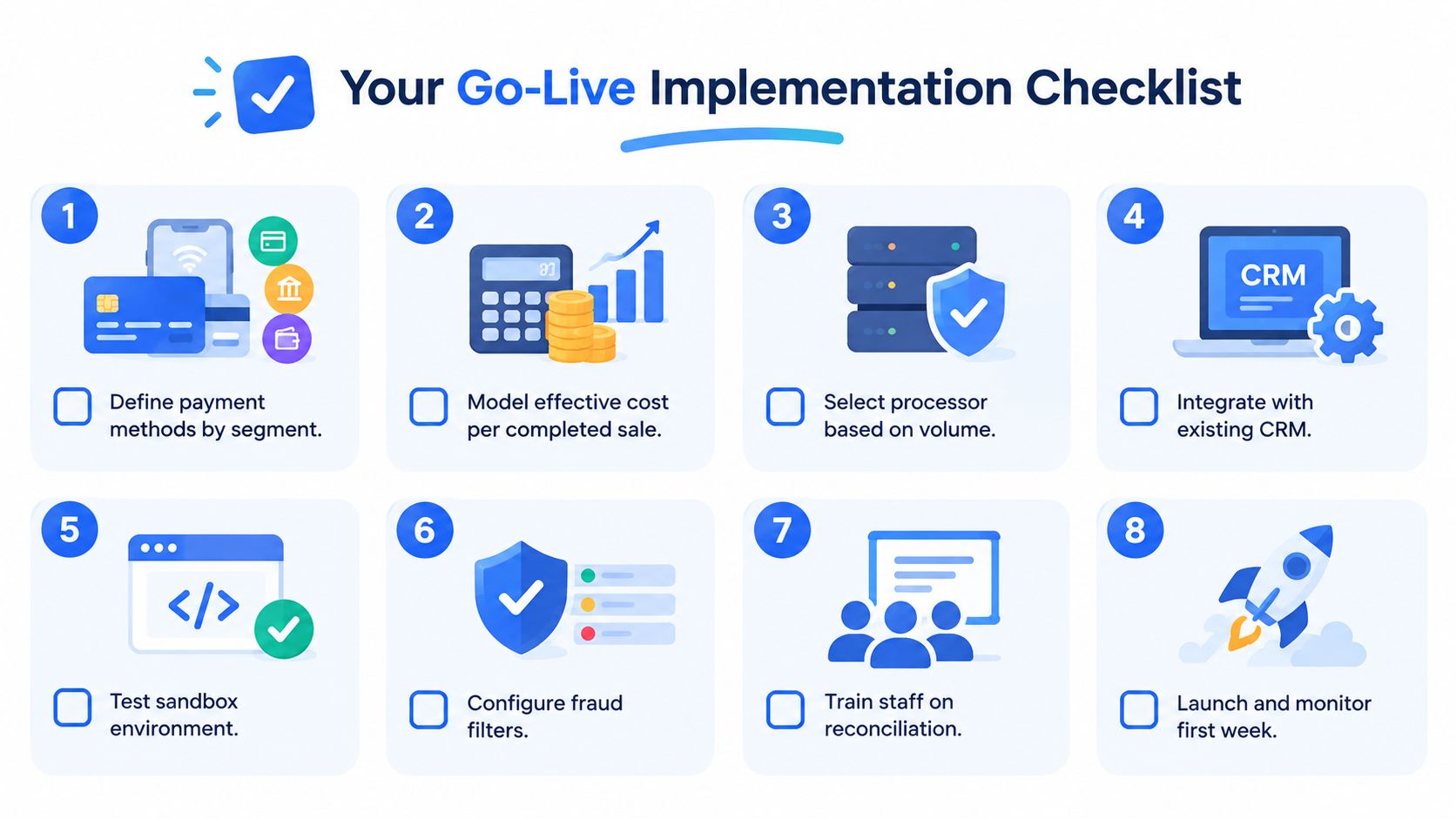
Define methods by customer segment. List the payment methods used by online buyers, in-person customers, invoice recipients, suppliers, and employees. This prevents a consumer checkout decision from dictating every financial workflow.
Model effective cost per completed sale. Use completed orders, abandoned attempts, refunds, disputes, settlement timing, and accounting effort. Don't approve a method because its headline rate looks low.
Select the processor and integration path. Decide whether hosted checkout, direct API integration, or embedded wallets match the product's control and staffing needs. Confirm responsibilities with the provider, acquirer, and internal teams before implementation.
Build in a sandbox. Test successful payments, declines, timeouts, duplicate submissions, refunds, reversals, delayed events, and permission failures. A happy-path test proves very little.
Persist idempotency keys and verify events. Store one operation key with each logical charge, transfer, refund, or payout. Verify event signatures, use durable queues, and make recovery safe when the same event arrives more than once.
Create the operating ledger. Map every external processor event to an internal transaction, balance mutation, settlement record, and audit entry. Finance should be able to reconcile provider reports and bank activity without reconstructing business history from email.
Set approval and fallback policies. Define who can issue refunds, release payouts, change risk rules, rotate keys, or move funds during an incident. Document what staff should do when a provider delays settlement or becomes unavailable.
Launch gradually and monitor. Review authorization outcomes, event lag, duplicate attempts, refund activity, settlement variances, fraud alerts, and support tickets. Broader payments research found that 74% of organizations cited reduced fraud and errors as a benefit of digital payments, while 43% identified convincing customers to pay digitally as a major barrier, according to the 2025 Swedish central-bank and payments research reference.
Start with modular components and add capability as volume and operational knowledge become predictable. Fixed minimums and an oversized stack can create cost and migration pressure before the business knows which payment flows deserve deeper investment.
Frequently Asked Buyer Questions
How long does a typical integration take for a small team?
A hosted checkout can be deployed faster than a direct API or embedded-wallet flow, but the integration isn't complete until refunds, retries, events, reconciliation, and permissions work. The reliable planning unit is the number of business states and exception paths, not the number of checkout fields.
What happens to refunds and disputes after settlement?
Settlement doesn't end the transaction's lifecycle. Keep the original order, provider transaction identifier, refund request, approval record, refund event, and dispute status linked in the ledger so finance can distinguish a settled sale from money later returned or challenged.
When should a business add stablecoin or crypto rails beside cards and ACH?
Add them when a specific customer, supplier, treasury, or payout workflow benefits from the rail and the business can support screening, address controls, confirmation policy, signing approval, and reconciliation. Crypto shouldn't be added merely because it exists. For a business that does add it, embedded wallets, network broadcast, MPC signing, and an append-only ledger need to operate as one controlled flow.
What should we do if a provider freezes or delays funds?
Pause assumptions, not records. Keep accepting only through approved fallback methods, preserve every provider status and support interaction, reconcile internal balances against confirmed settlement, and require authorized finance or compliance staff to decide whether payouts or refunds can proceed.
Does tokenization remove PCI responsibility?
No. Tokenization can reduce the systems that handle sensitive card data, but the website, scripts, credentials, APIs, and connected services may still affect payment security. Confirm the applicable validation requirements with the payment brands and acquiring bank before launch.
BroLabel offers modular infrastructure for teams that need wallets, an operating ledger, network broadcast, cards, and fiat integrations through one API. Start in the sandbox, connect only the components required for your first payment flow, and invite your product, finance, and compliance owners to review the operating controls at BroLabel. Bro has your back.