The most popular advice about stablecoins cross border payments starts with blockchain speed and network fees. That advice is incomplete. A transfer can settle on-chain in minutes, yet the customer still waits for local bank credit, pays an unfavorable FX spread, or leaves the finance team with a reconciliation problem that surfaces at month-end.
The practical question for a fintech CTO isn't whether a blockchain can move a token quickly. It's whether the entire corridor can convert, screen, authorize, settle, reconcile, and pay out predictably. Stablecoins can be a useful settlement rail, but only when teams design the off-chain operating model with as much care as the wallet layer.
Table of Contents
- The Real Bottleneck in Global Settlements
- How Stablecoin Rails Move Value Across Borders
- Designing Secure Custody and Settlement Architecture
- Production Use Cases for Remittances and B2B Payouts
- Navigating Compliance and Reconciliation Controls
- Deploying an API-First Infrastructure Stack
- Frequently Asked Questions by Product and Compliance Teams
The Real Bottleneck in Global Settlements
Traditional cross-border transfers can take 3 to 5 business days and often cost $25 to $50, while stablecoin settlement can complete in seconds for less than $0.01, according to Worldpay's analysis of stablecoin settlement. That difference matters for urgent payouts and treasury liquidity, but it doesn't prove that blockchain settlement solves the whole payment.
The core problem is the fragmented vendor chain. One provider supplies wallets, another supplies local FX, a third handles compliance screening, and a fourth provides bank payouts. Each system has its own identifiers, status model, retry behavior, permissions, and reporting format. Your engineering team becomes responsible for stitching together systems that were never designed to share a single transaction truth.
That fragmentation creates failure modes that gas optimization can't fix. A cheap on-chain transfer is still uneconomic if the destination market has weak liquidity, a broad conversion spread, unreliable cash-out partners, or manual beneficiary checks. A fast confirmation is still operationally slow if the payout provider doesn't expose a usable event, or if finance has to compare wallet exports with bank statements by hand.
Practical lesson: Optimize the corridor, not just the chain. Measure the complete path from source funding to destination payout, including FX, liquidity, compliance, exceptions, and reconciliation.
FXC Intelligence estimates that stablecoins moved $135 billion in global retail cross-border payments in 2025, out of a $44.3 trillion market, representing 0.31%. In 2024, stablecoins moved $82 billion out of $40.5 trillion, or 0.20%. The same analysis estimates cross-border stablecoin volume grew 64% in 2025, compared with 9% growth for fiat cross-border payments, so adoption is accelerating while stablecoins remain a small part of the overall market. These figures are set out in FXC Intelligence's stablecoin market analysis.
Teams evaluating the fastest payment options for SA businesses should therefore compare complete payment paths rather than advertised blockchain finality. A useful internal design reference is BroLabel's guide to cross-border payments, particularly when mapping correspondent banking, local payout, and digital settlement into one operating flow.
Stablecoins are best treated as programmable settlement instruments, not as a replacement for every part of banking. The infrastructure must hide unnecessary chain complexity while exposing the controls that finance, risk, and compliance teams need.
How Stablecoin Rails Move Value Across Borders
A stablecoin transfer usually has four distinct stages, and only one of them is the blockchain transaction.
First, the payer funds the transaction. That might mean converting fiat into USDC or USDT, drawing from a pre-funded treasury balance, or accepting a stablecoin deposit from a customer. The provider must identify the funding source, apply customer and transaction controls, and reserve enough liquidity for the intended corridor.
Second, the system broadcasts the stablecoin across a supported network. The wallet signs an approved transaction, the network records it, and the payment service waits for its configured confirmation state. The asset has moved between addresses, but the recipient may still need a local conversion before they can use the value in their economy.
Third, the destination liquidity provider sells the stablecoin for local fiat or transfers it to a recipient wallet. At this stage, local market depth, FX pricing, banking access, and cash-out reliability become decisive. The blockchain may provide a common settlement layer, but it doesn't create local currency liquidity at either end.
Fourth, the recipient receives the intended payout, and the operator records the relationship between the customer instruction, wallet movement, conversion, bank transfer, fees, and final status. Without that relationship, the payment may be settled on-chain but unresolved in the company's books.
Corridor design matters more than global coverage
Stablecoin adoption is uneven. The Bank for International Settlements research on stablecoins and the international monetary system notes that, from early 2022 onward, cross-border flows in the largest dollar-pegged stablecoins sometimes exceeded Bitcoin and Ether flows. It also identifies especially strong activity in Asia-Pacific and relatively high flows compared with economic size in Africa, the Middle East, and Latin America.
The concentration is operationally important. In 2025, the three largest corridors, Taiwan to Turkey, Taiwan to Indonesia, and Turkey to Indonesia, represented around 13% of stablecoin cross-border payments, according to the same BIS-referenced data. That doesn't mean every product should target those routes. It means a payment platform should validate each corridor independently instead of assuming that a token accepted globally has equal utility everywhere.
A remittance operator may need stablecoin settlement between its own treasury accounts, followed by local payout through a licensed partner. A B2B marketplace may need supplier verification, invoice references, and predictable delivery to a bank account. For a practical consumer example, teams researching using USDT to send money from Canada should examine the conversion and payout steps, not only the wallet transfer.
The benefits of stablecoins become meaningful only when the product controls the full sequence. Hold the asset for as little time as possible when FX exposure is undesirable, pre-validate destination liquidity, and attach one durable payment identifier to every stage.
Designing Secure Custody and Settlement Architecture
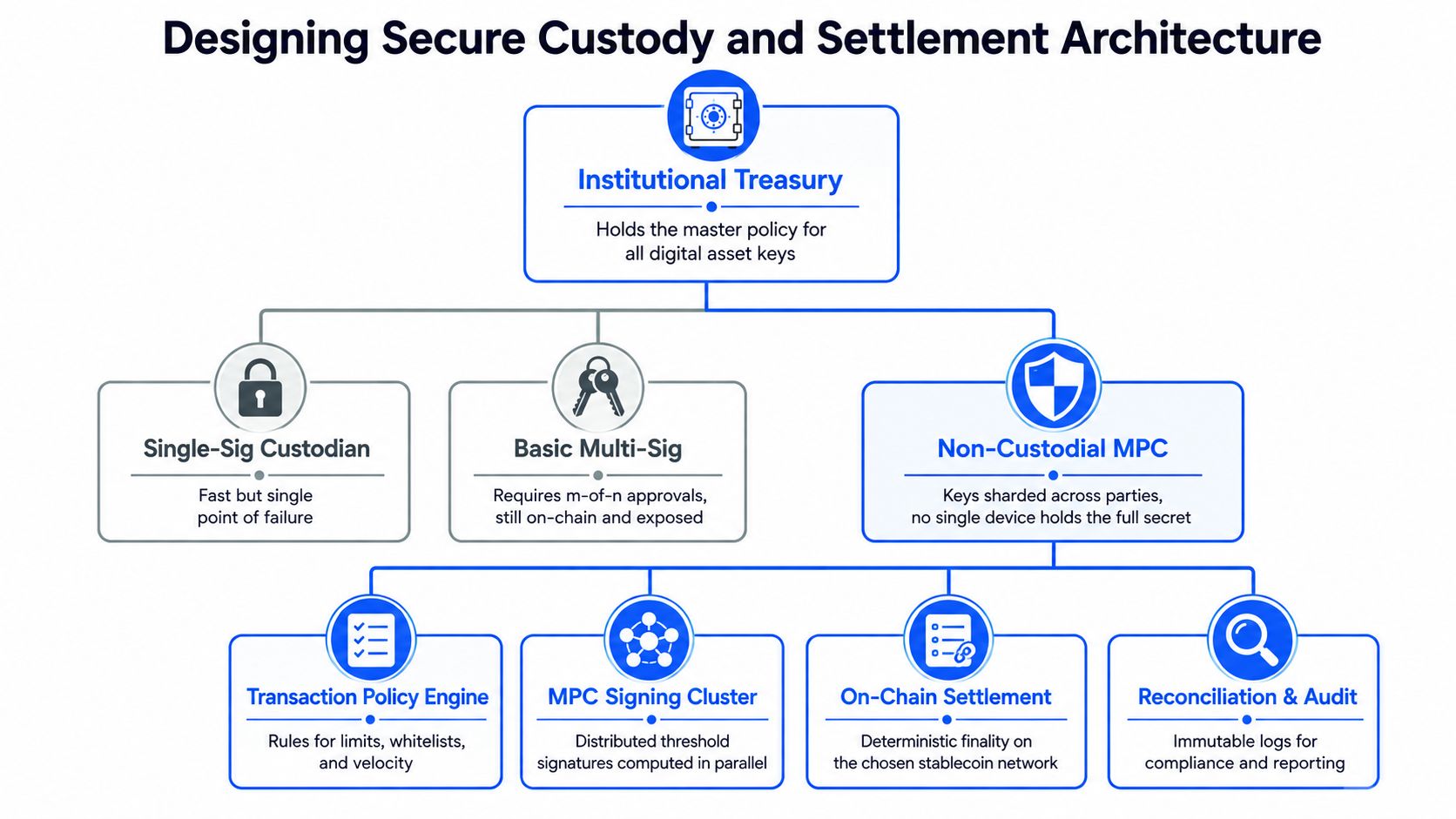
Institutional custody decisions should begin with the failure scenario, not the feature list. A single-signature custodian is operationally simple, but it concentrates authority and creates a single point of failure. Basic multi-signature arrangements distribute approval across keys, yet they can still leave the customer dependent on an external signing process and an on-chain coordination pattern that doesn't match internal workflows.
A non-custodial MPC architecture takes a different approach. Multi-Party Computation allows threshold signing without placing the complete private key on one device. The customer can retain control of a co-signer, while the infrastructure provider manages its own signing component and enforces the configured policy.
Use policy as an operating control
A 2-of-3 signing policy is a practical model for many production workflows. It can require two independent approvals while preserving availability if one signing participant is unavailable. The important point isn't the number alone. The policy must define who can approve, which destinations are allowed, what transaction limits apply, how velocity is measured, and what happens when an instruction falls outside the rules.
Co-Signer control should sit with the client or a clearly segregated control function. A payout service shouldn't be able to unilaterally move funds solely because its API accepted a request. The signing decision should combine the payment instruction, compliance result, account permissions, policy evaluation, and transaction context.
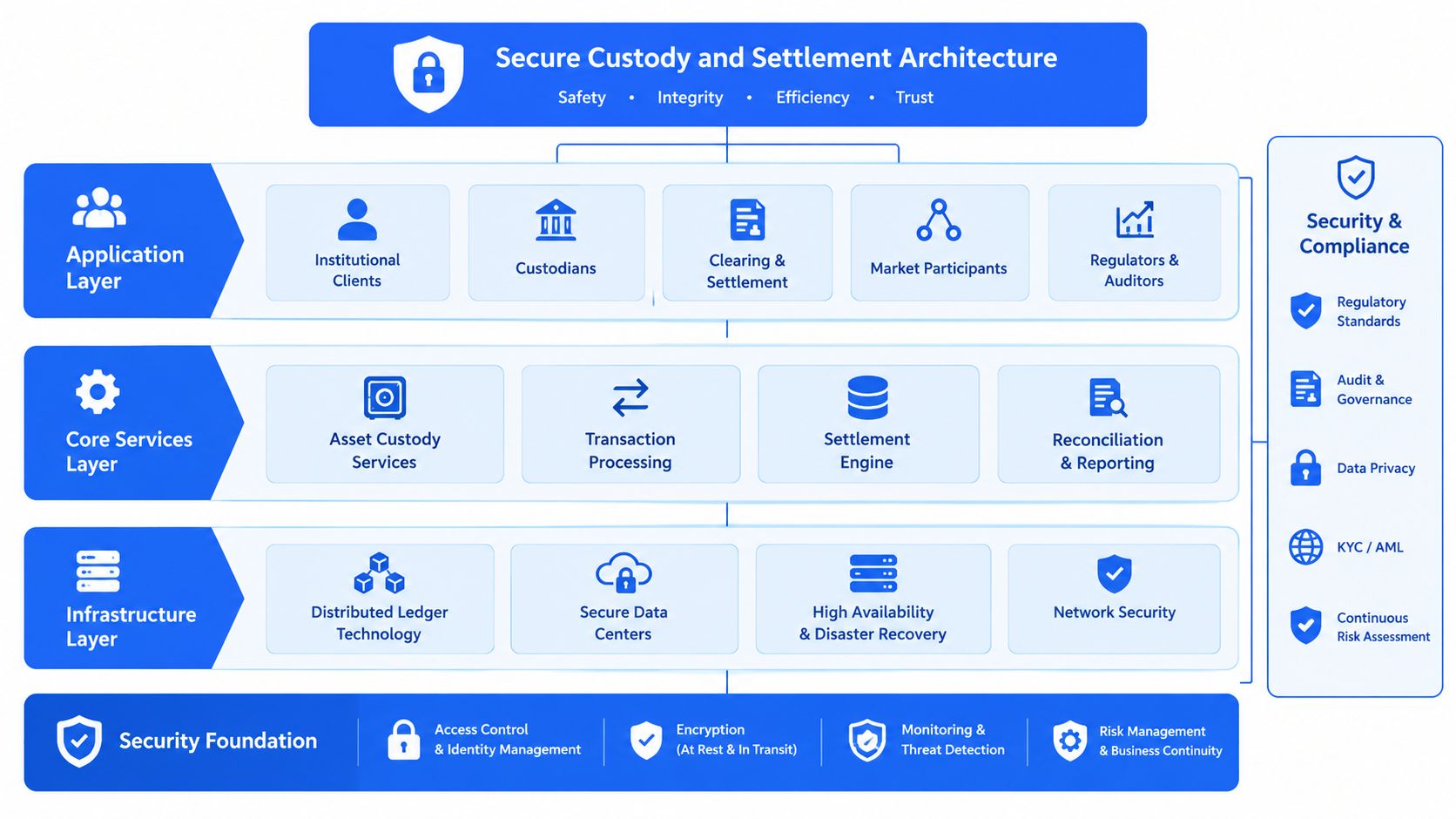
A useful architecture separates these layers:
- Instruction layer: Receives a business request with a stable idempotency key, beneficiary, asset, network, amount, and purpose.
- Policy layer: Evaluates limits, allowlists, role permissions, sanctions results, and approval requirements.
- Signing layer: Uses MPC threshold signing and the client-controlled Co-Signer to authorize the transaction.
- Settlement layer: Broadcasts to the selected network and tracks the confirmation lifecycle.
- Accounting layer: Writes append-only records that connect the instruction to every resulting movement and fee.
Make reconciliation event-driven
An immutable operating ledger should record state transitions rather than only final balances. It needs to distinguish a requested payout from an approved payout, a signed transaction, a broadcast transaction, a confirmed deposit, a failed conversion, and a completed bank delivery.
WebSocket events make this model usable in production. Finance and operations teams can receive deposit, confirmation, withdrawal, and policy events as they occur, while the ledger remains the authoritative record for reporting. REST APIs are appropriate for commands and queries. Event streams are better for monitoring what happened after a command was accepted.
Teams comparing custody approaches can use MPC wallet architecture as a reference point. The design objective is not to remove people from the process. It's to give the right people controlled authority, complete evidence, and a reliable recovery path.
Production Use Cases for Remittances and B2B Payouts
The strongest production cases for stablecoins begin with a defined corridor and a specific payout problem. They don't begin with a decision to support every token on every network.
Consider a remittance platform serving a consumer corridor where recipients want either a wallet balance or local fiat. The platform can accept source funds, convert them into a stablecoin for internal settlement, and instruct a destination partner to cash out. The key system objects are the sender, recipient, corridor, quote, compliance decision, payment instruction, wallet transaction, and payout result.
The platform should reserve liquidity before accepting an irrevocable instruction. It should also give the customer a clear state model, such as pending review, approved, broadcast, confirmed, conversion pending, paid, or exception. A generic “successful” webhook isn't sufficient because it hides which part of the flow has completed.
C2C remittances
Stablecoins reached 0.95% of C2C cross-border payment value in 2025 and are projected to exceed 1% in 2026, according to FXC Intelligence and Allium's C2C market analysis. That share remains limited, but it shows where adoption is developing fastest, in consumer and small-value corridors.
A remittance product should avoid holding unnecessary FX risk during the settlement window. Generate a quote with an expiry, reserve the destination liquidity, and convert close to the payout event. If the local partner is unavailable, the system should pause before signing or route to an approved alternative, rather than broadcast first and investigate later.
B2B supplier payouts
A marketplace paying suppliers can use an API instruction to settle from a treasury balance, attach an invoice or vendor reference, and deliver stablecoins or local fiat based on the supplier's preference. The value comes from reducing manual coordination and shortening the gap between the marketplace's obligation and the supplier's usable funds.
The ledger must still retain the commercial context. A blockchain hash alone doesn't tell finance which invoice was paid, which FX quote applied, or whether a return was due to an invalid beneficiary account.
Treasury and agent operations
Enterprise treasury teams may use stablecoins to move liquidity between approved accounts, while AI Agent Wallets can isolate funds for a specific automated process, player, or business function. For iGaming and betting operators, a production flow can generate a TRC20 USDT deposit address per player, observe the deposit, wait for confirmation, run policy checks, and only then submit a payout for signing.
That sequence keeps automation bounded. The agent can initiate an eligible action, but RBAC, policy evaluation, and co-signer approval remain part of the control plane. Research on newer corridor activity reported 4,708 new cross-border corridors in the twelve months to June 2026, with cross-border stablecoin flows rising 77.5% to $220.3 billion and an average transfer size of around $3,000. The analysis is summarized in coverage of Chainalysis corridor data. Those figures point to practical supplier, remittance, and savings movements, not a single universal use case.
Navigating Compliance and Reconciliation Controls
Compliance must sit inside the transaction lifecycle. It can't be a manual review queue that operates beside the wallet system and receives an export after funds have moved.
The EU boundary is particularly clear. The Transfer of Funds Regulation, EU 2023/1113, applies from 30 December 2024 and requires crypto-asset service providers to transmit originator and beneficiary information on every crypto-asset transfer, with no threshold. This is stricter than the jurisdiction-specific threshold approach associated with the FATF Travel Rule, as described in Openfort's stablecoin payments compliance guide.
Put controls before signing
A reliable payment lifecycle should perform controls in a deliberate order:
- Identify the parties: Capture originator, beneficiary, account ownership, jurisdiction, and required Travel Rule data before creating the final settlement instruction.
- Screen the instruction: Check customers, beneficiaries, wallet addresses, and transaction context against applicable AML and sanctions policies.
- Evaluate the route: Confirm that the asset, network, destination country, local partner, and payout method are permitted for the product.
- Apply authority: Enforce RBAC, spend limits, allowlists, velocity rules, and approval requirements before the MPC signing request.
- Retain evidence: Store the decision, rule outcome, reviewer or service identity, timestamps, transaction identifiers, and subsequent status changes.
A failed screen shouldn't be represented as a generic API error. The system needs a controlled outcome that tells operations whether to retry, request information, escalate, or permanently reject the instruction. Sensitive compliance data should be visible only to the roles that need it, with access itself recorded.
Close the reconciliation gap
The reconciliation problem has two dimensions. On-chain records show wallet movements, while off-chain systems show quotes, fees, bank payouts, customer balances, and accounting entries. The operator needs a durable relationship between both.
An append-only ledger should record the original instruction and each economic event without overwriting history. If a payout is retried, the ledger should show the failed attempt and the new attempt. If a conversion fee changes the destination amount, finance should see the quote, fee, and resulting balance movement as separate entries.
WebSocket events support timely investigation, but they shouldn't replace durable storage. Consume events into an internal processing queue, use event identifiers to prevent duplicate application, and periodically compare provider records, wallet records, bank statements, and internal ledger balances. That combination gives auditors a traceable path from customer request to final settlement.
Control principle: Compliance approves the movement, the policy engine authorizes the action, the signer controls the key, and the ledger explains the result.
Deploying an API-First Infrastructure Stack
A useful stack separates product logic from settlement mechanics without hiding the mechanics from control teams. The product owns customer journeys, pricing, permissions, and business rules. The infrastructure layer provides embedded wallets, network broadcast, fiat integrations, cards, policy enforcement, and ledger events through consistent interfaces.
Start with the narrowest viable corridor. Define the supported asset, network, source funding method, destination payout method, compliance obligations, liquidity provider, and exception process. Don't add multiple chains merely to create a longer compatibility list. Each additional route creates another set of addresses, fees, confirmation semantics, monitoring rules, and reconciliation cases.
Build around durable interfaces
The command side should expose explicit API operations for creating payment instructions, requesting quotes, approving withdrawals, and initiating payouts. Each write operation needs an idempotency key, a deterministic business reference, and a response that makes the accepted state unambiguous.
The event side should stream deposits, confirmations, withdrawals, policy outcomes, conversion results, and payout updates through WebSockets. Your system should be able to recover from a disconnected consumer by replaying or querying events from a known position. A dashboard that shows only current balances won't help an operations team reconstruct a failed payment.
Security controls belong in the developer experience:
- Scoped API keys: Separate read, wallet, payout, ledger, and administrative permissions.
- Ed25519 authentication: Use signed requests so the platform can verify the calling system and protect the request context.
- IP allowlists: Restrict production access to approved network locations where that control fits the operating model.
- Replay protection: Reject reused timestamps, signatures, or request identifiers according to a defined validity window.
- Sandbox testing: Test policy failures, duplicate requests, delayed confirmations, and partner downtime before production launch.
Teams responsible for managed environments can also review guidance on security testing for MSSPs, particularly when third parties administer infrastructure or connect operational tools.
A unified stack can reduce integration risk by keeping wallets, BROsettlement, BROwallet, AI Agent Wallets, cards, fiat movement, ledger records, and events within one API model. The commercial model matters too. Early corridors rarely have predictable volume, so modular components and tiers aligned to uncertain usage can protect the launch decision while the team validates product-market fit.
Frequently Asked Questions by Product and Compliance Teams
How should an API prevent duplicate payouts?
Require an idempotency key for every payout command and persist the key with the resulting instruction, status, and response. If the client retries after a timeout, return the original instruction instead of creating a second withdrawal. Idempotency must apply across the business workflow, not only to the HTTP request, because a network retry can happen after signing or broadcast.
What should scoped API keys protect?
Separate permissions by function and environment. A service that observes deposits shouldn't be able to create withdrawals, and a reconciliation worker shouldn't be able to change signing policy. Combine scoped keys with IP allowlists, replay protection, rotation procedures, and an audit record for key use.
What happens if the local fiat partner is down?
Don't broadcast a settlement transaction unless the destination route has passed a current availability and liquidity check. Place the instruction into a visible exception state, preserve the quote and customer intent, and route only to an approved fallback. If neither route is available, communicate the delay rather than leaving the customer exposed to an unpriced FX or payout failure.
Do WebSocket events replace reconciliation?
No. WebSocket events provide timely operational visibility, while the append-only ledger provides durable accounting evidence. Store event identifiers, make event processing idempotent, and reconcile wallet, provider, bank, and internal records on a defined schedule.
What should a CTO ask a settlement vendor?
Ask who controls the signing authority, how the co-signer works, which corridor partners provide liquidity, how Travel Rule data is transmitted, how failed states are represented, and whether the ledger preserves every attempt. A fast demo matters less than a clear answer to those operational questions.
BroLabel provides API-first infrastructure for embedded MPC wallets, BROsettlement, network broadcast, operating ledger, WebSocket events, card issuing, and fiat integrations. Visit BroLabel to assess a controlled path from sandbox testing to production stablecoin settlement across the corridors your product serves.