
Card issuing is the infrastructure and operating model for creating and managing payment cards on major networks, and it already runs at global scale: 17.45 billion network-branded cards were in circulation at the end of 2023, supporting 687.19 billion purchase transactions that year. That's why card issuing isn't just about printing plastic. It's how a product turns an account, balance, or wallet into something people can spend.
A lot of teams ask what is card issuing when they reach the same product moment. They've built accounts, stored balances, or wallet funding, but users still can't pay a merchant directly. ACH is too narrow for daily spend. Bank transfers are too slow for point of sale. Reimbursements create support work. The team doesn't want to become a bank, but it does need a reliable way to let users pay.
That's where card issuing enters the stack. In plain language, card issuing is the infrastructure and operational process behind distributing payment cards on major networks and managing everything that follows: onboarding, card creation, activation, authorization, settlement, controls, and compliance responsibility. The scale alone explains why it matters. Major network cards reached 17.45 billion in circulation at the end of 2023 and generated 687.19 billion purchase transactions worldwide in 2023 according to Nilson card issuing data and insights.
The mistake most glossaries make is treating issuing as a card-format problem. They focus on whether the card is virtual or physical. Buyers usually need a different answer. They need to know how issuing connects to wallets, ledgering, authorization, tokenization, and controls. Neutral coverage increasingly frames issuing as part of a broader programmable infrastructure layer rather than a card-only product, as described in this card issuing overview from DashDevs.
The enemy is fragmented vendor chains. One provider handles wallets, another handles ledgering, another processes cards, another manages compliance workflows, and finance teams end up reconciling the gaps by hand.
Practical rule: If your team can issue a card but can't explain who holds funds, who approves transactions, and who reconciles settlement, you haven't finished the design.
Table of Contents
- Introduction to What Is Card Issuing
- How Card Issuing Works Across Issuer Acquirer and Scheme
- Virtual Cards and Physical Cards Compared
- Funding Authorization and Settlement Explained
- Essential Card Controls and Security Features
- Compliance Risks and Controls Before You Launch
- Choosing Your Card Issuing Integration Path
- FAQ
- What is card issuing in simple terms
- Is card issuing the same as printing cards
- Who are the main parties in a card transaction
- Do I need a bank to launch a card program
- What's the difference between virtual and physical card issuing
- Why do finance teams care about authorization versus settlement
- Which controls matter most in modern issuing
- When does issuing become operationally painful
Introduction to What Is Card Issuing
A founder launches a treasury app for digital businesses. Users can hold funds inside the product. They can top up balances. They can see transactions. Then the first real customer asks a simple question: “Can my team spend from this balance with a card?”
That question sounds small. It isn't.
The moment you let a user spend through a card network, your product touches authorization logic, card lifecycle state, settlement timing, program controls, and regulated accountability. A card isn't just a user interface artifact. It's an access method into the payment system.
The plain-language definition
What is card issuing? It's the infrastructure and operating process that creates and manages payment cards on major networks for debit, credit, or prepaid programs. That includes the card itself, but also the systems that decide whether a transaction is approved, the controls that limit where and how the card can be used, and the operational routines that settle money correctly.
A useful analogy is a building access badge. Printing the badge is the easy part. The hard part is connecting that badge to the access system, rules engine, audit log, and identity record. Card issuing works the same way. The card is only the visible edge of a larger system.
Why product and finance teams care
For product teams, issuing creates a spend surface. It lets a wallet balance, business account, benefit pool, or expense budget move into everyday commerce.
For finance and operations teams, issuing creates obligations. Someone has to keep balances accurate, manage funding, reconcile end-of-day files, and prove what happened when an authorization was approved, reversed, or settled.
A lot of teams also underestimate how established this market already is. Historical and regional data shows that issuing behaves like a mass financial utility. South Korea's card issuance rose from 89,565 thousand cards in 2007 to 129,802 thousand in 2023, while transaction volume increased from 401,944 billion won to 999,373 billion won over the same period, according to Dataintelo's card issuing market analysis. That same source notes large purchase volume concentration in the U.S. and Asia-Pacific, which tells you where issuing sits: on core financial rails, not at the edge of the market.
Card issuing makes stored value spendable. Everything else is implementation detail.
By the end, the key decision is practical: whether issuing belongs in your stack, which operating model fits, and what controls you need before a program goes live.
How Card Issuing Works Across Issuer Acquirer and Scheme
Card transactions make more sense if you picture a rail system. The scheme is the rail network and rulebook. The issuer is the station that gave the passenger the card. The acquirer is the station serving the merchant. A payment succeeds when those stations exchange the right messages over the same rails.
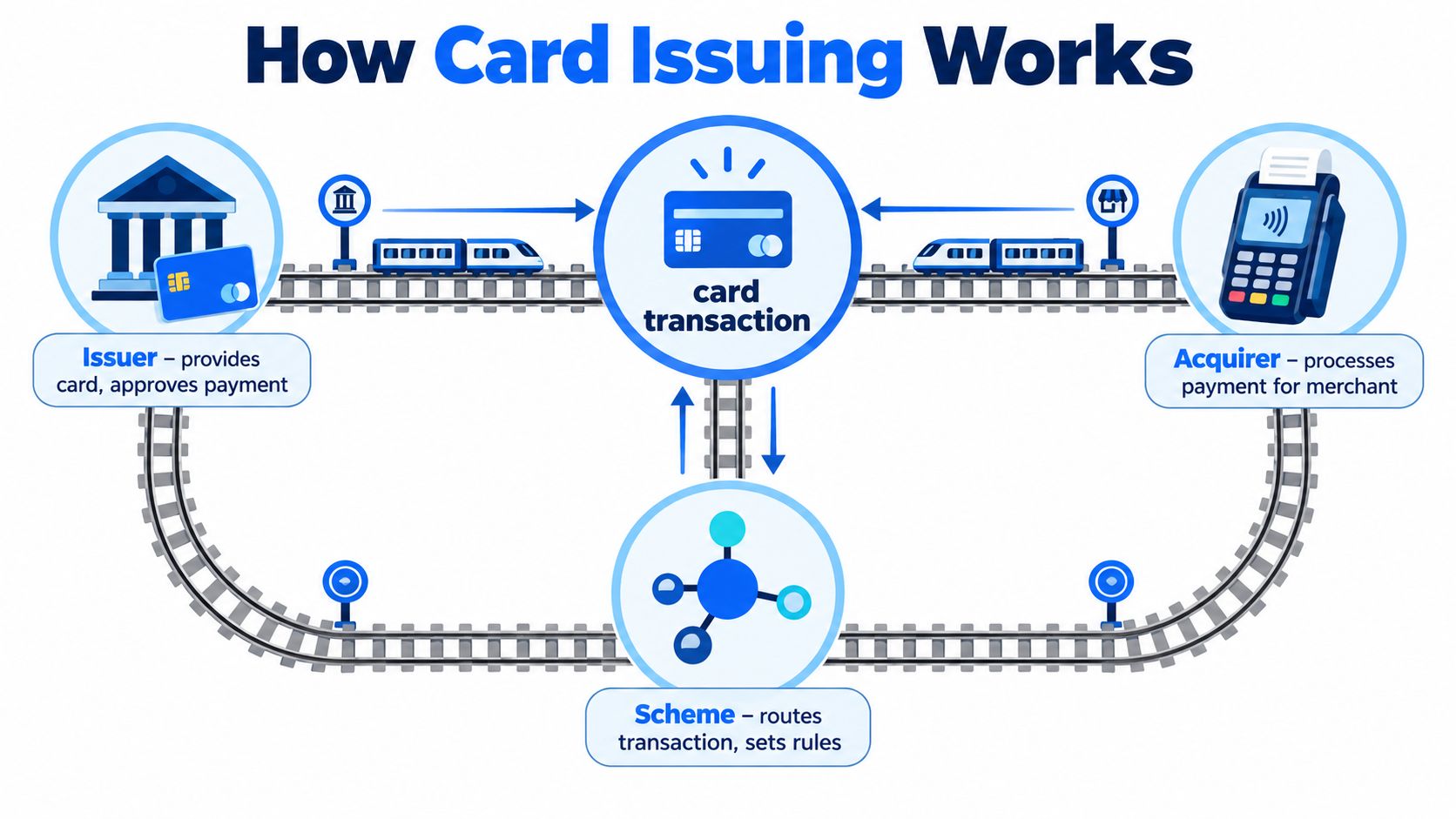
The three parties in a card payment
Here's the simplest version:
| Role | What it does | Why it matters |
|---|---|---|
| Issuer | Provides the card and approves or declines payment | Controls spend access |
| Acquirer | Processes payment on behalf of the merchant | Connects merchant acceptance |
| Scheme | Routes messages and sets network rules | Makes issuer and merchant-side systems interoperable |
When a cardholder pays, the merchant sends the transaction through its acquirer. The scheme routes the authorization request to the issuer side. The issuer side decides whether to approve based on balance, controls, risk, and card state.
That's the market-facing model. Inside an issuing program, the operating model is more specific.
The modern three-layer model
Modern issuing commonly splits into three layers: BIN sponsor or issuing bank, issuer processor, and program manager. Visa's partner model describes the underlying separation that lets a program ship cards without immediately becoming the regulated issuer of record or building direct network connectivity, as outlined in Visa partner types and issuing roles.
- BIN sponsor or issuing bank holds the BIN range and settlement relationship with the scheme.
- Issuer processor runs the time system that authorizes transactions, maintains card state, and exchanges network messages.
- Program manager operates the customer-facing program, product logic, support workflows, and often parts of onboarding.
This split is where many buyers get confused. A provider may say “we issue cards,” but that can mean very different things. Some firms own processing. Others depend on a sponsor bank and an external processor. Some manage only the product layer.
The question behind every provider pitch
When you evaluate an issuing setup, ask three direct questions:
- Who owns the BIN and scheme relationship?
- Who makes the real-time authorization decision?
- Who carries the regulated liability if something goes wrong?
If those answers come from three different vendors, expect more operational coordination.
For a deeper look at the bank side of that relationship, this guide to the card issuer bank role is a useful companion.
The cleanest product demo can still sit on a messy operating model. The liability map matters more than the dashboard.
Virtual Cards and Physical Cards Compared
Many start with the wrong question. They ask whether they need a virtual card or a physical card. The better question is what job the card has to do.
Different jobs, same control plane
A virtual card is usually the fastest way to turn an approved user into an active spender. It can be provisioned immediately for online payments or linked to a mobile wallet. This is useful for contractor payouts, subscription-specific spend, agent-level budgets, or any workflow where waiting for mail slows down product value.
A physical card solves a different problem. It works where plastic is still expected or where tap-to-pay through a mobile wallet isn't enough. Think field teams, travel, retail acceptance, or users who want a tangible backup.
Underneath, both formats usually share the same authorization logic, card state model, and spend controls. The form factor changes. The operational core doesn't.
A side-by-side decision view
| Need | Virtual card | Physical card |
|---|---|---|
| Immediate use | Strong fit | Usually slower because fulfillment is involved |
| Recurring software spend | Strong fit | Often unnecessary |
| In-person backup | Depends on wallet support | Strong fit |
| Per-user or per-agent issuance | Strong fit | Useful when long-lived access is needed |
| Mailing and personalization | Not required | Required |
One practical pattern is to issue virtual first, then add physical where user behavior demands it.
What changes operationally
Virtual programs emphasize instant provisioning, tokenization, and card lifecycle events inside your product. Physical programs add printing, personalization, shipping, delivery exceptions, and activation support.
Both need clean API behavior. If your card-creation call retries and accidentally creates duplicate cards or duplicate funding events, operations gets messy quickly. That's why many teams treat create card, freeze card, update control, and top-up actions as idempotent business operations.
If you're evaluating implementation details, this virtual card issuing API guide is worth reading alongside processor documentation.
A virtual card is not a “lite” card. It's the same issuing system exposed through a faster distribution model.
For wallet experiences such as Apple Pay and Google Pay, tokenization sits between the card and the device. That doesn't replace issuing. It extends it. The issuer still governs card state, limits, and approval logic.
Funding Authorization and Settlement Explained
Issuing gets operational the moment a cardholder tries to spend money. At that point, your team stops thinking about cards as objects and starts thinking about balances, holds, and settlement obligations.
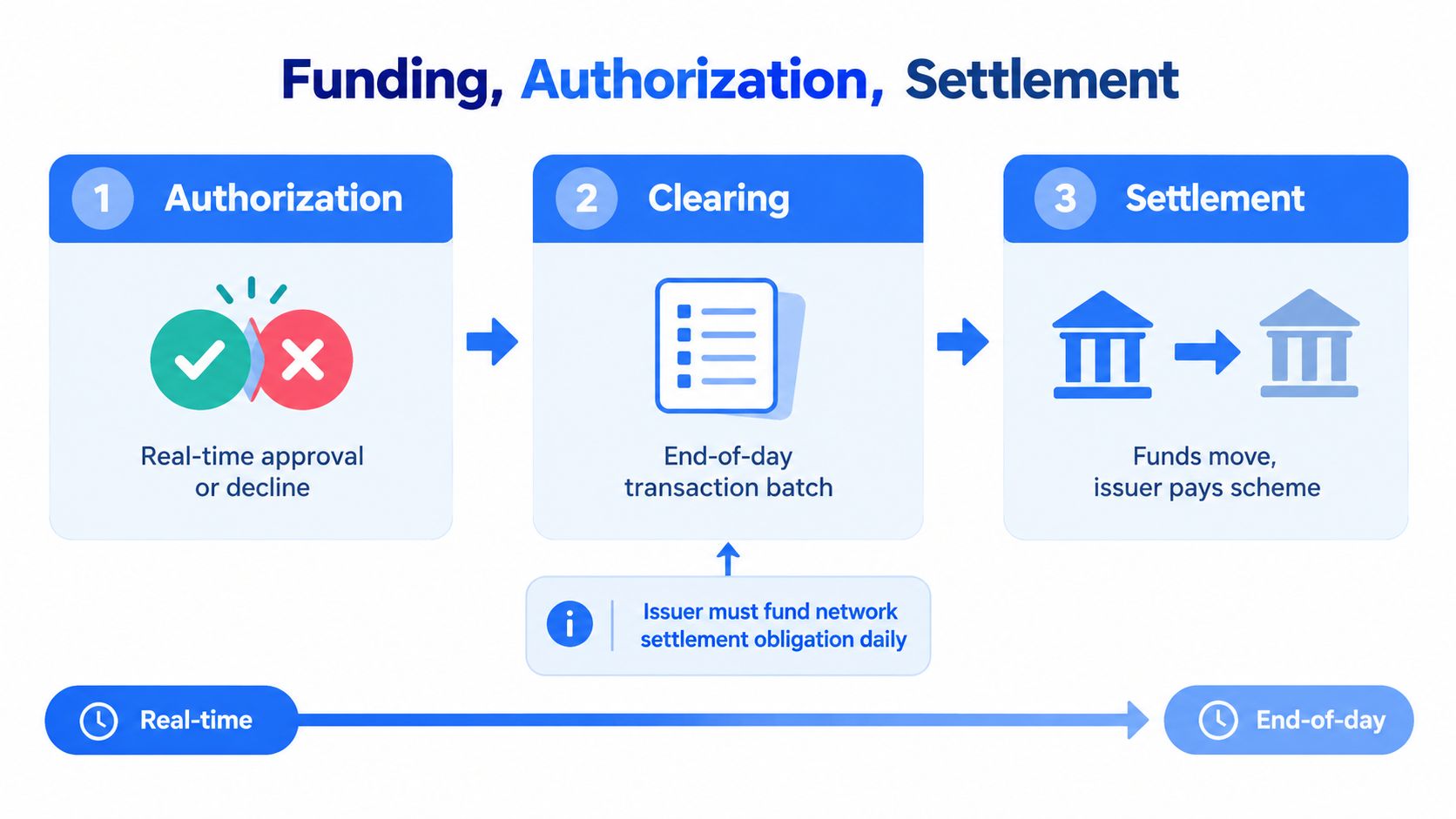
Authorization is not settlement
A card payment has at least two different financial moments.
The first is authorization. This is the real-time decision to approve or decline the transaction. The second is clearing and settlement, which happens later when the network sends clearing files and the issuer funds the settlement obligation. A neutral operational overview explains that split clearly in this card issuing and settlement guide.
That gap matters because an approved transaction doesn't always settle exactly as first authorized. Amounts can change. Reversals can occur. Delays can appear. If your available balance logic and your ledger don't stay aligned, users see stale balances and finance teams inherit unexplained differences.
Available balance versus ledger balance
A simple way to explain it internally:
- Available balance is what the user can spend right now after accounting for holds and controls.
- Ledger balance is the recorded financial state after entries are written and matched.
Those should relate cleanly, but they aren't the same thing.
If a merchant places an authorization hold, your system may reduce available balance immediately. The ledger may not finalize until later events arrive. If a reversal or partial clearing comes in and your system doesn't reconcile correctly, the user can appear to have more or less money than they really do.
The practical lesson for finance teams
Ask these questions before scale creates pressure:
- How do holds affect available balance?
- What happens when an authorization is reversed or expires?
- How does clearing update the ledger?
- Who reconciles issuer settlement files against wallet balances and product state?
Operational lesson: Reconciliation is not an accounting afterthought. It is the mechanism that proves your card program and your balance system describe the same money.
The common enemy here is fragmented funding logic. If wallet balances live in one system, card authorizations in another, and settlement reporting in a third, the team spends its mornings chasing timing mismatches instead of shipping.
Essential Card Controls and Security Features
The part of issuing that product teams love is control. The part that operators respect is that good controls reduce support load, fraud exposure, and reconciliation noise.
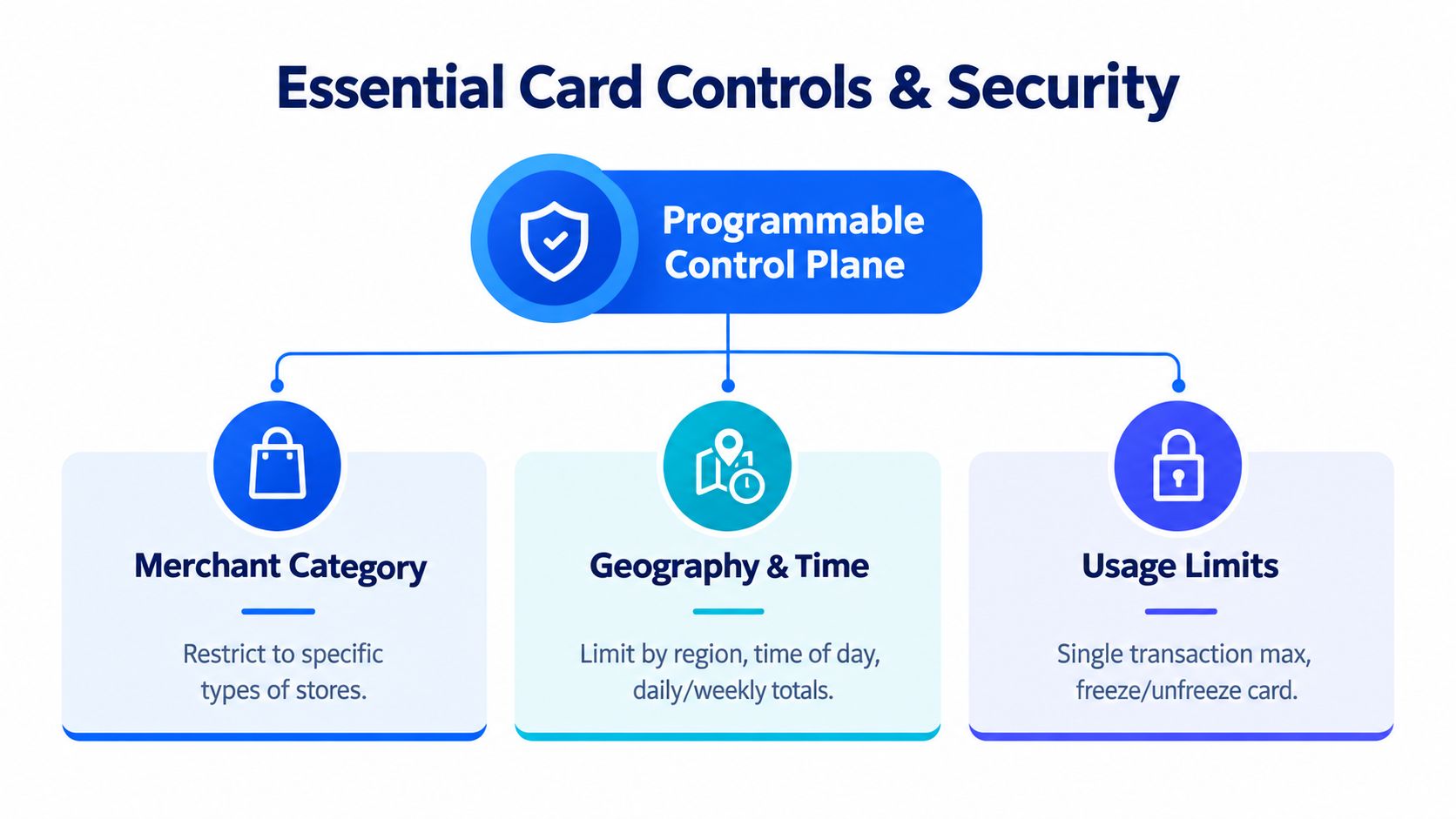
What a programmable control plane actually does
A modern issuing platform can expose granular controls such as spend limits by merchant category, geography, time of day, single transaction amount, and daily or monthly totals, along with real-time transaction alerts and lifecycle APIs for creating cards, updating controls, changing card state, and streaming status events, as shown in this overview of card controls and lifecycle resources.
That's why the unique angle matters. Card issuing is a programmable spend control plane, not just a manufacturing process for cards.
Common controls include:
- Merchant restrictions so a fuel card can't be used for unrelated retail categories.
- Geographic limits so a domestic card doesn't work outside approved regions.
- Time-based rules so a card only works during shift hours.
- Velocity and amount limits so one card can't drain a budget in a burst of transactions.
- State controls such as freeze, unfreeze, replace, or close.
Events matter as much as controls
Controls only work cleanly if your event model is reliable. Virtual card platforms commonly expose webhooks for authorization, decline, settlement, reversal, and dispute events. Duplicate deliveries are normal, and non-idempotent handling can double-count balances, which is why this virtual card launch guide from Simplify Labs treats webhook deduplication and replay control as core controls.
That principle applies beyond webhooks. Lifecycle actions such as create card, update control, freeze card, and top up wallet should behave as idempotent business operations. Stable operation identifiers, append-only ledger entries, replay protection, and reconciliation jobs are all recommended in this virtual card issuing API architecture guide.
A practical design pattern
For serious programs, the minimum safe pattern looks like this:
- Write append-only ledger records so finance can audit every financial event.
- Use idempotent endpoints so retries return current state instead of creating a second financial event.
- Stream transaction events so support, risk, and finance see the same sequence.
- Expose controls to the user or operator through app or web flows without bypassing policy logic.
A wallet-linked card stack often adds one more useful layer: card controls tied directly to wallet balances and policy decisions. In practice, that can mean funding a card from a wallet, restricting who can approve top-ups, and logging every policy outcome.
Compliance Risks and Controls Before You Launch
Teams often treat card issuing as a technical integration. That's the wrong mental model. Issuing is a regulated operating model with a technical surface.
Who actually carries the risk
In many programs, the sponsor bank or BIN sponsor holds cardholder funds and regulatory risk, while another party runs daily operations. Liability still remains with the sponsor even when the program manager handles customer workflows, as explained in this guide to issuing programme operations.
That single fact changes how you should plan launch. Product can't decide controls alone. Finance needs settlement visibility. Compliance needs auditable workflows. Risk needs policy boundaries. Engineering needs to know which system is the source of truth when messages conflict.
The hidden bottlenecks
Another common mistake is underestimating dependency on sponsor banks, legacy processors, and regional licensing constraints. Recent market coverage points out that older issuing architectures can slow customization and expansion while newer wallet-first and API-driven models are emerging, as discussed in Cross River's overview of modern issuing tradeoffs.
That bottleneck shows up in practical ways:
- Approval chains can slow product changes.
- Legacy processors can make real-time control updates awkward.
- Regional data and compliance rules can alter onboarding and funding assumptions.
- Address quality issues can trigger manual review in card fulfillment and compliance checks. For teams validating U.S. addresses, Cloud Residents explains RDI flags in a way operations teams can use.
The control review before go-live
A pre-launch review should include at least these controls:
- Scoped API keys so internal tools and third parties only get the permissions they need.
- Role-based access controls so support, finance, and ops don't share broad production privileges.
- Co-Signer policy where treasury or wallet-linked funding actions need explicit approval boundaries.
- WebSocket observability so operators can see transaction and policy events as they happen.
- AML screening and audit trails so sensitive actions are reviewable later.
Launch speed usually slows down where responsibility is ambiguous, not where APIs are missing.
Infrastructure choices matter. If your card program connects to wallets or treasury flows, controls around signing policy, event visibility, and auditability need to be designed before the first cardholder spends.
Choosing Your Card Issuing Integration Path
There are two broad ways to approach issuing.
One path is to build toward direct network and banking relationships over time. That gives maximum control, but it also creates more licensing, settlement, processor, and compliance work.
The other path is to use an API-first platform and design your product around a managed issuing model. That often fits teams that need to ship before volume is predictable, especially when cards are only one part of a broader stack.
A decision framework that reflects operations
Use this lens:
| If your team needs | Integration bias |
|---|---|
| Direct ownership of scheme connectivity and issuer-of-record functions | Build toward deeper in-house capability |
| Faster launch with managed issuing layers | API-first platform |
| Wallet-funded card spend in the same product flow | Unified wallet plus issuing stack |
| Strong finance controls from day one | Ledger-first architecture with reconciliation jobs |
| Operational visibility across policy and transaction events | Event-driven model with WebSocket or webhook streaming |
One option in that second category is BroLabel, which offers an API-first stack that combines BROcard for Mastercard virtual and physical cards, BroWallet for wallet funding flows, BROsettlement for treasury movement, an append-only ledger for reconciliation support, WebSocket events for operational visibility, scoped API keys, and policy controls such as Co-Signer and MPC for wallet-linked operations. For teams comparing platforms, this card issuing platform guide gives useful context on evaluation criteria.
What serious buyers should verify
Before signing with any platform, ask to see:
- Sandbox to go-live process with real examples of event flows.
- Ledger and reconciliation model across authorization, settlement, reversal, and wallet funding.
- Idempotency behavior on create card, top-up, freeze, and control updates.
- Fee engine calibration if your economics depend on card usage, funding, or FX behavior.
- Digital wallet support for Apple Pay and Google Pay if instant usability matters.
The practical lesson is simple. Don't buy issuing as a card feature. Buy it as an operating system for spend.
FAQ
What is card issuing in simple terms
Card issuing is the infrastructure and operating model that lets a company provide payment cards and manage how those cards are used. That includes card creation, transaction approval, controls, settlement handling, and compliance responsibilities.
Is card issuing the same as printing cards
No. Printing and shipping are only one part of the process. The larger job includes authorization systems, balance controls, card lifecycle management, settlement operations, and the regulated relationships behind the program.
Who are the main parties in a card transaction
The issuer provides the card and approves or declines transactions. The acquirer processes payments for the merchant. The scheme routes messages between them and sets network rules.
Do I need a bank to launch a card program
Many programs rely on a BIN sponsor or issuing bank because that party owns the network relationship and regulated settlement role. Even when a program manager or platform handles day-to-day operations, the sponsor typically remains accountable.
What's the difference between virtual and physical card issuing
Virtual cards are usually faster to provision and work well for online spend, wallet-first experiences, and controlled use cases like subscriptions or agent budgets. Physical cards add fulfillment and activation steps but remain useful for in-person and long-lived access.
Why do finance teams care about authorization versus settlement
Because an approved transaction is not the same thing as final money movement. Authorization affects available balance in real time. Clearing and settlement happen later and must reconcile correctly to avoid stale balances or funding shortfalls.
Which controls matter most in modern issuing
Merchant category restrictions, geographic limits, time-based rules, amount limits, freeze and unfreeze actions, event logging, idempotent lifecycle operations, and append-only ledger records are all core controls.
When does issuing become operationally painful
Usually when the stack is fragmented. If wallets, card processing, ledgering, compliance workflows, and event visibility sit with different vendors, teams spend more time reconciling systems than managing the product.
BroLabel offers a modular card issuing and wallet infrastructure stack for teams that need Mastercard virtual and physical cards, wallet-linked funding, ledger and reconciliation support, real-time WebSocket events, and policy controls that fit institutional operations. If you're evaluating how issuing should fit into your product and finance stack, visit BroLabel to review the platform and integration path.