At 02:14 UTC, a VIP customer requests a 12 BTC withdrawal from a hot wallet. The destination address was added to the OFAC SDN List three hours earlier, and the broadcast window is roughly the next four seconds. If screening happens after signing, the operator has already authorized an irreversible transfer to a sanctioned counterparty.
That scenario isn't mainly a list-matching failure. It's an infrastructure failure. The control must sit inside the withdrawal path, where wallet events, counterparty data, risk decisions, signing policies, and ledger records meet. This is the operating problem behind AML transaction screening: stop prohibited value movement before broadcast, while preserving enough evidence to explain every decision later.
For a broader compliance foundation, see this guide to crypto AML compliance.
Table of Contents
- The Problem a Sanctioned Withdrawal Exposes
- What AML Transaction Screening Actually Means
- The Four Layers That Catch Suspicious Activity
- Real-Time Versus Batch Screening in Crypto
- Implementation Best Practices for Crypto Stacks
- Wiring Screening Into Events, Ledgers, and Signing Policies
- Metrics and Tuning That Hold Up Under Audit
- Operating Workflows, Coverage Gaps, and Buyer FAQs
The Problem a Sanctioned Withdrawal Exposes
The first question is simple: where can the system still stop the transfer? Before the request reaches the signing service, the platform can hold it. After signing but before broadcast, it may still be possible to cancel an internal job, though the control is already weaker. After broadcast, the transaction may be visible in the mempool, but cancellation depends on the chain and transaction mechanics. After confirmation, screening becomes detection, investigation, and remediation rather than prevention.
In the scenario above, the destination wallet needs more than a basic string comparison. The screening path may need sanctions data, address attribution, cluster relationships, chain analytics, customer context, and the withdrawal policy that determines whether the result means allow, hold, or reject. The signing layer must receive the decision as a precondition, not as an informational tag.
Practical rule: If a transaction can be signed without a current screening verdict, screening isn't controlling the transaction. It's observing it.
The same principle applies beyond withdrawals. Deposits need sender analysis, swaps need both sides of the value flow, and bridges need controls that account for origin and destination chains. A crypto platform may not know the actual identity behind a self-hosted wallet, but it can still evaluate the address, its observed exposure, and the behavior surrounding the transfer.
Identity also matters at the human and system boundary. Teams designing agent or operator access can use the AgentStack developer identity docs as a reference point for thinking about verified actors, delegated actions, and identity assertions in automated workflows. That identity context should connect to transaction authorization, not remain isolated in onboarding records.
The foundational FATF framework updated in June 2019 extended risk-based AML/CFT expectations to virtual asset activities and VASPs. It also established the Travel Rule expectation that firms obtain, hold, and transmit accurate originator and beneficiary information, while screening that information for designated persons or entities. FATF guidance summarized by PwC makes the operational implication clear: transaction-level screening belongs in the transfer control plane.
What AML Transaction Screening Actually Means
AML transaction screening is a transaction-level decision process. It evaluates the parties, payment instructions, addresses, identifiers, and relevant risk context of a transfer, then produces an actionable outcome tied to that specific transaction record. The outcome may be a pass, hold, reject, freeze, or escalation for review.
That differs from three controls that teams often combine too loosely:
- KYC onboarding verifies a customer when the relationship begins. It doesn't automatically clear every future destination wallet or counterparty.
- Transaction monitoring looks across activity over time, searching for patterns such as velocity, structuring, or unusual movement.
- Sanctions screening focuses on prohibited persons, entities, addresses, and jurisdictions. It forms one important part of broader transaction screening.
The direction of value matters. For a withdrawal, the platform should evaluate the receiving wallet and relevant beneficiary information. For a deposit, it should evaluate the sender and the exposure associated with that address. A single customer profile can't substitute for transaction context, especially when crypto counterparties may be pseudonymous and have no prior KYC record.
The regulatory anchors
A defensible implementation maps each decision to the obligation it supports. OFAC's virtual currency guidance says firms should screen customer information against OFAC-administered lists, including the SDN List, at onboarding, and screen transactions using physical, digital wallet, and IP addresses where relevant to a sanctions nexus. OFAC's virtual currency compliance guidance provides the operational reference.
OFAC also states that U.S. persons and others subject to its jurisdiction must block property and interests in property of SDN-listed persons, including entities owned 50 percent or more directly or indirectly by blocked persons, and must not transact with them. OFAC's ownership and blocking FAQ is the source to use when translating that rule into policy logic.
FATF Recommendation 16 and the Travel Rule concern information that travels with a transfer. They don't remove the need to screen the transaction itself. In the EU, the European Banking Authority's Travel Rule guidance describes originator and beneficiary information requirements for crypto asset service providers.
A useful implementation principle is to bind the verdict to the transaction ID, input snapshot, data-source versions, scoring output, and policy version. That gives compliance, operations, and auditors the same answer to one question: what did the platform know, and what rule did it apply, when it authorized the transfer?
For list-focused workflows, this AML watchlist screening guide covers the matching problem. The harder engineering task is making the result enforceable in the payment path.
The Four Layers That Catch Suspicious Activity
A reliable stack doesn't ask one matcher to detect every form of financial crime. It separates controls by the signal they can observe, the decision they can support, and the evidence they need to retain.
Layer one, sanctions and watchlists
This layer checks names, entities, wallet addresses, cluster attribution, jurisdictions, and internal deny lists against sources such as OFAC, EU, UN, and HMT lists. Address attribution needs provenance and confidence because an address can be connected to a service, cluster, or indirect exposure without being directly named on a government list.
A sanctioned wallet is the straightforward example. The difficult cases involve transliteration, aliases, ownership relationships, and incomplete data. Name-only fuzzy matching can over-match common names, so the engine should retain the matched fields and the reasoning behind its score.
Layer two, PEP and adverse media
PEP and adverse-media signals become especially useful when a crypto transfer connects to a known exchange, fiat off-ramp, corporate account, or beneficial owner. The system shouldn't treat a PEP indicator as an automatic sanctions decision. It should route the result into the institution's risk policy, enhanced review, or transaction limits.
Layer three, behavioral rules
Rules catch activity that a static list cannot. Examples include rapid velocity, structuring below reporting limits, a dormant wallet becoming active, hops through sanctioned jurisdictions, and exposure to mixers or non-KYC exchanges. These controls need transaction history and network context, which is why they often run asynchronously even when sanctions screening runs synchronously.
Layer four, machine-learning anomaly detection
Models can score residual risk when a sequence resembles a known laundering typology but doesn't match a hard-coded rule. A transfer may look ordinary in isolation, then become unusual when its timing, asset path, counterparty network, and prior behavior are evaluated together. Models should assist prioritization, not replace policy ownership or analyst judgment.
| Layer | What It Checks | Typical Latency | Example Caught |
|---|---|---|---|
| Sanctions and watchlists | Lists, addresses, entities, clusters, and identifiers | In-flow | A wallet linked to a designated person |
| PEP and adverse media | People, beneficial owners, and reputational risk signals | In-flow or review queue | A politically exposed counterparty at an off-ramp |
| Behavioral rules | Velocity, structuring, dormancy, geography, and exposure | Near-real-time or batch | Repeated transfers designed to avoid a reporting trigger |
| ML anomaly detection | Typology features and network behavior | Usually asynchronous, with selected real-time scores | A laundering pattern that resembles normal activity until network context is added |
The layers should produce separate reasons even when they share a single case. That separation helps teams tune thresholds without weakening sanctions controls to solve a behavioral-alert problem.
Real-Time Versus Batch Screening in Crypto
Real-time screening and batch screening solve different operational problems. Treating one as a replacement for the other creates either an unsafe signing path or an expensive monitoring system that tries to make every historical calculation synchronous.
Real-time screening runs inside the transaction pipeline. The withdrawal, swap, or bridge transfer waits for a verdict before the signing policy authorizes it. This is the right default for outbound sanctions and PEP controls where the value can become irreversible after broadcast. It requires cached or locally available list data, isolated screening services, tight latency budgets, and a failure policy for provider timeouts.
Batch screening evaluates accumulated activity. It suits retrospective exposure analysis, periodic re-screening, behavioral rules, model scoring, and investigation backlogs. It can use broader historical context and heavier computation, but it cannot prevent a transfer that has already been signed and broadcast.
Crypto adds complications that traditional payment diagrams often hide. Mempool visibility can expose a pending transfer before confirmation. MEV can alter the economic context around swaps. Bridges create an origin-to-destination relationship that may not be obvious from one chain's transaction alone. Finality also differs across networks, so the control point must be defined by product and chain rather than assumed globally.
A mature design uses both modes:
- Synchronous controls: sanctions, critical address exposure, PEP triggers, and signing-policy prerequisites.
- Asynchronous controls: behavioral sequences, network analysis, periodic re-screening, and case enrichment.
- Recovery controls: quarantine, reconciliation, and post-event investigation when a provider or data feed is unavailable.
Teams evaluating event timing can use Suby's real-time transaction monitoring guide as a practical comparison point, then test assumptions against their own chains, custody model, and failure handling.
| Dimension | Real-Time Screening | Batch Screening |
|---|---|---|
| Decision point | Before signing or release | After activity accumulates |
| Main strength | Prevents high-risk transfers in-flow | Adds history and analytical depth |
| Main cost | Latency engineering and availability | Queue management and delayed action |
| Best crypto use | Outbound withdrawals and bridge authorization | Monitoring, re-screening, and exposure analysis |
| Failure response | Hold or quarantine on unresolved risk | Reprioritize cases and investigate affected activity |
| Evidence | Verdict attached to a pending transaction | Reproducible job, input set, and case output |
For teams building an API-led control path, an AML screening API integration should expose idempotency, policy outcomes, list versions, and event references, not only a Boolean match result.
Implementation Best Practices for Crypto Stacks
Screening should sit between risk evaluation and signing. Wallet and custody services create a normalized transaction event, the screening and policy services evaluate it, and only an approved request can reach the signing layer.
Start with a canonical event schema. It should represent the customer or account, source and destination addresses, chain, asset, amount, transaction type, counterparty information, Travel Rule data where applicable, and a stable transaction intent ID. Normalize events from wallet services, custody systems, bridge connectors, and internal transfers before sending them to screening.
Controls that prevent operational drift
- Version the inputs: Store the sanctions-list version, attribution source, model version, policy version, and normalized payload used for each verdict.
- Make retries safe: Use idempotency keys so a timeout or duplicate WebSocket event can't create conflicting cases or repeated signing attempts.
- Resolve identity deterministically: Map cross-chain addresses and entity relationships through a reproducible process. Don't let two workers reach different conclusions from the same input.
- Quarantine unresolved transfers: A failed provider call, missing field, or stale list should create a controlled hold state, not an implicit approval.
- Separate permissions: Scope API keys so risk services can issue decisions, custody operators can request signing, and reporting services can read events without authorizing value movement.
A signing policy should require the latest acceptable screening verdict, the expected transaction intent, and the correct policy version. At that point, MPC, Co-Signer controls, and wallet permissions become compliance infrastructure rather than just key-management features.
The implementation model also needs to account for organizational controls. Guidance on building compliant digital asset custody platforms is useful when mapping custody roles, approval paths, and evidence requirements to the broader product architecture.
The practical test is a replay. Take a frozen transaction event, rebuild the screening inputs, apply the stored policy, and confirm that the result matches the original decision. If the platform can't reproduce its own authorization, it will struggle to defend the control during an audit or incident review.
Wiring Screening Into Events, Ledgers, and Signing Policies
A screening verdict becomes useful only when every operational system can consume it. Consider a withdrawal that passes sanctions screening but enters a manual review because a behavioral rule identifies unusual exposure. The event stream should publish the input, score, list versions, policy result, case ID, and state transition. The ledger should store a reference to that verdict beside the withdrawal entry.
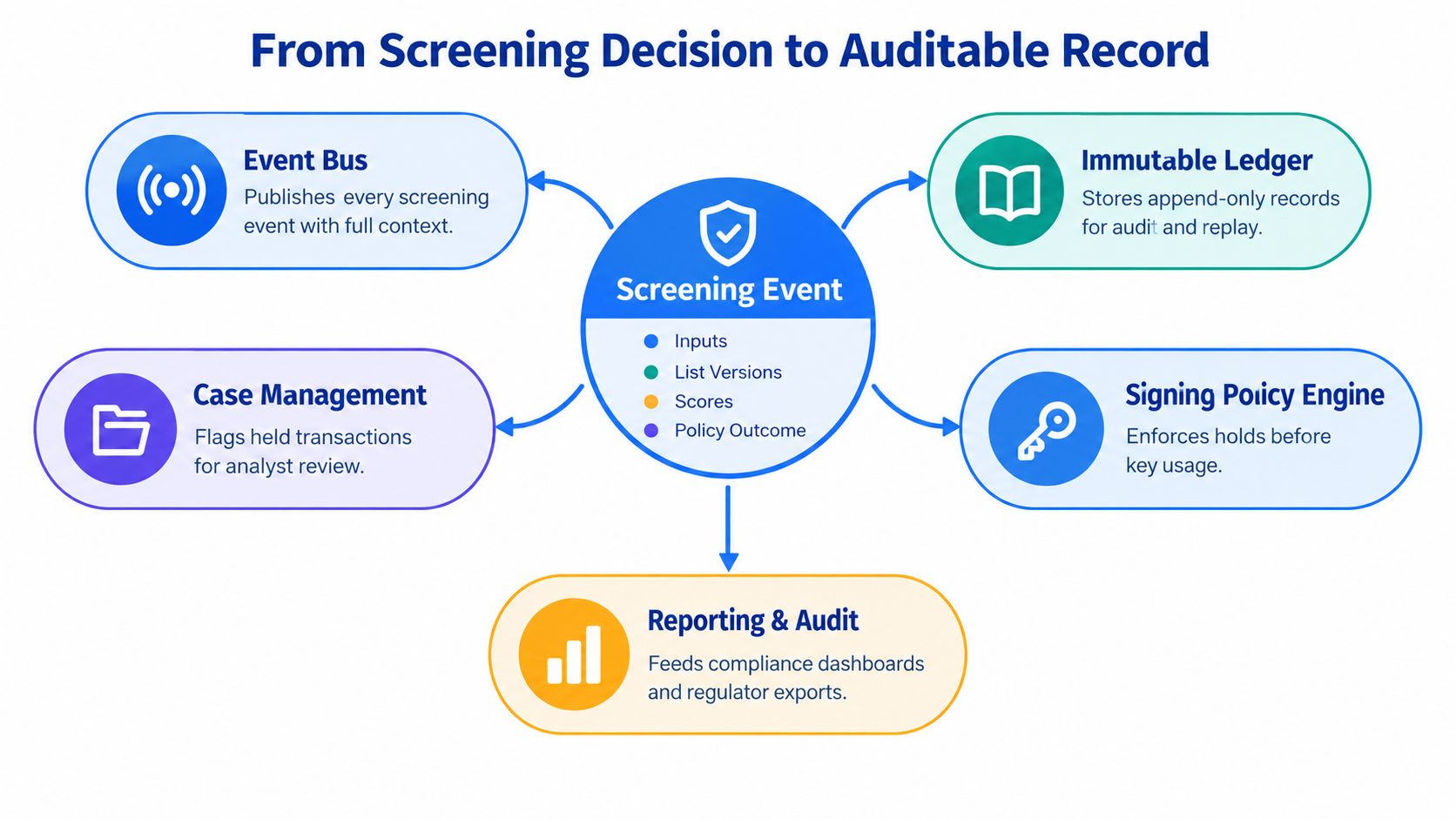
WebSocket events are valuable here because operations teams need state changes as they happen. A withdrawal.requested event can trigger screening. A screening.completed event can carry the decision. A policy.held event can open a case, while a withdrawal.signed event can be checked against the required approval state.
The ledger provides the financial explanation. It should connect the internal transaction intent to the signed payload, broadcast result, confirmation state, screening reference, and reconciliation status. An append-only record helps finance and compliance distinguish an approved transfer from a transfer that bypassed a control.
Least privilege at the authorization boundary
Scoped API keys make the control surface enforceable:
- Risk services can submit evidence and issue decisions, but can't sign.
- Custody operators can prepare or request signing, but can't override a compliance hold without an authorized workflow.
- Analytics services can consume read-only events and ledger data.
- Co-Signer policies can require a current, matching verdict before key use.
The reconciliation job closes the loop. It compares ledger entries with event-stream records and signing-policy decisions, then raises an exception when a transaction has a signature but no corresponding screening result. That exception is more valuable than a dashboard showing a healthy alert count because it identifies a broken control path.
BroLabel's infrastructure modules illustrate this operating pattern through BROsettlement, BROwallet, AI Agent Wallets, an immutable operating ledger, WebSocket events, scoped access, MPC signing, and a client-controlled Co-Signer. Used together, those components can place policy evaluation and evidence around the transaction rather than leaving compliance in a separate console.
Metrics and Tuning That Hold Up Under Audit
A screening system needs a measurable control plan. The useful metrics fall into three groups: effectiveness, latency, and operations. Each metric should have an owner, a review cadence, a target band defined by the institution's risk assessment, and a documented response when performance leaves that band.
The market's false-positive problem shows why calibration matters. Industry survey data often places false positives in traditional AML screening and monitoring systems at 90% to 95%, according to Mordor Intelligence's transaction monitoring market overview. High alert volume can hide real risk, exhaust analysts, and encourage unsafe overrides.
A useful tuning loop freezes a representative alert corpus, backtests proposed rule changes, canaries thresholds against controlled production traffic, and reviews list-feed diffs before deployment. The system should keep sanctions, PEP, adverse-media, and behavioral policies distinct so that reducing noise in one category doesn't reduce sensitivity in another.
| KPI | Category | Target Band | Cadence |
|---|---|---|---|
| Confirmed-hit recall against labeled test data | Effectiveness | Risk-approved minimum | Each rule or model release |
| False-positive ratio | Effectiveness | Risk-approved operating range | Weekly or monthly |
| PEP false-dismissal rate | Effectiveness | Tightly controlled exception range | Monthly |
| p99 decision time per withdrawal | Latency | Within the signing-path budget | Continuous |
| Queue depth under load | Latency | Below the quarantine threshold | Continuous |
| Re-screen lag after list updates | Latency | Within policy-defined window | Each list update |
| Alert mean time to triage | Operations | Service-level target by severity | Daily or weekly |
| Case aging | Operations | Escalation limits by risk tier | Daily |
| Override rate with rationale | Operations | Low, reviewed exception rate | Weekly or monthly |
Data quality deserves its own governance. A 2026 survey cited by Liminal identified integration with existing banking systems as the top transaction-monitoring challenge at 27%, ahead of false positives at 16% and detection of complex schemes at 15%. The same source reported that data quality was the leading blocker to AI adoption for up to 89% of respondents, while confidence in transaction monitoring had fallen from as high as 75% to below 30%. These findings are summarized in Liminal's 2026 AML compliance report.
The lesson is operational: measure whether the right data reached the decision, not only whether the model produced a score.
Operating Workflows, Coverage Gaps, and Buyer FAQs
A defensible workflow starts with intake and normalization, moves through screening and policy evaluation, and creates a case when the result isn't an automatic pass. A compliance officer owns escalation, the institution handles SAR or STR filing where required, and analyst outcomes feed back into rule tuning and model validation.
Coverage gaps usually appear at product boundaries. Non-custodial counterparties, swaps, bridges, fiat off-ramps, and beneficial owners can fall outside a narrow withdrawal-only design. A provider that covers one chain or asset may not cover another, so buyers should request an asset-by-asset coverage matrix, update process, attribution methodology, and evidence of failed-provider handling.
Buyer questions that need direct answers
Does the Travel Rule replace sanctions screening? No. Travel Rule exchange concerns originator and beneficiary information. Screening remains a separate control, and national requirements and best practice determine how it is applied. FATF's June 2025 update noted continuing implementation gaps for virtual assets and VASPs, particularly around the Travel Rule, as reported in the market overview cited earlier.
Does Travel Rule compliance require real-time sanctions screening? Not necessarily. Recent guidance on the FATF revisions explains that the Travel Rule itself doesn't require real-time sanctions screening, while national regulation and best practice may still require screening at the transfer point. The Mayer Brown analysis of the FATF revisions also highlights that provider and asset coverage can vary, so a Travel Rule exchange may complete even when screening coverage is partial.
What happens when a sanctioned counterparty is found after the event? Freeze or restrict affected assets where legally required, preserve the original evidence, escalate to compliance, assess reporting obligations, and record the remediation path. Don't overwrite the original verdict.
How do buyers avoid vendor lock-in? Require portable event schemas, stable decision IDs, exportable evidence, configurable policy ownership, and clear separation between screening data and signing authorization. Test whether the platform can replay decisions without a proprietary console.
What should a buyer validate first? Ask for coverage by asset and chain, list-update provenance, latency behavior, timeout handling, false-positive controls, analyst workflows, API permissions, and reconciliation evidence. A polished match screen isn't proof that the control reaches the signing boundary.
AML transaction screening compounds in value when events, ledgers, policies, and analyst decisions reinforce one another. The enemy is not only the sanctioned address. It's the fragmented operating model that lets a screening result disappear before the transaction reaches a signer, ledger, or audit record.
BroLabel provides API-first wallets, BROsettlement with MPC signing and a client-controlled Co-Signer, BROwallet, AI Agent Wallets, WebSocket events, an immutable operating ledger, reconciliation support, and policy-aware transaction workflows. Use BroLabel to evaluate how those controls could fit your screening, signing, and audit architecture.