A player's USDT deposit is confirmed on-chain, but your iGaming platform hasn't credited the balance. Operations sees the transfer, finance sees an unmatched entry, and the payout queue disagrees by one batch. Nobody wants to approve the withdrawal until someone explains which record is authoritative.
The enemy is the reconciliation gap, the silent mismatch between on-chain movements, signing decisions, and internal balances. Creating another wallet address won't close it. Your team needs to connect deposit detection, confirmation, balance availability, payout approval, signing, and settlement without losing the evidence between those steps.
The best crypto wallet API is the one that narrows that gap for your operating model, whether you run an exchange, a fintech product, or an iGaming platform. That means evaluating MPC and non-custodial signing, client-controlled Co-Signer options, multi-chain broadcast, ledger and event coverage, fiat and card integrations, developer tooling, pricing transparency, and compliance suitability.
The seven options below are equally valuable candidates for different operating models, not a universal quality ranking. Some reduce consumer onboarding work. Others give engineering teams programmable signing infrastructure or broader institutional controls. The deciding question is how much financial and operational infrastructure your team must still build.
Table of Contents
- 1. BroLabel
- 2. Privy
- 3. Turnkey
- 4. Fireblocks
- 5. Circle Wallets
- 6. BitGo
- 7. Openfort
- How the seven wallet API providers compare on custody model, published pricing, best fit, and fiat or card scope
- Choosing a Wallet API by Operating Burden, Not Feature Count
1. BroLabel
When a payout is disputed, the operating question is whether your team can trace the request through approval, signing, ledger entry, and settlement. BroLabel positions BroSettlement around that workflow, combining embedded wallets, signing, network broadcast, an operating ledger, and transaction events in one integration.
BroLabel describes DKG-based 2-of-3 MPC signing, a client-controlled Co-Signer, and broadcast across 10+ chains, including BTC, ETH, SOL, BNB, TRX, POL, BASE, and ARB. This setup connects signing authority with business records, but your team still needs to define who may request, approve, and authorize each movement.
For an iGaming operator, the workflow can cover player deposit addresses, observed and confirmed deposit events, and operator policy checks before payout signing. For AI Agents, it can provide a wallet for each agent with restricted permissions instead of a shared treasury credential.
Where the operating model matters
The append-only ledger and real-time WebSocket events support reconciliation. Configure your implementation to correlate requests, approvals, ledger postings, and blockchain transactions. Use idempotency to prevent retries from creating duplicate payouts.
Signing controls need careful setup. Scoped API keys, role-based access, and the Co-Signer can separate withdrawal requests from authorization. Confirm permission boundaries during integration rather than assuming all credentials support identical restrictions.
- Integration strengths: REST, OpenAPI documentation, Swagger resources, Ed25519 authentication, IP allowlisting, replay protection, and engineer-assisted setup can support implementation and launch.
- Commercial trade-off: Modular positioning may suit uncertain transaction volume, but specific prices aren't public. The platform advertises a trial month without upfront payment. Confirm the terms before budgeting.
- Availability boundary: BroSettlement's production API is described as live. BroWallet and BroCard are described as coming soon or in development, so confirm availability before planning for bank funding, fiat withdrawals, mobile wallets, or card issuing.
Public materials don't provide notable customer testimonials, awards, or certifications, and describe the sandbox as a simulated demo.
Practical lesson: A unified API can reduce integration work, but your team still needs to trace each payout from its request through approval, signing, ledger posting, and settlement.
2. Privy
Onboarding can be the first operational bottleneck. If users abandon your application before they have a usable wallet, an elaborate treasury architecture won't rescue the experience.
Privy combines embedded wallets and authentication, supporting email, SMS, social login, passkeys, and custom authentication. Its published pricing includes a free Developer tier and paid plans starting at $299 per month, alongside custom enterprise pricing.
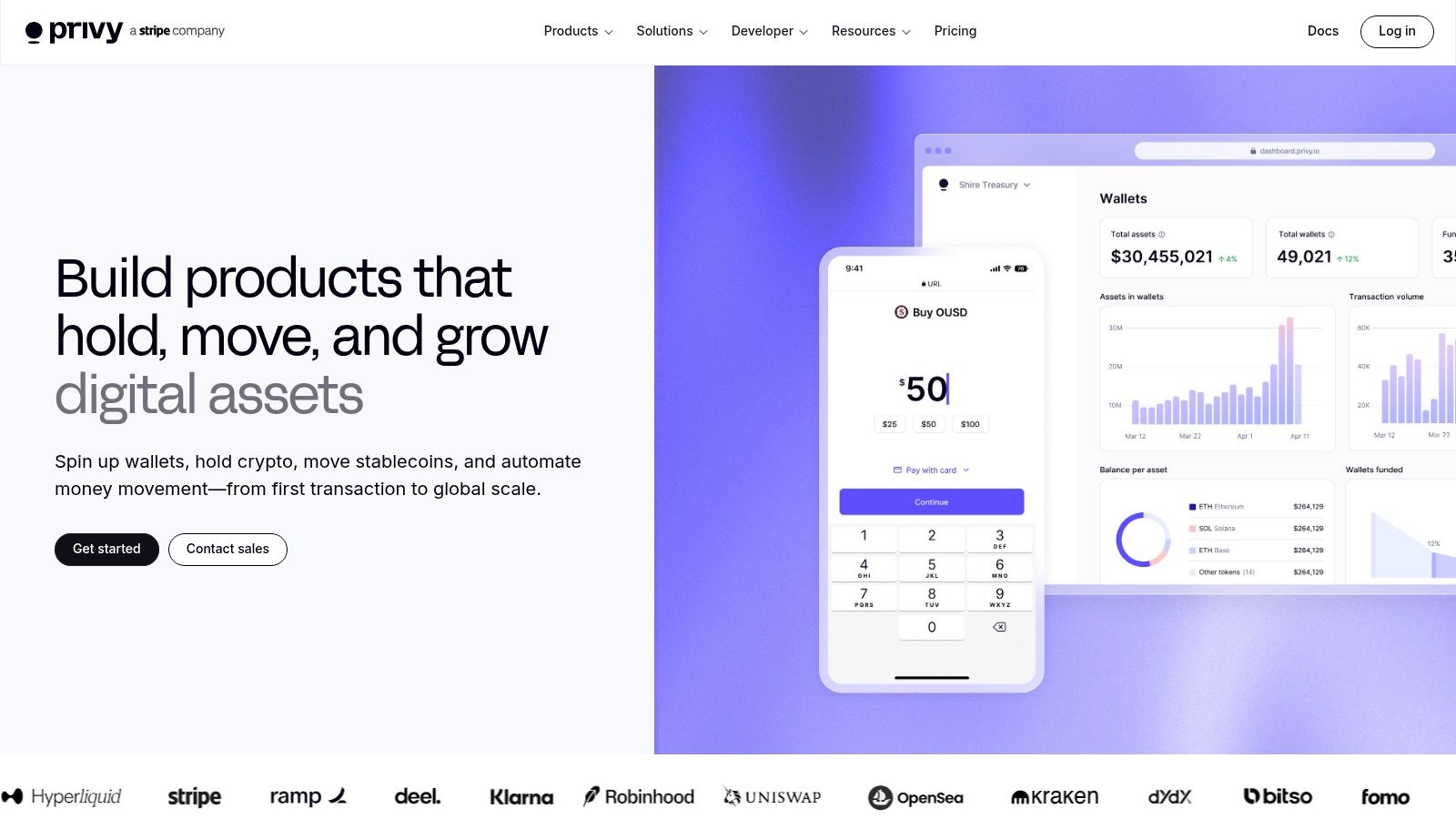
Privy supports EVM chains, Solana, and Bitcoin, plus server-side wallet access and delegated signing for backend workflows. Webhooks, transaction monitoring, and gas sponsorship make it relevant when the product team wants users to transact without managing every blockchain detail.
What you still need to operate
The trade-off is scope. Authentication plus wallet creation isn't an operating ledger, and a transaction notification doesn't explain whether finance has recognized a customer liability or released a pending balance.
- Best fit: Consumer applications and fintech products where login, recovery, and embedded-wallet usability are central.
- Budget check: Model monthly active users and signature volume together. An accessible entry plan doesn't establish the total cost of automated activity.
- Control check: Test delegated signing, recovery, and server-side permissions against your intended custody model.
A useful evaluation starts with an ordinary customer journey, then introduces a failed notification and a recovered account. Can operations establish who controlled the wallet, which action was authorized, and whether the customer's internal balance is correct?
Choose Privy when reducing onboarding work is the priority and your team is prepared to supply the financial recordkeeping around it.
3. Turnkey
Turnkey is a candidate when signing policy is part of the product you're building. Its API-based wallet creation and transaction signing suit teams that want to define custom workflows rather than adopt a broader financial operations suite.
Turnkey emphasizes programmable policies, secure enclaves, and multi-chain infrastructure; its pay-as-you-go option includes 25 free signatures before per-signature charges, with Pro and custom enterprise plans also available.
Its stated applications include embedded wallets, payments, treasury, and AI-agent wallets. That makes it worth testing when a backend service needs permission to perform a narrowly defined action without receiving unrestricted authority over funds.
A valid signature proves authorization under a key system. It doesn't prove that the recipient, amount, or contract action matches the business's intent.
Test policy boundaries before convenience
The useful comparison isn't just how quickly Turnkey creates a wallet. It's whether your team can express the restrictions it needs and demonstrate that prohibited actions remain blocked during application compromise or operator error.
- Strength: Programmable access and action controls support custom user-facing and automated workflows.
- Cost trade-off: Signature-based billing is understandable, but forecast automated signing and the Pro plan's monthly commitment before selecting a tier.
- Operating responsibility: Your team still needs ledgering, reconciliation, payment orchestration, and any fiat or card integrations.
Ask engineers to demonstrate an allowed payout, a rejected destination, and a recovery procedure. Finance should then verify that every outcome, including rejection, has a durable internal record.
Turnkey is a stronger fit when your team wants wallet and key infrastructure as a building block, not a substitute for the rest of its payments platform.
4. Fireblocks
An exchange or established payments company may prefer a broader institutional platform over assembling separate wallet services. Fireblocks belongs on that shortlist, particularly when approval structures and vendor-supported operations matter alongside developer access.
Fireblocks offers REST APIs, SDKs, wallet management, embedded wallets, policy and approval features, API co-signer options, and a developer sandbox. Its published commercial structure includes an Essentials plan and custom plans.
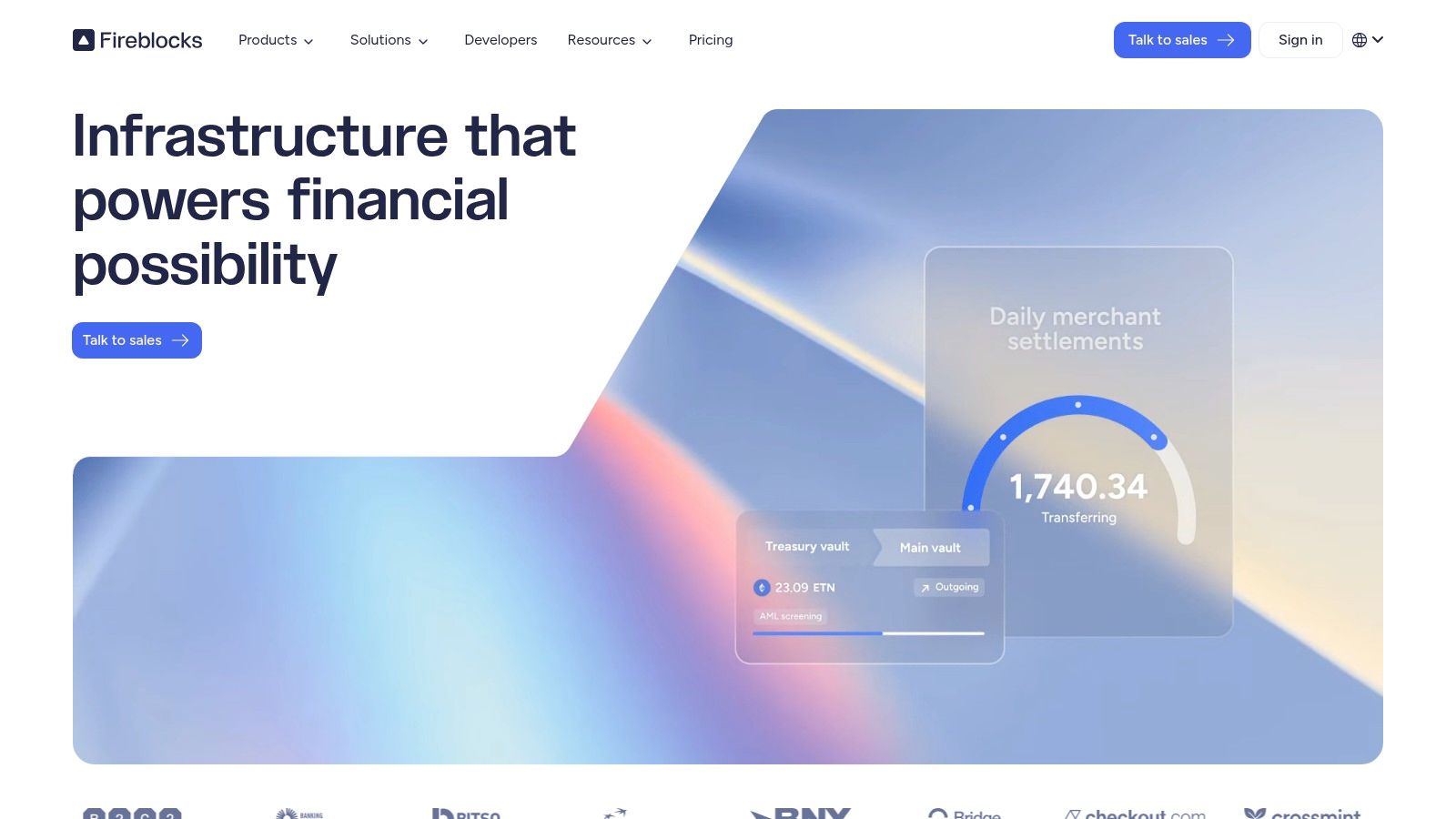
The appeal is breadth across digital-asset operations. The trade-off is procurement and configuration: your team must establish which capabilities are included, which require additional products, and how the resulting contract fits uncertain transaction volume.
Compare authority, not terminology
Use an MPC wallet architecture review to distinguish the cryptographic design from the operating arrangement. Ask who controls signing participants, who can change policy, and what happens when your application or a co-signer becomes unavailable.
- Institutional strength: Policy, approval, and integration capabilities are relevant to organizations with formal operating responsibilities.
- Budget concern: The entry production plan may be difficult for an early-stage product to justify, while custom plans and add-ons require a full cost review.
- Implementation question: Confirm how transaction notifications map to your customer ledger and exception-handling process.
Don't assume that buying a broad platform eliminates reconciliation work. Require a demonstration of how finance identifies an unmatched transfer, how operations resolves it, and how the resolution remains auditable.
Fireblocks is worth evaluating when your organization values institutional breadth and structured support, provided the signing arrangement and commercial commitment match your actual requirements.
5. Circle Wallets
A payment product built around USDC has different infrastructure needs from one that treats every supported asset equally. Circle Wallets offers developer-controlled and user-controlled wallet models, with APIs and SDKs for wallet creation, signing, and transaction management. The operating question is how signing authority and transaction records fit your controls, reconciliation, and finance workflows.
Circle Wallets includes the first 1,000 monthly active wallets free. Circle does not state a post-allowance per-active-wallet rate here, so confirm that rate and any related charges directly before comparing costs.
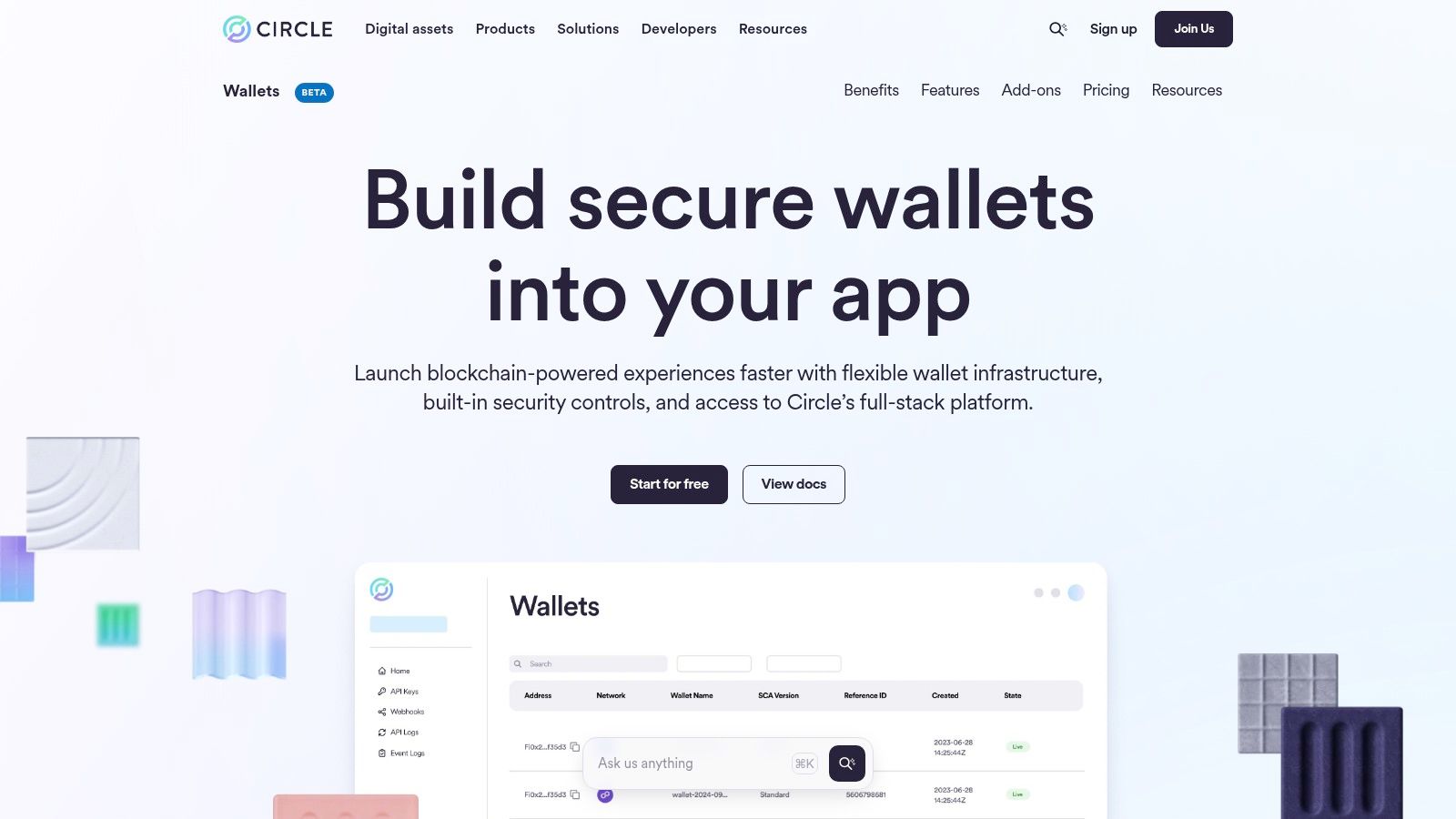
The platform lists gas sponsorship, blockchain indexing, and transaction broadcasting options. Evaluate how these capabilities handle failed or delayed transfers and whether their event data can support your internal ledger and exception process.
Trace payment operations beyond broadcast
Circle's stablecoin and onchain tooling may suit teams whose product depends on USDC transactions. The digital-asset technology review provides context on digital-asset technologies, but a provider decision still depends on how the specific wallet workflow supports your business operations.
A wallet-as-a-service evaluation should account for the boundary between wallet execution and customer accounting, compliance decisions, redemption, and fiat settlement. Confirm which capabilities Circle provides for your use case; do not assume the wallet API supplies a general-purpose operating ledger or card issuing.
- Strength: Published pricing for the initial active-wallet allowance supports early cost estimates.
- Boundary: Confirm the availability and scope of compliance capabilities directly with Circle, since the materials cited here do not specify their eligibility or terms.
- Remaining work: Model transaction fees, ledger reconciliation, and any separate fiat or card requirements.
Estimate costs using both wallet activity and transaction behavior. A product with many occasional users can have a different operating and cost profile from a treasury application with repeated transfers through fewer wallets. Circle is a focused candidate when USDC execution is central and your team has defined how surrounding financial operations will be handled.
6. BitGo
Custody and self-custody are different procurement decisions. BitGo is relevant when your team needs to evaluate both rather than assume a single wallet architecture will suit every business line.
BitGo provides REST APIs and developer tooling for wallet creation, signing, and transaction operations. Its offerings include MPC and multisignature approaches, self-custody configurations with external-signer modes, custody services, and Crypto-as-a-Service workflows.
That architectural range is useful for exchanges and institutional platforms, but buyers shouldn't transfer assumptions from one configuration to another. Signing authority, recovery responsibilities, onboarding obligations, and service boundaries need to be documented for the specific offering under consideration.
Separate the architecture from the contract
Transaction submission and notifications address blockchain execution. Your finance team still needs to establish how those records connect to customer balances, fees, approvals, and reconciliation adjustments.
- Strength: Multiple wallet and custody architectures provide meaningful alternatives for institutional operating models.
- Commercial limitation: There isn't a universal self-serve production rate to apply across the offering. Request a quote tied to the exact configuration.
- Product trade-off: BitGo is less centered on plug-and-play social-login experiences than consumer-oriented embedded-wallet providers.
The evaluation should include an external-signer outage and a recovery exercise, not just a successful transfer. Ask which actions your organization can perform independently, which require vendor participation, and what evidence remains available during an incident.
BitGo suits buyers prepared to make a deliberate custody decision and operate within its consequences. It's less suitable to choose a configuration first and postpone the legal, operational, and accounting implications until after integration.
7. Openfort
Gaming products and automated agents need more than a wallet address. They need constrained actions, manageable transaction fees, and an authentication model that fits the application.
Openfort combines embedded wallets, account-abstraction tooling, gas sponsorship, and policy-based workflows; its developer portal advertises a free tier with 2,000 operations per month.
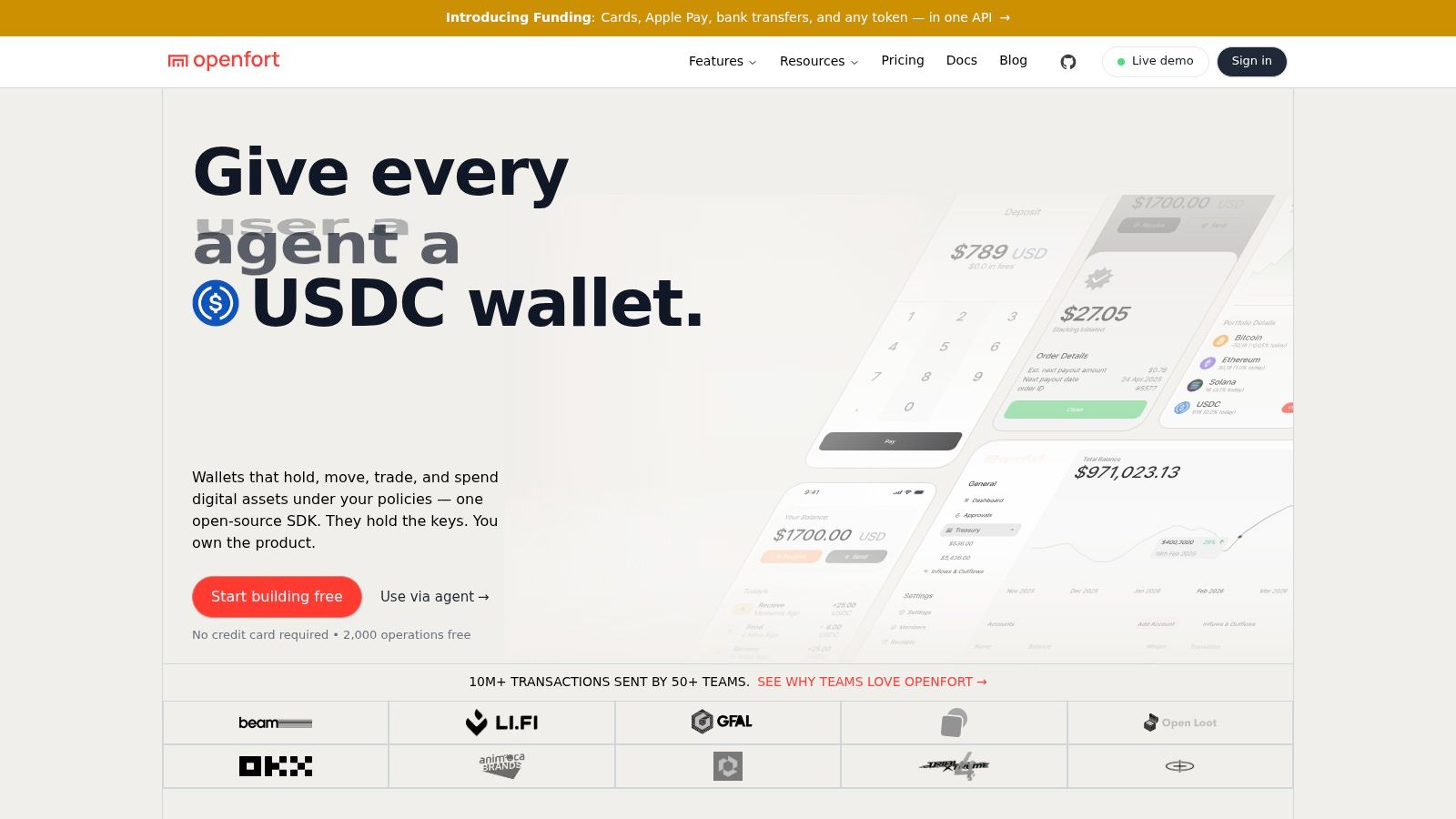
Its stated focus includes stablecoin products, payments, gaming, and AI-agent wallets. SDKs for web, mobile, and game-development environments, custom authentication, and sandbox or test-mode support make it relevant when wallet functionality must fit an existing product experience.
Evaluate the workflow your application needs
A crypto wallet SDK review should start with the intended production platform and chain, not the longest feature list. Confirm that the necessary SDK, authentication path, and transaction policy work together in that configuration.
- Strength: Embedded-wallet and gas-handling tools suit applications that want to hide unnecessary blockchain mechanics from users.
- Boundary: Openfort is wallet and transaction infrastructure, not a complete financial operations suite.
- Validation: Review status history and run representative workloads rather than relying on general performance or uptime claims.
For an AI agent, test whether a permitted payment succeeds while a prohibited destination or action is rejected. For gaming, test how a delayed transaction affects the player's displayed balance and withdrawal eligibility.
Operating test: If the application retries after losing its connection, the customer should receive the intended outcome without a duplicate payment or an unexplained balance change.
Openfort is a useful candidate for programmable application wallets, provided your team supplies the ledger, reconciliation, and oversight around them.
How the seven wallet API providers compare on custody model, published pricing, best fit, and fiat or card scope
| Item | Custody Model | Published Pricing | Best For | Fiat or Card Scope |
|---|---|---|---|---|
| BroLabel | Non-custodial 2-of-3 MPC with client-controlled Co-Signer | Trial month with no upfront payment; prices and terms unpublished | Teams launching API-based wallets and settlement before volume is predictable | Fiat and card integrations are part of the broader platform; BroWallet and BroCard are coming soon or in development |
| Privy | Embedded wallets with server-side access and delegated signing; custody controls depend on configuration | Free Developer tier; paid plans from $299/month; enterprise pricing is custom | Consumer apps and fintech products onboarding users to crypto | Not a complete fiat, ledger, or card stack |
| Turnkey | Wallet and key infrastructure with secure enclaves and programmable policies | 25 free signatures, then per-signature charges; Pro and custom enterprise plans | Teams building custom wallet, signing, and automation workflows | No fiat or card scope specified |
| Fireblocks | Institutional wallet infrastructure with policy controls and API co-signer options; custody model depends on arrangement | Essentials plan listed; price not stated; custom plans available | Institutions and larger fintech or payments teams needing operational controls | No fiat or card scope specified |
| Circle Wallets | Developer-controlled and user-controlled wallets | First 1,000 monthly active wallets free; per-wallet pricing above that | Stablecoin and USDC-focused products | Stablecoin payment tooling; no card-issuing scope specified |
| BitGo | MPC and multisignature options; supports self-custody and custody workflows | Quote-based; no universal self-serve rate published | Exchanges and institutions comparing custody and self-custody models | No fiat or card scope specified |
| Openfort | Embedded wallets with programmable transaction policies; custody model not specified | Free tier includes 2,000 operations per month | Stablecoin, gaming, payments, and AI-agent wallet products | No fiat or card scope specified |
Choosing a Wallet API by Operating Burden, Not Feature Count
A payout can pass through wallet creation, signing, broadcast, and reconciliation before finance knows whether the books are right. Evaluate wallet APIs by who controls signing, how policies apply before execution, whether movements enter an append-only ledger, and how events reach finance and risk teams. Include total cost at uncertain volume.
Provider strengths differ: Privy focuses on onboarding, Turnkey on programmable signing, Fireblocks on institutional infrastructure, Circle on stablecoin tooling, BitGo on custody-model options, and Openfort on application wallets. BroLabel connects transaction execution with an operating ledger and event-driven oversight. The operational fit depends on the controls and reconciliation work your team still has to provide.
Risks and controls before commitment
- Verify custody: Record who can sign, change policies, recover access, or block execution.
- Test recovery: Simulate a lost signer and unavailable infrastructure. Confirm recovery does not bypass approval controls.
- Validate production behavior: Test live transaction broadcast, event replay, idempotency, and reconciliation. Sandbox success alone does not establish production readiness.
- Confirm availability: Get written confirmation of the required products, supported networks, commercial terms, and compliance boundaries.
FATF guidance says virtual asset service providers must obtain, hold, and securely transmit required originator and beneficiary information, as described in its virtual-asset implementation update. A wallet API may support these processes, but it does not define or automatically meet your legal obligations.
Frequently asked questions
Does MPC mean a wallet is non-custodial?
No. Confirm who controls signing participants, policy changes, and recovery before accepting a custody label.
Which pricing model is most transparent?
Published prices provide a starting point. Compare expected charges for active wallets, users, signatures, operations, support, and add-ons. Ask for explicit overage rates and minimum commitments.
How should buyers assess multi-chain coverage?
Check the exact asset and network combination. Test deposits, confirmations, withdrawals, fees, and failure handling. A supported-chain label does not confirm that your full transaction flow works.
Can a wallet API handle compliance?
It may provide screening integrations, approval controls, and audit evidence. Your compliance team still needs to identify jurisdiction-specific requirements and check that the end-to-end workflow meets them.
Assess BroLabel's settlement flow, operating ledger, and sandbox against your acceptance criteria. Run a payout end to end, including a retry, a policy rejection, and final reconciliation.
BroLabel offers API-first wallet and settlement infrastructure with MPC signing, a client-controlled Co-Signer, an append-only operating ledger, and real-time events. A sandbox walkthrough can help your team test a deposit-to-payout flow before production.