
Your team is probably closer to launching cards than it feels. The product team already knows the user flow. Finance knows the spend policy. Engineering has APIs everywhere else in the stack. Then the hard part appears. Card creation is easy to demo, but production card operations touch authorizations, holds, settlement files, wallet funding, disputes, controls, audit trails, and signing policy.
That's why serious teams get stuck in the same place. They don't fail on the first card. They fail on the operating model behind the card.
A modern Card Issuing API helps you ship card products without becoming a processor yourself. It exposes issuing infrastructure through software so your app can create cards, manage lifecycle states, receive transaction events, and connect spend controls to your own product logic. That shift matters because API-first issuing has become a large infrastructure category. Juniper Research projects modern card issuing platforms will issue 756 million payment cards in 2025 and almost 1.6 billion in 2030 worldwide, implying 108% growth over five years. It also projects these platforms will account for nearly 45% of all credit cards issued by 2030 and 32% of debit cards issued that year according to Juniper Research on modern card issuing platform growth.
The enemy is fragmented vendor chains and reconciliation gaps. One vendor issues cards. Another tracks wallets. Another emits transaction events. Your finance team still has to explain why one user balance differs from the processor report and the bank deposit. That's where programs become fragile.
The practical lesson is simple.
A card issuing API isn't just a card factory. It's an operating system for money movement, controls, and evidence.
Treat it that way from the start, and your product, finance, and compliance teams can work from the same source of truth. Ignore it, and each approval, retry, and settlement exception turns into manual investigation.
Table of Contents
- Introduction Why Card Issuing APIs Now Power Modern Products
- What a Card Issuing API Actually Does
- Core Technical Primitives You Will Configure
- How Money Moves From Authorization to Settlement
- Integration Patterns That Survive Production Volume
- Security Compliance and Controls Before You Go Live
- Putting It Together With BroLabel and Next Steps
- A practical next-step checklist for the sandbox
- FAQ
- What's the difference between a virtual card and a physical card?
- Can virtual cards work with Apple Pay and Google Pay?
- Why can't we treat authorization as final spend?
- Why do idempotency keys matter so much in card issuing?
- What should finance ask before approving launch?
Introduction Why Card Issuing APIs Now Power Modern Products
A familiar scenario: your app needs to issue a card the moment a user is approved. Maybe it's for employee spend, a treasury wallet, contractor payouts, platform rewards, or an AI agent that needs bounded payment authority. Users expect instant issuance. Finance expects policy controls. Compliance expects evidence. Engineering expects deterministic APIs.
Traditional bank-led card programs weren't built for that pace. They were built for static programs, manual operations, and long setup cycles. Product teams today need the opposite. They need embedded issuance that behaves like the rest of modern infrastructure. Create a wallet, issue a card, attach limits, stream events, reconcile outcomes.
That shift is visible in the market. Juniper Research projects the modern card issuing platforms market will grow from $1.8 billion in 2025 to $4.2 billion in 2030, a 129% increase over the forecast period, according to Juniper Research on the modern card issuing platforms market. That matters less as a headline than as a signal. Card issuing APIs have moved from niche fintech tooling into a core infrastructure layer.
The real job to be done
Teams don't want to “issue cards.” They want to solve a business problem.
- Launch controlled spend for employees, users, or agents.
- Attach money movement to product logic such as approval flows or user balances.
- Avoid becoming a processor with bespoke reconciliation work and dispute operations.
- Keep finance and compliance aligned with engineering from day one.
The confusion starts when teams scope issuing as a front-end feature. The card appears in the app, so it looks like a product surface. In production, though, the card is only the visible edge of a deeper system. The hard work sits behind it: ledger records, event delivery, retries, token provisioning, settlement matching, and signing controls where digital asset balances are involved.
One enemy to watch
The main operational enemy is fragmentation. A program may look complete in demo form while still being split across issuers, wallet systems, ad hoc ledgers, and manual spreadsheet reconciliation.
Practical rule: If your authorization events, wallet balances, and settlement records live in separate truth systems, your team doesn't have a card program yet. It has a future reconciliation project.
That's why institutional teams now evaluate a card issuing API less like a feature and more like a control plane.
What a Card Issuing API Actually Does
A useful analogy is a card factory with a control tower.
The factory handles manufacturing and network participation. The control tower decides who gets a card, what state it's in, how it's funded, and what the rest of your business learns when money moves. The API is that control tower. Your app sends instructions to it, and it returns structured outcomes your systems can trust.
What the API abstracts away
A working card program usually depends on several layers that your team doesn't want to build from scratch:
- Network connectivity so transactions can move through card rails.
- Sponsor-bank and issuer relationships that support the issuing program structure.
- Card lifecycle operations such as issue, activate, suspend, resume, or terminate.
- Transaction event delivery so your product can respond when the card is used.
- Wallet and funding linkage so spend can map back to a user, department, or balance.
That doesn't mean the API owns everything. Your application still owns user experience, access model, approval rules, internal policy, and the business meaning of each card. The boundary matters. If the provider owns network and issuing operations, while your app owns identity, user permissions, and spend intent, each side can do its job cleanly.
Processor, program manager, and API layer
Buyers often get confused.
An issuing processor handles the transaction machinery and card-network workflows. A program manager often coordinates operational and compliance parts of the program. The API layer gives your software a clean way to interact with those capabilities.
If you need a simpler conceptual walkthrough before evaluating vendors, BroLabel's guide on what card issuing is is a useful primer for non-specialist stakeholders.
Where teams mis-scope the integration
Many roadmaps treat issuing as a single endpoint: “create card.” That's the shortest path to a pilot and the fastest path to confusion later. A better model is:
- Create or identify the wallet or funding source.
- Define who or what controls spending.
- Issue the card in the right form factor.
- Receive events and apply policy.
- Reconcile every state change to a ledger.
That's why the product question isn't just “Can we issue cards?” It's “Can our systems explain every card action after the fact?”
Core Technical Primitives You Will Configure
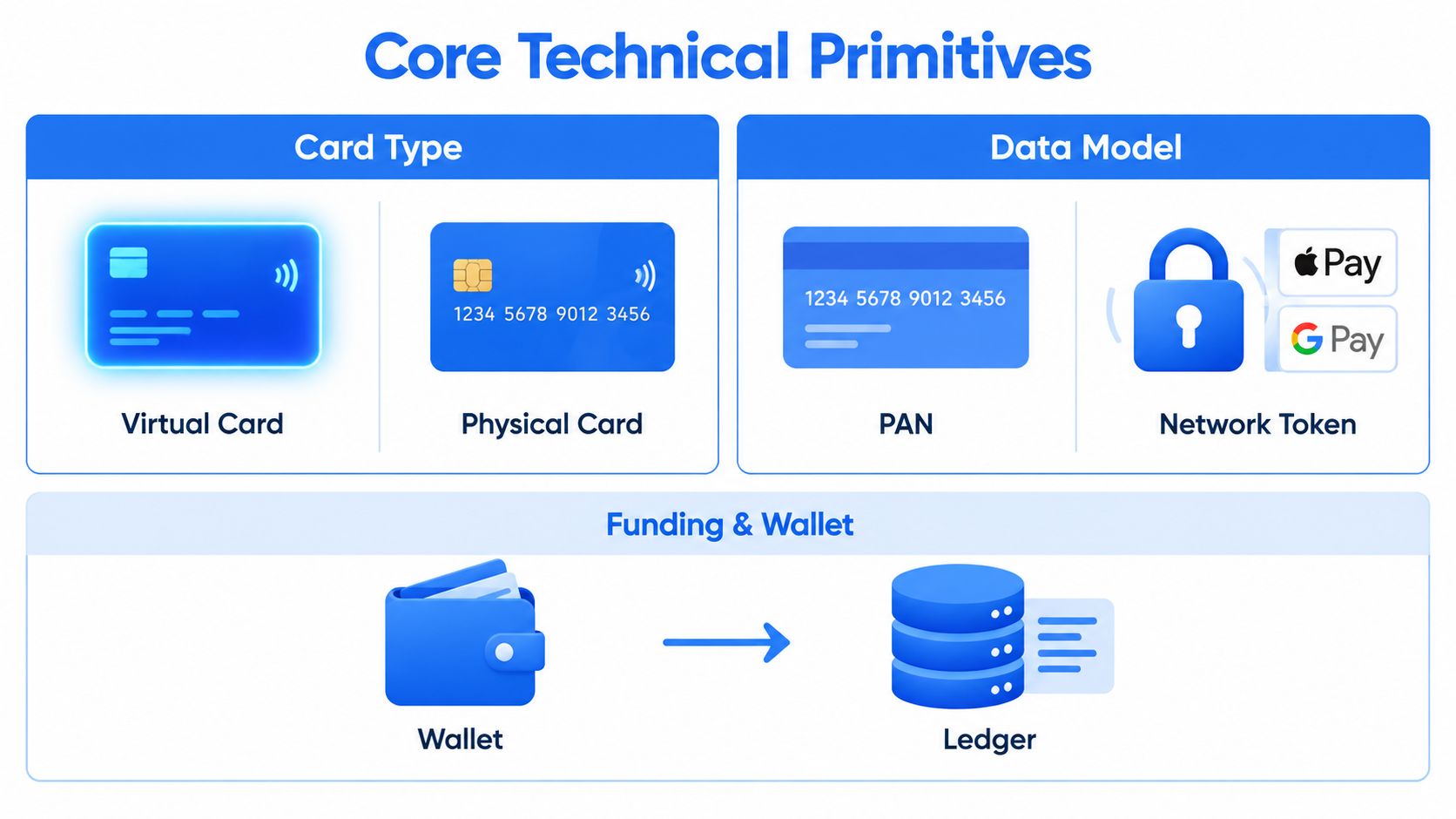
The first production decisions usually aren't about branding. They're about primitives. Which card type fits the job. Whether you expose a PAN or a tokenized wallet credential. How spend links to balances. What controls exist before the transaction reaches your finance team.
Virtual or physical
A virtual card is usually the default for software-first use cases. It works well for online spend, one-user-one-card setups, vendor controls, or per-agent payment authority. A physical card matters when the user needs in-person acceptance or a durable payment instrument.
For a closer market-level overview of how providers package these options, this guide to a card issuing platform is helpful context.
PAN or network token
A PAN is the primary card number. It's still useful, but wallet provisioning increasingly relies on network tokenization. In EMVCo-aligned token flows, the issuer validates the cardholder through ID&V, the token service provider exposes token lifecycle APIs, and the token requestor must be registered and approved before token issuance. This pattern reduces PAN exposure and allows domain controls and token-specific assurance levels, as described in Visa Token Service Provisioning documentation.
That matters when users want Apple Pay or Google Pay support. You're not just storing card details in another format. You're working with a token lifecycle that has its own controls and trust model.
Funding and wallet linkage
A card without a funding model is just a credential. Teams need to decide whether spend maps to a user wallet, department balance, agent wallet, or dedicated operational pool.
Use cases differ:
- Per-user cards fit employee or retail spend.
- Per-agent cards fit AI agent systems where each agent needs bounded authority.
- Per-player cards fit operator models that need isolated balances and policy checks.
- Per-expense cards fit vendor or single-purpose spend.
A good operating model links card controls and wallet balances in one flow so the authorization decision, available balance, and ledger state all line up.
Choosing the right primitive for your use case
| Primitive | Best For | Issuance Speed | Key Control |
|---|---|---|---|
| Virtual card | Online spend, vendor payments, automated workflows | Fast | Expiration and spend policy |
| Physical card | In-person spend and durable user access | Slower than virtual because fulfillment is involved | Card state and user possession |
| PAN-based usage | Direct card credentials in app-managed flows | Depends on program flow | Access to sensitive card data |
| Network token | Apple Pay, Google Pay, reduced PAN exposure | Depends on provisioning and ID&V | Domain restriction and token lifecycle |
| Wallet-linked card | User, treasury, agent, or player balances | Depends on upstream wallet readiness | Available balance and policy enforcement |
The safest primitive is usually the one that gives finance the narrowest spend scope and engineering the cleanest event trail.
How Money Moves From Authorization to Settlement
The easiest production mistake is treating card usage like a single transaction. It isn't one thing. It's a sequence of distinct events that happen over time, and each event has different accounting meaning.
The key distinction
An authorization is not settled money. It's a hold decision.
Authorization places a temporary hold. Settlement is the later event that actually moves funds.
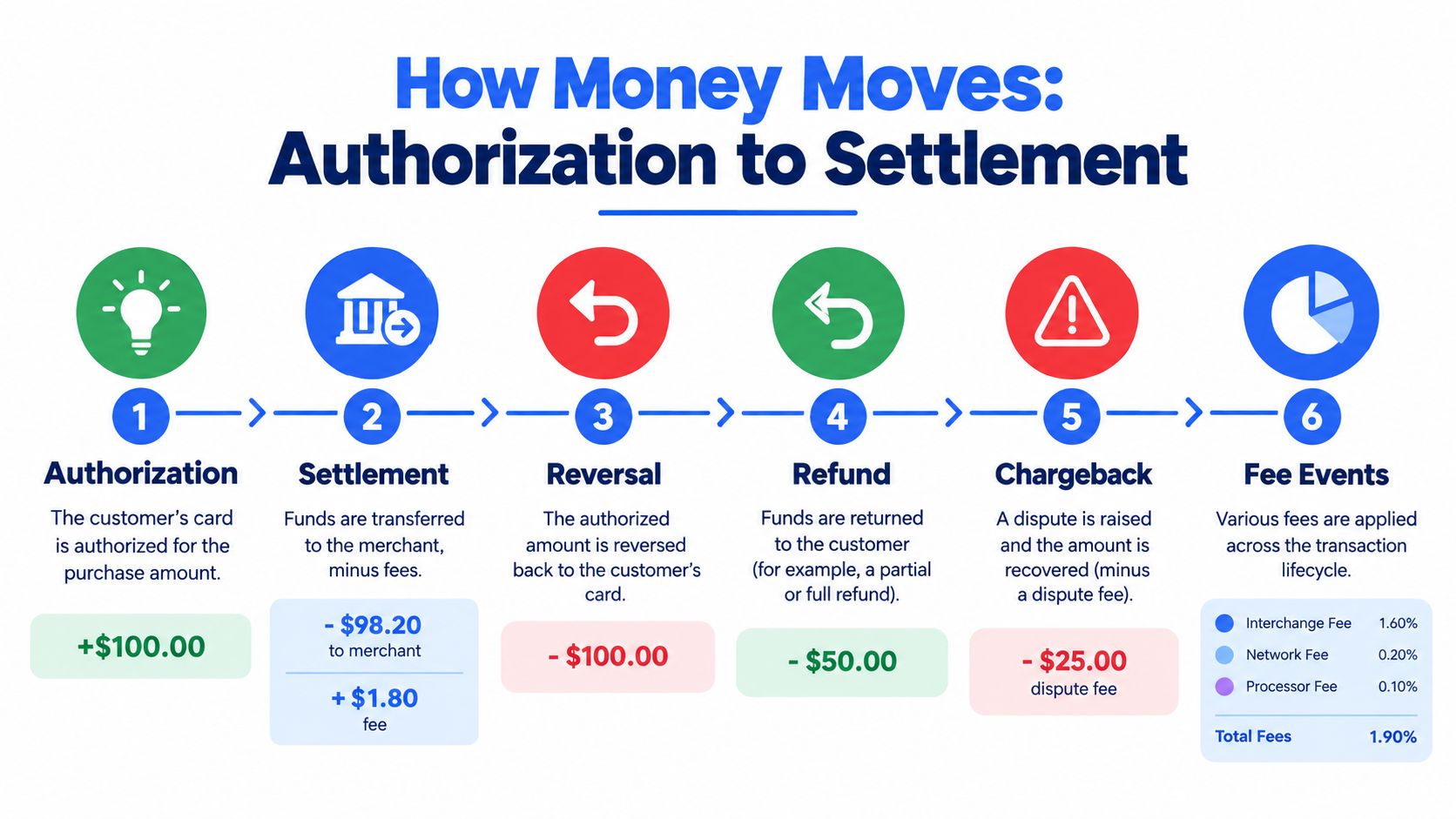
That distinction isn't optional architecture. It's a core integration requirement. Card issuing APIs must treat authorization, settlement, reversal, refund, chargeback, and fee events as distinct ledger records because auth only places a temporary hold, settlement later moves funds, and chargebacks can only be initiated after settlement, as outlined in OpenRambo's card issuing API ledger guidance.
A transaction timeline in plain language
A single purchase might look like this:
- Authorization arrives. You approve or decline, and a hold is placed.
- Settlement arrives later. The merchant captures funds.
- Reversal may release a hold if the auth never settles.
- Refund may credit part or all of a settled transaction.
- Chargeback may dispute a settled transaction.
- Fee events may post separately from the principal movement.
If your ledger collapses these into one record, finance loses traceability. If your app marks authorization as final spend, user balances drift. If your dispute logic ignores settlement timing, operations teams won't be able to explain exceptions cleanly.
Why CTOs should care
This isn't just a finance problem. It's a systems problem. The moment your app offers balances, transaction history, pending spend, or real-time limits, your product relies on event semantics.
Teams that want a grounded example of what payment operations can look like in infrastructure-heavy environments may find PushOps' success stories for cloud infrastructure useful reading. The lesson isn't the specific stack. It's that operating resilience comes from system design, not from polished dashboards.
The ledger implication
A production-grade issuing stack needs an immutable operating ledger that records each event type separately. Finance can then reconcile reports and explain timing differences without asking engineering to reconstruct history from logs.
Integration Patterns That Survive Production Volume
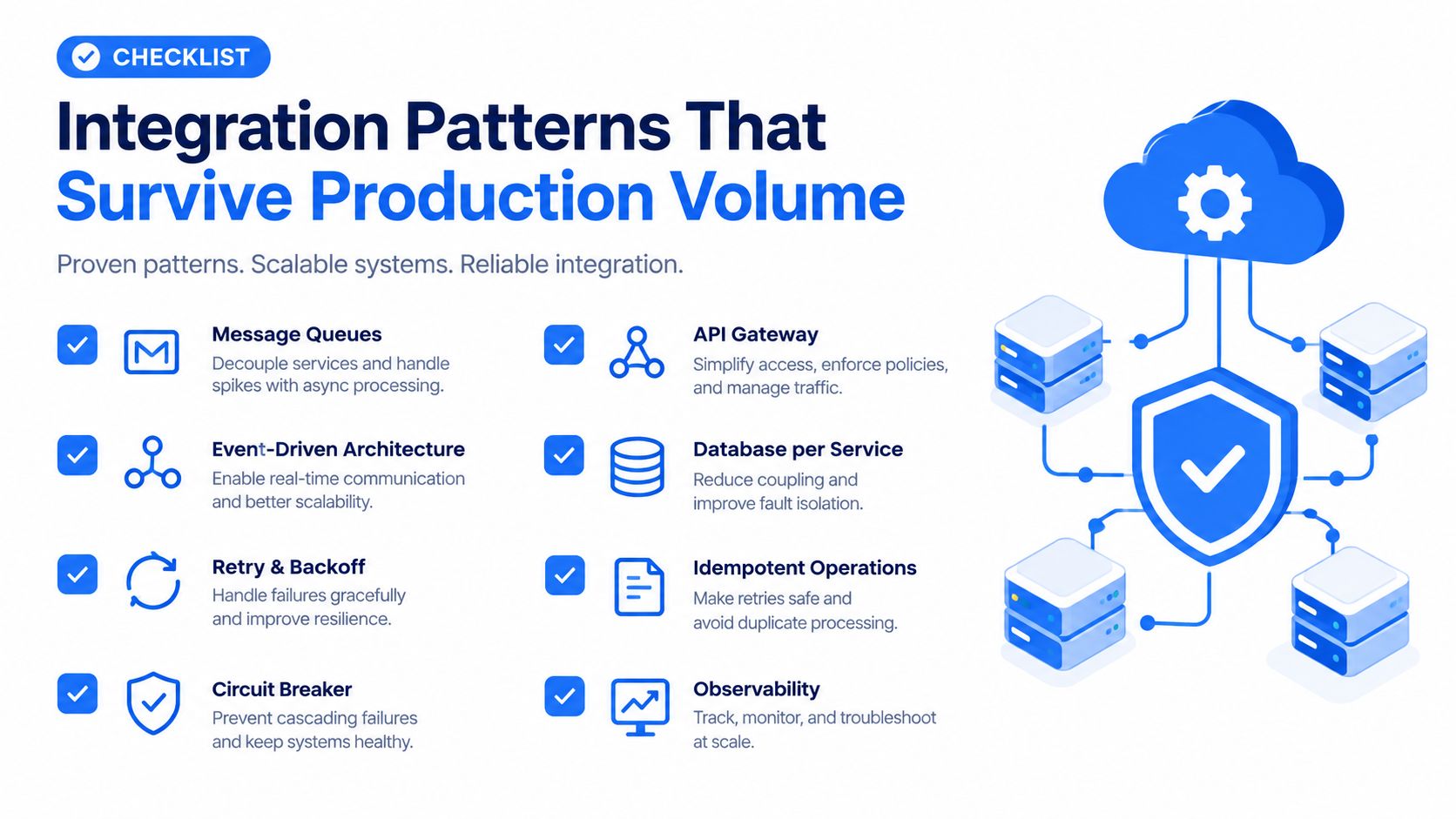
A pilot often works because people are filling the gaps. An operator retries a failed action by hand. Finance corrects a mismatch in a spreadsheet. An engineer checks logs to decide whether a card was created. At production volume, those human patches stop scaling. The issuing API has to behave more like an operating system, with clear state, durable memory, and rules for what happens when the same instruction arrives twice.
Start at the system boundary, not the card endpoint
Teams often begin with "create card" and "freeze card" endpoints because they are visible product actions. Production reliability starts one layer earlier, at the request boundary where systems decide whether an instruction is authentic, unique, and allowed to change money state.
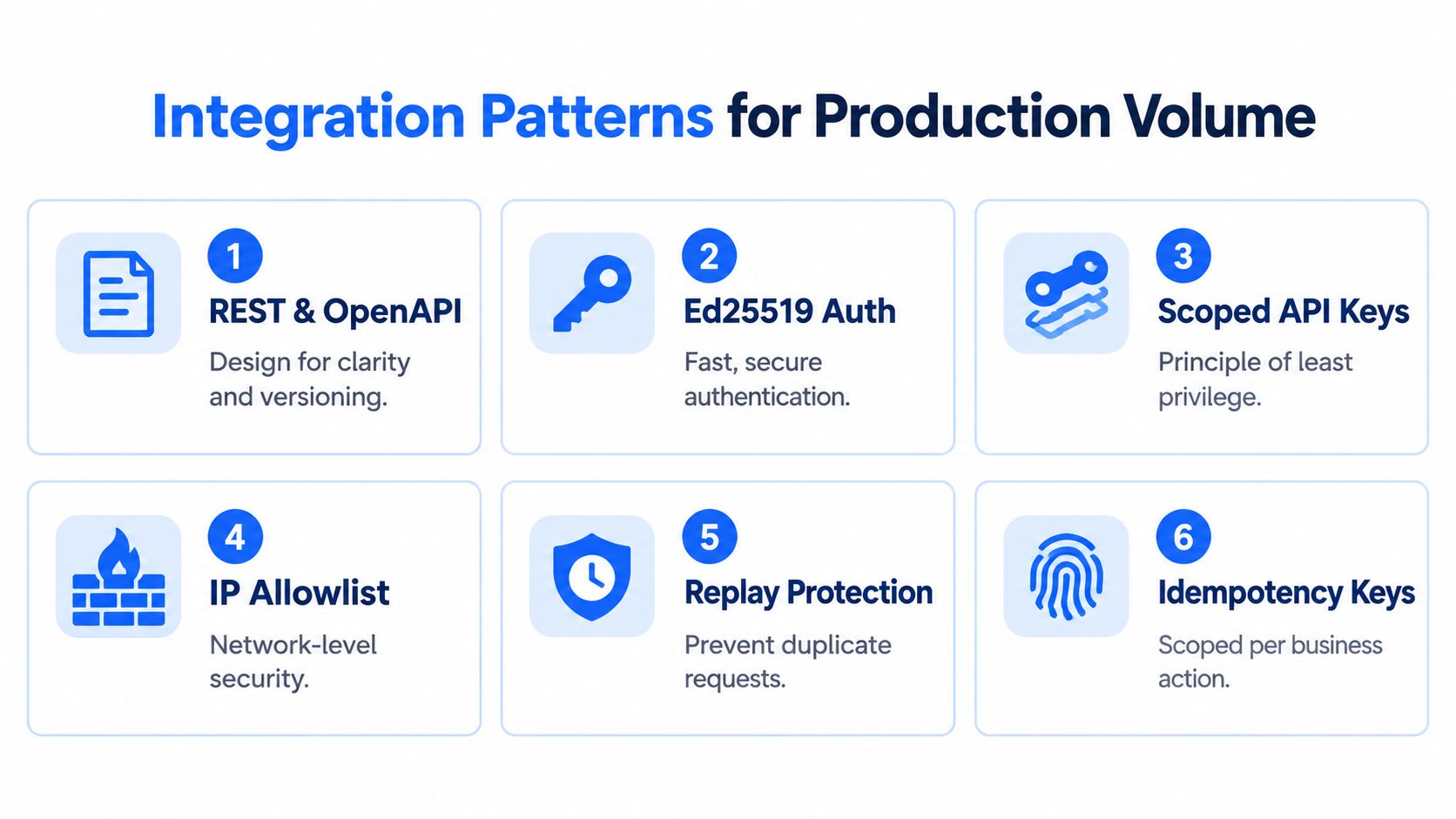
That usually means a small set of controls working together:
- REST and OpenAPI contracts. Clear resource models and versioned schemas keep partner systems and internal services aligned.
- Signed request authentication. Ed25519 auth fits API flows where each request must be attributable and tamper-evident.
- Scoped API credentials. Treasury tools, support consoles, and background workers should not share the same mutation rights.
- IP allowlists and replay protection. Network and timestamp checks reduce exposure before business logic runs.
These choices look ordinary until multiple callers start issuing cards, updating limits, and funding wallets at the same time.
Idempotency is ledger protection
Retries are normal in distributed systems. Timeouts happen. Workers restart. Users click twice. The question is whether your integration treats a retry as a second instruction or as the same instruction seen again.
Use one stable idempotency key for one business action. Store it with the authenticated caller, operation type, payload hash, and final response. If the same key returns with the same payload, return the original result. If the same key returns with a different payload, reject it as a conflict. OpenRambo's guide to API idempotency and retry safety explains this pattern well.
That sounds like an API concern. It is also a ledger concern.
Without idempotency, a timeout during "fund card" can become two wallet debits. A retry during "create card" can become duplicate instruments tied to one user. Finance then sees reconciliation noise, and engineering has to decide which write was the intended one. The safer model is simple. The API accepts an instruction once, and every later retry resolves against that original instruction record.
Event ingestion needs one-way state transitions
High-volume issuing systems do not fail only on request writes. They also fail when inbound events are processed loosely. Webhooks retry by design, and event streams can arrive out of order. Your handler should assume both conditions from day one.
A disciplined flow usually looks like this:
- Verify the event signature before any business parsing.
- Check event age to block stale replays.
- Deduplicate by event ID in durable storage.
- Load the current internal record for the wallet, card, authorization, or settlement object.
- Apply one valid state transition for that event type.
- Write an audit entry with the decision and resulting state.
OpenRambo's webhook event handling guide describes this approach in practical terms.
The important design choice is that handlers should apply state transitions, not re-derive the whole world each time. An authorization event should move a transaction into a pending state. A reversal should release that pending state. A settlement should post a final movement. That keeps product balances, finance reporting, and support tooling aligned even when delivery is noisy.
For teams working through rollout responsibilities across product, operations, and legal, this tag archive from Kons Law on integration is a useful outside perspective.
Treat cards, ledger, and custody as one operating model
This is the integration mistake that causes the hardest production failures. Teams wire card issuance in one service, wallet balances in another, and signing policy somewhere else. Each component works on its own. Reconciliation and custody control then break in the gaps between them.
A stronger pattern treats the issuing stack as one operating model:
- Cards expose user-facing spend controls.
- The ledger records every money movement and status change as immutable events.
- WebSocket events carry balance and transaction updates quickly enough for product and operations to react in near real time.
- Signing policy controls how funds can move when wallet or payout actions are involved.
BroLabel is relevant here because its stack groups these layers together: BROsettlement, BROwallet, BROcard, append-only ledger support, real-time WebSocket events, and MPC 2-of-3 with a client-controlled Co-Signer. That architecture matters for a practical reason. It reduces the gap between card activity, settlement accounting, and custody approval paths. Teams that want a related example can review this guide to a virtual card issuing API.
The useful mental model is an operating system, not a card printer. Card creation is the visible command. The harder work is state management underneath: making sure retries do not duplicate money movement, event streams do not corrupt balances, settlement can be reconciled without log forensics, and custody rules do not depend on one hidden signing path. That is what survives production volume.
Security Compliance and Controls Before You Go Live
A typical go-live failure starts on an ordinary afternoon. An authorization is approved, a wallet balance changes, a withdrawal request is queued, and finance asks a simple question: which record is the source of truth? If the answer depends on checking three dashboards, a spreadsheet, and one engineer who understands the retry logic, the problem is not compliance paperwork. The problem is that the issuing stack is missing operating controls.
Card security is only one layer. The harder risks sit underneath the card itself: who can approve fund movement, how duplicate requests are prevented, whether every balance change lands in the ledger once, and whether operations can see exceptions before settlement turns them into a reconciliation incident.
Hidden failure modes
Three patterns cause trouble repeatedly.
- Custody concentration. One provider or one internal team controls too much of the wallet and signing path. That creates governance risk and makes incident response harder.
- Approval path fragility. A single signer, key path, or manual process becomes the only way money can move. If that path fails, operations stall. If it is too permissive, funds move without enough review.
- Ledger ambiguity. Events exist, but finance cannot trace them cleanly from authorization to settlement to bank record. You end up with transaction history, not accounting evidence.
These are system design problems. They show up before scale, then become expensive at scale.
Controls that matter before scale
A useful model is an operating system with permissions, event logs, and process isolation. Card issuance is one application running on top of it. The controls below protect the underlying state.
- MPC threshold signing. A 2-of-3 policy with a client-controlled Co-Signer reduces key concentration and lets treasury approvals stay under your control.
- Role-based access control. Product support, finance, treasury, and engineering should have different rights for issuing cards, moving funds, updating policies, and exporting records.
- Append-only audit evidence. Policy changes, event ingestion, approvals, reversals, and signing outcomes should all leave immutable records.
- AML and review gates. Screening and manual review need to sit on the paths that can release funds, not only on account opening.
- Real-time event monitoring. WebSocket events should feed operations tooling fast enough to catch failed confirmations, duplicate retries, and suspicious withdrawal behavior while there is still time to act.
For teams using BroLabel, this is the practical value of combining BROsettlement, ledger behavior, and Co-Signer controls in one stack. It reduces the chance that card activity, settlement accounting, and custody policy drift apart and force finance to reconstruct state after the fact.
A real security review ends with three proofs: why a balance changed, who approved the action, and which external record confirms it.
A pre-launch verification checklist
Before go-live, verify these points with engineering, operations, and finance in the same room:
- Access scope: Are API credentials segmented by service and by action?
- Idempotency: Can a retry create a second mutation, or does the system recognize the request as already applied?
- Event handling: Are duplicate webhooks and repeated event deliveries safely ignored after the first valid write?
- Settlement traceability: Can finance match internal ledger entries to provider reports and bank movements without manual interpretation?
- Signing policy: Who co-signs sensitive actions, who can approve exceptions, and what record is stored for each decision?
- Operational alerting: Which failures trigger a human review, and which are handled automatically with clear status updates?
If any answer is vague, do not treat it as a documentation gap. Treat it as an operating gap that will surface later as a reconciliation break, a custody dispute, or an avoidable incident.
Putting It Together With BroLabel and Next Steps
A useful way to judge a card issuing stack is to watch what happens on a bad day. An authorization arrives twice. A webhook is delayed. A finance analyst asks why a balance changed. A treasury action needs approval before funds move. If the answers live in four different systems, the card program is already harder to operate than it looks.
That is why this category behaves more like an operating system than a card printer. The hard part is keeping state consistent across card activity, settlement outputs, approval policy, and custody actions. BroLabel's model is built around that operating layer. BroSettlement handles settlement coordination, the ledger gives finance a stable accounting source, and Co-Signer adds approval controls for sensitive asset movement. Together, they reduce the two failures that create the most cleanup later: reconciliation gaps and custody disputes.
A buying decision should test for operational proofs, not feature screenshots. Ask each provider to show what your team can verify after an incident, after a retry, and at month-end close.
A practical next-step checklist for the sandbox
Run a short sandbox exercise with engineering and finance on the same call. Five tests are enough to expose whether the platform behaves like an operating system or just an issuance front end.
- Create a wallet or funding account. Confirm the API returns a stable identifier your application can store and reuse across later card and settlement events.
- Issue a virtual card tied to that account. Check which card state changes are available through API responses and event delivery, not only in the dashboard.
- Simulate an authorization and a reversal or completion. Verify your application receives the full event sequence in order, including enough reference fields to trace the payment lifecycle.
- Verify webhook signatures with a failed-case test. Send one valid event and one tampered event. Your handler should accept the first and reject the second with a clear audit trail.
- Reconcile one ledger outcome to one external record. Pick a single transaction and confirm finance can trace it from app event, to ledger entry, to settlement or provider record without spreadsheet interpretation.
That checklist adds something important to vendor evaluation. It forces each team to prove not only that a card can be created, but that the stack can preserve financial truth under retries, asynchronous delivery, approvals, and exception handling.
A CTO usually looks for integration shape. Finance looks for traceability. Security looks for control over high-risk actions. A sound card issuing API should satisfy all three with the same primitives, not with separate tools patched together after launch.
FAQ
What's the difference between a virtual card and a physical card?
A virtual card is better for online and software-driven spend. A physical card is necessary when the user needs in-person acceptance or a persistent card they can carry.
Can virtual cards work with Apple Pay and Google Pay?
Yes, when the issuing setup supports network token provisioning and the cardholder passes the required ID&V checks. In practice, wallet support depends on token lifecycle integration, not just card creation.
Why can't we treat authorization as final spend?
Because authorization only places a hold. Settlement is the event that moves funds. If you collapse the two, balances and reconciliation reports drift.
Why do idempotency keys matter so much in card issuing?
Because payment clients, mobile apps, and webhook senders retry. Without stable idempotency per business action, the same operation can create duplicate cards, duplicate debits, or conflicting state.
What should finance ask before approving launch?
Ask for a trace from one transaction to every record it creates. Finance should be able to see the internal ledger entry, the provider settlement reference, the approval record for any sensitive movement, and the external confirmation that closes the loop.
BroLabel offers modular infrastructure for teams that need wallets, card issuing, settlement controls, event streams, and reconciliation support in one operating model. If you're designing a card program that has to survive real funding flows and production controls, visit BroLabel and start with the sandbox path before you scale.