
The popular advice is to convert crypto to a stablecoin, send it, and cash out. That skips the part customers care about: when the money becomes spendable in their bank account. A blockchain transfer can finish while a compliance team, payout provider, or bank still has work to do.
For teams evaluating crypto currency fiat infrastructure, the enemy is the time-to-cash illusion, treating an on-chain confirmation as a completed payment. The practical lesson is to design around separate settlement states, named operational owners, and evidence finance can reconcile.
Table of Contents
- Crypto Assets, Stablecoins and Fiat Money
- Conversion Rails From Crypto to Bank Balance
- Custody Models and Who Controls the Keys
- AML and Regulatory Duties for Fiat Flows
- How to Build a Crypto Fiat Flow Step by Step
- Risk Controls to Set Before Going Live
- Questions Buyers Ask About Crypto Fiat Flows
Crypto Assets, Stablecoins and Fiat Money
Is a dollar-pegged token the same as a dollar in a bank? No. They can share a reference currency without sharing the same issuer, redemption rights, or settlement process. Classify the asset before designing the payment flow.
Crypto assets, stablecoins and fiat money compared
| Asset | Issuer and backing | Price stability | Settlement window |
|---|---|---|---|
| Fiat currency (bank balance) | Central bank and banking system; a bank deposit is the bank's liability | Nominal balance denominated in the national currency; purchasing power isn't fixed | Banking hours or continuous availability under the payment rail's rules |
| Bitcoin-type crypto asset | No issuer obligated to redeem at a fixed value | Market-priced, without a fiat-value guarantee | Continuous on-chain submission, subject to confirmations |
| Fiat-backed stablecoin (USDT, USDC) | Private issuer with reserves and applicable redemption rights | Targets a fiat peg; stability rests on reserves, liquidity, and redemption | Continuous on-chain transfer; redemption follows issuer and banking arrangements |
Similar denominations, different claims
The distinction is institutional, not cosmetic. The IMF statistical treatment described in the BIS survey of central bank digital currencies and crypto separates Bitcoin-like assets from currency because they generally lack both issuance by a monetary authority and a corresponding issuer liability. A bank deposit, by contrast, sits inside a banking framework and represents a claim against the bank.
A stablecoin occupies a different position again. Its issuer may undertake redemption obligations, but the holder must establish which legal entity owes what, who can redeem directly, and what conditions apply. A token bought through an intermediary doesn't automatically give every holder identical access to the issuer's redemption channel.
That matters because stablecoin infrastructure is concentrated. According to the BIS stablecoin analysis, stablecoins' share of the overall crypto market increased from 9% at the beginning of April 2022 to 13% by the end of January 2023, while the largest stablecoins represented 92% of the stablecoin market at the end of 2022.
The larger share during market stress partly reflected sharper declines in other crypto assets. It wasn't proof that redemption had become risk-free. For an operator, concentration means alternative tokens may still leave the business exposed to the same issuer, banking partner, or liquidity route.
Use the fiat-backed stablecoin guide to distinguish the backing model from the customer-facing payment promise.
What atomic settlement does and doesn't solve
The BIS working paper on stablecoin risks and regulation explains atomic settlement, where tokenized assets exchange within a transaction so that both transfers execute or neither does. That can reduce bilateral settlement exposure without a separate clearing step.
It doesn't make an external bank payout atomic. The token transfer, issuer redemption, and recipient bank credit can involve different counterparties and operating windows.
Practical rule: A deposit confirmation proves an on-chain event. It doesn't prove that a bank has credited the beneficiary.
Track these states separately:
| State | What it proves | What still needs verification |
|---|---|---|
| Token balance | The platform has recognized the relevant on-chain balance | Confirmation policy, ownership attribution, and restrictions |
| Reserve-backed redemption value | The applicable claim or executable conversion value | Eligibility, pricing, liquidity, and redemption completion |
| Fiat payout | The bank-side payment has reached its recorded settlement state | Beneficiary credit, returns, and final reconciliation |
The concept map is token ownership → conversion or redemption claim → bank-side availability. An application should advance between those states only when it receives evidence for the next one.
Conversion Rails From Crypto to Bank Balance
Crypto-to-fiat conversion isn't instant just because the blockchain leg is fast. Time to cash includes every unresolved stage, from deposit confirmation through screening, liquidity allocation, payout submission, and beneficiary credit.
The Spark on/off-ramp market overview identifies jurisdictional registration, payment-method risk, bank cut-offs, and sanctions screening as operational constraints, and notes that card businesses exceeding a 0.9% chargeback rate can face increased monitoring, higher fees, or termination. Treat that card figure as a market-overview observation, not a universal contractual threshold.
Conversion rails and typical time to cash
| Rail | Typical direction | Typical time to cash | Main constraint |
|---|---|---|---|
| Card funding | Fiat into crypto, funding leg only | Issuer authorization followed by provider release | Issuer approval and chargeback exposure |
| Bank transfer, ACH-style or wire | Both ways | Applicable bank processing and settlement window | Bank cut-offs and holidays |
| Instant payment scheme | Both ways | Scheme processing window where supported | Jurisdiction and bank coverage |
| Stablecoin to bank payout | Crypto out to fiat | Blockchain confirmation plus payout window | Licensing, sanctions screening, and payout rail |
| OTC or peer-to-peer trade | Both ways | Counterparty release and escrow conditions | Counterparty reliability and escrow risk |
These are operating rules, not promised service levels. Publish measured estimates for each supported corridor rather than attaching a single global speed claim to the product.
Build a transaction-level clock
Say a treasury team submits a stablecoin payout after the destination bank's cut-off. The deposit can be confirmed and approved while the bank payment remains queued. Showing “complete” at that point gives support an explanation problem and finance a reconciliation problem.
Create a time-to-cash record for every payout:
- Stage and owner: Identify who owns confirmation, screening, conversion, submission, and settlement.
- Expected duration: Store the applicable service window and its starting event.
- Blocking reason: Distinguish missing information, a risk hold, unavailable liquidity, and a closed banking window.
- Failure handling: Record whether the operator should retry, repair beneficiary details, return funds, or escalate.
Separate the cost layers
A quoted exchange rate doesn't describe the customer's full cost. Store the FX spread, network fee, provider fee, bank fee, and reversal adjustments as separate fields, with the quote's expiry and the actual execution outcome.
A useful customer receipt shows the source amount, conversion rate, deductions, and destination amount. A useful finance record also identifies which party earned or charged each component.
Measure success at beneficiary availability, not at the earliest event your application can display.
Custody Models and Who Controls the Keys
Custody models and who can move funds
| Model | Who holds the keys | Who can move funds | Main failure point |
|---|---|---|---|
| Custodial exchange account | The platform | The platform, under its own controls | Platform solvency and account freezes |
| Custodial PSP wallet | The provider | The provider on the customer's instruction | Single approval path and provider policy |
| Self-custody wallet | The user alone | The user only | Lost keys without a recovery path |
| MPC threshold signing with a client Co-Signer | Separate participants hold shares | The required signing quorum | Policy misconfiguration and loss of co-signer access |
The operational distinction is who can authorize movement, not whose logo appears in the interface.
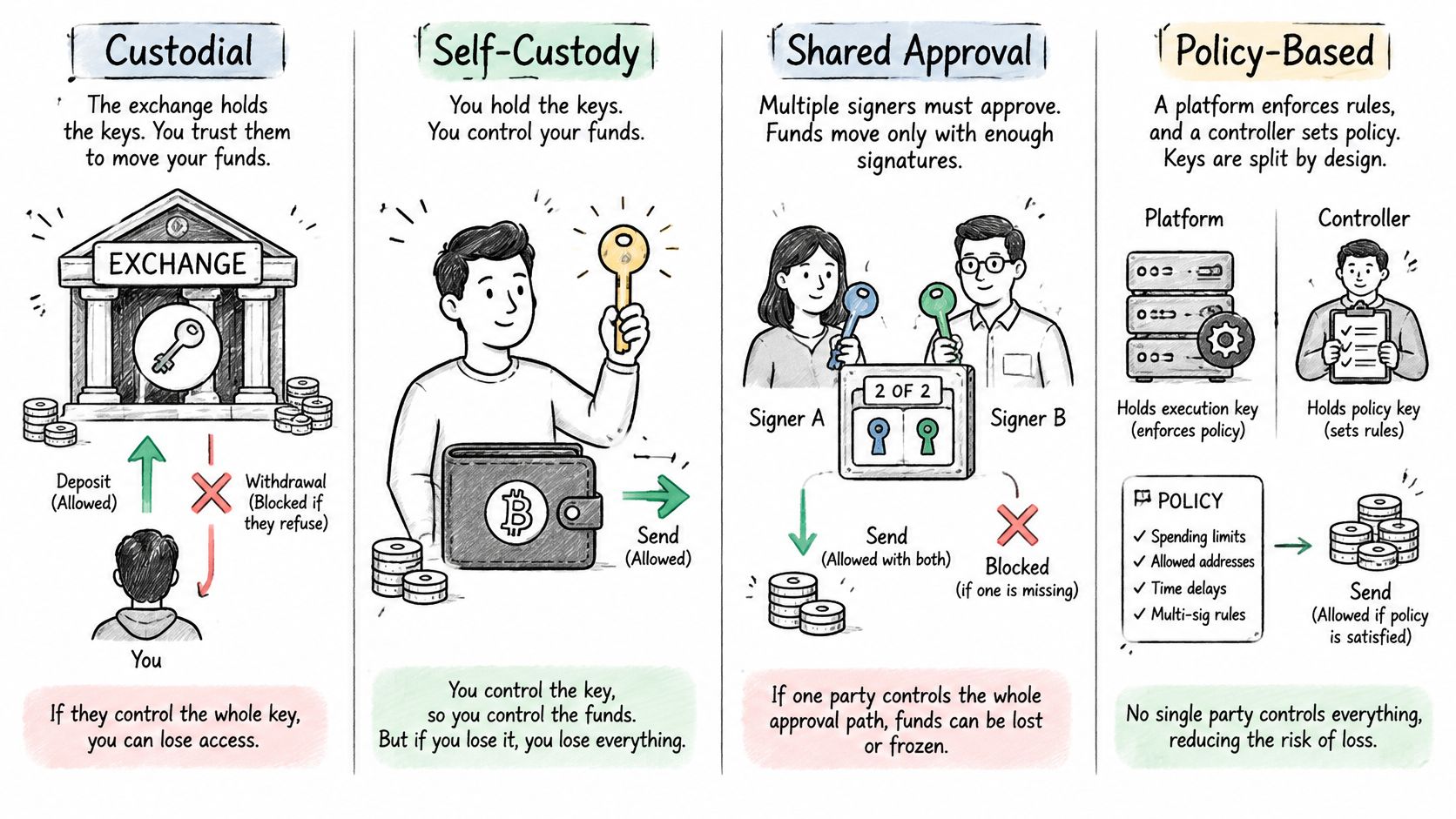
Replace a single key with a defined quorum
NIST's threshold-cryptography materials describe splitting a secret across participants and using secure multiparty computation for operations such as signing, providing the mechanism for a 2-of-3 policy in which separate shares exist and the required pair must participate. No participant needs to reconstruct or possess the complete private key.
MPC therefore changes the technical authorization boundary. It doesn't automatically establish a sound business approval process.
If the same administrator controls the application credentials, policy configuration, and all available signing participants, organizational separation may be weaker than the cryptography suggests. Review effective control, including emergency access and recovery procedures.
Give the customer an independent approval boundary
A client-controlled Co-Signer can preserve an independent signing veto while infrastructure handles transaction preparation and network submission. Define what it checks: destination eligibility, amount limits, asset and network, approval evidence, and the current policy version.
The digital asset custody guide provides context for choosing between operational convenience and independent control. Make that choice per flow, rather than imposing the same approval design on treasury movements and routine user withdrawals.
Use the accompanying video as a discussion aid alongside the written signing policy.
Before production, name the shareholders, document role authorization, and test co-signer unavailability. Recovery must not introduce a bypass that defeats the original approval boundary.
For treasury payouts, require stronger approval evidence and tighter destination controls than for low-value routine withdrawals. Keep an auditable record of the policy decision and signing participants, not merely the resulting transaction hash.
AML and Regulatory Duties for Fiat Flows
Public-chain transparency doesn't establish regulatory compliance. A transaction hash can show movement between addresses without establishing the verified originator, beneficiary, purpose, or responsible regulated entity.
The FATF Travel Rule supervision guidance applies Recommendation 16 and Interpretive Note 15 to virtual-asset transfers. Originating VASPs must obtain and retain required, accurate originator and beneficiary information, transmit it immediately and securely to the receiving provider, and make it available to competent authorities on request; receiving VASPs must also obtain and retain the required information.
Carry identity through the workflow
Capture required identity and beneficiary fields at the API request. Associate screening results and any missing-information decision with the transfer before signing, then preserve that association through submission and reconciliation.
The FATF payment-transparency update sets standardized requirements for peer-to-peer cross-border payments above USD/EUR 1,000, including the originator's name, address, and date of birth, with implementation scheduled by the end of 2030. Treat this as a scheduled standard, not a statement that every jurisdiction already applies identical domestic rules.
For cross-border operating context, Africhange's explanation of AML requirements for international transfers is a useful companion to jurisdiction-specific legal advice.
Assign responsibility explicitly
Use this allocation as a design starting point, then validate it against licenses, contracts, and local law:
- Stablecoin issuer: Reserve management, redemption arrangements, and issuer eligibility.
- Platform: Customer due diligence, transaction monitoring, and customer-level decisions.
- Bank: Fiat account controls and bank-side payout processing.
- Payment service provider: Applicable merchant acceptance and payout obligations.
- Infrastructure provider: Wallet technology, policy integration, and audit records within its contracted scope.
Our provision of wallet technical infrastructure doesn't make BroLabel the issuer of customers' assets or instruments, their legal advisor, or the party responsible for end-user balances, certificate rights, or regulatory decisions.
Use the crypto AML compliance guide when translating those responsibilities into operating procedures. For every flow, answer: Who is the regulated party? Who holds the required data? Who has the authority and technical ability to stop or freeze the transaction?
How to Build a Crypto Fiat Flow Step by Step
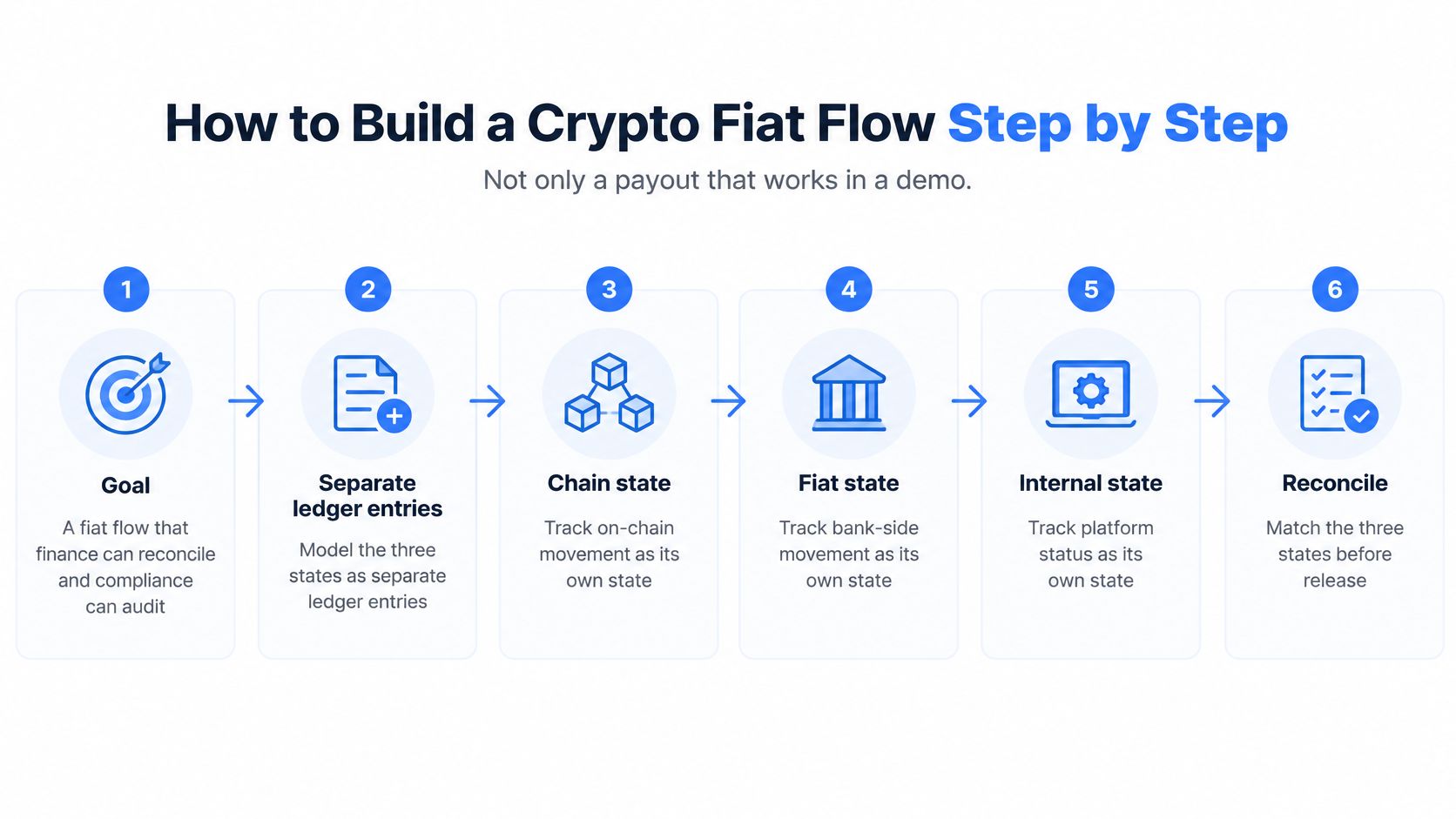
Build a fiat flow that finance can reconcile and compliance can audit, not merely a payout that works in a demo. Start with the evidence required to close the transaction, then define the services and events that produce it.
The process illustration separates the accounting and settlement checkpoints.
Configure the flow before automating it
Create separate ledger entries. Record token receipt, conversion or redemption, and fiat payout independently, linked by a durable transaction identifier. This lets finance locate an unresolved obligation without inferring it from a wallet balance.
Choose custody and signing policy for the specific use case. Set a threshold-signing arrangement with client-controlled approval for releases above your business limit, and document the unavailable-signer procedure.
Scope API credentials by service. Separate observation, transaction preparation, and approval permissions wherever the implementation supports them. Apply IP allowlists, authenticated requests, and replay protection so a compromised integration has a bounded impact.
Validate originator and beneficiary information before signing. Reject incomplete requests or route them into an explicit review queue rather than broadcasting first and repairing the record afterward.
Assign each module an honest role. Our BroSettlement provides MPC wallets, network submission across 10 networks, and a customer-controlled Co-Signer; use it for the available wallet and signing layer. BroWallet is planned for Telegram, web, and mobile and is coming soon, while AI Agent Wallets are in development, so don't make launch dependencies on those future capabilities or assume they're included in the settlement product.
Make execution observable and repeatable
Consume WebSocket events into a durable event history. Use deposit observations, confirmations, withdrawals, and policy outcomes to update customer-facing status. Reconnect safely, deduplicate delivered events, and verify gaps against authoritative records instead of treating a live connection as an accounting system.
Attach an idempotency key to every logical payout in your application and preserve it across retries. Enforce duplicate suppression at the payout boundary, and verify downstream support before assuming a timed-out request is safe to resend.
Reconcile ledger entries, chain records, and bank statements daily. Match amounts, assets, fees, references, and terminal states, then assign every unmatched item to an owner. Preserve corrections as new accounting entries rather than overwriting history.
Rehearse the complete path in the sandbox before release. Include duplicate requests, delayed events, rejected beneficiaries, unavailable approvers, and a payout whose submission response is lost.
For future agent-driven workflows, let AI Agents prepare only policy-permitted actions and keep required signatures behind the approval boundary. Automation should reduce preparation work, not acquire an undocumented route around customer control.
Risk Controls to Set Before Going Live
A blockchain transfer sent to the wrong address, network, or asset cannot be unwound by the platform. Approval quality therefore matters before signing, while status quality matters throughout the remaining lifecycle.
Use the launch checklist as a release gate, not an informal reminder.
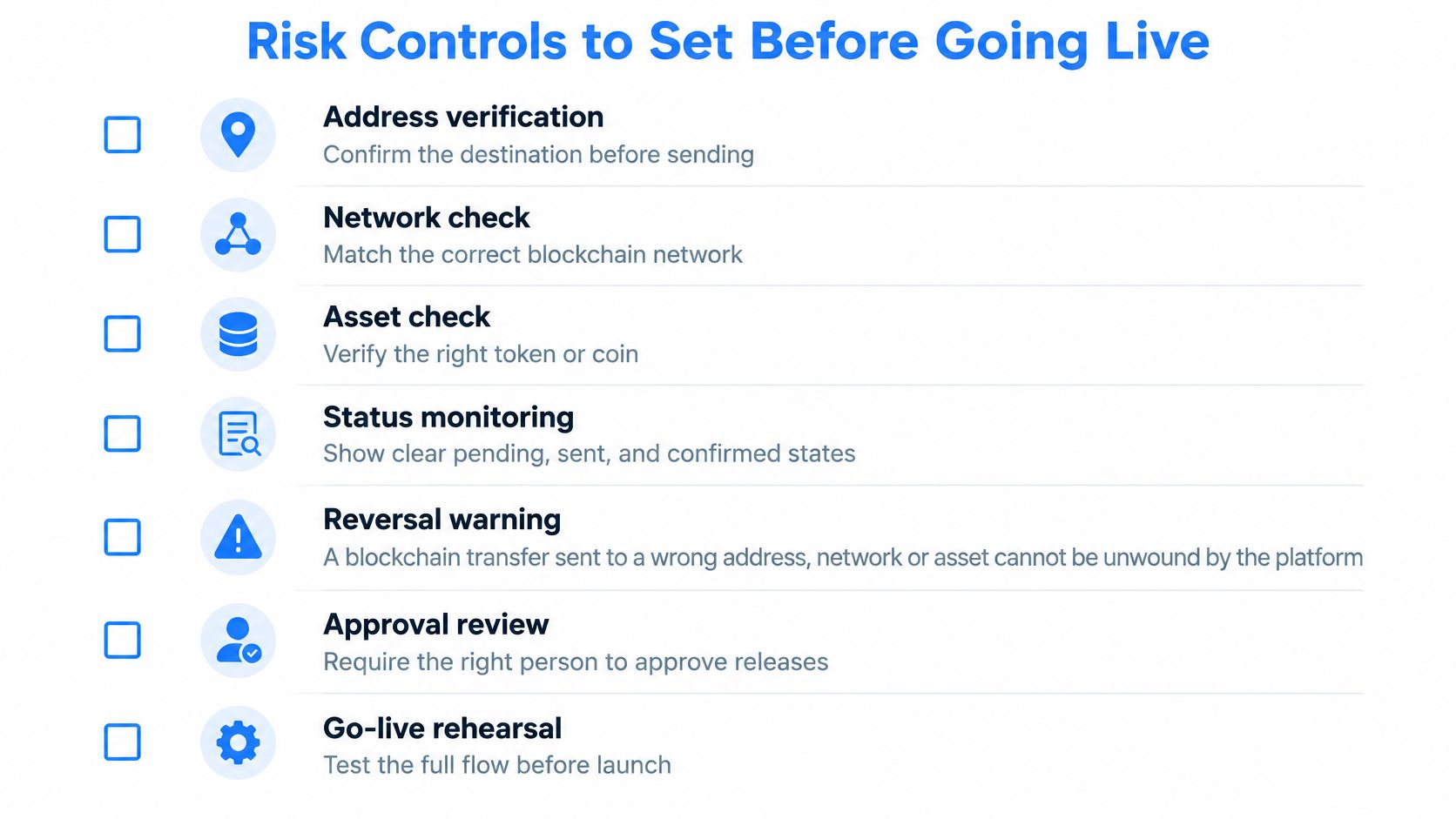
Verify the instruction and its funding
- Destination verification: Validate address format, network, asset, amount, and recipient details against the approved instruction. Require renewed approval when material fields change.
- Fee sufficiency: Keep enough of the asset required for network fees in the source wallet. Network fees are debited from that wallet, are independent of BroLabel, and may change between estimation and execution.
- Approval evidence: Record who approved the release, which policy applied, and whether the destination or limit required additional review.
- Release rehearsal: Test rejected and interrupted paths, including what an operator sees when no definitive submission result arrives.
Define what uncertain status means
Public blockchains, validators, token issuers, and independent providers may fail, change, delay or reject transactions, change block order, or cancel a transaction's visible status. Customers must account for those risks in confirmation thresholds, reconciliation procedures, and end-user servicing rules.
Don't turn every observed event into a final balance. Distinguish pending, submitted, confirmed, failed, returned, and reversed according to the relevant rail, and ensure support and finance use the same definitions.
The BIS analysis of stablecoins' role in the financial system identifies currency substitution and reserve-liquidation channels that connect token activity to traditional financial risk. Monitor issuer exposure, reserve composition, redemption concentration, currency mismatch, and executable liquidity rather than assuming a nominal peg guarantees immediate cash.
Release criterion: An unresolved status needs an owner, a next action, and a customer message.
The customer remains responsible for correct instructions, addresses, network and asset selection, amounts, recipient data, and its compliance and risk decisions. The operating team must configure and test pre-signing controls and retain the audit evidence that shows those controls ran.
Questions Buyers Ask About Crypto Fiat Flows
Is a stablecoin the same as dollars in a bank?
No. A fiat-backed stablecoin is a token with issuer-specific backing and redemption arrangements, not the same claim as a bank deposit. Evaluate redemption access, reserve quality, operating hours, and concentration before presenting it as a cash equivalent.
Why does a payout take days when the blockchain transfer takes minutes?
Because confirmation isn't beneficiary credit. Screening, risk holds, conversion execution, bank cut-offs, and payout processing can remain unfinished after the token arrives. Ask for the current stage, its owner, and the next expected event rather than a generic processing message.
Does a non-custodial wallet remove compliance duties?
No. Key control doesn't determine every obligation attached to operating an exchange, payment service, or customer account. Establish the regulated entity and its due-diligence and information-sharing responsibilities separately from the wallet's technical design.
Does fiat conversion need a licence?
The answer turns on jurisdiction, activity, and business model. Have qualified counsel assess who converts, holds, transmits, or pays out funds, rather than relying on a provider's general description of its infrastructure. Fiat on/off integrations also depend on the selected provider and jurisdiction.
What should buyers test first?
Map a complete customer flow and rehearse its failure paths. Use the rails comparison to identify bank-side constraints, then exercise approval, timeout recovery, duplicate suppression, and reconciliation in the sandbox. The useful acceptance test is whether operations can explain every unresolved balance without manually reconstructing the transaction.
BroLabel offers API-first MPC wallet infrastructure, customer-controlled signing, operational records, and provider-dependent fiat integrations for teams connecting crypto movement to bank-side workflows. Visit BroLabel to map your first settlement flow and plan a sandbox rehearsal with explicit approval, status, and reconciliation checkpoints. Bro has your back!