
The most common advice about a fiat-backed stablecoin is to check whether it's backed one-to-one. That's necessary, but it doesn't tell a treasury team whether it can redeem on time, whether reserves are accessible during a banking disruption, or whether finance can reconcile the full flow. A stablecoin is a liquidity and redemption system first, and a token second.
For founders, product leaders, operations, finance, and compliance teams, the practical question isn't what sits behind a token. It's whether the issuer, banking partners, wallet controls, and settlement processes can deliver the promised dollar value under ordinary conditions and stress. The enemy is the gap between a published reserve claim and operationally available liquidity.
Table of Contents
- Why a Fiat-Backed Stablecoin Is a Reserve Machine First
- The Mint, Hold, Burn, and Redemption Lifecycle
- What Actually Sits Behind the Token
- Par Redemption as an Engineering Target
- Where Fiat-Backed Stablecoins Replace Bank Rails
- Cutting Through Volume Hype With Better Questions
- Risks and Controls Before Anything Goes Live
- The Operating Model That Holds the Peg
- Frequently Asked Questions
- What makes a fiat-backed stablecoin hold its peg?
- Does “fully backed” mean the reserves are all cash?
- What should treasury teams verify before choosing a stablecoin?
- What's the difference between a token transfer and a completed redemption?
- Do stablecoin transaction volumes prove broad payment adoption?
Why a Fiat-Backed Stablecoin Is a Reserve Machine First
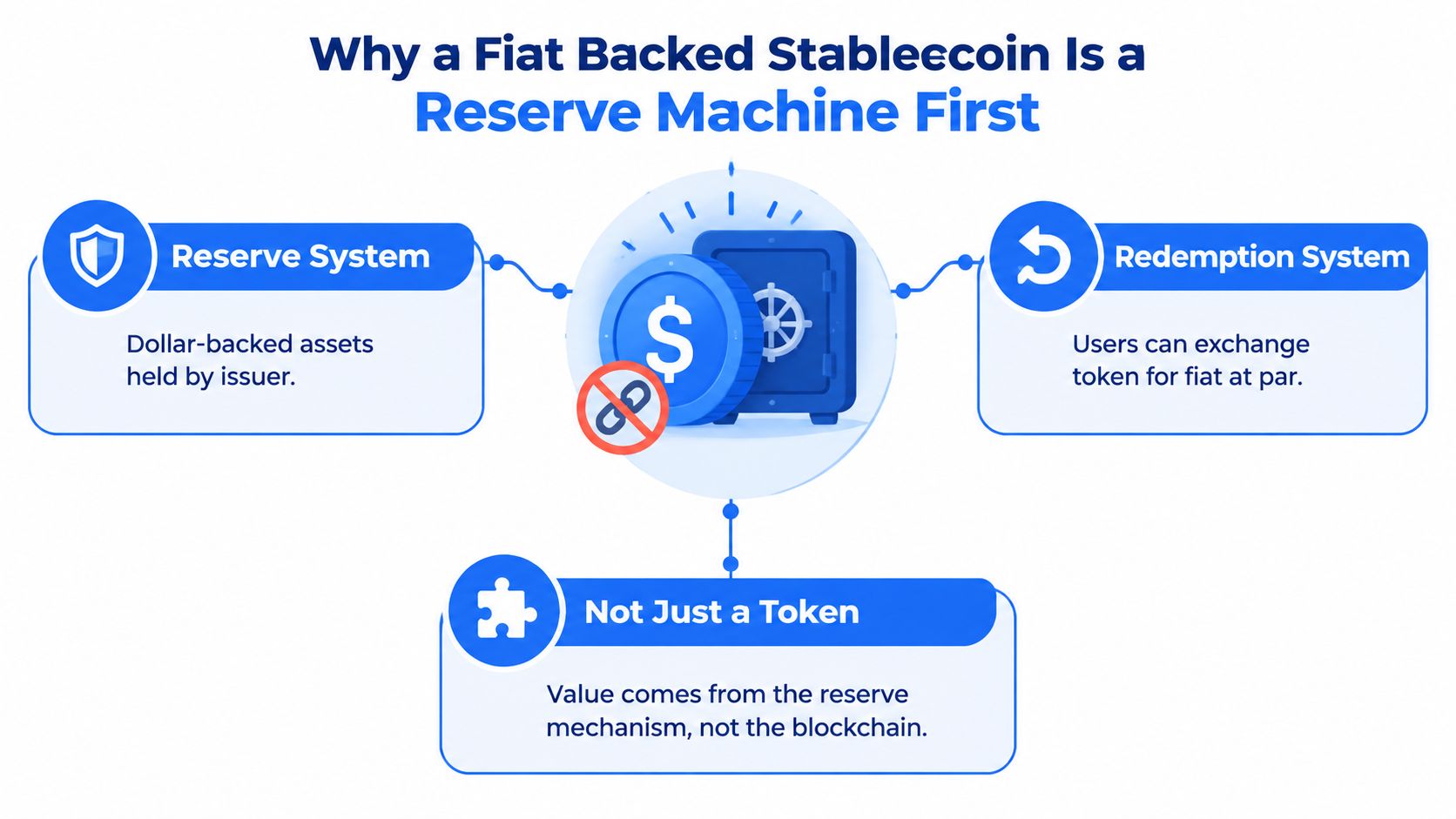
A fiat-backed stablecoin isn't reliable because it runs on a blockchain. Its value depends on an issuer accepting fiat, creating tokens against reserves, and honoring eligible redemptions at approximately one dollar per token. The Federal Reserve describes stablecoin backing in terms of cash and cash equivalents, including bank deposits, U.S. Treasury securities, and commercial paper (Federal Reserve analysis of stablecoin reserves and financial stability).
That makes the issuer's reserve and redemption arrangements the core product. Banking partners hold or move reserve assets and provide access to fiat settlement. If those relationships are unavailable when holders want to redeem, the token's on-chain transferability can't fulfill the off-chain dollar promise by itself.
Before choosing a token or provider, treasury teams need clear answers to four questions: Who can redeem? How quickly? Under what legal claim? With what audit trail? If the answers are vague, the peg is less defensible than the marketing suggests.
| Marketing Claim | Operating Requirement |
|---|---|
| “Fully backed” | Reconcile outstanding token supply against eligible, available reserve assets. |
| “Redeemable at par” | Define who can redeem, applicable conditions, settlement timing, and fees. |
| “Fast settlement” | Track token movement separately from bank settlement and final fiat credit. |
| “Transparent reserves” | Preserve records that connect reserve data, issuance, redemption, and reconciliation. |
For teams building a wider treasury operation, BroLabel's digital asset treasury guide is a useful companion to a stablecoin review. The lesson is straightforward: trust comes from observable controls, not from the phrase “fully backed.”
The Mint, Hold, Burn, and Redemption Lifecycle
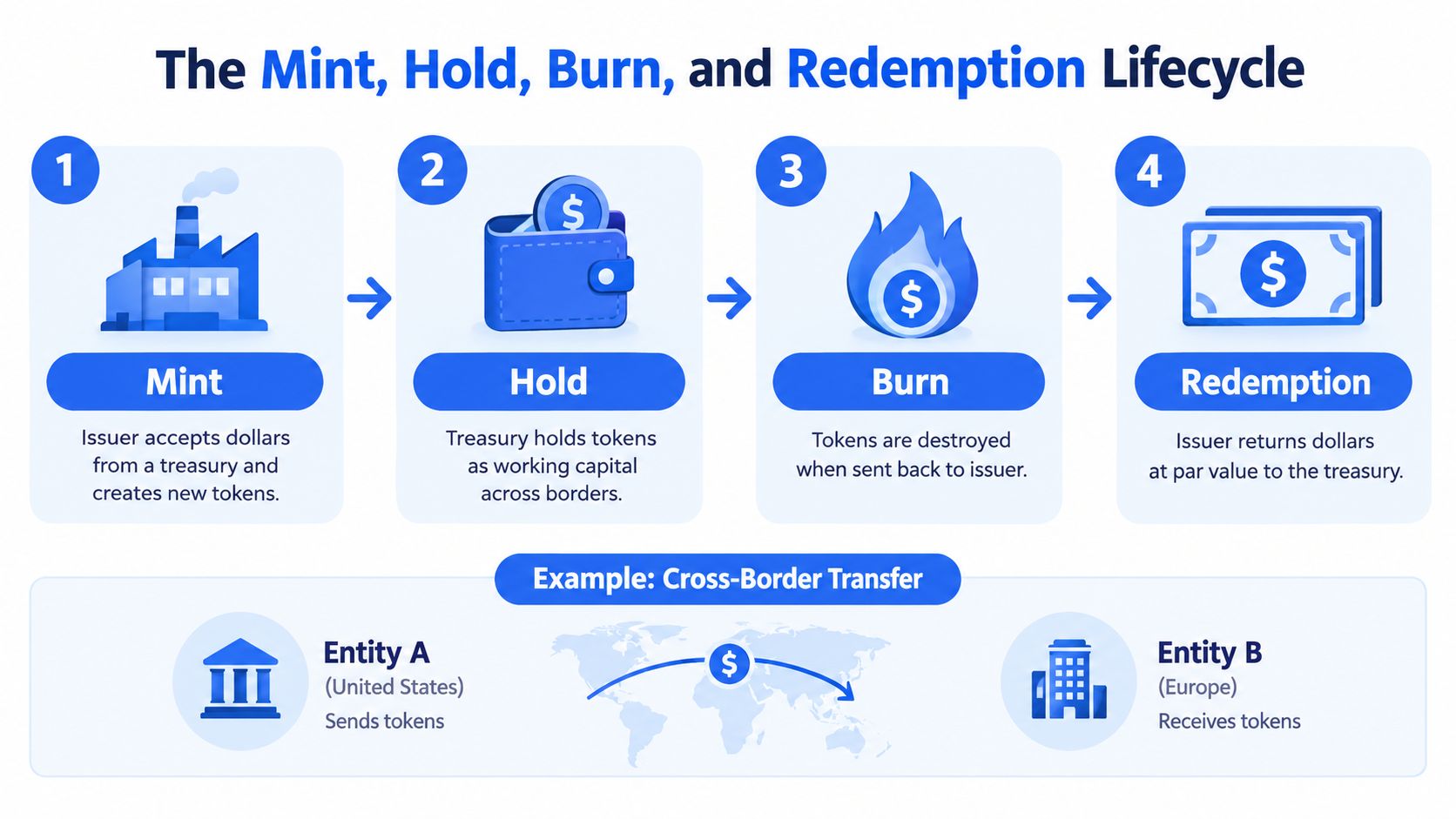
A cross-border treasury flow shows why stablecoin operations must be recorded as business events, not treated as a series of unrelated blockchain transactions. A treasury team first sends fiat to an issuer through an approved channel. After the issuer confirms receipt and eligibility, it creates tokens and sends them to the designated wallet.
Record every state change
The operating ledger should make each transition visible and recoverable:
- Mint requested: Record the requesting entity, destination wallet, amount, approval, and idempotency key.
- Reserve received: Capture confirmation that fiat arrived through the issuer's banking channel.
- Token issued: Record the mint and link it to the reserve receipt.
- Transfer confirmed: Track the transfer to the treasury's receiving wallet, including confirmations and policy outcomes.
- Redemption requested: Store the requester, destination bank details, eligibility checks, and requested amount.
- Burn executed: Reconcile the token burn against the approved redemption.
- Settlement initiated: Track the issuer's instruction to return fiat through its banking partner.
- Fiat credited: Record the bank-side completion and reconcile the credit to the original request.
A successful chain transaction doesn't prove that the fiat obligation is complete. The ledger must distinguish a confirmed token transfer from an initiated bank payment and a final credit.
When several internal services retry the same request, idempotency prevents duplicate execution. Scoped API keys restrict each service to the actions it needs, while an append-only record lets finance and compliance teams trace the event history without relying on mutable status fields. Keep the identifiers and state transitions linked, so a team can investigate a delayed redemption without reconstructing the flow from separate systems.
What Actually Sits Behind the Token
A fiat-backed stablecoin is a liquidity and reconciliation problem before it is a token. Treasury and compliance teams need to know what backs outstanding supply, how quickly those assets can become settlement-ready fiat, and whether each reserve movement can be traced in an append-only record.
“Fiat-backed” does not mean every token is matched only by cash in a bank account. Reserve portfolios can include short-term government securities, repurchase agreements, money-market funds, secured loans, bank deposits, and other assets. They differ in liquidity, counterparty exposure, and the time needed to convert them into fiat.
Federal Reserve snapshots show distinct reserve profiles. As of June 30, 2025, Tether's reported USDT reserves included 64.15% U.S. Treasuries, 10.47% repurchase agreements, 5.89% secured loans, 13.91% money-market funds, 3.69% bank deposits, and 1.89% other assets. Circle's USDC reserves, reported as of August 23, 2025, consisted of 33.59% U.S. Treasuries, 50.79% repurchase agreements, 14.24% bank deposits, and 1.38% other assets (Federal Reserve reserve composition analysis).
Those percentages are a starting point, not a liquidity test. Ask which assets the issuer can monetize during a redemption surge, through which counterparties, and within the stated settlement window. Stated reserve value alone does not prove immediate access during market closures, bank disruption, or settlement delays.
Treat reserve disclosures as stress-test inputs
The March 2023 USDC episode shows why access matters. Circle disclosed that roughly 8% of USDC reserves were held at Silicon Valley Bank, which entered FDIC receivership on March 10. The disruption exposed the gap between an asset's reported value and the issuer's immediate access to it. The Federal Reserve reported that USDC's market capitalization fell by approximately $10 billion while USDT's rose by about $9 billion during March 2023, as holders shifted between issuers (FDIC account of the Silicon Valley Bank receivership).
Build reserve oversight around event records, not static snapshots. Treasury and compliance should be able to reconcile reserve disclosures, banking exposures, and redemption activity against an append-only ledger, with dated events and accountable approvals. Request reserve maturity and liquidity details, banking concentration, encumbrance status, redemption cutoffs, and the documented process for handling a surge in requests. For a comparison with other reserve models, see BroLabel's guide to commodity-backed stablecoins. Investors handling digital assets can also consult crypto tax advice for investors.
Par Redemption as an Engineering Target
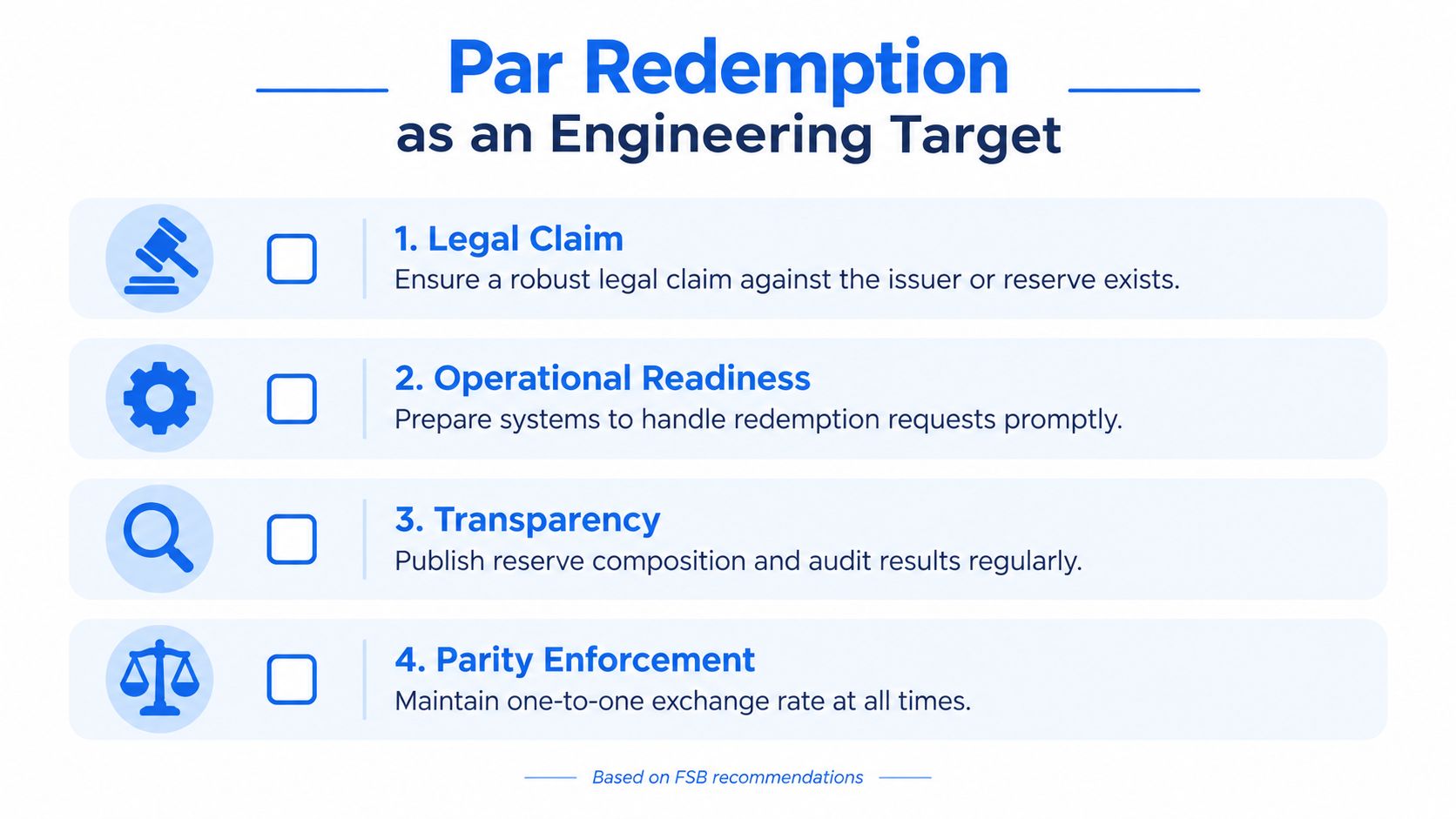
Par redemption is not an automatic property of a token. It's a commitment that needs a legal basis, operational capacity, and records that prove the issuer can meet its obligations. The Financial Stability Board recommends that a stablecoin referencing one fiat currency provide a solid legal claim against the issuer and/or reserve assets, guarantee timely redemption, and redeem at par into that currency (FSB recommendations for global stablecoin arrangements).
The operating team should turn that guidance into controls it can test:
- Legal claim: Confirm who holds the right to redeem and what claim applies to the issuer or reserves.
- Reserve coverage: Reconcile outstanding supply against eligible reserves continuously. The FSB's broader recommendations call for reserves at least equal to outstanding coins at all times, unless equivalent prudential safeguards apply (FSB recommendations on stablecoin arrangements).
- Segregation: Where possible, structure reserves so they're legally segregated and protected from the issuer's general estate.
- Redemption terms: Document eligibility, minimums, fees, cutoffs, settlement windows, and exceptions in language the customer and operations team can apply.
- Auditability: Maintain immutable records linking issuance and redemption events to reserve movements, bank settlement, and reconciliation outcomes.
A redemption promise needs to work within the actual hours and constraints of its banking, custody, and settlement arrangements. A reserve that can't be accessed in the promised window isn't operationally equivalent to immediately available cash.
Practical rule: Make each redemption traceable from the customer request through the token burn, reserve movement, bank settlement, and final reconciliation.
Finance, risk, and audit should be able to replay that chain from the system of record. Par redemption is an engineered operating property, not an inherited feature of the asset class.
Where Fiat-Backed Stablecoins Replace Bank Rails
The strongest operating case for stablecoins isn't that every consumer will pay with them. It's that a business can move dollar-denominated value between entities or across borders where existing banking routes introduce delays or operational friction.
Consider a company paying a supplier in another market. Treasury funds an approved wallet, applies a policy to the payout, and sends the stablecoin to the supplier's receiving wallet. The supplier then needs a dependable local off-ramp. The company's advantage depends on the whole path: who authorized the transfer, which compliance checks applied, which banking partner receives the off-ramp request, and whether the ledger records both token delivery and fiat completion.

The same logic applies to treasury rebalancing between operating entities and to remittance corridors where correspondent banking is slow. In each case, a stablecoin acts as a payment instrument paired with access to liquidity. The token itself doesn't solve the recipient's conversion, compliance, or bank-settlement needs.
That's why product teams should design the on- and off-ramps before promising a faster payment experience. Embedded wallets, bank or card funding, and fiat withdrawals can help connect the token flow to a user's actual financial needs, but each integration needs clear ownership of screening, approvals, and reconciliation. For a corridor-specific view of these mechanics, see BroLabel's guide to stablecoins in cross-border payments.
Use stablecoins where the route has a defined payer, recipient, permitted purpose, and workable off-ramp. Don't mistake successful on-chain delivery for completed payment if the beneficiary still can't access usable fiat.
Cutting Through Volume Hype With Better Questions
Stablecoin volume is a liquidity and reconciliation question before it is a token-adoption question. McKinsey estimates stablecoin payment flows at about $390 billion in 2025, more than double the prior year, with Asia accounting for approximately $245 billion, or 60% of the total (McKinsey analysis of stablecoin payment flows). Those figures matter only when teams can distinguish payment flows from other on-chain activity and reconcile each transfer to an economic purpose.
Visa reports that retail-sized transaction volume for USDC, USDT, and PYUSD reached $69.8 billion in 2025, while stablecoins represented about 0.1% of U.S. cashless payments (Visa's stablecoin transaction volume dashboard). The gap is a warning against treating headline volume as proof of broad checkout adoption. Treasury and compliance teams should judge a product by the flows it can verify, the fiat liquidity available at each end, and the records it can defend in an audit.
Segment flows before choosing a product bet
For each proposed use case, examine:
- Purpose: Is the flow a supplier payment, treasury transfer, remittance, or exchange-related movement?
- Geography: Where are the sender, recipient, and fiat off-ramp?
- Transfer size: Does the flow fit the intended payment context?
- Repeat behavior: Do the same counterparties make recurring economic payments?
- Off-ramp access: Can the recipient reliably convert the balance into needed fiat?
Record each lifecycle event in an append-only ledger, then use event-driven workflows to reconcile token movement with payment purpose and settlement status. That gives teams evidence to assess flows, not just a volume chart.
Start with cross-border and treasury flows that have clear counterparties, particularly where banking access is a material constraint. Don't assume ordinary domestic checkout will lead adoption everywhere. Build for the flow you can verify, not the volume you can quote.
Risks and Controls Before Anything Goes Live
A treasury team should price risk by asking what fails first, who detects it, and how the system responds. Depeg risk calls for reserve-liquidity monitoring and concentration limits, not a dashboard that shows only total reserve value. Banking-rail risk calls for settlement monitoring and alternative banking arrangements, so a cutoff or partner outage doesn't remain invisible until customers report missing funds.
Custody and reserve-access risk require clear segregation arrangements, current reserve information, and a defined escalation path when assets or accounts become inaccessible. Jurisdictional restrictions call for diversified off-ramps and documented rules for who may transact and where. Operational risk needs controls in the transaction path itself: append-only ledger records, idempotent APIs, real-time WebSocket alerts, scoped API keys, and policy checks before signing.
The BIS notes that secondary-market stablecoins studied hadn't maintained parity at all times, and that liquidity, not nominal reserve value alone, determines whether a run can be met (BIS analysis of stablecoin stability and regulatory responses). That changes what a team should watch during off-hours: available and encumbered reserves, pending redemptions, settlement status, banking-partner exposure, and the time needed to convert assets into fiat. A ledger must distinguish a token burn from reserve movement and completed bank settlement.
| Risk | Control to Enforce |
|---|---|
| Depeg during rapid redemptions | Monitor reserve liquidity, concentration, and redemption demand. |
| Bank cutoff or delayed settlement | Track banking windows, settlement states, and contingency arrangements. |
| Custody freeze | Verify reserve access, segregation, and escalation procedures. |
| Jurisdictional block | Maintain eligible off-ramp options and enforce location-based policy. |
| Duplicate or unauthorized transaction | Use idempotency, scoped keys, approval policies, and signing controls. |
Threat models need regular review as dependencies and operating assumptions change. For a practical approach to keeping threat models current, DevArmor's threat-modeling process is a relevant resource. These controls aren't add-ons to an institutional product. They are the product surface that determines whether its peg can be defended in operations and audit.
The Operating Model That Holds the Peg
The defensible operating model has one source of truth for money movement and one observable event stream for teams that need to act. An append-only operating ledger records issuance, redemption, reserve movement, and bank settlement. Real-time events feed treasury, risk, and compliance workflows, while reconciliation connects those events to independent reserve and banking records.
Access controls must govern the action, not merely the account. Scoped API keys limit which systems can initiate a mint, burn, or payout. Policy checks run before signing, and idempotency protects against duplicate execution when a service retries. Client-controlled signing and Co-Signer approval can separate transaction preparation from authorization; MPC can help distribute signing control without turning the operating process into an opaque handoff.
For teams assessing infrastructure, BroLabel provides embedded wallets, BROsettlement with client-controlled Co-Signer signing, an operating ledger, and WebSocket events, alongside BROwallet for wallet and fiat flows, BROcard for card-linked use cases, and AI Agent Wallets for per-agent transaction flows. Treat these as components to evaluate against your own signing, compliance, and reconciliation requirements, not as substitutes for the issuer's reserve and redemption obligations.
Before launch, take this checklist to treasury, product, operations, and compliance:
- Redemption: Can your eligible users redeem at par under explicit, usable terms?
- Liquidity: Can the issuer show how reserves become settlement-ready fiat during stress?
- Reconciliation: Can your team match supply, reserve records, token events, and bank settlement?
- Authorization: Are signing policies, Co-Signer roles, and API scopes defined and tested?
- Observability: Do events identify delayed, rejected, partial, and completed states clearly?
| Operational Risk | Required Control | Supporting Module |
|---|---|---|
| Unmatched token and fiat records | Append-only ledger and reconciliation | Operating ledger |
| Unauthorized signing | Client-controlled approval and policy checks | Co-Signer and MPC |
| Missed or delayed status updates | Real-time event monitoring | WebSocket events |
| Duplicate execution on retry | Idempotency and scoped API access | API layer |
| Fragmented payment and off-ramp flow | Linked wallet, card, and fiat operations | BROwallet and BROcard |
Calm infrastructure, not slogans, holds the peg.
BroLabel provides embedded wallets, MPC signing, an append-only operating ledger, real-time WebSocket events, and fiat and card integrations for teams building controlled stablecoin operations. If you're evaluating how to connect transaction policy, reconciliation, and payment flows, visit BroLabel to review the infrastructure against your launch requirements.
Frequently Asked Questions
What makes a fiat-backed stablecoin hold its peg?
The peg depends on reserve quality and access, a credible legal claim, and workable redemption at par. A token's market price can still move away from its reference value when holders doubt that redemption will be timely or reliable.
Does “fully backed” mean the reserves are all cash?
No. Reserve portfolios may include bank deposits, U.S. Treasury securities, repurchase agreements, money-market funds, secured loans, and other assets. Teams should assess liquidity, custody, encumbrance, and settlement timing, not just the reported reserve total.
What should treasury teams verify before choosing a stablecoin?
Confirm who can redeem, the legal basis for the claim, applicable fees and cutoffs, settlement timing, reserve composition, banking dependencies, and available audit records. Also test how the provider reports pending requests, exceptions, and final fiat settlement.
What's the difference between a token transfer and a completed redemption?
A token transfer records movement on a blockchain. Redemption also requires the issuer to process the request, burn the tokens where applicable, move or liquidate reserves, send fiat through banking channels, and confirm the credit. The operating ledger should record those states separately.
Do stablecoin transaction volumes prove broad payment adoption?
No. Transaction activity needs to be segmented by purpose, geography, transfer size, repeat behavior, and fiat off-ramp availability. High volumes can coexist with limited use for ordinary retail payments.