A digital security is a financial instrument that already meets the legal definition of a security and is formatted as, or represented by, a crypto asset whose ownership record is kept on or through one or more crypto networks.
The popular advice to start by choosing a blockchain gets the sequence wrong. Start by identifying what the holder owns, who may hold it, which register controls ownership, and what evidence permits operations to release value. The enemy is treating a token balance as a complete ownership and settlement record.
A useful digital securities definition must survive a failed transfer, an ineligible recipient, a missing cash payment, and an auditor's request for evidence. That's the operating standard for product, treasury, engineering, and compliance teams.
Table of Contents
- What Counts as a Digital Security
- How Tokenization Records a Claim
- Which Rules Still Apply in 2026
- Custody and Transfer Without a Single Key
- Institutional Uses That Survive Transfer Limits
- Controls Before Value Is Treated as Settled
- Buyer Questions and Next Step
What Counts as a Digital Security
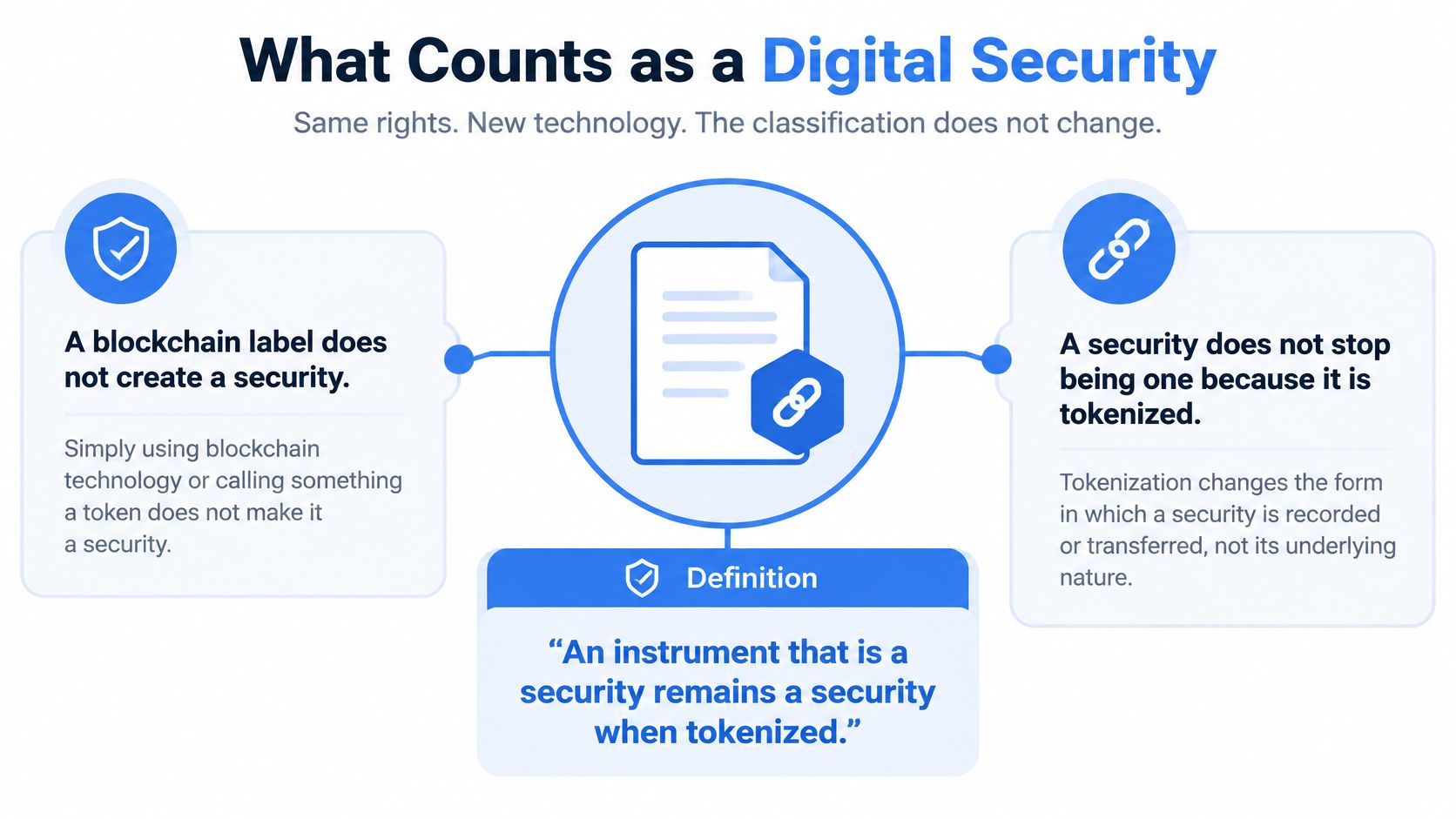
A blockchain label does not create a security, and a security does not stop being one because it is tokenized. The SEC's explanation of crypto assets and federal securities laws connects the underlying financial instrument with its digital representation, including tokenized stocks, bonds, and fund interests.
A digital security is an instrument that already meets the legal definition of a security, represented as a crypto asset, with ownership records maintained on or through crypto networks.
The legal claim comes first. A wallet interface may display an asset name and balance without explaining whether its owner holds equity, a custody entitlement, or merely a contractual claim against another party. Those distinctions determine whom the investor can enforce rights against.
Four structures behind a digital security
| Structure | What the token is | Authoritative rights | What does not change |
|---|---|---|---|
| Native security on DLT | The security is issued on the ledger | Instrument documents and applicable securities law | Registration, exemption, disclosure, and transfer limits |
| Digital twin | A representation of an existing security | Off-chain security plus governing documents | The underlying security's legal character |
| Receipt or entitlement | Evidence of a claim on a held security | Custody and entitlement terms | Insolvency and intermediary risk |
| Contractual exposure only | A contractual right, not the security itself | The contract, which may omit votes or economics | It may not confer holder rights in the underlying |
A native holder owns the issued instrument under its governing terms. A digital-twin holder needs a documented connection between the token and the existing security. A receipt holder has the entitlement described by the custody arrangement, while a contractual-exposure holder owns the contractual promise, not necessarily the referenced asset.
The Investor.gov guide to tokenized securities warns that token-holder rights can differ materially from underlying-security rights, including economic and voting rights. Don't infer dividend rights, redemption rights, or voting power from the token's name.
Classify before building
The practical lesson is to record the classification rationale, registration or exemption status, and holder rights before building wallet, transfer, or treasury workflows. Have counsel identify the controlling documents and compliance approve the operational interpretation.
Our wallet infrastructure doesn't make BroLabel the issuer, the customer's legal advisor, or the party responsible for end-user balances, certificate rights, or regulatory decisions. Unless a signed contract states otherwise, customers remain responsible for their products, issuer programs, end-user relationships, instructions, authorization rules, and applicable legal requirements.
How Tokenization Records a Claim
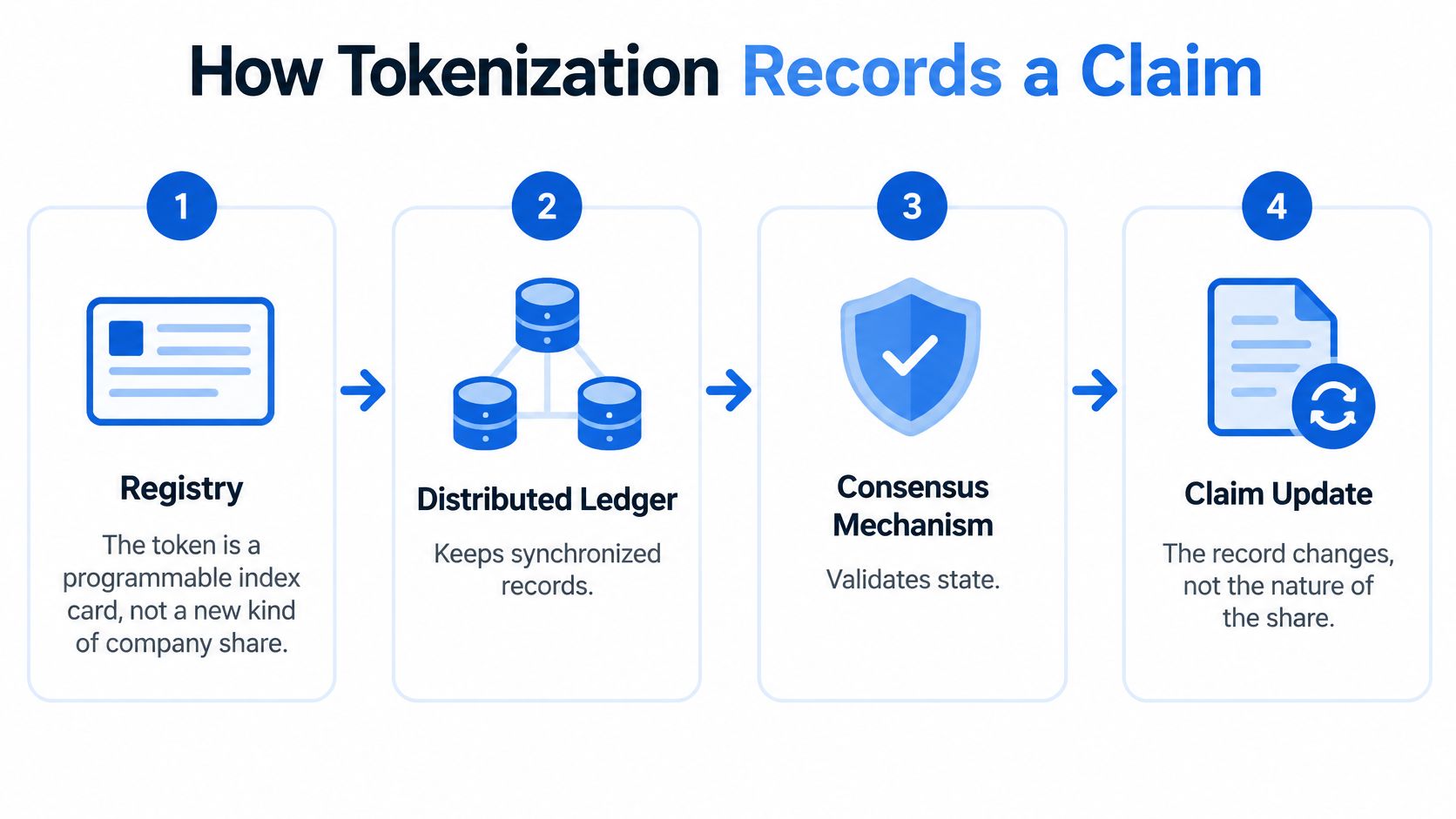
Think of a token as a programmable index card in a registry, not a new kind of company share. It can identify a claim, reference its terms, and carry instructions about permitted movements. The claim still needs an issuer, governing documents, and an authoritative ownership record.
Distributed-ledger infrastructure keeps synchronized transaction records, while a consensus mechanism validates changes to the shared state. The ESMA definitions of distributed-ledger technology provide the technical vocabulary for distinguishing the ledger, its nodes, and the mechanism used to agree on transactions.
Choose what the ledger represents
With a digital twin, engineering links the token to a traditionally issued security. The integration must explain how an accepted token transfer changes, or requests a change to, the existing register. Without that connection, the application may show a completed movement that the issuer hasn't recognized.
With native issuance, the instrument is issued on DLT, but the product specification must still identify which records and documents establish legally enforceable ownership. Native issuance doesn't mean every blockchain event automatically has the intended legal effect.
For teams translating conventional equity issuance into a digital workflow, Lighthouse Consultants' guide to how UK companies issue shares is useful context. Define the corporate issuance process before deciding which parts the token will represent.
A token design can carry operational controls:
- Allowlists restrict transfers to approved addresses.
- Jurisdiction rules limit permitted recipients according to the instrument's distribution policy.
- Holding periods prevent transfers before a permitted release point.
- Corporate-action logic supports distributions or other lifecycle instructions.
These controls work only if somebody maintains their inputs. An approved address can become stale when eligibility changes, a mandate expires, or an investor replaces a wallet.
Build the holder mapping
Maintain an auditable relationship in this order: wallet address → verified investor identity → eligibility status → token balance → legally operative ownership register. Use an internal investor reference in the operational mapping rather than placing identity documents on a public ledger.
Say a bond changes wallets near an interest-payment record date. The chain shows the transfer, but the governing documents identify the trustee's record as controlling entitlement to that payment. Operations should apply that record, preserve the discrepancy, and resolve it through an approved correction process rather than paying whichever address currently holds the token.
Design rule: Ledger finality is not legal finality.
Write the precedence rule into the product specification. When the wallet balance and issuer records disagree, the team must know which register wins, who investigates, and which actions remain blocked until resolution.
Which Rules Still Apply in 2026
Rules that still govern a tokenized security
| Framework | What it covers | Operating consequence | What it does not do |
|---|---|---|---|
| US federal securities law | Instruments that meet the security definition | Register or use an exemption; analyze each asset | Format does not remove securities law |
| Digital asset versus digital asset security | Ledger-issued assets versus those that are securities | Keep separate product, custody, and compliance workflows | A digital asset is not automatically a security |
| EU MiCA from December 2024 | Crypto-asset markets outside existing securities law | Don't use MiCA as the rulebook for tokenized securities | It does not replace banking or securities legislation |
| EU DLT Pilot Regime | Tokenized shares, bonds, and UCITS in a test setting | Expect targeted MiFID II and CSDR exemptions | It does not drop investor protection or market integrity |
Start with the instrument, then identify the offer, sale, intermediary, and jurisdiction involved. For a US security, the offering workflow needs a registration route or an applicable exemption. A platform-wide label such as digital assets isn't a substitute for asset-by-asset analysis.
In the EU, MiCA became fully applicable in December 2024, but tokenized securities remain governed by existing banking and securities legislation; the BIS survey report also describes the DLT Pilot Regime's controlled testing framework and targeted exemptions. Participation in that framework isn't permission to discard investor protection or market-integrity controls.
Turn legal analysis into asset configuration
Compliance should file the classification, offering status, and transfer restrictions beside the asset record, not in a memo disconnected from production. Product and engineering need executable decisions: who may subscribe, who may receive transfers, what evidence expires, and which changes require renewed approval.
Keep classification status separate from investor eligibility. An instrument can be correctly classified while a particular recipient remains unauthorized to receive it. Likewise, an approved investor doesn't establish that every offering available through the application is suitable for distribution to that investor.
Use the compliance management process to assign owners, approval evidence, and review triggers. A change to redemption terms, distribution geography, or intermediary arrangements should enter a controlled review queue rather than arrive as an undocumented configuration edit.
Tax treatment needs its own workstream. For introductory context, Allied Tax Advisors explains capital gains, but that resource doesn't establish an instrument's securities classification or replace current, jurisdiction-specific tax advice.
Before launch, assign responsibility for:
- Legal interpretation: Approving the instrument structure and distribution route.
- Configuration: Translating approved restrictions into product controls.
- Change management: Preventing unreviewed rights or eligibility changes.
- Custody responsibilities: Recording which party controls each operational component.
Our asset custody model and each party's responsibilities depend on service configuration and contractual terms. Any regulated service or asset custody role must be separately defined in a signed contract and supported by appropriate permits. A technical integration alone doesn't establish that regulated role.
Custody and Transfer Without a Single Key
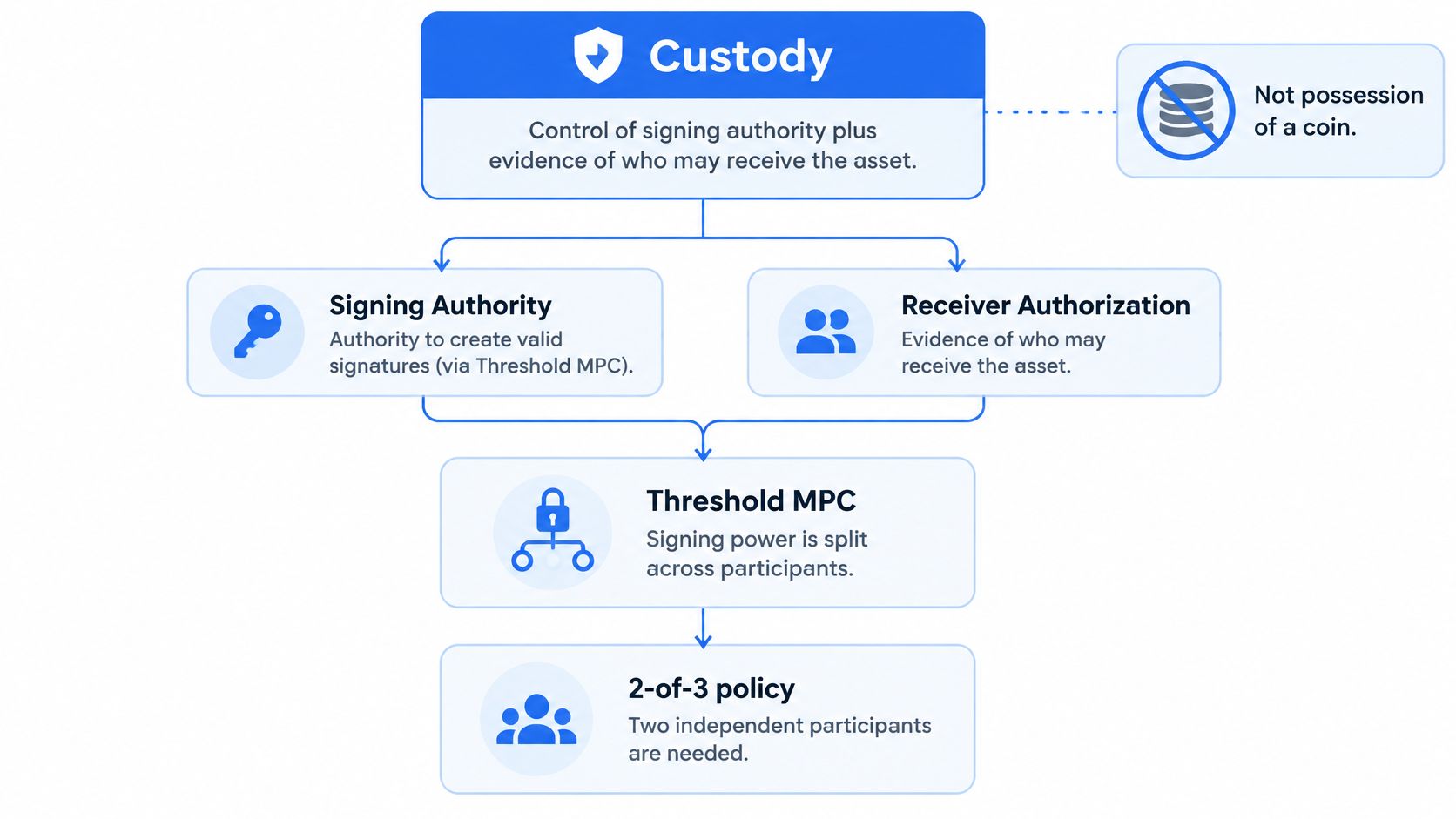
Custody design starts with control of signing authority plus evidence of who may receive the asset, not possession of a coin. Split the ability to authorize a transaction from the application's ability to request one. Otherwise, a compromised application can turn a valid API request into an unauthorized asset movement.
NIST's discussion of MPC key management describes distributing cryptographic operations across participating components; a 2-of-3 policy, for example, requires two participants to authorize signing. In ordinary operation, no single component needs to hold the complete private key.
Separate orchestration from authorization
Place the customer-controlled Co-Signer between the application's transaction orchestration and final signing authorization. Its policy should evaluate the recipient, asset, amount, business purpose, and approval evidence. Signing participants that share the same unrestricted administrator don't provide meaningful operational independence.
When customers manage a Co-Signer or control signing or recovery materials, they're responsible for protecting and operating those components. That includes access control, backups, and approval rules. Recovery must preserve authorization discipline rather than become a bypass available to an operator under pressure.
Apply request-level controls before signing:
- Scoped API keys: Limit the operations each application or service account may request.
- Destination and amount limits: Constrain permitted movements before human approval.
- Replay protection: Reject reused authorization material.
- Approval logs: Preserve who approved which exact transaction payload.
Our digital asset custody guide provides context for assigning these responsibilities. Also account for regulated intermediary obligations: the SEC's broker-dealer custody statement discusses Rule 15c3-3, including the general requirement to hold fully paid and excess-margin securities free of liens at a good-control location.
Separate the asset, payment, and register movements
A securities transaction can involve a token transfer, a cash movement, and a legal-register update. Treat them as distinct actions with explicit dependencies. Successful signing proves authorization of a particular transaction, not completion of the entire business obligation.
The BIS explanation of securities settlement identifies delivery-versus-payment as the condition that securities move if and only if the corresponding payment occurs. Without that linkage, a counterparty can deliver irrevocably without receiving payment, creating principal risk.
Where the cash and security use different systems, document the coordination mechanism and failure handling. Don't call a sequential process atomic because both instructions originate in the same application. A created or broadcast transaction is not a completed transfer.
Institutional Uses That Survive Transfer Limits
Transferability is not liquidity. In Broadridge's 2025 survey, 63% of custodians already offered tokenized-asset services and another 30% planned to enter within two years, while only 15% of asset managers had launched tokenized offerings. Custody readiness and investment-product availability are different measures.
Investor interest is another distinct measure: EY-Parthenon's 2024 survey found that 50% of 277 institutional investors were interested in tokenized assets such as funds and securities. Interest doesn't establish executable bids, reliable prices, or permission to transfer.
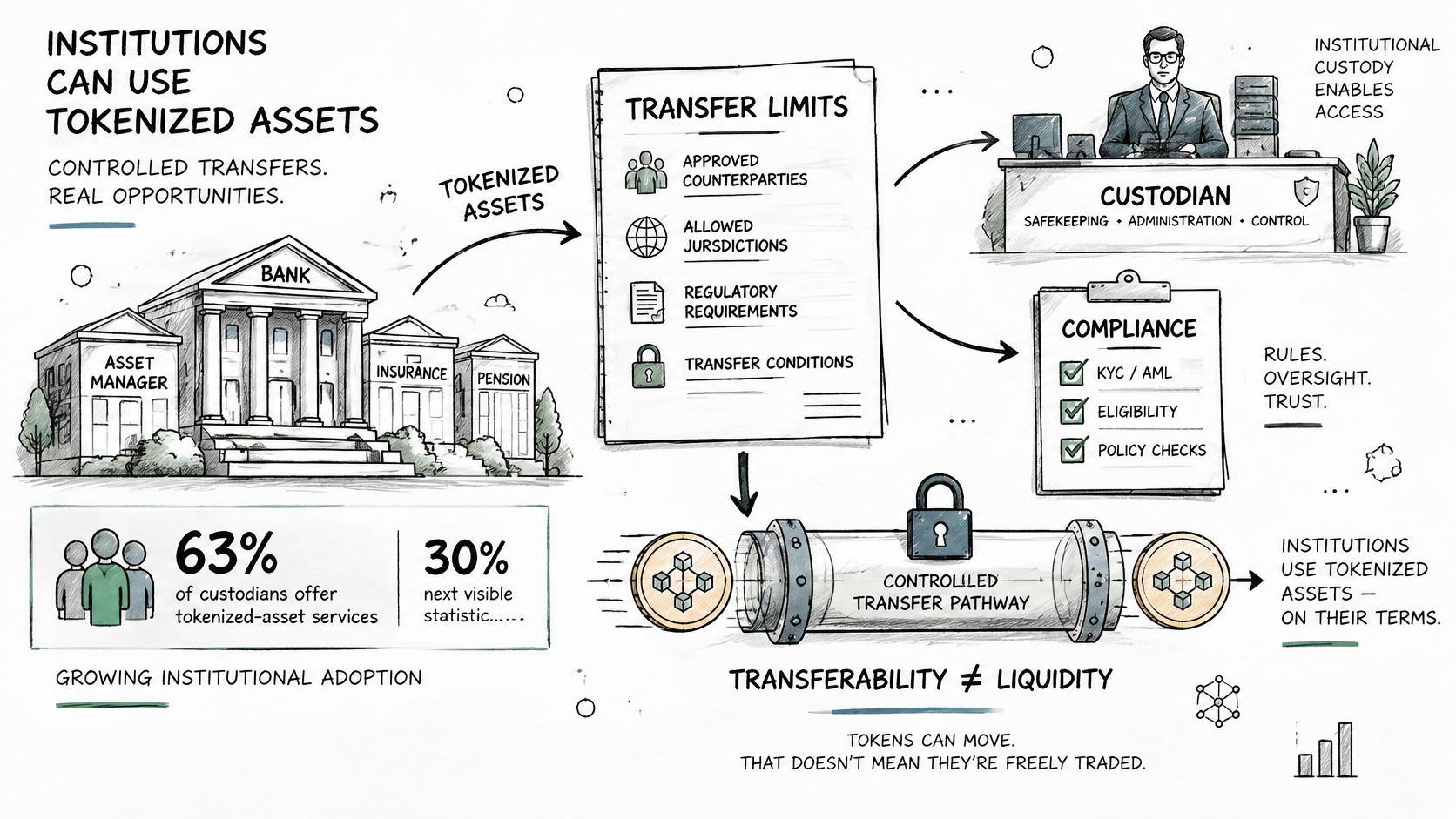
Controlled workflows and their binding constraints
| Workflow | What must be true | Binding constraint |
|---|---|---|
| Tokenized fund subscription | Eligibility checked before minting | Investor eligibility and identity checks |
| Treasury collateral transfer | Moves only to an allowlisted venue | Venue interoperability and transfer restrictions |
| Controlled bond allocation | Corporate actions stay with the issuer record | Issuer register authority and pricing |
Funds, treasury movements, and collateral are useful starting points because operators can define counterparties, approval windows, and exception owners. Programmability and clearer records can improve these workflows without requiring unrestricted retail trading.
A secondary buyer still needs an eligible seller, an acceptable price, a permitted venue, and a functioning payment route. When restrictions or selling practices lead to a dispute, Kons Law's discussion of recovery options for restricted securities losses offers context, not a guarantee of recovery.
Describe the product's liquidity assumption as restricted, scheduled, or continuous. Don't promise continuous execution merely because the chain remains available.
Build the interface around that assumption. Show redemption windows, transfer-review status, and pricing conditions instead of a sell button that implies an immediately available buyer.
Controls Before Value Is Treated as Settled
Model settlement as a state machine: trade, funding, authorization, broadcast, confirmation, finality, exception, and reconciliation. Each transition needs evidence and an owner. Release value only when the required asset and payment conditions are satisfied.
When a digital security movement is not settled
| State | Evidence you have | Release value | Required control |
|---|---|---|---|
| Observed | Deposit or transfer event seen | No | Record the event once with a stable identifier |
| Submitted | Transaction broadcast | No | Idempotent retry; don't create a second movement |
| Confirmed | Network confirmation received | No | Compare confirmation with payment and eligibility |
| Final | Asset and cash conditions both met | Yes, under policy | Verify signing authorization and release only after both legs and policy pass |
| Exception or reversed | Failure, rejection, or legal reversal | No | Keep the exception visible for finance and compliance |
Co-signing occurs before the relevant network submission. Its policy should enforce the approved settlement arrangement, while the final-state gate checks that the required outcomes occurred. Don't attempt to establish delivery-versus-payment retrospectively with a successful signature.
The BIS discussion of tokenization and settlement records distinguishes operational transfer from legal final settlement. Maintain an append-only ledger of requested, authorized, submitted, confirmed, reversed, and reconciled states, rather than replacing history with the latest wallet balance.
Make retries safe and exceptions visible
WebSocket events for deposits, confirmations, withdrawals, and policy outcomes need stable identifiers. An idempotency key should bind retries to the original business instruction so a duplicate event doesn't create a duplicate credit, debit, or withdrawal. Reconciliation then compares internal entries with network evidence, payment records, and policy decisions.
Use scoped API keys to limit who can request movements, and protect credentials and customer-controlled signing materials. Report suspected compromise promptly. AI Agents should receive constrained permissions and explicit approval boundaries, not unrestricted authority because their requests are automated.
Public blockchains, validators, issuers, and independent providers can delay, reject, reorder, or change a transaction's visible status. Our service restrictions don't deactivate public-chain addresses or unwind blockchain transactions. Customers must reflect those limitations in confirmation rules and end-user servicing.
Risk, fraud, and sanctions checks run only when configured for the specific service and agreed with the customer. They aren't automatic across every service. Customers remain responsible for addresses, networks, assets, amounts, recipient data, instructions, and their own compliance decisions because blockchain transfers may be irreversible.
For implementation review, use our resource set covering signing and the Co-Signer, the operating ledger and reconciliation, and WebSocket deposit and policy events. Evaluate them together against the state table, not as independent feature checklists.
Buyer Questions and Next Step
Who owns the classification file?
Assign compliance ownership of instrument classification, offering status, and holder-rights evidence. Product owns the mapping between wallet, verified identity, eligibility, balance, and legal register, with engineering responsible for implementing the approved rules.
What evidence should we prepare for an auditor?
Prepare the classification rationale, holder mapping, and an export of the append-only operating history. Include approval and co-signing logs tied to transaction identifiers and idempotency keys so reviewers can reconstruct an instruction without relying on screenshots.
Is infrastructure a substitute for counsel?
No. BroLabel's technical role doesn't replace the customer's issuer responsibilities or legal advice, and customer-controlled signing components still require customer-operated access controls, backups, and approval rules.
What should a buyer validate before connecting wallets?
Draft one checklist covering instrument structure, holder rights, eligibility rules, register authority, and settlement states, then obtain compliance approval. The guide to how to invest in tokenization offers broader context for evaluating the investment proposition separately from the operating infrastructure.
For the operating layer, BroSettlement provides API-oriented wallet infrastructure with DKG, MPC signing, network submission, a customer-controlled Co-Signer, and embedded MPC wallets across 10 networks. Standard access starts by registering and activating a tariff in the app, without a separate master services agreement for the standard self-service plan.
BroWallet, card products, and per-agent AI Agent wallets remain subject to their own terms and availability; they aren't automatically included in that access. BroCard is in development, with availability dependent on issuers, partners, and markets.
BroLabel offers modular wallet, signing, ledger, and event infrastructure for teams that need to keep digital-security instructions and audit evidence aligned. Visit BroLabel with your instrument checklist and settlement-state model to evaluate the operating layer before connecting production wallets. Bro has your back!