The broadest API catalog isn't automatically the best fintech infrastructure choice. A long feature list can hide the operating problems that appear after launch: unclear custody boundaries, fragmented signing authority, reconciliation gaps, inconsistent event delivery, and integrations nobody fully owns.
The enemy is fragmented financial infrastructure. One vendor moves money, another creates wallets, a third issues cards, and your team becomes responsible for joining transactions, policies, balances, and audit records across systems that weren't designed to agree with one another.
The market has already moved beyond experimental middleware. One industry report estimates 137 billion global open banking API calls in 2025, with a projection of more than 722 billion by 2029, while open banking payment transaction value was estimated at $57 billion in 2023 and projected to reach $330 billion by 2027. Those projections and historical figures are documented by Ozone's analysis of global open finance interoperability.
For founders, CTOs, product leaders, operations, finance, and compliance teams, the useful question isn't “Which provider has the most endpoints?” It's “Which operating model can we run safely?” This comparison evaluates supported rails, wallet and card scope, API quality, onboarding, controls, events, ledgering, compliance, pricing visibility, and production responsibility.
The list starts with BroLabel, then separates payment platforms, card specialists, bank connectivity providers, stablecoin infrastructure, and institutional digital-asset controls. Use it alongside entity search parameters and errors, especially when vendor identity, legal entities, and procurement records need to match.
Table of Contents
- 1. BroLabel
- 2. Stripe
- 3. Adyen
- 4. Checkout.com
- 5. Marqeta
- 6. Lithic
- 7. Plaid
- 8. Moov
- 9. Circle
- 10. Fireblocks
- Top 10 Fintech API Providers Comparison
- Choose the Operating Model Before the API
1. BroLabel
BroLabel fits teams that need non-custodial crypto settlement and operational controls before transaction volume is stable. Its core infrastructure, BroSettlement, combines DKG and MPC 2-of-3 signing with a client-controlled Co-Signer, broadcast across more than 10 mainnets, an append-only operating ledger, and real-time WebSocket events.
Supported networks include BTC, ETH, SOL, BNB, TRX, POL, BASE, and ARB. The chain list matters less than how the pieces fit together. Wallet creation, signing policy, broadcast, ledger records, and event handling stay in one operating path, so finance teams can track deposits, confirmations, withdrawals, and policy outcomes without rebuilding state from disconnected provider responses.
Why the operating model matters
BroSettlement can sit beneath an existing product, while higher-level modules such as BroWallet, BroCard, and BroPay can support broader wallet, card, and fiat experiences as they become available. Teams can also create embedded wallets for users, agents, or players. For iGaming, the operating model supports per-player TRC20 and USDT flows, per-player deposit addresses, and deposit.observed and deposit.confirmed events before payout policy is applied.
Security is built around threshold signing, not a single centralized private key. In a 2-of-3 setup, two of three authorized parties produce a valid signature, and signing logs can record which participants or shares were involved, as described in audit-ready MPC wallet controls.
Developer controls include REST, OpenAPI and Swagger documentation, Ed25519 authentication, IP allowlisting, replay protection, sandbox access, and production API resources. AML screening, RBAC, audit trails, and reconciliation-oriented ledger records cover the operational layer that many wallet APIs leave to the customer.
Practical rule: Treat the Co-Signer, signing policy, ledger, and event stream as one control system. A wallet address without accountable approval and reconciliation logic is not a complete settlement architecture.
BroSettlement advertises no upfront payment for a trial month and flexible tiers intended for uncertain early-stage volume. Public pricing remains limited, so teams should expect direct commercial and legal discussions. BroWallet and BroCard are described as coming soon or planned, and card availability depends on issuer partnerships. Public social proof is also limited, although the company is registered in Estonia as SPACEBUS OÜ.
Best fit: Exchanges, PSPs, neobanks, stablecoin issuers, enterprise treasury teams, iGaming operators, and AI agent products that need modular non-custodial settlement infrastructure.
View BroLabel infrastructure documentation
2. Stripe
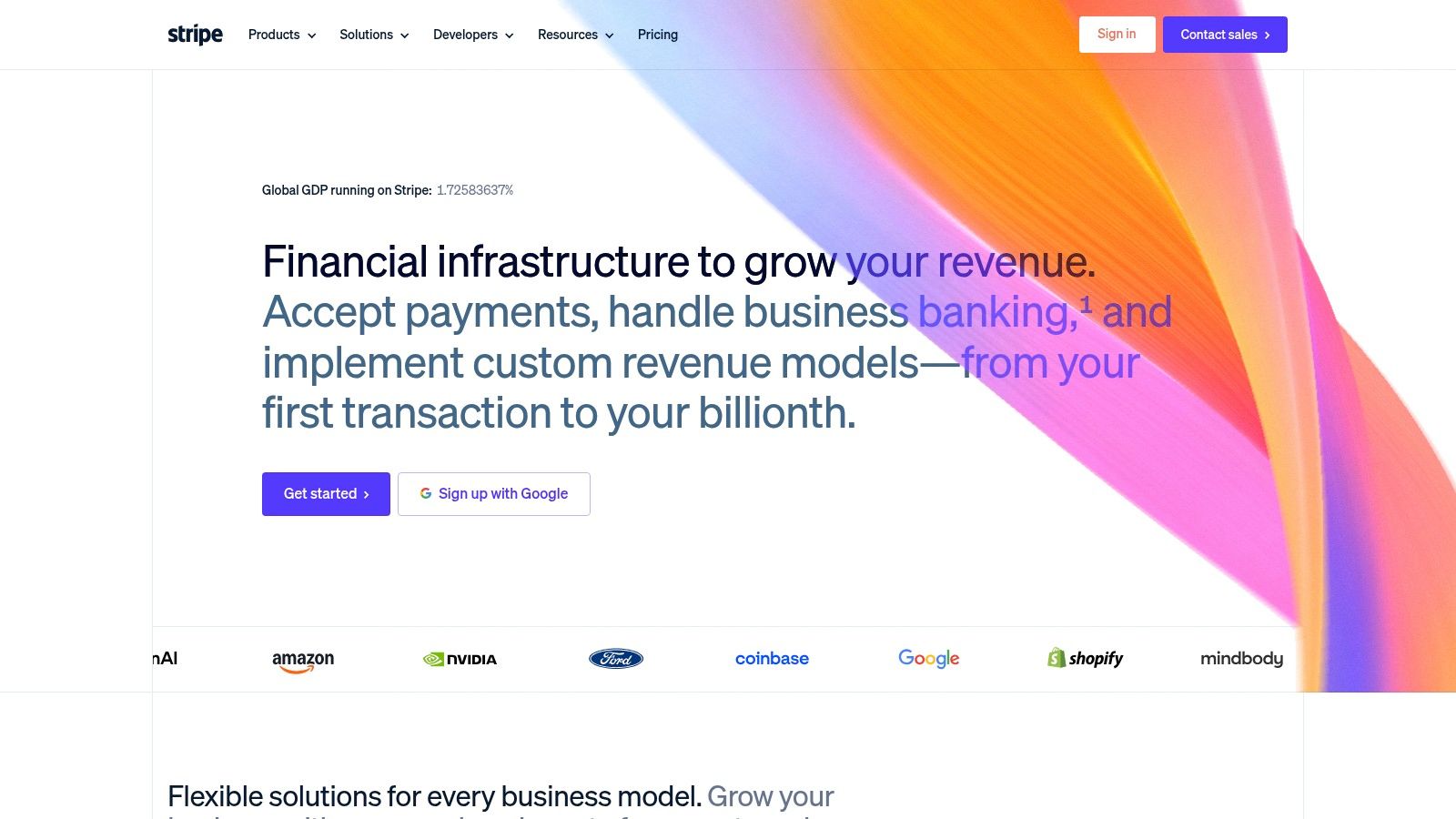
Stripe is the broadest general-purpose choice in this list for teams building payments, marketplace flows, payouts, cards, or embedded financial accounts under one developer-oriented platform. Payments and Connect support collection, connected accounts, multi-party payouts, and compliance workflows. Issuing supports virtual and physical cards, while Treasury supports embedded business accounts and money movement such as ACH, wires, and RTP.
A strong default for modular payment products
Stripe's main advantage is composability. A SaaS company can start with payment acceptance and subscriptions, then add Connect for marketplace payouts, Issuing for cards, or Treasury for embedded account functionality. Prebuilt onboarding interfaces and hosted components can reduce the amount of customer-facing financial UX a product team has to build.
That breadth doesn't mean Stripe replaces every operating layer. Teams still need to establish ownership for ledger design, reconciliation policy, internal risk decisions, and provider-specific operational exceptions. Some advanced Treasury for Platforms capabilities may require sales approval or have availability constraints, and pricing for more complex services can be difficult to assess without a commercial conversation.
For teams comparing payment architecture rather than only checkout APIs, BroLabel's guide to a payment gateway solution provides a useful adjacent decision point.
Best fit: Marketplaces, SaaS platforms, internet businesses, and scale-ups that value a unified developer experience across payments, payouts, cards, and embedded finance.
Stripe is strongest when payment breadth and launch velocity matter more than client-controlled crypto signing or a specialized digital-asset operating ledger.
3. Adyen
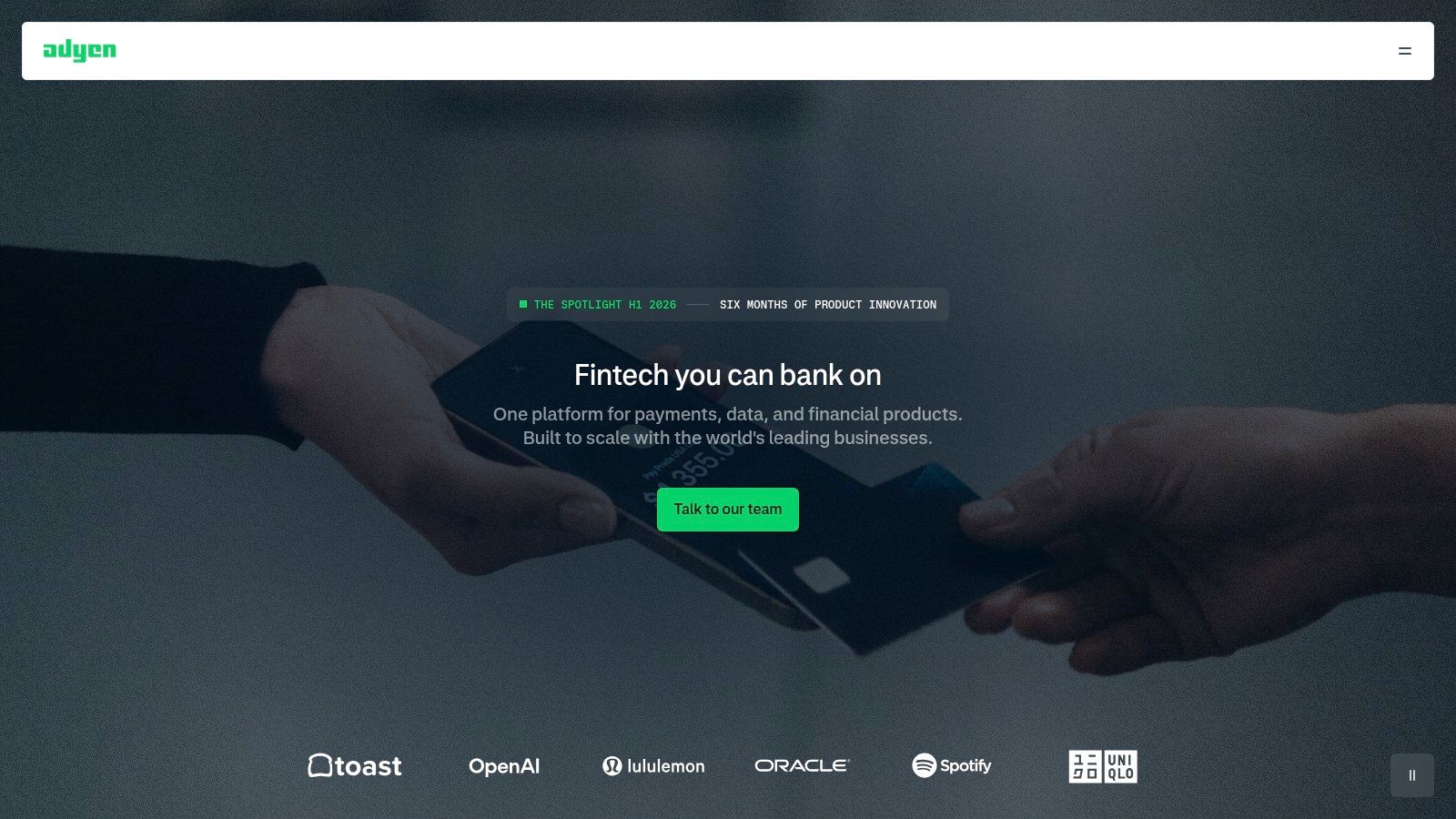
Adyen is built for enterprise payment operations that need acquiring, local payment methods, payouts, and card issuing within a coordinated platform. Its Balance Platform APIs cover account holders, balance accounts, and card issuance, while transaction and balance account APIs support programmatic management of funds and activity.
Enterprise control with heavier procurement
The platform is particularly relevant when acquiring and issuing must share a consistent operational and compliance model. Interchange++ pricing can improve cost visibility for acquiring discussions, although non-transactional products and platform features may still involve bespoke commercial terms.
Adyen's strength is less about being the easiest first integration and more about consolidating enterprise payment operations. Global merchants and platforms can evaluate payment methods, balance accounts, card programs, payouts, and transaction management in one provider relationship. That consolidation can reduce vendor sprawl, but it doesn't eliminate the need for an internal ledger, reconciliation process, or clear responsibility for exceptions.
Onboarding can be involved, especially where a platform has complex ownership structures, marketplace participants, or regulated flows. Issuing and some platform functions are oriented toward larger enterprises, so a smaller team should validate eligibility before treating the documented product scope as immediately available.
Best fit: Global merchants, marketplaces, and enterprise platforms that want acquiring and issuing from a single provider with substantial compliance tooling.
Primary trade-off: Adyen can reduce payment fragmentation, but procurement, onboarding, and bespoke pricing may require more planning than a startup expects.
4. Checkout.com
Checkout.com focuses on global acquiring, local payment methods, payouts, and payment analytics through a unified API. Its lifecycle model covers authorization, capture, refund, and void, which gives commerce teams a more explicit operational vocabulary than a simple “payment succeeded” response.
Useful for payment lifecycle ownership
The platform's sandbox, OpenAPI resources, and developer documentation support structured testing before production. Marketplace and platform products add payout schedule controls, which matter when a business needs to separate customer payment acceptance from seller or partner settlement.
Checkout.com can be a good fit when localized payment methods and international expansion are central to the roadmap. Its analytics and lifecycle tooling can also help operations teams investigate failed, refunded, or partially completed payment states. Those capabilities should still be mapped into the buyer's own ledger and reporting model rather than treated as a substitute for internal financial control.
Pricing is custom, so exact rates require a sales process. Some alternative payment methods operate in gateway-only mode and may require separate contracts. That creates a procurement question that feature pages alone won't answer: which services are covered by the primary relationship, and which depend on external method providers?
Best fit: Digital commerce companies, marketplaces, and international brands that need localized payment methods, pay-ins, payouts, and lifecycle analytics.
Primary trade-off: Strong payment breadth doesn't necessarily provide wallets, client-controlled signing, or a complete internal reconciliation model.
5. Marqeta
Marqeta is a specialized card issuing and processing platform for products that need real-time authorization decisions. Its Just-in-Time Funding model lets a platform approve, deny, and fund an authorization according to current business rules, while dynamic spend controls support more granular program behavior.
A decision engine for card programs
Marqeta also supports tokenization, digital wallets, and instant virtual issuance. These capabilities suit on-demand, gig, expense, and fintech card products where the issuer needs to control each authorization rather than rely on static card limits.
The platform's developer sandbox and Core API explorer help teams test card program behavior. The harder question is ownership. A card API can make an authorization decision, but the buyer still needs to define how balances, funding, reversals, disputes, compliance reviews, and reporting connect to the broader financial system.
Bank and BIN sponsorship can affect timelines and availability. Marqeta's commercial model is enterprise-oriented, and pricing depends on program complexity rather than a simple public schedule. That makes sponsor-bank alignment and implementation support procurement variables, not merely technical details.
For teams evaluating the card layer specifically, BroLabel's card issuing API offers a useful comparison with a broader wallet and settlement operating model.
Best fit: On-demand card programs, gig platforms, fintechs, and businesses that need granular, real-time control over card authorizations and funding.
Primary trade-off: Marqeta is a strong card specialist, but it isn't a complete banking, crypto custody, or cross-rail reconciliation platform.
6. Lithic
Lithic emphasizes developer-friendly card issuing and money movement for teams that want to launch pilots quickly. Its APIs support instant virtual and physical card creation, authorization rules, user and token controls, and real-time webhooks.
Good tooling for an early card program
The platform's documentation provides clear API basics and code examples, which can shorten the path from a product idea to a working card flow. Integrated fulfillment partners also help teams avoid building every physical-card operation themselves.
Lithic's real-time webhook model is important for card operations, but event delivery is only useful when the receiving system verifies, deduplicates, orders, and reconciles those events correctly. Buyers should test authorization reversals, declined transactions, card state changes, and delayed delivery behavior rather than stopping at a successful sandbox purchase.
Public pricing is limited, and most programs require a sales-led commercial process. Global coverage and advanced features may require enterprise arrangements, so a product team should confirm geographic eligibility, card availability, sponsor dependencies, and reporting scope before committing to a launch plan.
Best fit: Startups, product teams, and pilot programs that prioritize fast virtual issuance, flexible authorization logic, and approachable developer tooling.
Primary trade-off: Lithic can accelerate card experimentation, but teams with multi-rail treasury, crypto settlement, or complex institutional controls will likely need complementary infrastructure.
7. Plaid
Plaid is primarily a bank connectivity and payments-enablement provider. Auth supports account and routing verification for pay-by-bank flows, while Transfer supports ACH and RTP transfers with authorization, webhooks, and risk checks.
Connectivity is not the same as custody
That distinction matters during architecture review. Plaid's Auth product isn't a bank or payment processor, so a team using it for verification may still need a separate processor. Transfer provides a more complete money-movement path, but eligibility and premium features can depend on the commercial arrangement.
Plaid's Link interface and SDKs are designed for consumer account connection. A fintech app or neobank can use that layer to connect bank accounts, verify account details, and initiate supported transfers. The buyer still owns the downstream questions: how does the internal ledger represent pending and settled states, what happens when a bank connection changes, and who investigates a transfer that doesn't reconcile?
Plaid can also complement other providers rather than replace them. Its processor-agnostic position allows teams to pair account connectivity with services such as Stripe or Dwolla. That flexibility helps a modular architecture, but it also increases the number of vendor boundaries the operations team must monitor.
Best fit: Consumer fintech apps, neobanks, lenders, and products that need account linking, bank verification, ACH, or RTP enablement.
Primary trade-off: Plaid solves connectivity exceptionally well, but account connection alone doesn't provide wallets, card issuing, crypto signing, or a complete financial ledger.
8. Moov
Moov provides money-movement APIs for U.S. bank rails, including same-day and next-day ACH, instant push-to-card, RTP, and FedNow support. It also offers wallets with balances and ledgering, configurable sweeps, and developer documentation intended for direct integration.
A practical U.S. money-movement layer
Moov's strongest differentiator is the combination of bank rails, wallets, and published pricing. Clear pricing and caps can make early procurement easier for startups that need to model costs without waiting for a bespoke enterprise quote.
The wallet and ledger features are relevant for platforms that need to hold and move balances inside a product. They don't automatically answer every accounting question. Finance teams should establish whether Moov's records meet their reporting and reconciliation requirements, or whether the business needs a separate authoritative ledger for product balances, fees, reserves, and settlement obligations.
The main geographic limitation is scope. Moov is primarily U.S.-focused, and some capabilities depend on eligibility or specific bank support. A company planning international payouts or cross-border treasury should validate native rail coverage instead of assuming that a strong domestic API extends globally.
Best fit: U.S. platforms, marketplaces, payroll products, and fintech applications that need ACH, instant payouts, RTP, FedNow, and wallet-based money movement.
Primary trade-off: Moov can provide a coherent U.S. operating layer, but international teams may need additional providers for foreign rails, crypto networks, or non-U.S. compliance.
9. Circle
Circle is a crypto-native financial API provider centered on USDC settlement, programmable wallets, virtual accounts, fiat on- and off-ramps, payouts, and CCTP for cross-chain USDC transfers.
Designed for dollar-denominated digital flows
Circle fits products that need global dollar balances or crypto-embedded payments without designing every wallet and payout primitive from scratch. Programmable Wallets support automated wallet operations, while virtual accounts can connect fiat deposits to digital-asset workflows. CCTP addresses cross-chain USDC movement within the supported ecosystem.
The trade-off is scope and dependency management. Wallets, accounts, payouts, and cross-chain transfers may be priced or contracted as separate components. Geographic and regulatory constraints can also affect which flows a business may offer, so a technical integration isn't the same as approval for a commercial product.
Teams should define where Circle sits in the operating model. It may provide the digital-dollar rail while another system owns customer identity, cards, fiat banking, or internal accounting. A proof of concept should therefore test not only transfer completion, but also event states, failed payouts, policy holds, and reconciliation between fiat and USDC records.
Best fit: Stablecoin products, global payout platforms, crypto-embedded businesses, and companies building dollar-denominated digital accounts.
Primary trade-off: Circle is highly relevant for USDC-centered infrastructure, but it isn't a general card acquirer, bank-data provider, or universal custody platform.
10. Fireblocks
Fireblocks provides institutional digital-asset infrastructure for MPC-based key management, wallet-as-a-service, treasury operations, and programmatic asset workflows. Its platform includes policy engines, embedded wallets, RBAC, multi-approval workflows, and integrations with a broad counterparty network.
Strong controls for institutional digital assets
Fireblocks is suited to teams that need formal separation of duties around hot, warm, and cold environments. Distributed key shares, approval policies, and enterprise authentication can support institutional operating procedures, particularly where treasury, risk, and security teams need distinct authority.
The platform's sandbox and published entry pricing provide a clearer starting point than many enterprise crypto infrastructure products, although total cost will depend on usage, integrations, operational scope, and required controls. Buyers should compare not only wallet features, but also policy administration, audit records, support ownership, recovery procedures, and the boundary between provider-managed and client-managed responsibilities.
Fireblocks complements rather than replaces card acquiring or bank-data infrastructure. A team building a neobank or payment product may still need providers such as Stripe, Plaid, Adyen, or Moov for fiat and consumer rails. A team building an institutional digital-asset treasury operation may value the deeper security and approval model more than a broad consumer-finance catalog.
For a wider custody comparison, see BroLabel's guide to crypto custody solutions.
Best fit: Exchanges, institutional treasury teams, asset managers, and businesses with substantial digital-asset flows and formal approval requirements.
Primary trade-off: Fireblocks is more infrastructure-heavy and costly than many fintech SaaS APIs, and it doesn't replace a card acquirer or bank-connectivity provider.
Top 10 Fintech API Providers Comparison
| Provider | Core capabilities | Security & compliance | Dev experience & UX | Pricing & value | Target audience |
|---|---|---|---|---|---|
| BroLabel 🏆 | ✨ MPC DKG 2-of-3 + client Co‑Signer; wallets, broadcast (10+ chains); append-only ledger; WebSocket events | ★★★★ non‑custodial MPC; AML screening, RBAC, audit trails | ★★★★ REST + OpenAPI, Ed25519 auth, sandbox, hands‑on go‑live support | 💰 Trial month; flexible tiers for early stage launches | 👥 Early-stage products, iGaming (per‑player), neobanks, exchanges |
| Stripe | ✨ Payments, Connect, Issuing, Treasury; prebuilt UIs | ★★★★ PCI & global compliance tooling | ★★★★ Unified SDKs, rich UIs, developer docs | 💰 Custom/opaque; per‑product fees | 👥 Marketplaces, SaaS, global scale‑ups |
| Adyen | ✨ Global acquiring + Balance Platform & Issuing | ★★★★ Enterprise compliance & acquiring controls | ★★★ Solid APIs for enterprise flows | 💰 Bespoke enterprise pricing | 👥 Large merchants, global platforms |
| Checkout.com | Card acquiring, payouts, analytics, APMs | ★★★★ Global compliance & local payment support | ★★★ Clear docs, sandbox, OpenAPI | 💰 Tailored via sales | 👥 Digital commerce, marketplaces |
| Marqeta | ✨ Card issuing + JIT Funding, dynamic auth controls | ★★★ Enterprise controls; BIN/issuer integrations | ★★★ Sandbox & Core API explorer | 💰 Sales‑priced; program complexity varies | 👥 Fintechs, gig/on‑demand card programs |
| Lithic | Issuing APIs, auth rules, real‑time webhooks | ★★★ Developer‑focused controls, tokenization | ★★★★ Fast onboarding, clear docs, fulfillment partners | 💰 Program pricing via sales | 👥 Startups launching card pilots |
| Plaid | Auth (account/routing), Link UI, Transfer (ACH/RTP) | ★★★ Bank data controls; partner integrations | ★★★★ Ubiquitous SDKs & Link UI | 💰 Premium/data features need enterprise | 👥 Neobanks, fintechs needing bank connectivity |
| Moov | ACH (same/next), RTP/FedNow, wallets & ledger | ★★★ US bank‑rail focus | ★★★ Modern APIs, clear guides | 💰 Transparent, published pricing | 👥 US platforms, startups needing payouts |
| Circle | ✨ USDC programmable wallets, virtual accounts, CCTP | ★★★ Crypto‑native compliance; fiat rails via partners | ★★★ Developer examples & APIs | 💰 Custom; componentized pricing | 👥 Crypto apps, global dollar balances & payouts |
| Fireblocks | ✨ MPC key orchestration, embedded wallets, policy engine | ★★★★★ Enterprise security posture, audited controls | ★★★ Sandbox + enterprise SDKs | 💰 Higher entry; enterprise contracts | 👥 Institutional crypto teams, exchanges, custodians |
Choose the Operating Model Before the API
There isn't one universal winner among fintech API providers. The correct shortlist follows the financial operating model your team must control, including who holds authority, who owns the ledger, which provider emits the decisive event, and who handles a failed or disputed transaction.
Start with the primary need:
- Modular non-custodial crypto settlement: BroLabel is the relevant starting point when embedded wallets, client-controlled Co-Signer operations, network broadcast, an append-only ledger, WebSocket events, and policy enforcement need to work together.
- Broad modular payments and embedded finance: Stripe is a strong candidate for payment acceptance, Connect marketplaces, Issuing, Treasury, and prebuilt onboarding.
- Enterprise acquiring and platform payments: Adyen and Checkout.com deserve attention when global payment methods, acquiring, payouts, and enterprise support are central.
- Card programs: Marqeta suits granular authorization and Just-in-Time Funding, while Lithic is oriented toward developer-friendly card launches and pilots.
- Bank connectivity and U.S. money movement: Plaid is suited to account linking, verification, ACH, and RTP enablement. Moov is suited to U.S. bank rails, wallets, ledgering, and instant payout workflows.
- USDC-centered flows: Circle fits programmable wallets, fiat access, payouts, and cross-chain USDC movement.
- Institutional digital-asset custody infrastructure: Fireblocks is the stronger candidate when MPC orchestration, approval policies, treasury controls, and counterparty connectivity dominate the requirements.
The broader market supports this operating-system view. One market estimate places the global Fintech API and BaaS market at $8.7 billion in 2026, projected to reach $16.6 billion by 2034, while another estimates the financial data API market at $1.5 billion in 2026, projected to reach $3.3 billion by 2035. These projections come from the market landscape covering Fintech API and BaaS infrastructure. The implication is not that a larger market makes one vendor safer. It's that buyers should expect a multi-provider ecosystem and design ownership explicitly.
The proof-of-concept that matters
Don't approve a provider from a successful payment or wallet creation call. Run a proof of concept that exercises operational failure, authority, and accounting paths.
Test:
- Idempotency: Repeat a money-moving request with the same key and verify that the stored response is returned rather than creating another state change. Idempotency keys should also be scoped to the API credential, as explained in financial API idempotency guidance.
- Scoped API keys: Confirm that service accounts can perform only the actions they require and cannot retrieve another merchant's result or access unrelated resources.
- RBAC and approval policy: Test role separation, Co-Signer behavior, multi-approval workflows, and policy rejection.
- Event handling: Verify WebSocket delivery, webhook signature and timestamp validation, duplicate events, out-of-order events, retries, and reconnect behavior. Financial webhook handlers should treat events as untrusted until verification and should be idempotent, according to fintech webhook implementation guidance.
- Ledger and reconciliation: Compare provider balances, internal balances, fees, pending states, confirmations, reversals, and settlement reports.
- Compliance and reporting: Test AML screening, audit trails, transaction holds, export formats, retention, and review ownership.
- Commercial operations: Model pricing tiers, minimums, partner fees, geographic eligibility, support escalation, and the cost of adding another rail.
BroLabel's relevant internal modules include BroSettlement, BroWallet, AI Agent Wallets, Co-Signer and MPC controls, ledger and reconciliation, WebSocket events, and API security. These links point to the platform because the operating model, not an isolated endpoint, is the decision unit.
Risk and control review
Custody boundaries: Document whether the provider, your company, a customer, or a partner controls signing authority and recovery. Don't accept “non-custodial” as a complete answer without testing key-share access and approval paths.
Signing authority: Define who can initiate, approve, co-sign, reject, and audit a withdrawal. A policy engine is only useful if production roles and emergency procedures are documented.
Partner dependencies: Card programs, bank rails, acquiring, and fiat services may depend on sponsor banks, issuers, processors, or regional partners. Confirm what happens when a partner changes eligibility or service terms.
Geographic eligibility: Product availability, licensing, AML requirements, and payment methods vary by jurisdiction. Legal review should happen before a technical proof of concept becomes a launch commitment.
Pricing opacity: Request a complete schedule covering processing, payouts, cards, wallets, custody, data, support, setup, minimums, and partner charges. A low headline price can conceal operational costs.
Data protection: Review authentication, IP restrictions, encryption responsibilities, audit exports, data residency, retention, and access logging. Limit service accounts to the smallest practical scope.
Operational resilience: Test rate limits, retries, provider outages, delayed events, reconciliation breaks, and recovery. Ask who owns incident communication and how quickly your team receives actionable status information.
Regulatory review: Provider compliance tooling doesn't transfer every legal obligation to the customer. Confirm licensing, AML responsibilities, consumer disclosures, safeguarding, sanctions controls, and reporting duties for your exact product and market.
Buyer FAQs
How should teams compare fintech API providers?
Compare the operating system, not the feature catalog. Map each provider against required rails, wallet and card scope, ledger ownership, event delivery, signing or approval controls, compliance responsibilities, pricing visibility, geographic eligibility, and production support. Then run failure-oriented tests before selecting a primary or complementary provider.
Can one provider cover wallets and cards?
Sometimes, but coverage isn't the same as operational coherence. Stripe combines payments, Issuing, Connect, and Treasury, while BroLabel is designed around crypto wallets, settlement, signing, ledgering, and planned card and fiat layers. Teams should confirm which products are generally available, which depend on partners, and whether balances, events, and reporting reconcile across the full flow.
What should a fintech API proof of concept test before production?
Test idempotent retries, scoped API keys, RBAC, approval policies, Co-Signer or multi-approval behavior, WebSocket and webhook security, duplicate and out-of-order events, ledger updates, reconciliation, AML holds, reporting, pricing tiers, and support escalation. A successful happy-path transaction isn't evidence that the operating model is production-ready.
How is fintech API pricing usually structured?
Pricing may combine transaction fees, payout fees, card program costs, wallet or account fees, data access, partner charges, support, minimums, and bespoke enterprise terms. Moov emphasizes published pricing, while many advanced services from Stripe, Adyen, Checkout.com, Marqeta, Lithic, Circle, and Fireblocks require a commercial discussion. Ask for costs tied to the complete lifecycle, not only the first API call.
When is a modular full-stack approach better than a multi-vendor stack?
A modular full-stack approach is preferable when one provider can cover the critical ledger, events, controls, and financial rails without forcing unacceptable geographic or product compromises. A multi-vendor stack is useful when a specialist such as Plaid, Marqeta, Circle, or Adyen provides a capability your primary platform doesn't offer. The control requirement is clear: assign one owner for reconciliation, policy enforcement, incident response, and regulatory evidence across all vendors.
BroLabel provides API-first, non-custodial infrastructure for embedded MPC wallets, settlement, network broadcast, operating ledger, real-time events, and modular card and fiat workflows. Review BroLabel if your team needs to test client-controlled signing, reconciliation, scoped access, and production operations before volume is predictable.