A fraud rate of about 0.002% of total transaction value still coincided with €4.2 billion in losses (European Central Bank and European Banking Authority). Secure payment solutions must block suspicious activity and preserve evidence of each payment's path, from approval through settlement.
The risk is unverifiable money movement: a transfer that cannot be traced from its request and decision to execution and final outcome. For a disputed payout, the finance lead needs a record that connects those events. Chat messages, provider dashboards, and a spreadsheet that differs from the bank statement are separate puzzle pieces, not a reliable audit trail. Reconciliation and event integrity help establish what happened and when.
Table of Contents
- Why Secure Payment Solutions Start With the Money Path
- The Layers Behind Secure Payment Solutions
- How Authorization Gates Stop Unsafe Transfers
- Reconciliation and Event Streams After Authorization
- Matching Architecture to Your Business Model
- Risk Controls and Compliance Guardrails
- Choosing Your Next Step Before Go-Live
- Frequently Asked Questions About Secure Payment Solutions
- What separates secure payment solutions from payment processing alone?
- How does MPC 2-of-3 signing with a client-controlled Co-Signer differ from a single-key custody model?
- Does 3DS or SCA make a payment system secure on its own?
- How should a team reconcile deposits, withdrawals, and reversals without manual spreadsheets?
Why Secure Payment Solutions Start With the Money Path
Fraud can represent a small share of payment activity and still create significant losses. Across the European Economic Area, fraudulent payment transactions totaled €4.2 billion in 2024, up from €3.5 billion in 2023, while fraud was approximately 0.002% of the total value of payment transactions. The contrast shows why teams need to understand both the rate of fraud and the amount of money moving through their systems.
A disputed payout makes the security problem concrete. A customer says a withdrawal never arrived; the provider marks it as sent; the ledger records approval, but the team cannot establish who authorized it or whether it settled. Without a traceable sequence of events, operators cannot tell a delayed transfer from a duplicate request, failed broadcast, or unauthorized payment. Uncertainty itself can become an operational security failure.
Different businesses move money along different routes. Exchanges and trading platforms transfer customer funds between accounts and external networks. Neobanks and fintech apps connect card or bank funding with wallet activity. Payment service providers route transactions among merchants, processors, and acquirers. iGaming operators may associate deposits and withdrawals with individual players. Each needs a clear answer to the same questions: who initiated the movement, which controls permitted it, and what happened afterward?
Practical lesson: A secure payment flow must prevent unauthorized movement and preserve enough evidence to reconstruct authorized movement.
Authentication helps establish whether a payment request meets an identity check, but it does not prove the payment's final outcome. Earlier fraud reporting by the ECB and EBA found that, for the first half of 2023, card fraud involving cards issued in the EEA represented 0.031% of transaction value and 0.015% of transaction volume. Rates were approximately ten times higher when the counterparty was outside the EEA, where strong customer authentication wasn't legally required (ECB and EBA). These figures underline the role of authentication while leaving a separate question: did the authorized payment settle, and can the team prove what happened?
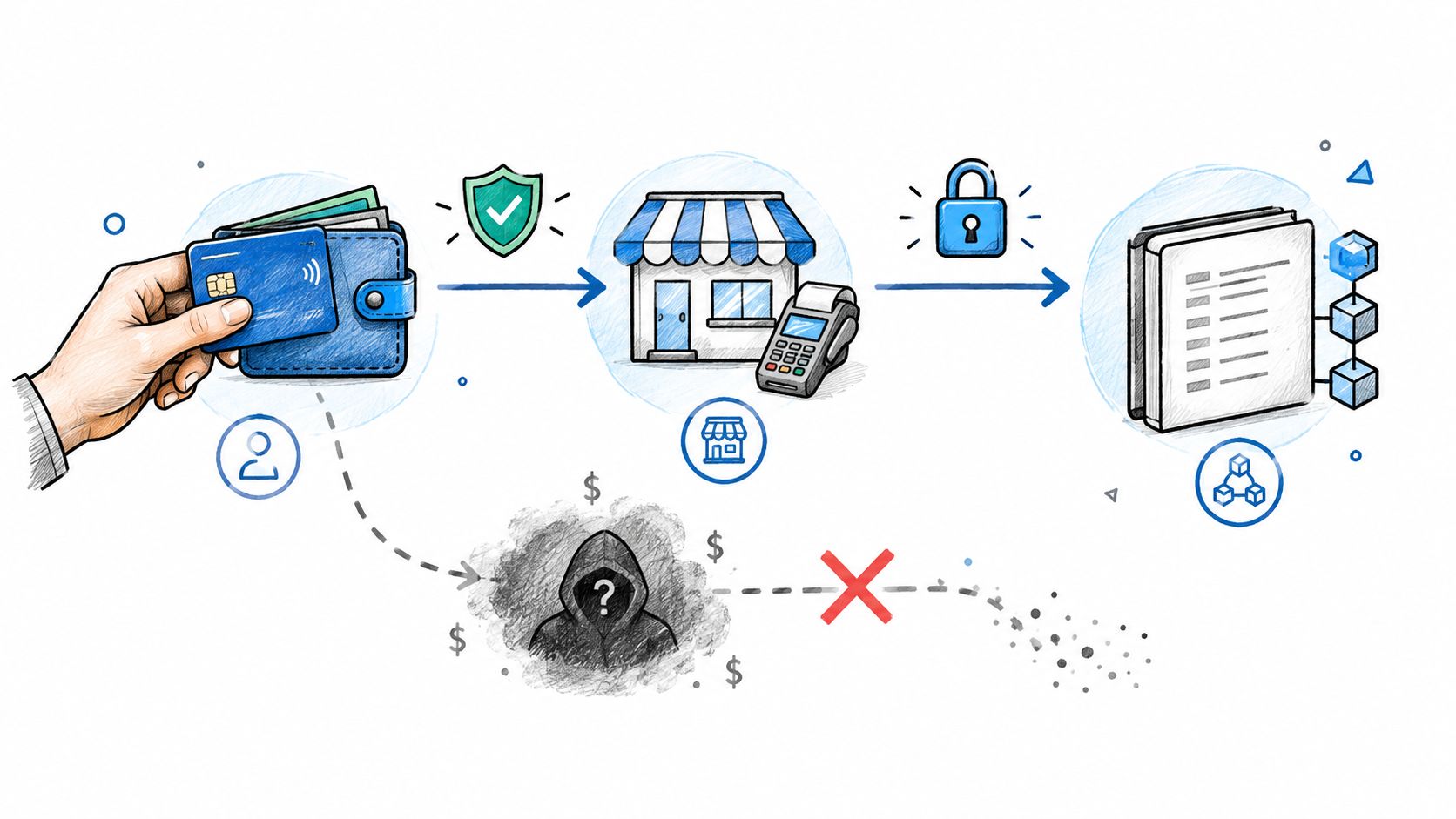
Follow the money path from identity and access through authorization and routing to settlement and its supporting record. Each stage is like a checkpoint in a delivery route: the decision to release funds is only one event, and the final receipt must confirm where the money went. Reconciliation, intact event records, and audit trails help teams verify that outcome, investigate exceptions, and resolve disputes with evidence.
The Layers Behind Secure Payment Solutions
Think of payment infrastructure as a building. A strong foundation keeps it standing; controlled doors determine who can enter; inspection rules govern what people may do; and a logbook records what happened. None of those functions replaces the others. Payment systems need the same separation of responsibilities.
Custody and data protection
Start with key custody. For a digital-asset transfer, the signing arrangement determines who can authorize a transaction and whether one compromised operator can move funds alone. BroSettlement supports DKG/MPC threshold signing with a 2-of-3 model and a client-controlled Co-Signer. In plain terms, signing authority is distributed rather than concentrated in one ordinary private key, and the client retains a defined role in the approval process.
Card data needs a different control. Tokenization can reduce the amount of sensitive card information held in general-purpose applications, while separated key-management functions help limit exposure. PCI DSS 4.0 makes clear that encryption alone doesn't remove a system from scope: systems that encrypt, decrypt, or manage keys can remain in scope, as can encrypted data accessible alongside the key needed to decrypt it. The PCI DSS quick reference guide also describes controls for protecting primary account numbers, restricting access by business need, and using unique identities and MFA for access to the cardholder data environment.
Policy and operating records
The policy layer decides whether a payment may proceed. It can check the amount, destination, asset, network, user or agent role, and compliance status before a signing request is accepted. The record layer then captures what the system did, including the decision and later payment states.
A useful evaluation question is whether a vendor can show how these layers interact, not just whether it offers a wallet or encryption. A security-first guide for fintech teams can help product and engineering teams consider security as part of application design rather than an add-on at checkout.
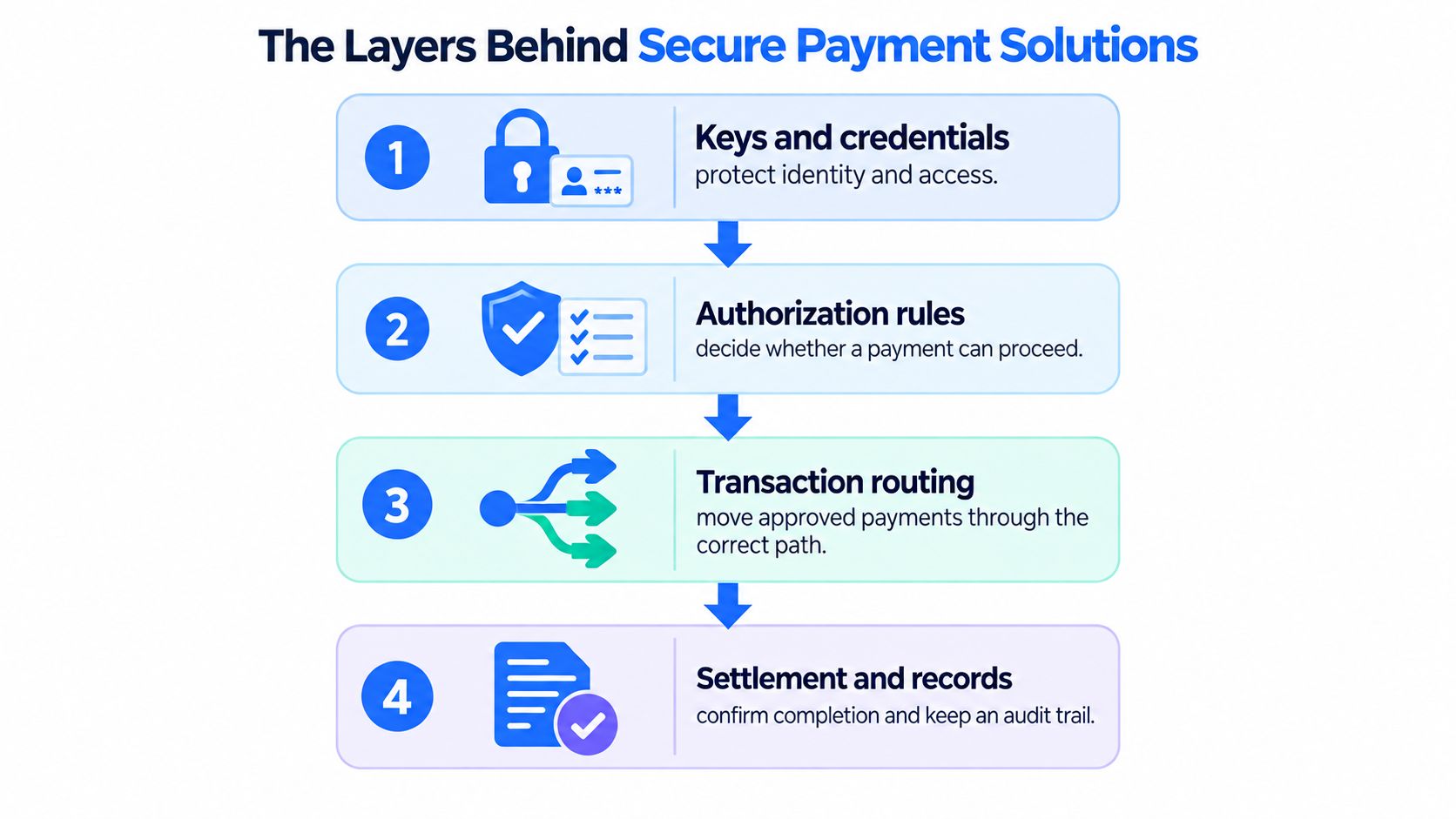
The layers depend on one another. Distributed custody limits who can sign, data protection limits what a database exposure reveals, policy controls decide which requests qualify, and durable records let finance and operations verify the result. A vendor's security story is incomplete if it describes only one layer.
How Authorization Gates Stop Unsafe Transfers
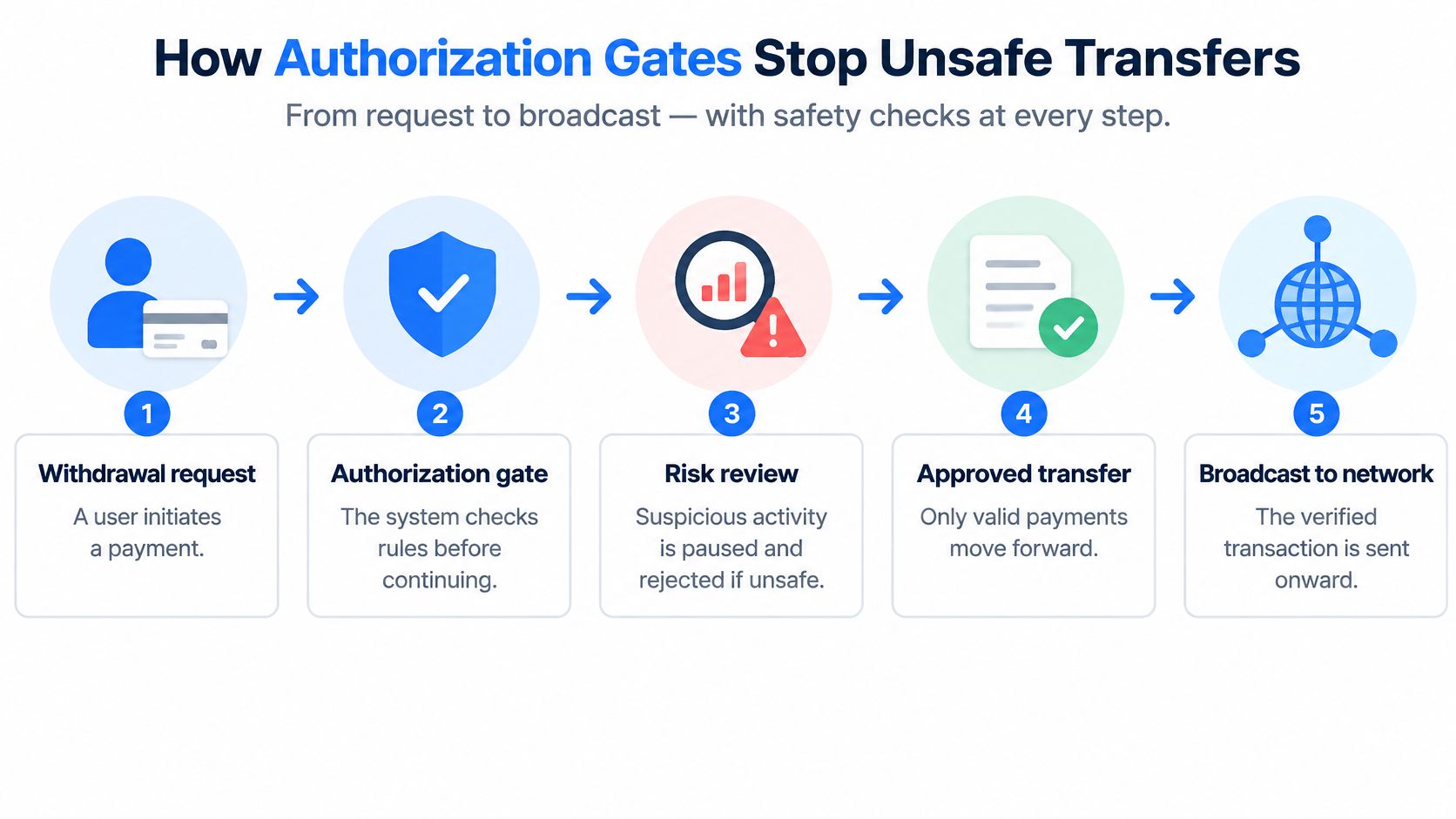
Follow a withdrawal from the moment a customer or service requests it. The first control is not the signing key. It's a durable client-generated identifier attached to the request. That identifier gives the system a stable way to refer to the same intended transfer when an application retries after a timeout.
The request then meets policy checks. The system evaluates the amount, destination, asset, network, the user or agent's role, and the relevant AML status. It confirms that the request has the required approval state. If a check fails, the transfer should pause or be rejected before it reaches the signing process.
Only a request that passes those gates proceeds to the MPC signing policy. With a client-controlled Co-Signer, the signing process requires the defined parties or components to participate in the required quorum. That structure makes a single compromised operator insufficient to complete a transfer when the signing policy requires another independent approval. The precise policy matters: threshold signing is not a substitute for deciding which transactions are eligible to be signed.
Preventing retries and limiting integrations
Idempotency connects the initial request to safe retry behavior. If an integration resends the same request after a network timeout, the system can recognize the identifier and avoid creating a second withdrawal. Without that safeguard, an application may mistake a missing response for a missing transaction and submit another request.
API credentials need similarly narrow boundaries. BroLabel's developer tooling supports Ed25519 authentication, IP allowlists, and replay protection. Scoped API keys should grant only the permissions an integration needs, while role-based access controls distinguish, for example, a service that can request a withdrawal from an operator who can approve a sensitive action. Teams reviewing those boundaries can also consult API governance best practices.
AI Agent Wallets are a bounded example. An agent may need to make a permitted payment, but that doesn't mean it should inherit broad operator access. Per-agent wallets and RBAC can constrain what each agent may do, while audit trails give the team a way to inspect its actions.
The sequence matters: authorization happens before signing, not after broadcast. Broadcast sends an already-approved transaction onward; it isn't the moment to discover that the destination, amount, or initiating role violated policy.
Reconciliation and Event Streams After Authorization
Authorization answers whether a transaction may proceed. Reconciliation answers what became of it. Those are different jobs, and a system that records only the initial approval leaves finance unable to tell whether funds were signed, broadcast, confirmed, failed, or reversed.
An append-only ledger preserves the history of a payment instead of replacing one state with another. A withdrawal can be represented as a sequence of durable records: requested, approved, signed, broadcast, confirmed, failed, or reversed. That gives operations and finance a common reference for investigating exceptions and comparing internal activity with processor, bank, or network records.
WebSocket events serve a related but distinct purpose. Events such as deposit.observed and deposit.confirmed, as well as withdrawal and policy outcomes, can alert systems and operators as activity changes. But an event notification isn't itself the financial record. Notifications can arrive late, out of order, or more than once, so consumers need idempotent processing and a way to reconcile event history against durable ledger entries.
Trace a deposit through its outcome
Consider an iGaming operator assigning a TRC20 deposit address to each player. When funds arrive, a deposit.observed event can prompt the application to show a pending deposit. A later deposit.confirmed event can update the player's payment state, while the ledger keeps the corresponding records needed to investigate what happened.
The same design helps with duplicate and out-of-order webhook delivery. A repeated notification shouldn't create a second credit; an event that arrives before an earlier notification shouldn't erase or misrepresent the transaction's state. Teams can route discrepancies to an exception queue, then investigate using identifiers and append-only records rather than trying to reconstruct the story from spreadsheets.
Real-time updates tell teams what may need attention. Reconciliation establishes what the records support.
This is why post-authorization controls belong inside secure payment design. Teams should be able to connect the request, policy decision, payment events, and final outcome into a traceable history. For a practical view of documenting that process, see BroLabel's audit workflow process.
Matching Architecture to Your Business Model
Different businesses share control principles, but they don't face identical operational risks. A trading platform may focus on withdrawals and custody. A neobank may need a coherent view of card, bank, and wallet activity. A payment gateway may prioritize merchant integrations and exceptions across providers. The architecture should match those realities rather than force every team into the same operating model.
| Business model | Primary control need | BroLabel module |
|---|---|---|
| Exchanges and trading platforms | Policy-gated withdrawals, distributed signing, and a traceable path from request to network outcome | BroSettlement for DKG/MPC signing and broadcast, plus the operating ledger and WebSocket events |
| Neobanks and fintech app teams | Connect wallet activity with funding, fiat withdrawals, and card usage while preserving access controls | Embedded wallets, BroWallet, BroCard, and the operating ledger |
| Payment gateways and PSPs | Manage integration permissions, payment status changes, and exceptions across connected services | API tooling, scoped access controls, WebSocket events, and reconciliation support |
| iGaming and betting operators | Attribute player deposits and payouts to the right player and apply policy before release | Per-player embedded wallets, TRC20 deposit addresses, event feeds, and payout policy |
| Stablecoin issuers and enterprise treasury teams | Control destinations and approvals, then reconcile transfers across counterparties and networks | BroSettlement, client-controlled Co-Signer policies, embedded wallets, and the operating ledger |
Match the control to the workload
For exchanges, the pressing question is whether a withdrawal can be independently reviewed before signing and reconstructed afterward. BroSettlement provides DKG/MPC 2-of-3 signing, a client-controlled Co-Signer, and 10-chain broadcast. The ledger and event feed then support operational visibility over the transaction's progress.
For fintech teams, wallet funding and payments may sit alongside card or fiat flows. BroWallet supports buy, sell, exchange, bank and card funding, and fiat withdrawals; BroCard supports Mastercard issuing, virtual and physical cards, and Apple Pay and Google Pay. The exact combination depends on the product's flow and operating requirements.
A gateway or PSP may care less about a single wallet experience and more about integration boundaries, status visibility, and clean exception handling. iGaming teams, by contrast, may need to associate many player-level deposit flows with their corresponding payout decisions. Treasury teams need records that help distinguish a requested transfer from an approved, signed, broadcast, and confirmed transfer.
Teams can choose modules as their operating model develops instead of treating a full integrated stack as the only starting point. That matters when early transaction volume is difficult to predict: a team can establish the controls it needs for launch, then add adjacent capabilities as payment flows become clearer. For a broader comparison of payment methods and their fit, consult BroLabel's guide to forms of payment.
Risk Controls and Compliance Guardrails
Authentication adds checks to a payment flow, but policy determines when those checks apply and how exceptions are handled. SCA and 3-D Secure (3DS) can help assess risk, yet a poorly tuned challenge may add friction without giving operators a clearer view of a transaction. Set rules for when to challenge, record exceptions, and review the effect on customers and fraud.
For card-not-present payments, 3DS lets an issuer assess transaction information and apply a challenge where appropriate. It does not guarantee protection from every fraud loss. Keep the authentication result with the payment record, and review which liability rules apply to the transaction and payment relationships. The Trust Payments guide to 3-D Secure liability explains why outcomes depend on those conditions.
Measure the policy, not just adoption
Track approval rate, challenge rate, fraud rate, chargebacks, and false positives by geography and customer segment. Set review thresholds for meaningful changes, alert the responsible team when a metric crosses them, and examine the affected rules on a regular cadence. If a rule reduces fraud but rejects legitimate customers, use the segment-level results to adjust the rule and check whether the change improves the balance.
Compliance controls must fit the payment flow. The FATF Travel Rule requires virtual-asset service providers and financial institutions to obtain, retain, and securely transmit specified originator and beneficiary information when transferring virtual assets. FATF reported that 99 jurisdictions had passed or were developing legislation implementing the Travel Rule in 2025 (FATF best practices). A withdrawal record should preserve both the required information and the compliance decision. Blockchain broadcast alone does not document the full process.
PCI DSS scope also requires active management. The standard covers entities that store, process, or transmit cardholder data, as well as systems that can affect the cardholder-data environment. PCI DSS v4.0 defines 12 principal requirements, and Requirement 8 expands MFA across access into that environment (Microsoft's PCI DSS guidance). Use scoped credentials, identifiable user access, approval for privileged actions, and audit trails. Shared accounts and broad service permissions make it harder to establish who did what.
Before launch, test whether controls leave evidence that finance and compliance can follow from request through final status. AML screening belongs in that record: capture the screening result and the compliance decision in the payment workflow. For guidance on screening controls, see AML transaction screening.
- Co-Signer policy: Confirm which transfers require additional signing participation and who controls it.
- RBAC: Check that user, operator, and agent permissions match their duties.
- Reconciliation drills: Test how finance handles duplicate notifications, delayed confirmations, failed transfers, and reversals. These cases check whether event records and audit trails remain useful after authorization, not just whether a payment was approved.
For a separate example of an independent review focused on smart contracts, see the smart contract security audit announcement.
Choosing Your Next Step Before Go-Live
Treat readiness as a sequence, not a feature checklist. Start by confirming custody and signing policy: decide who may initiate a transfer, which conditions require approval, and how the Co-Signer participates. Then connect the event stream to the operating ledger so that requests and outcomes can be tracked consistently.
Next, define scoped credentials and RBAC for applications, operators, and agents. Test the complete payment path in a sandbox, including cases where an event is delayed, repeated, or out of order. Finance should be able to perform a reconciliation drill without relying on a manually assembled spreadsheet.
For teams evaluating an API-first implementation, BroLabel's modules include embedded wallets, settlement, network broadcast, an operating ledger, WebSocket events, cards, and fiat integrations. Its documented launch path includes sandbox access, console setup, and fee-engine calibration, with commercial tiers aligned to uncertain early-stage volume. Choose components against the business model and controls you need; don't assume that every integration belongs in the first release.
A useful go-live decision is simple: can your team show who requested a payment, why it passed policy, who or what authorized it, and what records support its final status? If the answer is incomplete, keep the flow in testing until the missing control or evidence is addressed.
Frequently Asked Questions About Secure Payment Solutions
What separates secure payment solutions from payment processing alone?
Payment processing moves a transaction through a provider or network. Secure payment solutions also govern who may initiate and approve that movement, protect sensitive data, and preserve records that show how the transaction reached its outcome. When evaluating a provider, ask how it handles permissions, exceptions, and reconciliation, not only how it accepts a payment.
How does MPC 2-of-3 signing with a client-controlled Co-Signer differ from a single-key custody model?
A single-key model depends on control of one signing key. With an MPC threshold arrangement, signing authority is distributed among participants, and a defined threshold is required to produce a signature. A client-controlled Co-Signer gives the client a specified role in that signing process. The buyer should still examine who controls each participant, what policy gates apply, and how approvals are recorded.
Does 3DS or SCA make a payment system secure on its own?
No. Authentication can help verify a transaction or customer, but it doesn't replace authorization policy, monitoring, operational review, or evidence of settlement. It also doesn't guarantee that every payment is legitimate or that every transaction receives the same liability treatment. Teams should retain authentication outcomes and measure how their policies affect both risk and legitimate payment completion.
How should a team reconcile deposits, withdrawals, and reversals without manual spreadsheets?
Use durable transaction identifiers and an append-only ledger that records state changes instead of overwriting history. Treat WebSocket messages as timely notifications, then reconcile them against persisted records so duplicate or out-of-order events don't create duplicate credits or hide exceptions. Route mismatches, failed transfers, and reversals into an exception process that finance can review and audit.
BroLabel provides modular infrastructure for wallets, MPC settlement, payment events, and ledger-based reconciliation, so teams can evaluate controls against their actual money path. Open the sandbox and review the modules against your business model at BroLabel.