Stablecoin-linked card spending grew from roughly $582 million in 2024 to about $4.5 billion in 2025. The practical challenge is no longer proving that users want this product, but building the infrastructure layer that makes the growth operable, reconcilable, and compliant.
That distinction matters to anyone launching a fintech product, wallet, payout service, or card program. A stablecoin card doesn't turn a blockchain balance into a normal bank account by magic. It connects two payment systems with different settlement rules, different failure modes, and different evidence requirements.
Consumer marketing tends to focus on convenience. Institutional operators need to focus on authorization holds, confirmation thresholds, signing policies, clearing files, reversals, chargebacks, compliance decisions, and the ledger that ties them together. The card is visible to the user, but the operating layer determines whether the program survives production.
Table of Contents
- Why Stablecoin Cards Became an Infrastructure Problem
- What a Stablecoin Card Actually Does
- How On-Chain and Off-Chain Flows Stay in Sync
- Compliance Controls a Card Program Cannot Skip
- Integration Options and Real Use Cases
- Unit Economics Where Stablecoin Cards Leak Money
- Risks and Controls Before You Go Live
- From Sandbox to Production and Buyer Questions
Why Stablecoin Cards Became an Infrastructure Problem
Stablecoin-linked card spending moved from roughly $582 million in 2024 to about $4.5 billion in 2025, an increase of about 673% in one year, according to industry estimates compiled in stablecoin market data from Statista. A separate analysis placed Visa stablecoin-linked card spending at a $3.5 billion annualized run rate in the fourth quarter of fiscal 2025, roughly 460% higher year over year, and approximately 19% of total crypto-card settlement volume.
Those figures don't mean stablecoins are replacing conventional cards globally. They show that card-linked stablecoin spending has moved beyond isolated pilots and into measurable payment activity. The same reporting placed total annualized crypto-card volume above $18 billion by late 2025, while stablecoin-linked cards remained only one part of the wider stablecoin economy.
The enemy is the fragmented vendor chain. A wallet provider sees a deposit, the card issuer sees an authorization, the ledger sees a balance adjustment, the compliance system sees a screening decision, and finance receives a clearing file. If those systems can't agree on the same transaction state, volume turns into operational liability.
The reconciliation gap
A stablecoin card program can appear healthy in a product demo while producing unresolved questions in production:
- Was the balance confirmed? An observed blockchain transfer isn't necessarily available for spending.
- Was the card hold released? A reversed or partially completed authorization needs an explicit ledger state.
- Which asset was spent? Network context matters, particularly when the same stablecoin exists on multiple chains.
- Who approved the movement? Compliance and signing decisions must be retained with the transaction.
- What should finance settle? Card-network records and on-chain records rarely arrive in the same format or on the same schedule.
This is why a stablecoin payment infrastructure operating model must treat the card as one component in a larger system. The product team owns the user experience, but engineering, finance, treasury, risk, and compliance all depend on durable transaction states.
Practical lesson: Card volume doesn't hide weak controls. It exposes them faster.
A serious launch therefore starts with ownership of the operating record. Decide which system is authoritative for available balance, which events can change that balance, how pending and disputed transactions are represented, and how the business proves what happened after a failure. Without those decisions, adding more cardholders only increases the number of exceptions nobody can explain.
What a Stablecoin Card Actually Does
A stablecoin card is best understood as a bridge between blockchain settlement and conventional card authorization. The user holds or receives digital dollars, while the merchant continues to use familiar card-network acceptance and settlement. The merchant doesn't need to accept USDC or USDT directly for the card to work.
That bridge has two clocks. Public blockchains can finalize transfers within seconds after cryptographic validation. Card networks generally use deferred net settlement, with clearing and settlement commonly occurring over roughly 24 to 48 hours, as described in the technical analysis of finality and card payments.
The common misconception is that the card debits a crypto wallet in real time. In practice, the issuer must approve the purchase immediately, reserve or convert the required value, manage the risk of later settlement, and handle what happens if the blockchain transaction is delayed, reversed, or rejected.
Authorization is not settlement
A solid design separates the card transaction into distinct states:
- Authorization request. The issuer checks card status, available balance, merchant controls, risk rules, and spending limits.
- Hold creation. The system reserves the relevant amount without treating the transaction as final.
- Conversion or prefunding. Stablecoins may be converted, reserved, or funded according to the issuer's policy.
- Clearing intake. The card network supplies the final clearing record, which may differ from the original authorization.
- Settlement and posting. The ledger posts the completed amount, releases unused holds, and records fees or exchange-rate differences.
- Exception handling. Reversals, refunds, partial captures, disputes, and chargebacks receive explicit states.
The issuer therefore needs a prefunding and risk engine, not just a wallet balance endpoint. It also needs blockchain confirmation thresholds, chain-specific fee estimation, chargeback liquidity, and reconciliation between card-network files and on-chain activity.
A wallet balance tells you what the system can display. A controlled authorization balance tells you what the issuer is willing to spend.
This distinction affects product promises. “Spend directly from your wallet” may be a useful user-facing description, but the backend still needs policy-controlled conversion and ledger holds. Treating a card-linked wallet as a simple real-time debit creates hidden exposure precisely where card authorization expects certainty.
How On-Chain and Off-Chain Flows Stay in Sync
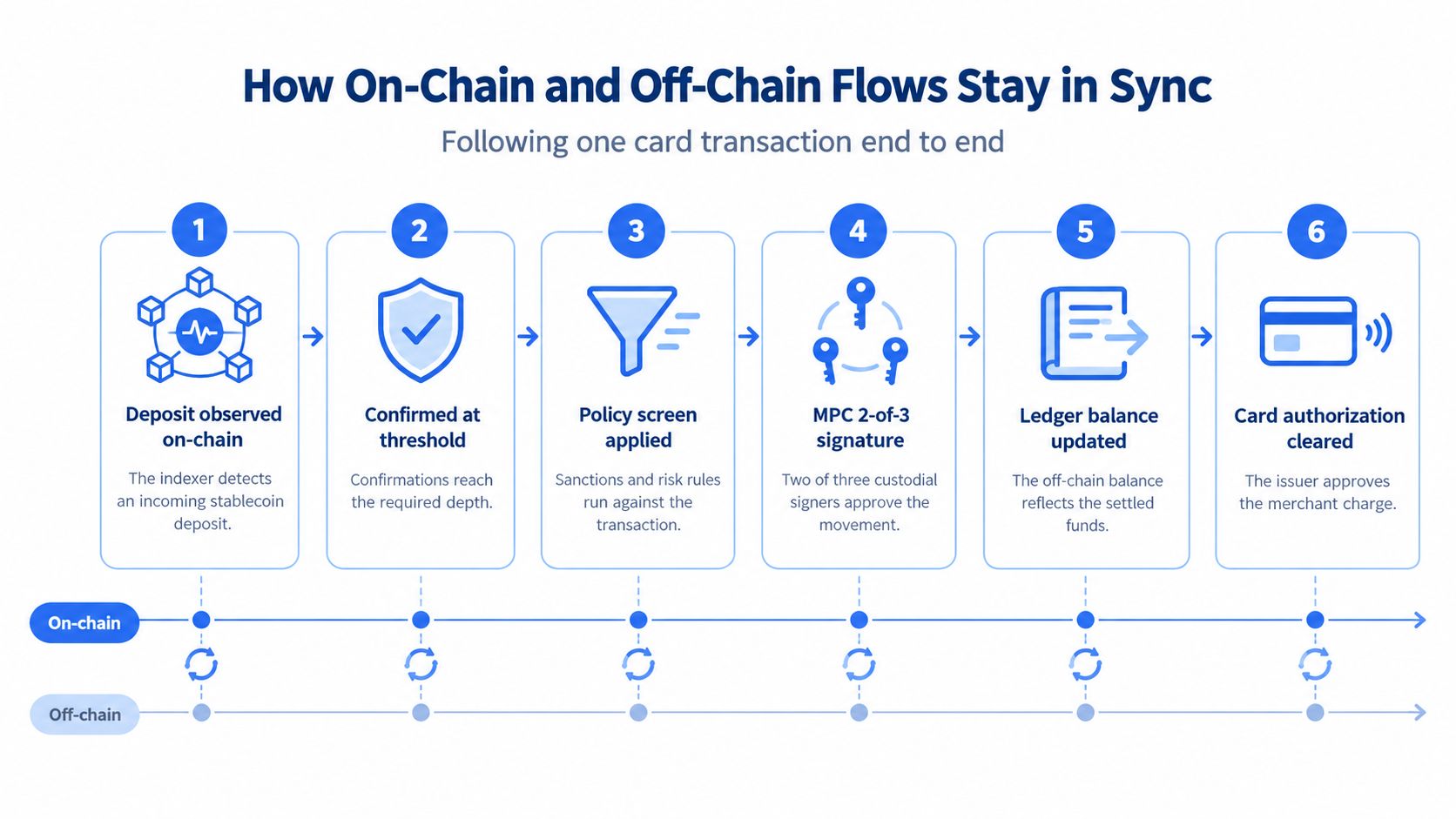
A production flow begins before the card is tapped. It starts when an indexer observes an incoming stablecoin deposit and continues until the card network clears the resulting purchase.
The transaction path
1. Deposit observed on-chain. The indexer detects an incoming transfer and records the transaction hash, asset, network, address, amount, and operation identifier. At this point, the funds have been seen, not necessarily confirmed or made available.
2. Confirmation threshold reached. The wallet service waits for the required chain-specific confirmation depth. The ledger should distinguish observed from confirmed, because downstream card authorization must not guess whether a transfer is safe to use.
3. Policy screen applied. Screening runs against the deposit and its relevant counterparties. The result should be retained as part of the transaction record, including whether the system approved, rejected, or routed the activity for review.
4. Movement signed through MPC. If funds need to move, a policy-controlled MPC 2-of-3 signing flow can require two of three custodial signers to authorize the transaction. A client-controlled Co-Signer adds an independent approval boundary, so the operating team doesn't rely on a single centralized signing point.
5. Ledger balance updated. The append-only operating ledger posts the settled balance and links it to the on-chain event. The ledger should also record holds, reversals, fees, and refunds rather than reducing everything to one mutable balance.
6. Card authorization and clearing. The issuer checks the available balance and approves the merchant charge. Later, the clearing record determines the final amount and triggers the correct posting, hold release, conversion adjustment, or dispute state.
One implementation detail matters more than it first appears. WebSocket events complement the ledger, but they don't replace it. Events such as deposit.observed, deposit.confirmed, withdrawal status updates, and policy outcomes give applications timely notifications. The append-only ledger provides the durable accounting record when a consumer disconnects, a worker retries, or two systems receive events in an unexpected order.
Idempotency is an accounting control
Cross-network assets make duplicate processing especially dangerous. The asset name alone isn't enough. USDT on one network and USDT on another must retain their network and address context, as highlighted in reporting on stablecoin network fragmentation and reconciliation.
Every operation should have a unique identifier, a defined lifecycle, and a replay-safe API contract. A retry must return the existing result or safely continue the same operation. It must not create a second withdrawal, post a deposit twice, or release a card hold more than once.
The practical architecture is straightforward:
- Durable lifecycle events tell downstream services what changed.
- Append-only ledger records preserve the financial history.
- Periodic reconciliation compares ledger entries, blockchain events, and card clearing files.
- Idempotency keys prevent duplicate actions during retries.
- Operational dashboards expose unresolved states instead of hiding them.
That gives engineering, finance, and compliance the same answer to a critical question: were the funds seen, confirmed, spent, returned, rejected, or still unresolved?
Compliance Controls a Card Program Cannot Skip
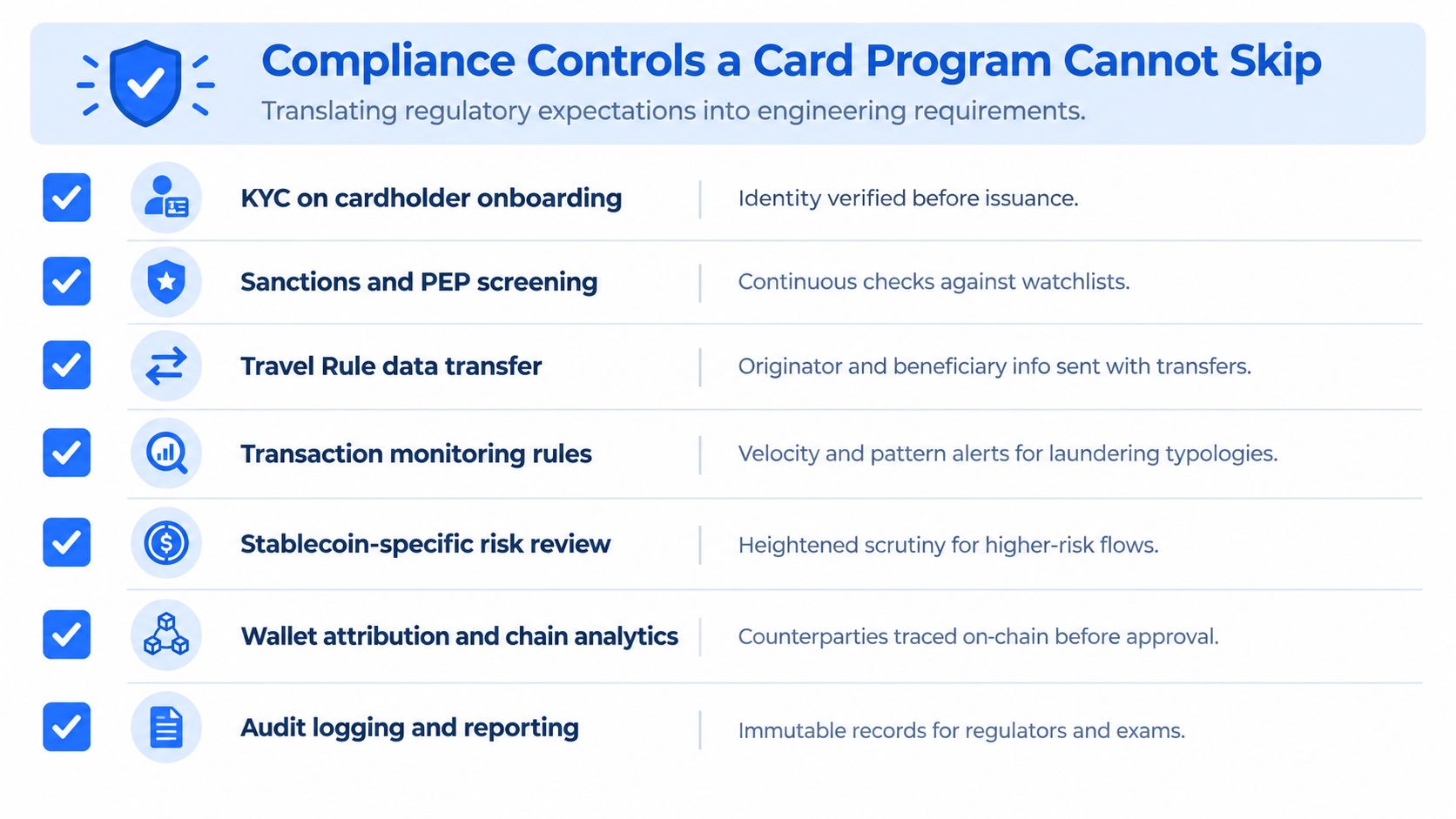
Stablecoins create a broader compliance surface than onboarding alone. Their perceived stability can encourage wider payment adoption, increasing the importance of screening deposits, transfers, card funding, withdrawals, and payouts. The IMF's analysis of stablecoin risks and reserve requirements describes heightened money-laundering, terrorist-financing, and proliferation-financing concerns and emphasizes strong controls around reserve assets.
The engineering response is a workflow that carries policy through the entire transaction lifecycle. A user shouldn't pass KYC once and then receive an unrestricted path from an external wallet to a card authorization.
Screening belongs at each value movement
A useful control model includes:
- Deposit screening. Assess incoming assets and wallet context before making funds available.
- Transfer screening. Apply policy before internal or external movements are signed.
- Card-funding screening. Link the funding event to the cardholder and spending profile.
- Withdrawal screening. Review destination address, network, amount, and risk indicators.
- Payout screening. Require an explicit outcome before funds are released to a recipient.
- Review escalation. Route higher-risk activity to a human or approved workflow before signing.
- Evidence retention. Store the policy decision, rule version, reviewer action, and transaction state.
The signing step should be separate from the policy engine. A compliance service can recommend approval, but a controlled Co-Signer policy should determine whether the transaction is permitted to move. Role-based access controls must restrict who can configure policies, approve exceptions, initiate broadcasts, and view sensitive records.
This same separation applies to card acceptance. Teams handling higher-risk merchants should understand high-risk merchant PCI compliance as part of the broader payment-control environment, not as a checklist delegated entirely to a processor.
A balance display also needs a status model. “Confirmed,” “screened,” “available,” and “approved for card authorization” are different states. A wallet may show a balance that remains restricted because the confirmation threshold, compliance review, or settlement policy hasn't completed. The compliance management process should therefore connect product states to operational decisions instead of leaving the interface to imply availability.
Integration Options and Real Use Cases
The right integration path depends on what the business already owns. A neobank may need cards and wallet balances but already have customer identity and support operations. An iGaming operator may need per-player deposit addresses, event-driven crediting, and payout approval. A payout platform may need automated treasury with constrained AI Agent wallets rather than a consumer wallet interface.
A full-stack approach connects BROsettlement, embedded wallets, the operating ledger, WebSocket events, BROcard, and BROwallet. A modular approach embeds only the components the existing application lacks.
BROsettlement handles DKG and MPC 2-of-3 signing, client-controlled Co-Signer policies, and broadcast across 10+ supported mainnets. Embedded wallets support user, per-agent, or per-player models. BROcard provides Mastercard issuing with virtual and physical card flows, including Apple Pay and Google Pay support. BROwallet covers buy, sell, exchange, bank and card funding, and fiat withdrawal workflows.
Three operating patterns
Neobank for unbanked users. The neobank can embed wallets, connect confirmed stablecoin balances to card controls, and offer dollar-denominated spending through existing card acceptance. The key controls are identity verification, balance availability states, conversion policy, withdrawal handling, and customer-facing records that explain fees and refunds.
iGaming operator. Each player can receive a dedicated TRC20 deposit address. deposit.observed and deposit.confirmed events update the operator's internal account state, while operator policy runs before a payout is signed. This separates player accounting from blockchain confirmation and prevents a payout service from treating an unconfirmed deposit as settled revenue.
Payout platform. AI Agent Wallets can support automated treasury actions with RBAC, audit trails, scoped permissions, and a separately controlled signing policy. The agent can prepare an operation, but the policy layer and Co-Signer determine whether funds may move.
| Scenario | Core Modules | Key Controls | Primary Risk |
|---|---|---|---|
| Neobank adding stablecoin spending | Embedded wallets, BROcard, ledger, fiat integrations | KYC, balance states, conversion rules, dispute handling | User balance and card settlement diverge |
| iGaming with per-player deposits | Per-player wallets, WebSocket events, ledger, BROsettlement | Confirmation thresholds, wallet attribution, payout policy | Deposits are credited or paid out twice |
| Automated payout treasury | AI Agent Wallets, RBAC, BROsettlement, ledger | Scoped permissions, Co-Signer approval, audit records | Automation signs an unauthorized transfer |
The decision shouldn't begin with the card surface. It should begin with the system of record, the signing boundary, and the exceptions the operations team can resolve. Teams evaluating a card program can use the card issuing API overview to map issuing requirements to the rest of the payment stack.
Unit Economics Where Stablecoin Cards Leak Money
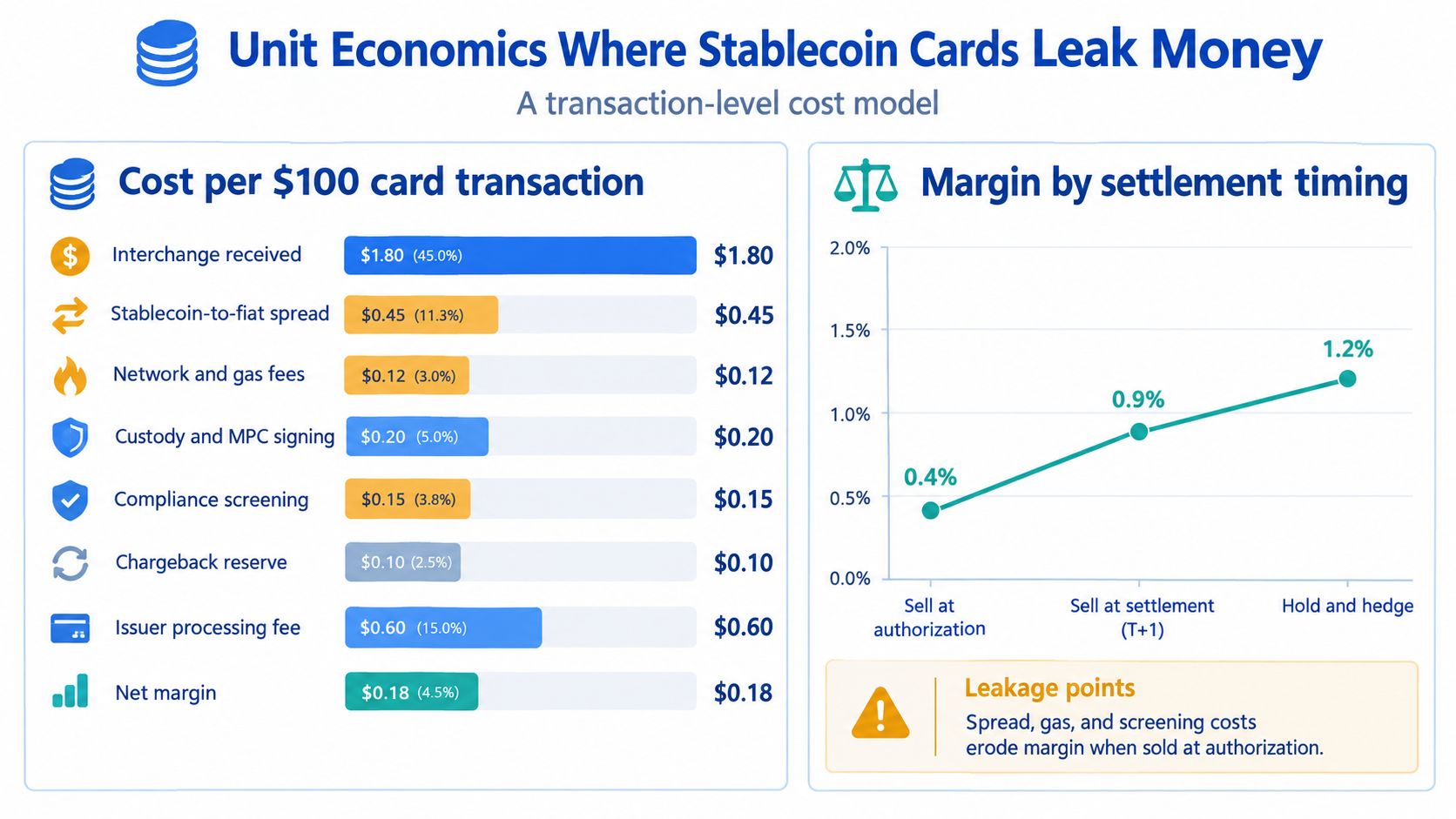
A stablecoin card can show positive interchange revenue and still lose money on each transaction. The outcome depends on when the stablecoin is sold, which exchange rate applies, who absorbs blockchain and network costs, and how the program funds refunds and chargebacks.
A transaction-level model should answer six operating questions:
- Conversion timing. Is the stablecoin sold when authorization is approved, when the transaction clears, or under a treasury strategy that holds and hedges?
- Pricing basis. Which exchange rate is used, and how is the spread disclosed to the user?
- Network cost. Which party absorbs blockchain fees, conversion costs, and failed broadcast attempts?
- Cash access. Are ATM, withdrawal, and fiat payout fees charged separately or absorbed in the margin?
- Exception treatment. Does a refund restore the original stablecoin amount, the fiat value, or a calculated equivalent?
- Dispute funding. Where does liquidity come from when a chargeback is raised after the original conversion?
The worked model needs timing, not just fees
Finance should model at least one domestic card purchase, one cross-border purchase, an ATM withdrawal, a refund, and a declined transaction. For each path, show the user-facing amount, stablecoin amount consumed, conversion rate, spread, network cost, custody cost, screening cost, issuer fee, reserve allocation, and final margin.
Timing determines the operator's exposure. Selling at authorization reduces later price and settlement uncertainty, but may create conversion leakage immediately. Selling at settlement gives the operator more information while leaving the card obligation and stablecoin position to be managed together. Holding and hedging preserve flexibility, but add treasury policy and execution risk.
“Zero fee” can still hide economic costs. Value may leave through an exchange spread, unfavorable timing, network conversion, gas, ATM charges, or a withdrawal fee shown only after the transaction. In some jurisdictions, a card purchase can also be treated as disposal of the underlying digital asset for tax purposes, even when the user experiences it as ordinary spending.
Instrument the operating margin
A production dashboard should focus on metrics that explain card profitability:
- Authorization approval rate, segmented by funding state and risk outcome.
- Settlement latency, measured from authorization through clearing and ledger posting.
- Chain fees per funded transaction, including failed or retried operations.
- Revenue by corridor, separated from gross payment volume.
- Refund timing and value restoration, so finance can identify conversion leakage.
These measures connect customer behavior and treasury decisions to margin. They also show whether a corridor is profitable because of genuine revenue or only because costs, reserves, or refund exposure have not yet been recognized.
Market size does not make the card channel economical by itself. Card spending remains a specialized stablecoin use case rather than a proxy for total adoption. Deloitte has projected that stablecoins could support more than $200 billion of US retail payments by 2030 and approximately 2.5% of US noncash transactions through direct payment, backend settlement, processing, or funding mechanisms, as described in its stablecoin retail payments forecast. A founding team should therefore approve the program against transaction-level contribution margin, corridor by corridor, rather than against broad adoption forecasts.
Risks and Controls Before You Go Live
Moving tokens isn't the same as running dependable payment operations. The Financial Stability Board's work on crypto-assets and global stablecoins identifies structural vulnerabilities, growing links with traditional finance, operational disruption risks, and gaps in how jurisdictions have implemented the global framework.
A launch checklist should rank failures by the damage they can cause.
| Failure mode | Control to require before launch |
|---|---|
| Card clearing files don't reconcile with on-chain events | Append-only ledger, unique operation identifiers, and scheduled reconciliation |
| One custody component can authorize every movement | MPC 2-of-3 signing with a client-controlled Co-Signer |
| Retries create duplicate deposits or withdrawals | Idempotency keys, replay protection, and durable operation states |
| A policy decision can't be reconstructed during an audit | Immutable records containing screening, approval, reviewer, and signing outcomes |
| Automation can move more funds than intended | Scoped API keys, RBAC, IP allowlisting, and defined spending policies |
| Blockchain confirmation is mistaken for final business settlement | Separate observed, confirmed, available, posted, reversed, and disputed states |
The Co-Signer should have a clear policy boundary. It shouldn't be an emergency button that the team bypasses whenever a transaction is inconvenient. Define who can approve, what conditions trigger review, which networks and assets are allowed, and how an exception becomes part of the permanent audit record.
Teams can also use broader practical risk management for DeFi with Yield Seeker as a useful reference for thinking about exposure, controls, and failure containment beyond the card layer.
Before launch, run failed confirmations, duplicate webhooks, delayed clearing, partial refunds, chargebacks, rejected withdrawals, unavailable signing participants, and policy-review holds. If finance can't explain the resulting ledger, or operations can't identify the next action, the program isn't ready for volume.
From Sandbox to Production and Buyer Questions
The card is only the visible surface of the product. Production readiness depends on whether the operating layer can reconcile balances, explain exceptions, and support review under uncertain early volume. Start in a sandbox, configure the console, calibrate the fee engine, and test the full path from authorization through settlement before issuing at scale.
A modular API stack can connect embedded MPC wallets, an operating ledger, network broadcast, card issuing, and fiat integrations while leaving the buyer's existing application in place. Treat those components as separate operating responsibilities, even when one platform supplies them. That separation makes ownership, failure handling, and provider evaluation clearer.
Buyer questions
Can we issue cards without custodying user keys?
Yes. A non-custodial design can distribute signing authority through MPC and place a client-controlled Co-Signer in the approval path. The custody and licensing model still depends on the jurisdictions, partners, and activities involved.
What happens to the stablecoin balance during a card dispute?
The system should retain the authorization, hold, clearing record, conversion details, and dispute state. A refund or chargeback must create an explicit ledger event showing what value was restored and why. Overwriting the balance without a trace makes finance and support investigations harder.
How do per-player deposit addresses work for iGaming?
The operator assigns an address to each player, observes the incoming transaction, waits for the required confirmation state, applies policy, and credits the player account through an idempotent ledger operation. Payout signing remains a separate controlled action, with its own approval and operational ownership.
What should we evaluate first when comparing card infrastructure providers?
Start with the operating record and failure handling. Ask how the provider represents pending states, distinguishes assets across chains, handles retries, reconciles card clearing, records refunds and chargebacks, and supplies compliance evidence. Confirm that clients can access events and ledger data. Commercial tiers should match uncertain early volume rather than require a premature commitment.
Run deliberately difficult test cases before launch, including delayed clearing, partial refunds, rejected withdrawals, and policy-review holds. Calibrate fees, document state transitions, assign owners for unresolved transactions, and expand the card surface only after finance and operations can explain the resulting records and next actions.
BroLabel provides modular infrastructure for embedded MPC wallets, an append-only operating ledger, network broadcast, card issuing, fiat integrations, WebSocket events, and policy-controlled signing. Visit BroLabel to evaluate the sandbox path and design a stablecoin card program around reconciliation, compliance, and production controls.