You're running a fintech, exchange, neobank, or iGaming platform, and a withdrawal request has just entered the queue. The transaction itself is routine. The difficult question is whether one compromised server, employee credential, cloud account, or hardware device could authorize it without anyone else noticing.
That's the operational problem a threshold signature scheme is designed to address. It distributes signing authority across independent parties, then connects that cryptographic control to policies, approval workflows, reconciliation, and incident response. In production, the signing algorithm matters, but so do the controls around it. A secure wallet that finance can't reconcile, operations can't monitor, or risk teams can't disable quickly still creates unacceptable exposure.
Table of Contents
- The Single Point of Failure in Crypto Custody
- How Threshold Cryptography Distributes Trust
- Threshold Signatures Versus On-Chain Multisig
- Managing Latency and Communication Overhead
- Incident Response and Key Compromise Protocols
- Integrating Signing with the Operational Ledger
- Frequently Asked Questions by Infrastructure Buyers
The Single Point of Failure in Crypto Custody
A treasury operator discovers that a withdrawal wallet has sent funds to an unfamiliar address. The cloud environment remains online, authentication logs are incomplete, and the usual withdrawal approver is unavailable. If one private key controlled the wallet, the response team has limited options. They can revoke access around that key, but they cannot revoke signatures it already authorized.
That is the operational risk created by the single private key. A cloud HSM can protect key material from some extraction attempts, and a hardware wallet can isolate secrets from ordinary servers. Neither changes the authorization model when one key can independently sign a transaction. A compromised administrator account, insider, or failed custody device can still become the decisive control point.
The consequences are not limited to theft. A lost key can stop withdrawals, while a failed device can interrupt settlement. Compliance teams may also lack a practical way to enforce separation of duties if one operator can move funds alone. In production, the control model must support both routine approvals and a fast, auditable response to compromise.
A threshold signature scheme changes that structure. Signing authority is divided into shares, and a predefined group must cooperate before the network accepts the resulting signature. Compromising fewer than the required number of parties is not enough to forge a valid signature. The design still requires availability planning, because a participant may be offline, unreachable, or deliberately refusing to cooperate.
The control question for CTOs
The useful question is not where the private key is stored. It is which independent controls must agree before value can move.
That distinction affects compliance, finance, and incident response. A policy can require participation from an application-controlled signer, a service provider, and an operational approval path. These parties can be separated by environment, role, or organization. An attacker who gains access to one layer still faces another authorization boundary, while responders can disable a compromised participant without exposing a complete key.
Practical rule: If one compromised credential can both create and approve a withdrawal, the system still has a single-point-of-failure problem, even if the credential is stored in a hardened vault.
The same reasoning applies when reviewing hardware incidents. The discussion in assessing wallet risks after Coldcard bug shows why teams should evaluate the failure model rather than focus only on a device brand or storage method. In BroLabel's infrastructure, that means tying signer independence to policy enforcement, key rotation, monitoring, and a documented incident path. Threshold signing defines how trust is distributed. Operations determine whether that design remains usable when a signer is compromised, unavailable, or due for replacement.
How Threshold Cryptography Distributes Trust
In production custody, a signer can be compromised, unavailable, or scheduled for replacement without the team wanting to rebuild the wallet. A threshold signature scheme supports that operating model by dividing signing authority across multiple shares. In the classic (t,n) model, n parties hold shares and t parties must cooperate to produce a valid signature. A group below the threshold cannot recover the secret key or create a valid signature. The protocol must also allow honest participants to complete the operation when a malicious participant attempts to block them, as described in research on fault-tolerant threshold signatures.
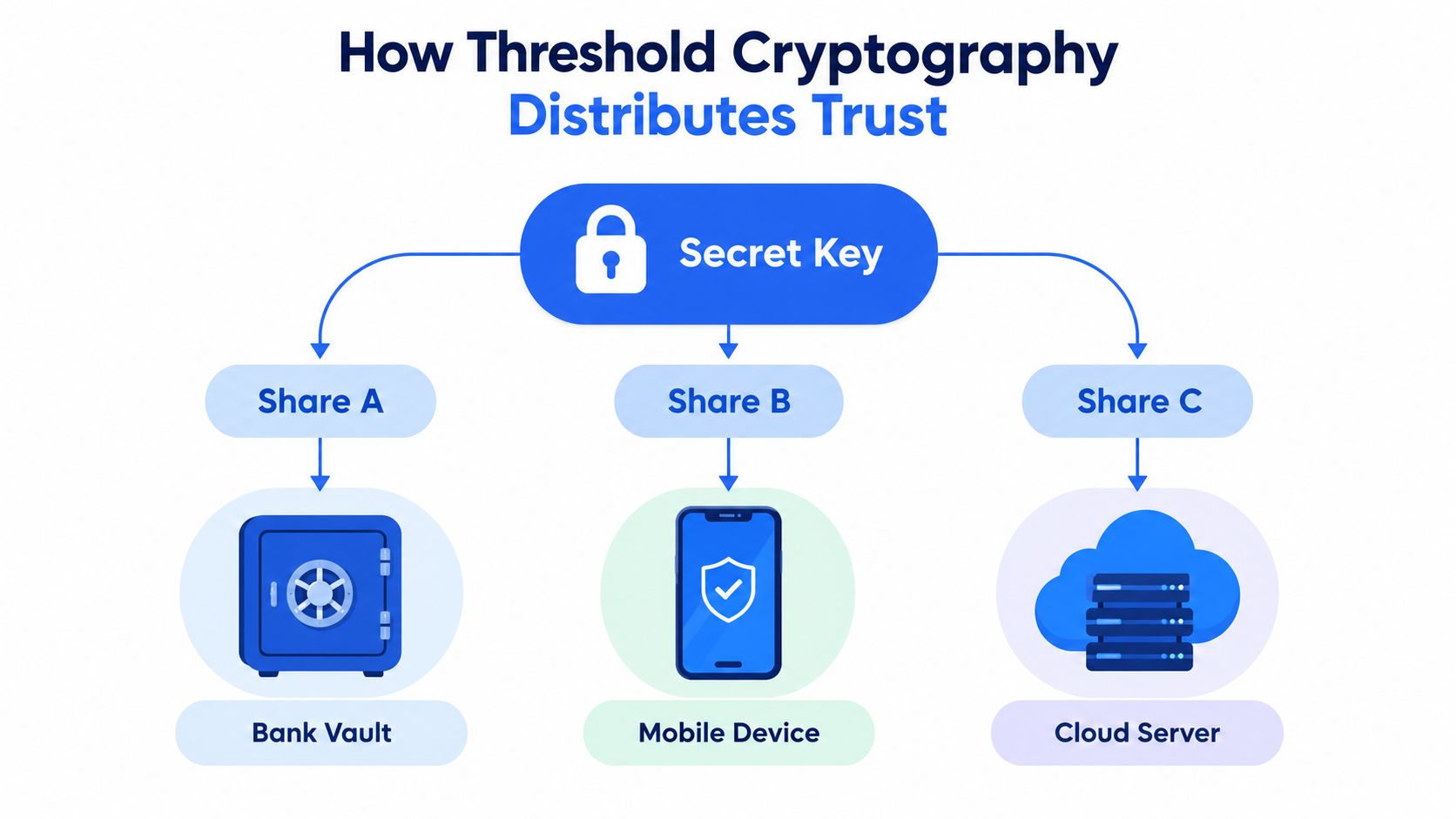
The design has two phases that affect production controls in different ways.
Distributed key generation
Distributed Key Generation, or DKG, creates the signing relationship. Participants exchange protocol messages to establish a public key and private shares. No participant receives the complete private key, and the wallet does not need to assemble that key on a single machine before it can be used.
That distinction matters during setup and recovery. Traditional key splitting may begin with a complete secret and divide it afterward, creating a moment when the full secret exists. DKG avoids making that complete secret the operational starting point. Each participant receives only its own share, while the system retains the public key required for address generation and signature verification.
DKG also defines who participates and what each participant is allowed to do. In BroLabel's infrastructure, those roles should correspond to enforceable controls rather than labels in a design document. An application signer can authorize a transaction under business rules. A client-controlled co-signer can apply an independent policy. A service component can coordinate protocol messages without gaining unilateral signing authority. Rotation procedures must account for these roles, because replacing one participant is an authorization change as well as a key-management task.
Threshold signing
After a transaction passes the required checks, the approved participants join an interactive signing protocol. Each uses its share to calculate partial values, exchanges messages through protected channels, and contributes to the final result. Validators receive an ordinary blockchain signature and verify it against the public key.
The full private key is not reconstructed during signing. That property underpins multi-party computation wallet infrastructure, in which several parties jointly compute an outcome while keeping their individual inputs private. It also changes incident response: disabling one participant can stop or limit signing without exposing a complete key, provided the remaining policy and availability design are configured correctly.
Why the history matters
Threshold signing developed from academic work into deployable cryptographic infrastructure over several stages. Desmedt and Frankel were credited with the first group-oriented (t,n) threshold digital signature scheme based on RSA in 1991. Harn published one of the first practical ElGamal-based threshold signature schemes in 1994, and Gennaro and others published an early threshold DSS or ECDSA-style construction in 1996. A practical threshold RSA scheme published in 1999 added non-interactive signature share generation and verification. These milestones appear in the historical survey of threshold signature schemes.
Standardization work followed. NIST held a threshold cryptography workshop in March 2019, published a roadmap in July 2020, released an initial public draft on threshold EdDSA and Schnorr signatures in August 2022, issued a first call for multi-party threshold schemes in January 2023, and published a second public draft in March 2025, as summarized in the threshold cryptosystem overview. For infrastructure buyers, the practical conclusion is straightforward. TSS can support serious custody systems, but protocol review, participant availability, key rotation, policy enforcement, and incident procedures remain engineering responsibilities.
Threshold Signatures Versus On-Chain Multisig
The choice between threshold signatures and multisig is not a contest between “secure” and “insecure.” Both distribute authority. They enforce that distribution in different places.
On-chain multisig uses multiple independent keys and asks the blockchain, script, or smart contract wallet to enforce the approval threshold. A threshold signature scheme coordinates shares off-chain and produces one ordinary signature for the chain. The network verifies the result without seeing how many participants contributed.
That difference affects product design. Multisig can make the custody policy visible on-chain and may require additional transaction data or contract execution. Threshold signing generally preserves the appearance and structure of a standard single-signature transfer. For a platform processing many transfers, that can simplify chain compatibility, transaction construction, and fee management. The Bitcoin multisig wallet architecture guide provides useful context on the alternative model.
| Feature | On-Chain Multisig | Threshold Signature Scheme |
|---|---|---|
| Authorization location | Enforced by chain script or smart contract | Enforced through an off-chain signing protocol |
| On-chain appearance | The multisig structure can be visible | The result appears as a standard signature |
| Key model | Multiple independent full keys | Shares represent one distributed signing authority |
| Chain support | Requires suitable script or contract support | Fits networks accepting the supported signature type |
| Transaction footprint | Can increase with signer and policy structure | Uses the ordinary single-signature form |
| Coordination | The chain validates submitted signatures | Signers exchange protocol messages before broadcast |
| Operational concern | Contract, script, and signer management | Protocol availability, share security, and coordinator reliability |
Where multisig remains useful
Multisig is often easier to explain to a board or auditor because the approval rule is explicit in the transaction or contract model. It can also provide a strong control when the target network offers mature native multisig support and the organization accepts the additional visibility and transaction complexity.
The downside is that the policy becomes part of the public or chain-level execution environment. A wallet address, script, or contract may reveal that several keys control the funds. Teams must also manage multiple full private keys, each of which needs its own backup, rotation, monitoring, and incident process.
Where TSS fits better
Threshold signing is attractive when a team wants a standard transaction format, broad compatibility with ordinary account-based wallets, and no public disclosure of the internal signer quorum. It can also reduce the number of distinct key objects that application code must reason about.
That doesn't make TSS automatically superior. The signing process is interactive, so network reachability and participant health become part of transaction reliability. A buyer should evaluate both the cryptography and the operational tooling before choosing the model.
Managing Latency and Communication Overhead
A withdrawal can be approved by policy and still miss its operational target if one signing participant is slow, unreachable, or waiting on a coordinator. A single-key signer calculates locally. A threshold signature scheme requires eligible parties to exchange messages, verify each contribution, and complete the signing ceremony before the transaction can be broadcast.
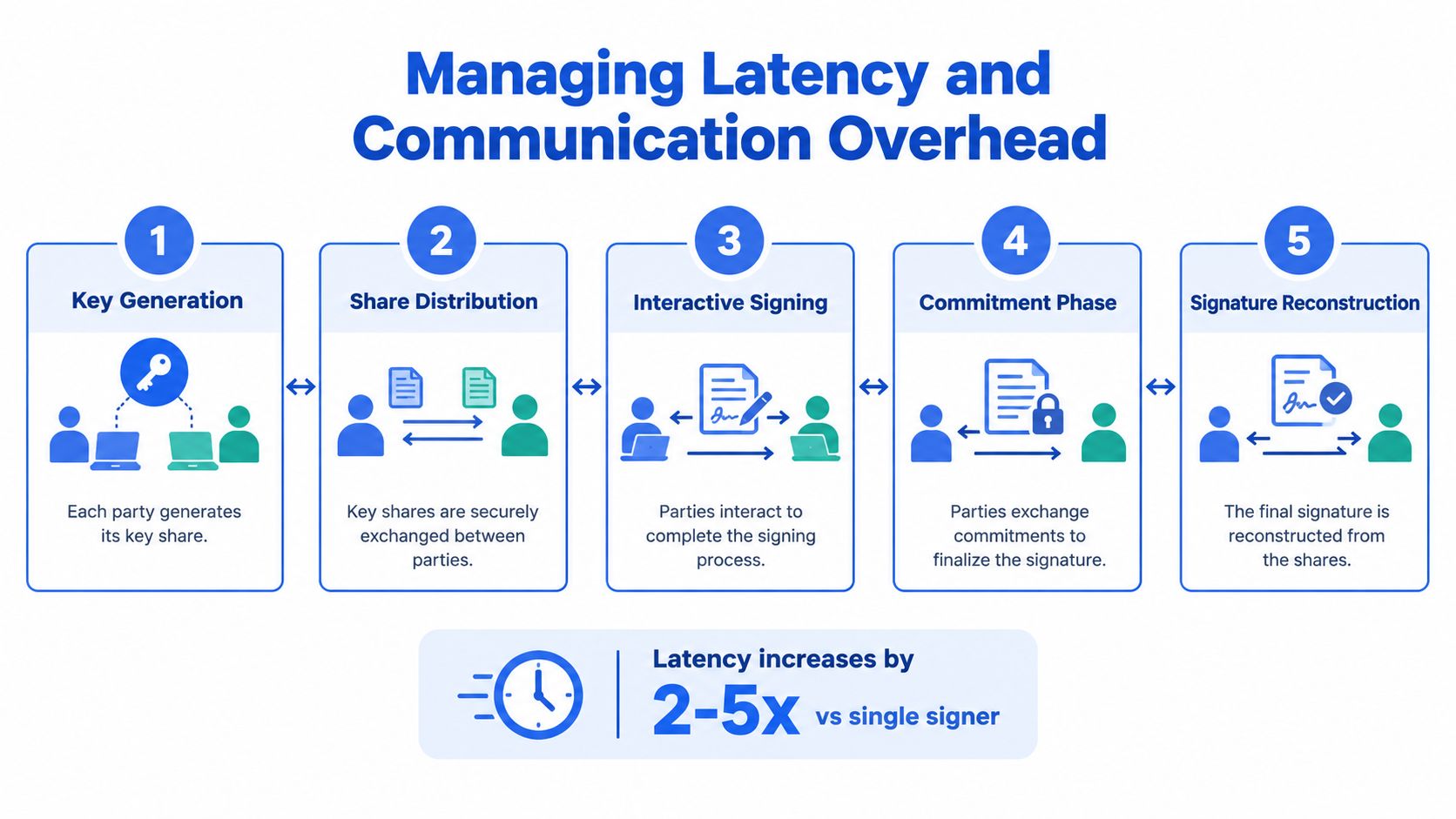
The added coordination is measurable in protocol design. A surveyed ECDSA threshold signing design uses a DKG setup with five rounds and an eight-round signing phase. That difference explains why latency and failure handling need explicit production controls, rather than an assumption that signing will behave like a local cryptographic operation. The design is discussed in the survey of threshold ECDSA protocols.
What creates delay
Several stages can extend a signing request:
- Participant discovery: The coordinator identifies which parties are eligible under the active policy.
- Message exchange: Participants send and validate partial protocol values instead of returning one local signature.
- Failure handling: A timeout, malformed message, or unavailable signer can abort the attempt or trigger a controlled retry.
- Broadcast sequencing: The final signature must exist before the network transaction is submitted.
- Confirmation tracking: The application observes network events and updates its internal state after submission.
Define the expected state, timeout, retry behavior, and customer message for each stage. A generic “instant withdrawal” promise creates avoidable support and reconciliation problems when a participant or blockchain endpoint is unavailable.
The production balance
A practical deployment can use a two-share approval pattern across three parties. A client-controlled Co-Signer retains a meaningful approval role, while managed infrastructure coordinates protocol messages and network broadcast. The MPC wallet implementation overview describes this operating model. It gives the client an independent approval function without requiring its team to run every signer service, communication path, and chain broadcaster.
BroSettlement uses DKG and MPC signing with a client-controlled Co-Signer. The relevant architectural choice is the division of responsibility. The client defines which transactions are eligible, while the infrastructure coordinates the signing ceremony and submits the resulting transaction. That division also determines who owns a stalled request, who can restart it, and which records prove what happened.
Operational lesson: Measure the full withdrawal lifecycle, not only cryptographic signing time. Policy evaluation, approval routing, retries, broadcast, and confirmation handling all affect the user-visible result.
Use asynchronous workflows for operations that do not need a blocking request. A withdrawal API can return a durable operation identifier, emit state changes through WebSocket events, and let the ledger record every transition. Idempotency keys should ensure that a client retry does not create a second signing request or duplicate broadcast. These controls make protocol latency manageable while preserving clear audit and incident records.
Incident Response and Key Compromise Protocols
A TSS design is incomplete if it works only while every signer is healthy. Production incidents include an offline signer, a suspected share compromise, a revoked employee, a changed withdrawal limit, or a transaction that must be stopped after approval but before broadcast. The response must be defined before one of these conditions occurs.
Start with policy, not improvised database edits. Define which signer can be disabled, which transaction states can be canceled, who can change a threshold policy, and how the system records each decision. The security team also needs a communication path that keeps engineering, operations, finance, compliance, and leadership aligned. Guidance on incident response communication workflows can help structure that human process.
If a signer goes offline
An unavailable participant should create a visible protocol state, not an ambiguous timeout. Distinguish among “waiting for approval,” “signing in progress,” “participant unavailable,” “aborted,” and “broadcast pending.” These states give operators a clear basis for action and prevent a stalled ceremony from being mistaken for a completed transaction.
A controlled workflow should:
- Stop retries from multiplying the same operation.
- Apply the configured availability and approval policy.
- Notify the operational owner through a real-time event.
- Preserve the failed attempt and its reason in the audit trail.
- Escalate only through authorized recovery procedures.
If the threshold cannot be reached, fail the operation in a controlled way. Lowering the threshold informally during an incident changes the security model precisely when scrutiny is weakest.
If a share may be compromised
Treat a suspected share compromise as a cryptographic incident, even when no unauthorized transaction has appeared. Revoke the affected signer's eligibility, pause policies that depend on it, review recent signing attempts, and begin a share refresh or wallet migration according to the protocol and custody design.
A share refresh can replace shares associated with the same public key in schemes that support it. If the compromise may include enough shares to meet the threshold, assume the address is at risk and follow a controlled asset migration plan. The runbook should identify who approves the migration and how the destination wallet is verified.
If policy changes mid-operation
Evaluate policy at defined checkpoints. A withdrawal approved under an old limit should not continue automatically after the account, destination, or risk classification changes. Bind approval to the transaction intent, policy version, signer set, and expiry conditions.
WebSocket events make these transitions observable. Scope API keys by function, environment, and asset action. Keep application authorization separate from signing authorization, and use replay protection so a captured request cannot be reused.
For recovery design, the MPC wallet architecture used for embedded workflows illustrates why signer coordination must sit within a wider operating model. A TSS wallet still needs application controls, role-based access, audit trails, and a tested recovery plan; the cryptography alone is not the control set. In BroLabel infrastructure, those controls should be tested as part of incident exercises, not documented only after a compromise.
Integrating Signing with the Operational Ledger
Cryptographic authorization answers one question: can this transaction be signed? Finance and operations need answers to several others. Who initiated it? Which policy evaluated it? Which approval was granted? What network transaction resulted? Did the balance reconcile after confirmation?
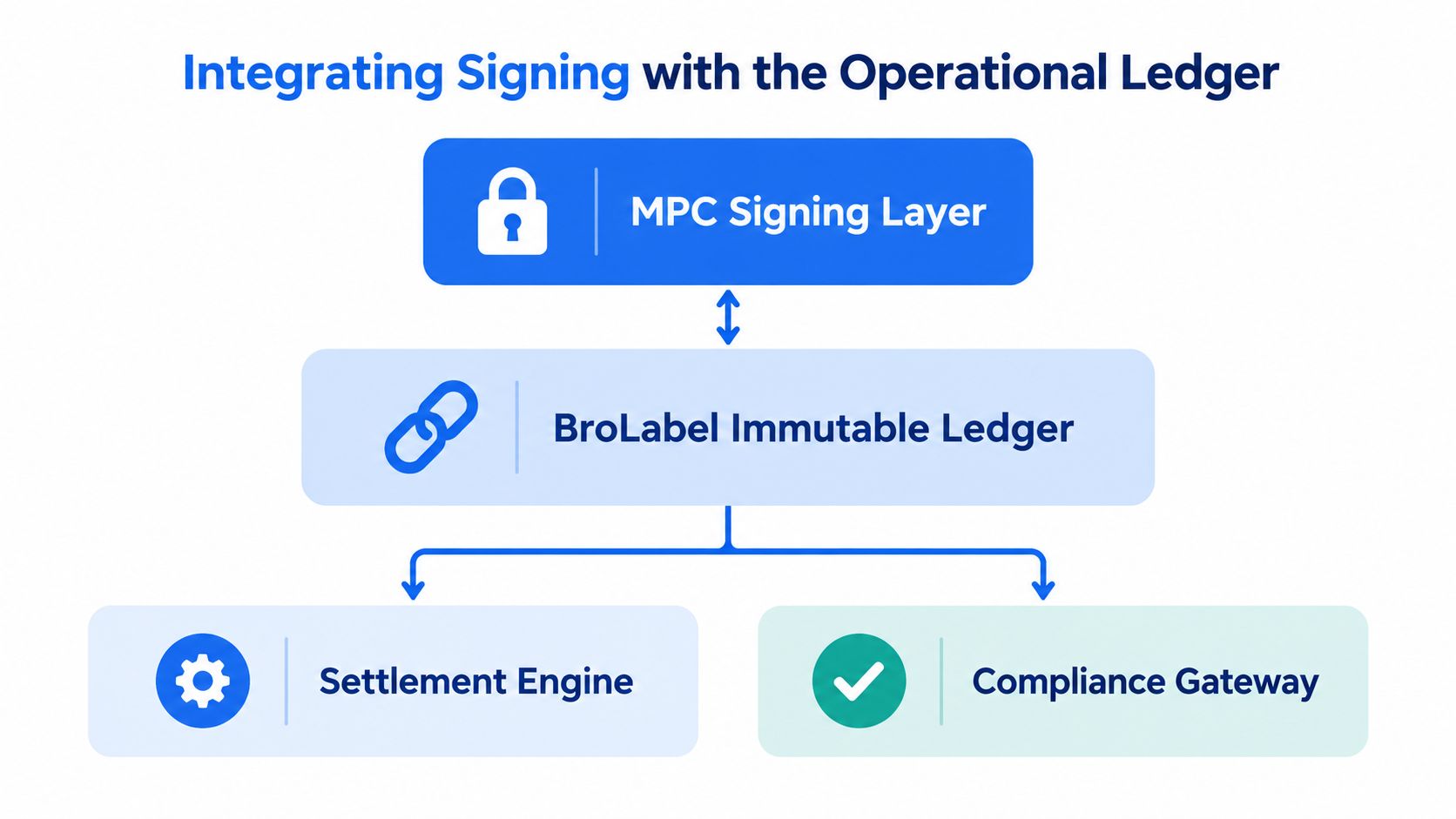
An append-only operating ledger should capture the business event and the cryptographic event as related records. The withdrawal request, policy outcome, signing attempt, broadcast identifier, confirmation updates, fees, and reconciliation result should remain connected without allowing an operator to rewrite history after the fact.
Make state explicit
A useful event model separates intent from outcome:
- Requested: The application created a withdrawal or settlement instruction.
- Screened: Risk and compliance checks returned a policy result.
- Approved: The authorized parties accepted the instruction.
- Signing: The threshold protocol is exchanging messages.
- Signed: A valid signature was produced.
- Broadcast: The transaction was submitted to the network.
- Confirmed: The network state met the configured confirmation rule.
- Reconciled: The ledger balance and external network data agree.
WebSocket events can stream these transitions to operations dashboards, reconciliation services, and customer-facing status systems. The API should also expose durable state so a consumer can recover after disconnecting. Events are notifications, not the ledger itself.
Idempotency belongs beside signing
A retry-safe withdrawal flow needs an idempotency key tied to the business operation. The system should return the existing operation when the same request is retried, rather than initiating another approval or signing ceremony.
This matters during outages. A client may lose its connection after submitting a withdrawal, while the platform continues processing it. Without idempotency and durable state, the client may submit again and create a duplicate. With them, the client can query the original operation, receive its event history, and reconcile the final result.
The broader stack can connect embedded wallets, network broadcast, fiat movement, card balances, and compliance records through one operating model. BroWallet supports wallet interactions across web, mobile, and Telegram contexts, while AI Agent Wallets can apply per-agent ownership, role-based access, and audit trails. The value isn't just fewer integrations. It's a single operational vocabulary for authorization, settlement, and review.
Frequently Asked Questions by Infrastructure Buyers
Is a threshold signature scheme ready for post-quantum migration?
Not automatically. Existing ECDSA and Schnorr threshold designs address distributed control, but they don't by themselves provide post-quantum security. Recent research describes post-quantum threshold schemes as still heavy, with signature sizes an order of magnitude larger than post-quantum digital signatures in some designs. A newer construction approaches the size of a single Dilithium signature for thresholds up to eight users, showing progress but also the remaining engineering trade-offs. See the research on post-quantum threshold signatures.
Treat migration as a design path, not a product checkbox. Ask which signature families are supported, how addresses and assets would migrate, and whether the implementation has an interoperability plan. A 2026 NIST-related conference paper identifies an interoperability gap for threshold schemes aligned with ML-DSA, which indicates that production guidance is still developing. Cybersecurity controls around identity, access, monitoring, and recovery remain important during that transition, as the material on cybersecurity for mid-market enterprises also makes clear.
How does a non-custodial model differ from a white-label wallet?
A non-custodial architecture keeps signing authority distributed and gives the client a defined control role. A traditional white-label stack may present a branded wallet while centralizing key control and policy execution with the vendor. Buyers should inspect who can authorize transactions, who can change policies, and how the client recovers if the provider is unavailable.
How can an iGaming operator manage per-player USDT flows?
Create a distinct TRC20 deposit address for each player, associate deposits with the internal player ledger, and process deposit.observed and deposit.confirmed events separately. Payout signing should evaluate the operator's policy before the transaction enters the threshold signing flow. Reconciliation must connect the player balance, blockchain transaction, fee treatment, and payout decision.
What should a CTO test before production?
Test signer loss, duplicate requests, policy revocation, delayed confirmations, reconciliation differences, share rotation, and recovery from disconnected WebSocket consumers. Review audit records as a compliance user, not only as an engineer. A sandbox that demonstrates successful signing but doesn't exercise failure states isn't a production readiness test.
BroLabel provides embedded MPC wallets, a client-controlled Co-Signer, signing policies, WebSocket events, an append-only operating ledger, network broadcast, and fiat and card integrations for teams building financial products. Visit BroLabel to review the infrastructure and discuss how its threshold signing model can fit your custody, settlement, and incident response requirements.