A treasury team sees a USDT transfer confirmed on-chain. Finance still shows the payout as pending, and support can't tell the customer whether the money has left. The chain, the internal ledger and the customer-facing status each tell a different story.
That uncertainty is the ledger gap, the window in which value has moved but no record agrees on what happened. For founders and operations teams, tokenization as a service isn't just a way to issue digital assets. It's the operating layer that connects permissions, signing, compliance, transaction processing, reconciliation and settlement, while making clear who is responsible when an on-chain token and the legal ownership record diverge.
This guide maps the operating layers, compares buyer use cases and custody models, walks through a payout, and sets out the controls and launch checks that help close the gap.
Table of Contents
- Why Tokenized Launches Stall at the Ledger Gap
- What Tokenization as a Service Covers Layer by Layer
- Business and Technical Use Cases by Buyer
- Choosing Between API, Custody and MPC Models
- How a Payout Flow Closes the Ledger Gap
- Security and Compliance Controls to Test Before Launch
- Run the Launch Checklist Before Go-Live
- Buyer Questions About Tokenization as a Service
Why Tokenized Launches Stall at the Ledger Gap
Tokenization represents a financial or real-world asset as digital units that can be issued, transferred, recorded and settled on distributed-ledger infrastructure. A 2024 survey by the Bank for International Settlements found that 48% of responding jurisdictions had private- or public-sector entities working on financial or real-asset tokenization by the end of 2024, while 38% reported tokenized assets already issued. Bonds were the most common asset category, followed by investment-fund shares, real estate, equities and commercial paper.
That adoption is no longer a question of whether a team can mint a token. The harder question is whether the operation around it works: who can hold and transfer it, which records establish ownership, what checks run before signing, and how finance learns that a transfer has settled. Tokenization projects stall when the wallet, compliance record, chain status and accounting entry live in separate systems with no shared definition of “complete.”
A useful way to understand this is through revenue reconciliation explained by Creem, which shows why matching transaction activity to financial records is an operating discipline, not a back-office afterthought. The same principle applies to tokenized assets: an event on one system is not a complete business record until it can be matched to the relevant policy decision and ledger entry. For background on the infrastructure beneath these flows, see BroLabel's guide to blockchain digital infrastructure.
Practical rule: A transfer isn't final for the business until the policy decision, chain confirmation and ledger entry agree.
The buyer's question has shifted from “Can we mint it?” to “Can we operate it safely from issuance through settlement?” The practical outcome should be a layer map, a use-case matrix, an integration comparison, a control table and a launch checklist that assign owners to the points where records can diverge.
What Tokenization as a Service Covers Layer by Layer
A token is like a receipt for a box in a warehouse. The receipt can move quickly, but the warehouse still needs to know who owns the box, whether it may leave and who checks it. Tokenization as a service rents that operating layer through an API rather than requiring a team to build every component itself.
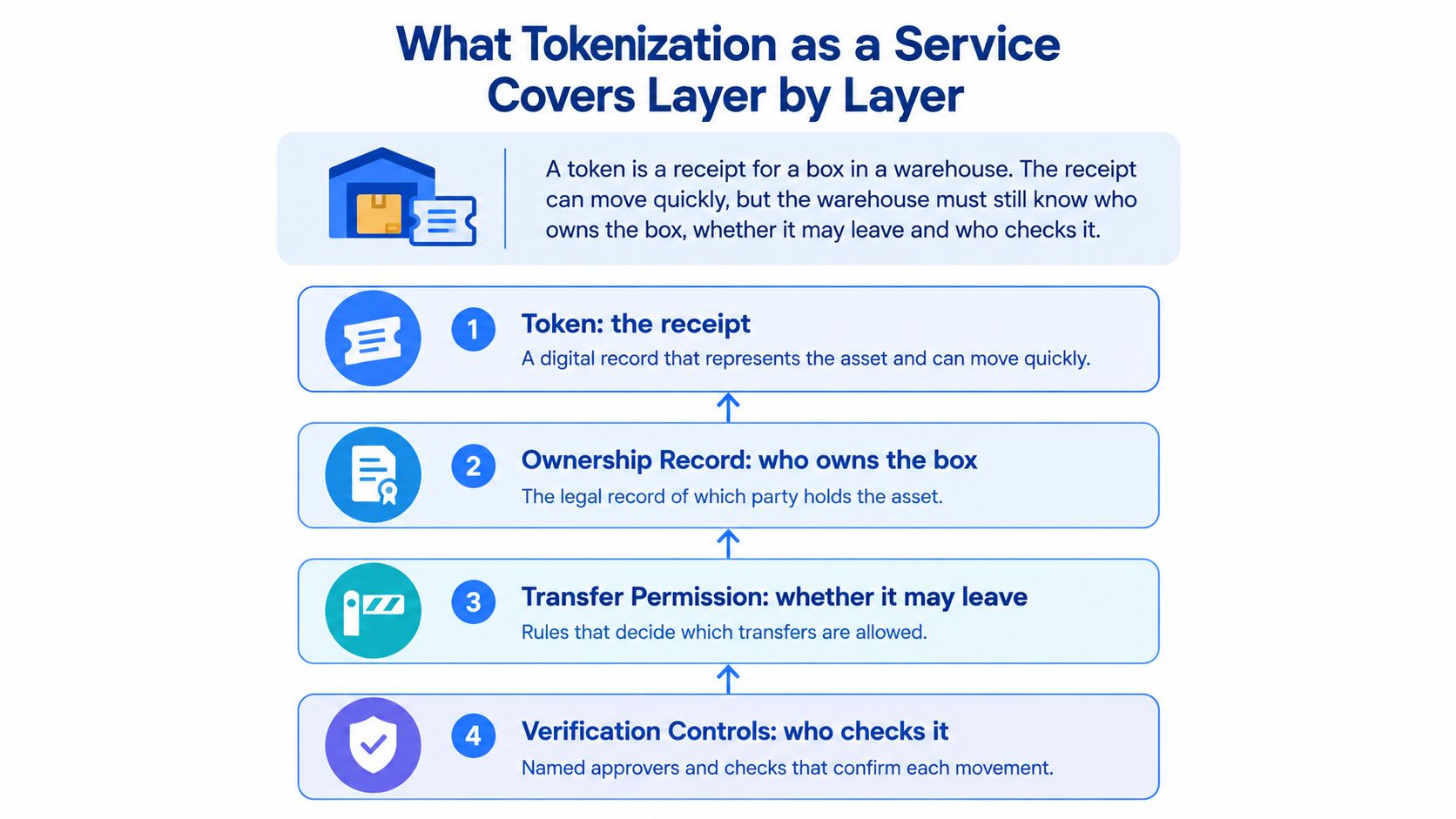
Production platforms separate issuance, provisioning, processing and lifecycle management. The EMVCo payment-token framework illustrates why: payment-token systems need controls around token requests, generation, provisioning and processing, as well as security boundaries around sensitive data. A token that is limited to a merchant, device or transaction context is harder to replay outside its permitted use. A segregated vault or equivalent sensitive-data boundary also reduces exposure, though systems that connect to or handle cardholder data can remain in scope for payment-card security requirements.
There are two meanings of tokenization worth separating. Asset tokenization represents securities, funds or treasury instruments on a ledger; payment tokenization replaces card numbers with payment tokens. This guide focuses on asset and stablecoin operations, where legal records, transfer rules and settlement determine whether a token movement corresponds to a business outcome.
| Layer | What it does | What fails without it |
|---|---|---|
| Issuance | Creates the token and binds it to an asset ID and issuing entity | Tokens with no traceable issuer or asset identity |
| Provisioning | Enrolls wallets, permissions and scoped API keys | Unauthorized or overbroad access to funds |
| Processing | Broadcasts transactions and tracks them across selected networks | Duplicate, lost or silently delayed transfers |
| Lifecycle management | Handles freeze, revoke, redemption and corporate actions | No controlled exit when a position must be closed |
| Ledger and reconciliation | Keeps an append-only record of every state change | Balances disagree with the chain and with finance |
| Settlement and cash legs | Connects tokens to fiat, card or bank rails | Tokens that can't be turned into cash on time |
Asset identity must also be explicit. The OECD describes the ISO-standardized Digital Token Identifier as a way to identify digital ledgers and tokens consistently across networks and jurisdictions. An API should keep the asset identifier, issuing entity, legal wrapper, network, transfer restrictions, settlement status and authoritative ownership record as separate but linked fields. Then a difference between a chain balance and a legal register becomes an exception to resolve, not a mismatch hidden behind a single “balance” field.
BroLabel combines API-first infrastructure for embedded MPC wallets, operational logs, network broadcast, card products and fiat integrations, so teams can use a coordinated operating layer rather than stitch every component together from separate vendors.
Business and Technical Use Cases by Buyer
Start with the failure that would cause the most damage, then choose the controls and components that contain it. A team that can't tolerate an unauthorized withdrawal should design around signing policy first; a team that can't reliably identify which player funded a balance should design around player-level reconciliation.
| Buyer | Primary use | Dominant requirement | Stack component |
|---|---|---|---|
| Crypto exchange | Hot-wallet withdrawals | Policy-gated signing before broadcast | BroSettlement with Co-Signer |
| Neobank or fintech app | Stablecoin balances, fiat funding, card spend | Per-user wallets and card-to-balance linkage | BroWallet; BROcard in development |
| Payment gateway or PSP | USDT and USDC settlement and payouts | Event-driven status matched to ledger | WebSocket events and operating ledger |
| iGaming operator | Per-player USDT deposits and payouts | Operator policy before payout and player-level reconciliation | Per-player TRC20 address; deposit events; append-only log |
| Treasury or stablecoin issuer | Mint, redeem and internal treasury moves | Role-based approvals and audit trails | Scoped API keys, RBAC, ledger |
| Tokenized fund or asset issuer | Ownership records and transfers | Eligibility and registry match before final settlement | Correlation IDs and exception queues |
| AI agent builder | Actions performed by software agents | Per-agent spend limits and audit | AI Agent Wallets; in development |
Two requirements often surprise teams. For exchanges, a hot-wallet withdrawal needs policy-gated signing before broadcast. That means the system should evaluate the withdrawal, route approval through a client-controlled Co-Signer where required, and only then request a signature. A single approve button with no enforceable policy boundary makes it difficult to separate routine operations from exceptions.
For iGaming, the hard problem isn't merely receiving funds quickly. Operators need a TRC20 USDT deposit address for each player account, with deposit.observed and deposit.confirmed events, then an operator policy that runs before any payout is signed. BroLabel supports the per-player wallet and deposit-event pattern without a custodial PSP, while an append-only log supports reconciliation of player balances.
The stack should follow the buyer's dominant control. Neobanks and fintechs need per-user wallets and a clear relationship between balances and funding flows; BROcard remains in development, and availability depends on the issuer, partners and market. Payment gateways need settlement events tied to ledger entries. Treasury teams need role-based approvals and audit trails, while tokenized fund issuers need linked transaction IDs and exception handling when an ownership register and network state don't match. AI Agent Wallets are also in development, so teams should confirm readiness before making them a launch dependency.
Choosing Between API, Custody and MPC Models
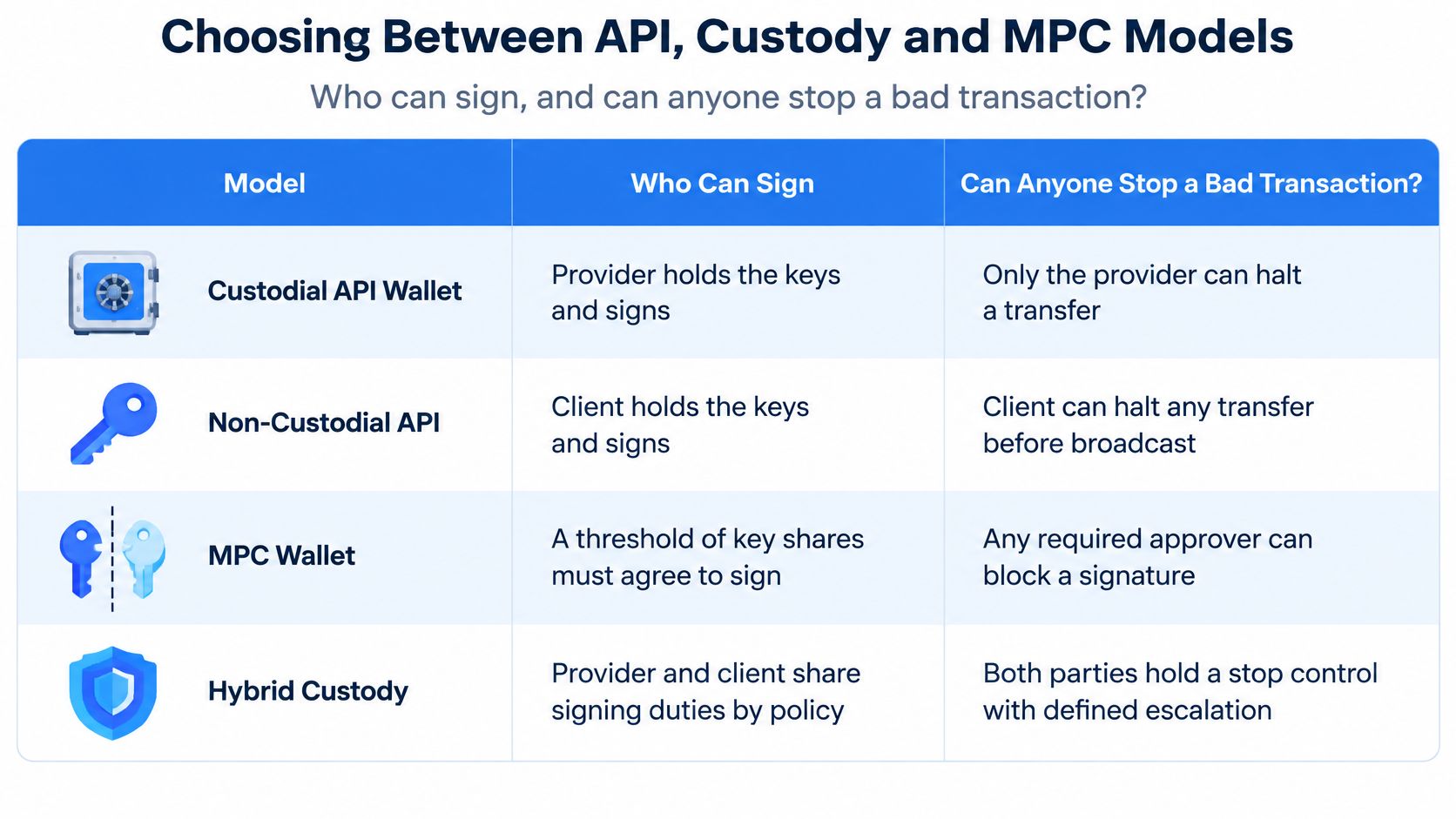
With an MPC 2-of-3 policy, any two of three authorized signing shares are needed to sign a transaction. That lets a client-controlled Co-Signer block a transaction, while loss or compromise of one share doesn't automatically expose the complete signing secret.
| Model | Who holds signing power | Client control kept | Best fit | Main trade-off |
|---|---|---|---|---|
| Custodial API wallet | Provider holds the keys | Low; depends on provider policy | Fast pilots with low value at risk | Counterparty concentration |
| Single self-managed key | Client team holds one key | Full, but unshared | Small teams with strong key operations | One compromise exposes all funds |
| MPC 2-of-3 with client Co-Signer | Three shares; any two sign | High; Co-Signer can block | Production treasury, exchanges, iGaming payouts | Policy design and approval workload |
| Hybrid MPC with pre-approved limits | Shares plus policy engine | Medium to high, set by threshold | Mixed-volume products with routine payouts | More configuration and testing |
A custodial API wallet is straightforward to integrate, but the provider holds the signing power, so the client's intervention options depend on provider policy. A single self-managed key gives the client direct control, but concentrates the signing risk in one secret and the operational procedures around it. These models can be appropriate for different levels of exposure; neither removes the need to define who can authorize movement.
MPC distributes signing authority across parties. NIST's threshold-cryptography program describes secure multiparty computation as allowing parties to perform a computation jointly without revealing their private inputs to one another. That provides the technical basis for splitting signing authority instead of keeping one complete private key in a central service.
MPC reduces a single point of failure, but it adds approval routing, policy design and operational work.
The hybrid option adds pre-approved limits to threshold signing. It can make routine payouts easier to handle while retaining a higher approval bar for exceptions, but the limits and exception paths need careful testing. Commands such as payout requests fit a REST API; changing state, such as confirmation or failure, fits a WebSocket event stream. The integration pattern should mirror the custody model, so an approval is not treated as complete until the required signer action has been recorded.
For a more detailed distinction between key control and operational custody, see BroLabel's guide to digital asset custody. Before choosing a provider, get clear answers to three questions: Who controls each signing share? How are policy exceptions recorded? Can the client veto a transfer before it is signed?
How a Payout Flow Closes the Ledger Gap
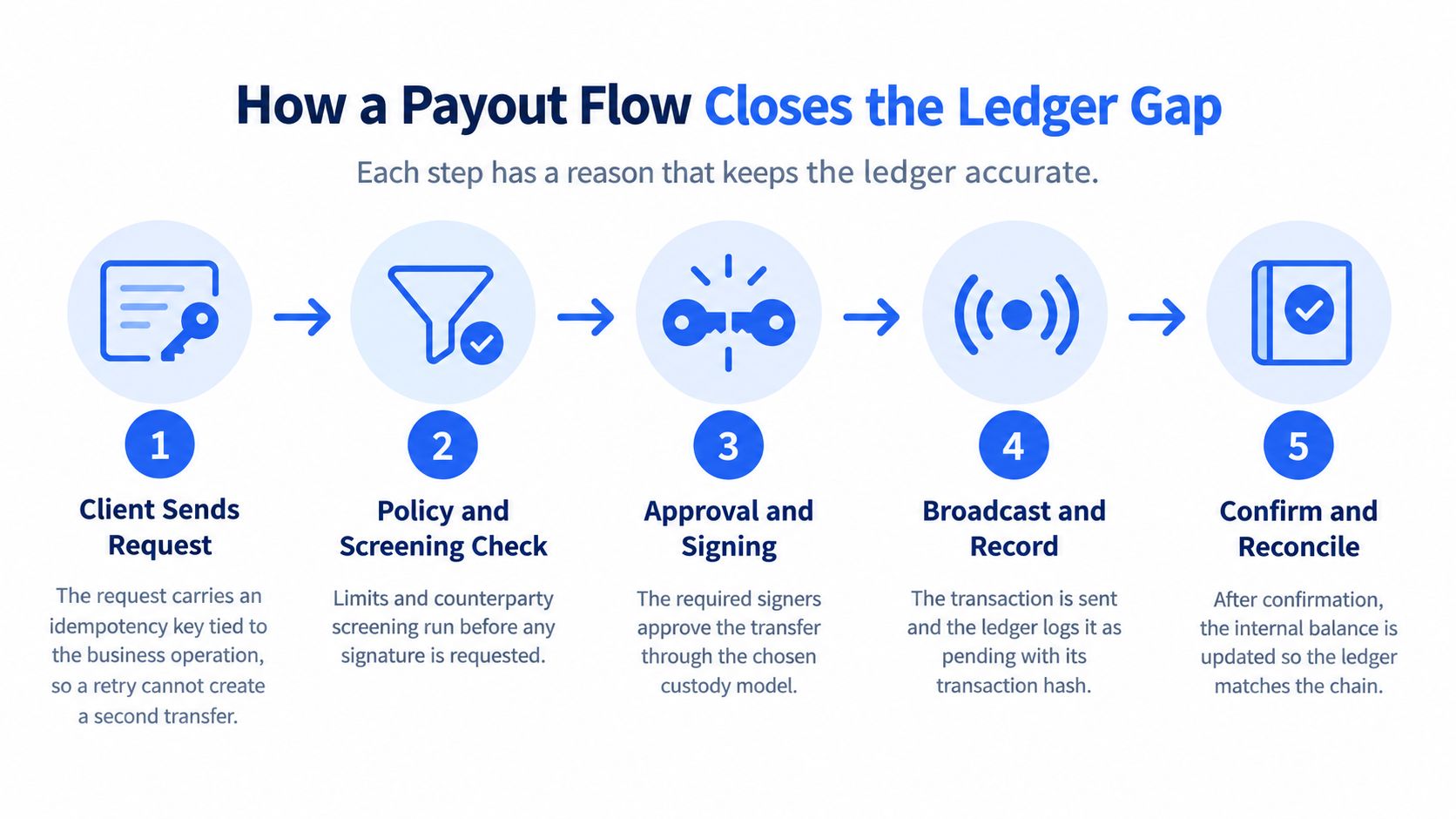
A payout closes the ledger gap only when each transition leaves an authoritative record. The gap is the window in which value has moved on-chain but the internal balance, the approval trail and the ownership record still disagree, and whoever holds the reconciliation duty owns that disagreement. The flow below ties the request, policy, signer, network and internal balance together so no state exists without a record naming who authorized it.
Create the request with an idempotency key. Tie the key to the business operation so a retry cannot create a second transfer. This gives the client a stable way to identify the operation even if a network response is lost.
Authenticate and scope the caller. Check the API key's permissions, IP allowlist and replay protections, using Ed25519 authentication. A valid credential should authorize only the actions its scope allows.
Evaluate policy and screening before signing. Check limits, destination rules, configured screening and required Travel Rule fields before requesting a signature. Running controls after broadcast cannot prevent a non-compliant transfer.
Route the request to the Co-Signer. The Co-Signer approves or rejects the transfer under the signing policy. This gives the client a meaningful stop control rather than an audit-only notification.
Produce the signature through MPC. The required signing shares authorize the transaction. The approval record should identify the policy outcome and the signers involved.
Broadcast to the selected network. Submit the signed transaction and store its transaction identifier and current state. Until the network reaches the configured finality threshold, report the status as pending rather than settled. A premature "settled" flag is how a chain reorganization becomes an unexplained balance change.
Publish state changes through WebSocket events. Send submission, confirmation or failure events to the client system as the state changes. Commands such as payout requests travel over REST; state changes belong on the event stream so the client never has to poll for an outcome it may have missed.
Record the operation in the append-only ledger. Capture the actor, policy result, timestamp and before-and-after balance. In an iGaming flow, the operator policy runs before payout signing, and the append-only log supports player-balance reconciliation, so a disputed payout can be traced to a named approval rather than reconstructed from chain data alone.
Reconcile internal records against network status. Compare the ledger entry with chain status and route mismatches into an exception queue with an owner and an aging limit. Teams building matching procedures can adapt the approach described in payment matching workflows with Loopfour, which focuses on connecting gateway activity to financial records.
BroLabel's guide to stablecoin payment infrastructure covers how these pieces fit together for teams integrating stablecoin flows.
Timeout rule: If the response is lost, query the outcome using the idempotency key and authoritative events rather than blindly resending. Keep the key valid for as long as a retry is plausible, never reuse it for a different request body, and treat an unresolved operation as pending until an event or query settles it.
Security and Compliance Controls to Test Before Launch
A signed transaction can still leave the books wrong. The gap opens when value moves on-chain while the ledger, approval record or legal ownership record tells a different story, so test the controls that decide who can move funds, who approved the move and which record wins when systems disagree.
| Risk | Control | Evidence to request |
|---|---|---|
| Duplicate payout after a timeout | Idempotency key per business operation; conflicting payloads rejected | Retry test showing one transfer |
| Single-key compromise | MPC 2-of-3 with shares under separate control | Key-share custody map |
| Insider override of a payout | Co-Signer approval and RBAC; overrides logged | Sample audit log with actor and policy result |
| Chain delay, rejection or reorganization | Network-specific finality thresholds before a transfer is final | Confirmation policy per network |
| Missed sanctions or AML hit | Screening scope set per service and written into the customer contract | Screening scope document for each service |
| Leaked or overbroad API credentials | Scoped keys, Ed25519 authentication, IP allowlist | Key rotation and access review log |
| Ledger and chain disagree | Reconciliation with exception queue | Reconciliation report and exception aging |
Log enough detail to reconstruct authority after the fact: user, event type, time, outcome, origin and affected resource. Apply that evidence standard to Co-Signer approvals, API-key changes, privilege changes and payout overrides so a reviewer can see who authorized an action and which policy allowed it. KYC or KYB enters only when the specific service requires that check under its terms or provider, so the evidence should name the trigger rather than assume a blanket identity process.
The compliance perimeter needs the same precision. FATF Recommendation 16 applies the Travel Rule to virtual-asset transfers, and jurisdictions may use a USD/EUR 1,000 de minimis threshold; review the FATF guidance on Travel Rule supervision with counsel and compliance teams against the services and jurisdictions involved. Below that threshold, keep the workflow explicit about what originator and beneficiary data is collected, when wallet addresses or transaction references are required and how linked transfers are aggregated.
Screening is not automatically applied to every BroLabel service. On-chain transactions may be checked by third-party blockchain analytics providers when AML screening is enabled for the relevant service, and risk, fraud or sanctions checks are configured for the specific service and agreed with the customer. Put that scope in writing, including which events are screened, which provider applies and who owns exceptions.
Legal responsibility belongs in the same test plan. Decide which record controls ownership when the token state and the off-chain register diverge, then assign an owner for disputes, reversals and end-user communication. For offerings that may be securities, SEC exemptions explained by Coto & Waddington can frame the registration questions counsel should settle before launch.
Public networks can delay, reject or reorder transactions, and BroLabel does not guarantee uninterrupted operation of systems outside its direct control unless an availability commitment or acceptance criterion is explicitly agreed in a signed Order Form or SLA. Treat the table as a test plan: every row should produce evidence that finance, operations and compliance can read the same way.
Run the Launch Checklist Before Go-Live
A sandbox that returns successful API responses isn't proof that the operating model works. Verify that every critical transition has a named owner and a record that finance, operations and compliance can interpret.
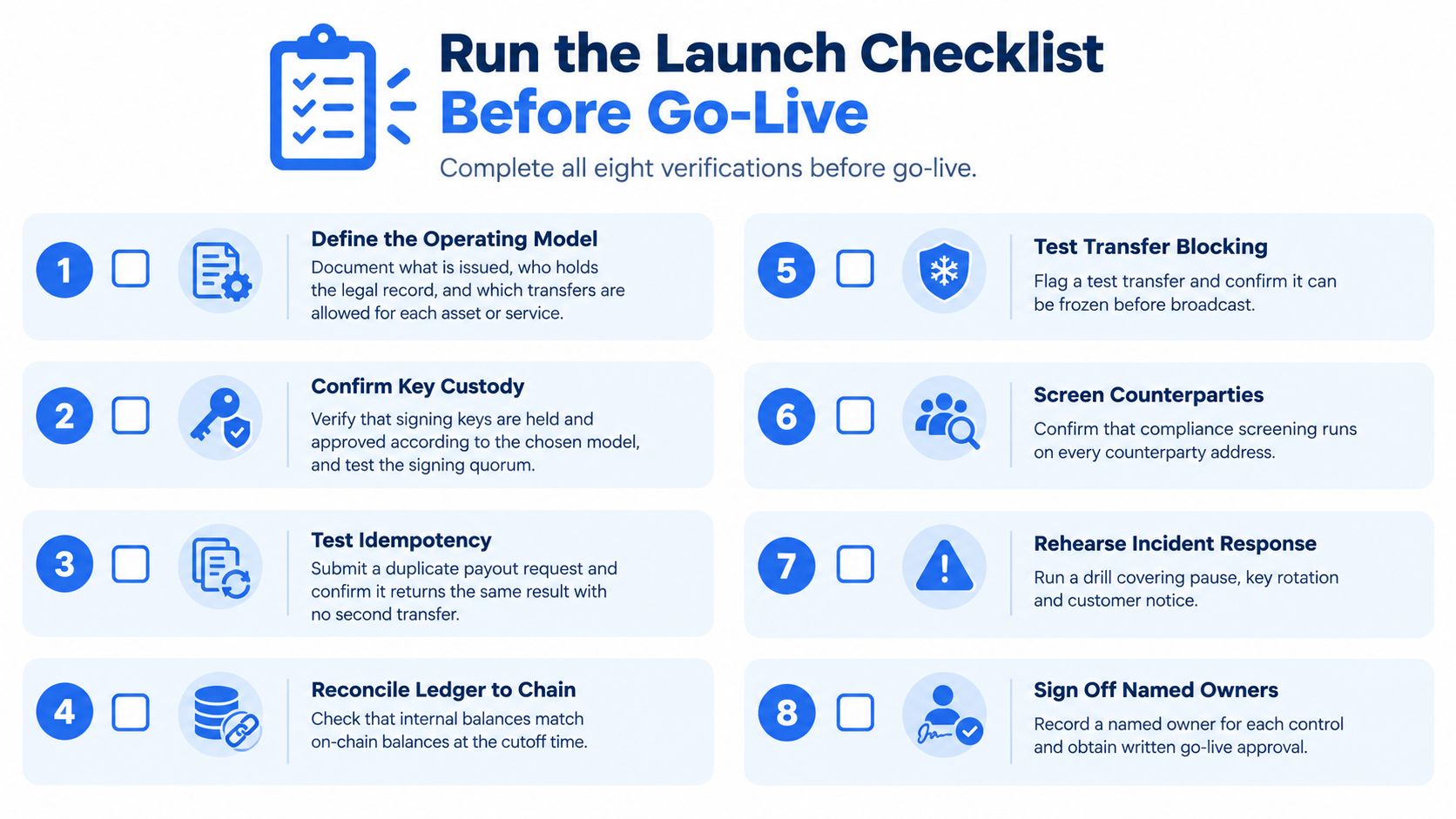
Define the operating model. Document what's issued for each asset or service, who holds the legal ownership record, and which transfers count as final. Verify that operations, finance and legal teams agree on the same definitions.
Choose the custody model. Record who controls each MPC share and whether the Co-Signer can veto a transaction. Verify the signing quorum with a test approval and rejection.
Set idempotency rules. Apply keys to withdrawals, payouts and webhook handlers, and reject conflicting payloads under the same key. Verify that a repeated request returns the existing operation rather than creating another transfer.
Create scoped API keys. Limit each key to the actions its service needs, set IP allowlists and define a rotation schedule. Verify that an access review identifies each key's owner and permissions.
Map WebSocket events to ledger entries. Subscribe to deposit, confirmation, withdrawal and policy-outcome events. Verify that each event updates the correct internal operation and balance state.
Run a reconciliation dry run. Reconcile sandbox activity and deliberately route a mismatch into an exception queue. Verify that an assigned owner can resolve it with a documented record.
Confirm AML and KYC scope in writing. Document which services require each check and who defines the applicable workflow. Verify that compliance has approved the configuration before production.
Complete configuration and launch sign-off. BroLabel's building and configuration step covers API integration, admin-console setup, compliance configuration and fee-engine calibration; launch moves the integration to production with a defined signing policy, event handling and support. Verify that the signing policy is approved and a support contact is named.
Use the relevant operating guides for BroSettlement, BroWallet, Co-Signer and AI Agent Wallets as you assign owners and test controls. For product details, visit BroLabel. Questions about AML policy or checks for a specific service can be sent to compliance@brolabel.io.
Buyer Questions About Tokenization as a Service
Who is liable when the token and legal ownership record diverge? The legal wrapper and issuer's register define legal ownership, while the provider's ledger and reconciliation process should show where the records disagree. Put responsibility for maintaining the authoritative register, resolving mismatches and communicating with affected parties into the contract before launch.
Can a provider guarantee liquidity? No, a provider can create an instrument and connect cash rails, but it can't guarantee secondary-market depth, redemption liquidity or collateral eligibility. Ask which networks and fiat exit paths are supported, and what share of your expected flows can reach regulated rails.
Is KYC required for every user? Not always, since KYC may be required by a service's configuration, contract, jurisdiction or provider. The operating model should state which service requires checks and when KYC data is processed.
What happens if the chain is slow? The transaction may remain pending, be rejected or be reordered, so customer-facing status should stay honest until the network's finality threshold is met. Define what support says during that interval and how the team reconciles any later change in status.
BroLabel provides API-first infrastructure for embedded MPC wallets, operating-ledger records, network broadcast, card products and fiat integrations. If you're designing tokenized flows, visit BroLabel to review the infrastructure and discuss your operating model, signing policy and service-specific compliance scope before go-live.