USDT, also called Tether, is a blockchain token issued by Tether that is designed to track one U.S. dollar and runs on several separate networks.
If two wallets both display USDT, does that mean you can transfer between them safely? Not necessarily. For an institutional team, the useful unit isn't just the token ticker. It's the token, its network, the signing authority, and the accounting record.
Table of Contents
- What USDT Is in Plain Terms
- How the Peg and Reserves Keep USDT Near One Dollar
- Why USDT Differs by Network
- Where Teams Use USDT in Payments and iGaming
- Custody Models and Who Controls the Keys
- Tracking Deposits and Reconciling USDT Records
- Compliance Controls and a Planning Checklist
- Frequently Asked Questions About USDT
What USDT Is in Plain Terms
USDT is a dollar-referenced stablecoin, a transferable token intended to provide a dollar-denominated balance on a blockchain. Think of it as a dollar-denominated chip that moves on a shared ledger instead of through a bank wire. The analogy explains how it moves, but it doesn't make the token a bank liability or guarantee redemption through whichever application holds it.
A customer might see a USDT balance inside an exchange, a payment application, or a wallet. Those screens can look similar while representing different arrangements. An exchange account may show the provider's internal record; a self-controlled wallet displays assets associated with a blockchain address.
USDT at a Glance
| Attribute | Detail |
|---|---|
| Issuer | Tether |
| Peg target | 1 USDT to 1 U.S. dollar, approximately |
| First launched | October 2014 on Omni, a token layer built on Bitcoin |
| Backing | Reserves including traditional currency, cash equivalents and other assets |
| Form | Blockchain token transferable between compatible wallets |
| Networks | Multiple public blockchains, each carrying its own version |
These attributes describe the instrument, not the safety of every platform offering it. For a broader explanation of the category, The Coin Course stablecoin guide provides useful context for distinguishing stablecoins from other crypto assets.
USDT is not:
- A bank deposit. Holding the token isn't the same as depositing dollars at a bank.
- The U.S. dollar itself. Its value references the dollar.
- Government-issued currency. A private issuer operates the reserve-backed instrument.
- A guaranteed balance. Access and value involve issuer, platform, wallet, and network risks.
For a product team, the distinction changes how balances should be labeled. Use an asset label that identifies USDT rather than presenting it as unrestricted cash. After identifying the instrument, establish which network carries it before generating payment instructions.
How the Peg and Reserves Keep USDT Near One Dollar
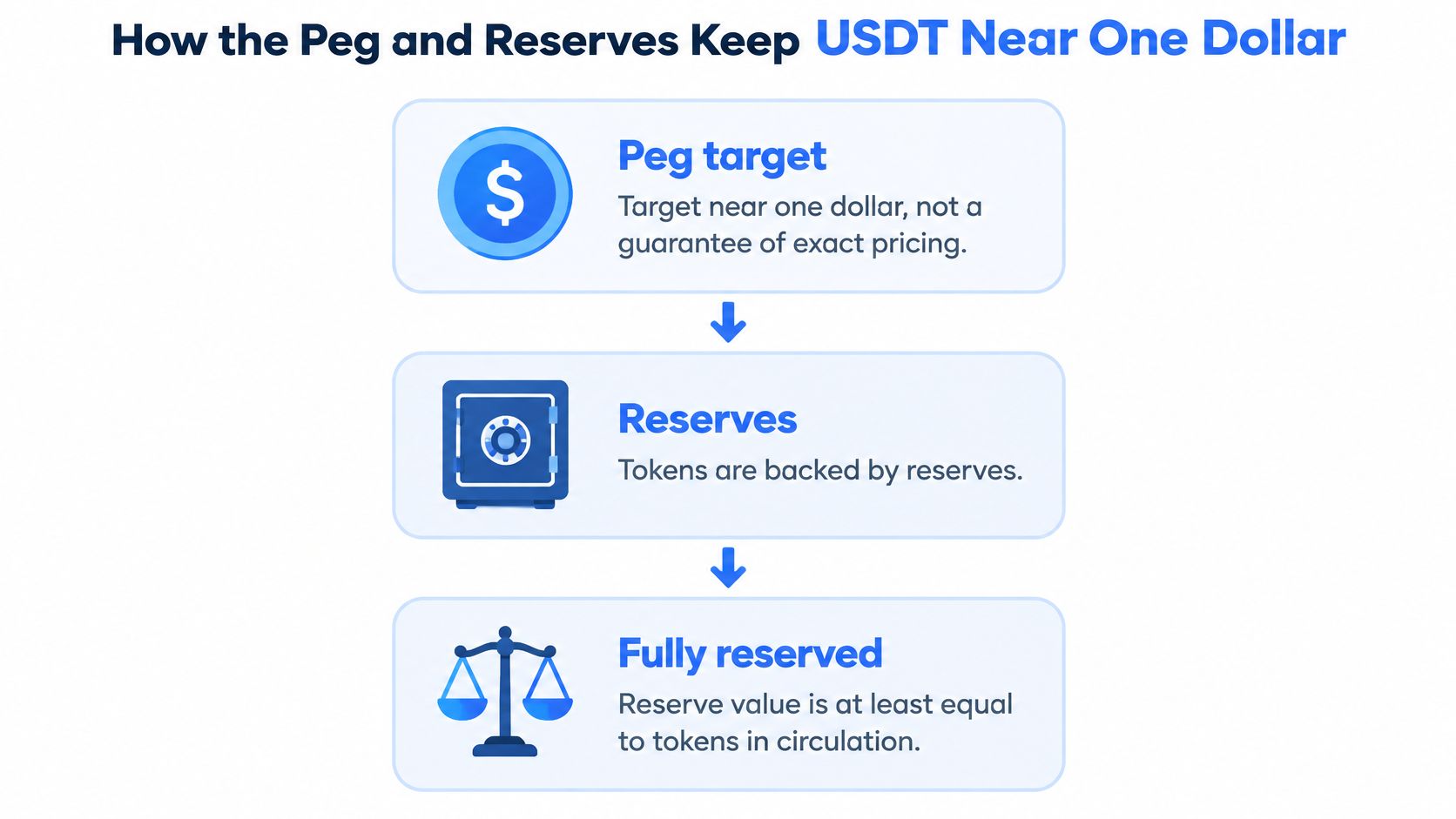
The peg is a target, not a promise that every exchange quote will always equal a dollar. According to StablecoinBeat's USDT reference, USDT targets approximately 1 USDT to 1 U.S. dollar, launched in October 2014 on Omni, and is fully reserved under Tether's definition when reserve value is at least equal to tokens in circulation.
That reference describes reserves as traditional currency, cash equivalents, and other assets, including receivables from loans to third parties. It also describes quarterly reserve reports with independent assurance from BDO Italia. Circulation reporting and reserve reporting serve different purposes: token supply tells you how much is outstanding, while the reserve report describes the backing at its reporting date.
Backing and Market Price Are Different Questions
A warehouse receipt is a useful analogy: its usefulness depends on the stored assets, the process for obtaining value against it, and buyers' confidence. It isn't a literal description of every holder's legal redemption rights.
For scale, BIT's USDT explainer reports that Tether's Q4 2025 market capitalization reached $187.3 billion, while total reserves reached $192.9 billion. Those are dated figures, not a live reserve balance.
A reserve portfolio isn't a pile of physical dollars allocated individually to every token. Reserve quality, access to redemption, trading liquidity, and confidence all matter. During market stress, buyers and sellers on a particular exchange may transact slightly above or below the target.
Before making a treasury decision:
- Find the latest reserve report. Read the asset categories and liabilities it covers.
- Check its date. Don't treat a reporting-date snapshot as continuous verification.
- Compare the executable quote with the peg. Include the spread and conversion route, not just the displayed price.
Why USDT Differs by Network
The enemy is the wrong-network transfer, which can be unrecoverable or never reach a usable balance.
The same ticker can identify separate chain-specific tokens. Tether's transparency disclosures describe a multi-network instrument, so infrastructure teams must treat the chain and token contract as part of the asset's identity. TRON's TRC-20 implementation isn't interchangeable with Ethereum's ERC-20 implementation.
A recipient supporting Ethereum USDT hasn't necessarily agreed to accept a token on another EVM-compatible network. Even where address formats look identical, the receiving platform may monitor only the selected chain.
Common USDT Networks and What Differs
| Network | Fee profile | Verification step |
|---|---|---|
| TRC-20 on TRON | Usually low; paid with TRON network resources | Confirm TRON network and USDT contract address |
| ERC-20 on Ethereum | Set by network congestion; paid in ETH | Confirm contract address and chain ID 1 |
| BEP-20 on BNB Smart Chain | Usually low; paid in BNB | Confirm BNB Smart Chain network and BEP-20 USDT contract address |
| Polygon PoS | Usually low; paid in POL | Confirm Polygon PoS network and USDT contract address |
| Solana | Usually low; paid in SOL | Confirm the recipient has a USDT token account |
These are routing comparisons, not fee quotes or assurances of issuer-native availability. Before enabling a route, determine whether the specific token is issuer-native, bridged, or another platform's representation. A familiar ticker doesn't establish that relationship.
Address validation also needs chain-specific rules. TRON uses a different address format from Ethereum, while EVM-compatible networks can share the same address appearance. Solana introduces token-account checks that an Ethereum-only validator won't perform.
Verify the Route Before Sharing the Address
- Network name. Match the sender's withdrawal network to the recipient's supported deposit network.
- Token contract. Validate the exact contract or token identifier against the approved asset configuration.
- Chain identity. Check the wallet's chain ID where applicable, rather than trusting its displayed asset name.
The network fee generally uses the chain's native token or network resources. A self-controlled wallet therefore needs a fee-funding plan as well as a USDT balance. An application may abstract that funding, but someone still has to supply it.
Practical rule: Record the network with every address before any transfer instruction is shared.
For consumer withdrawals, separate blockchain confirmation from operator approval. FastCashout's guide to TRON withdrawal times at casinos is useful context for understanding why a platform's withdrawal timeline isn't only a network-speed claim.
Choose the network before displaying the address. Then attach supported-token rules, confirmation policy, fee funding, and recovery limits to that route.
Where Teams Use USDT in Payments and iGaming
A payment or iGaming operator needs more than a transfer button. It needs to identify the customer, recognize the correct asset, and decide when a deposit can support a business action.
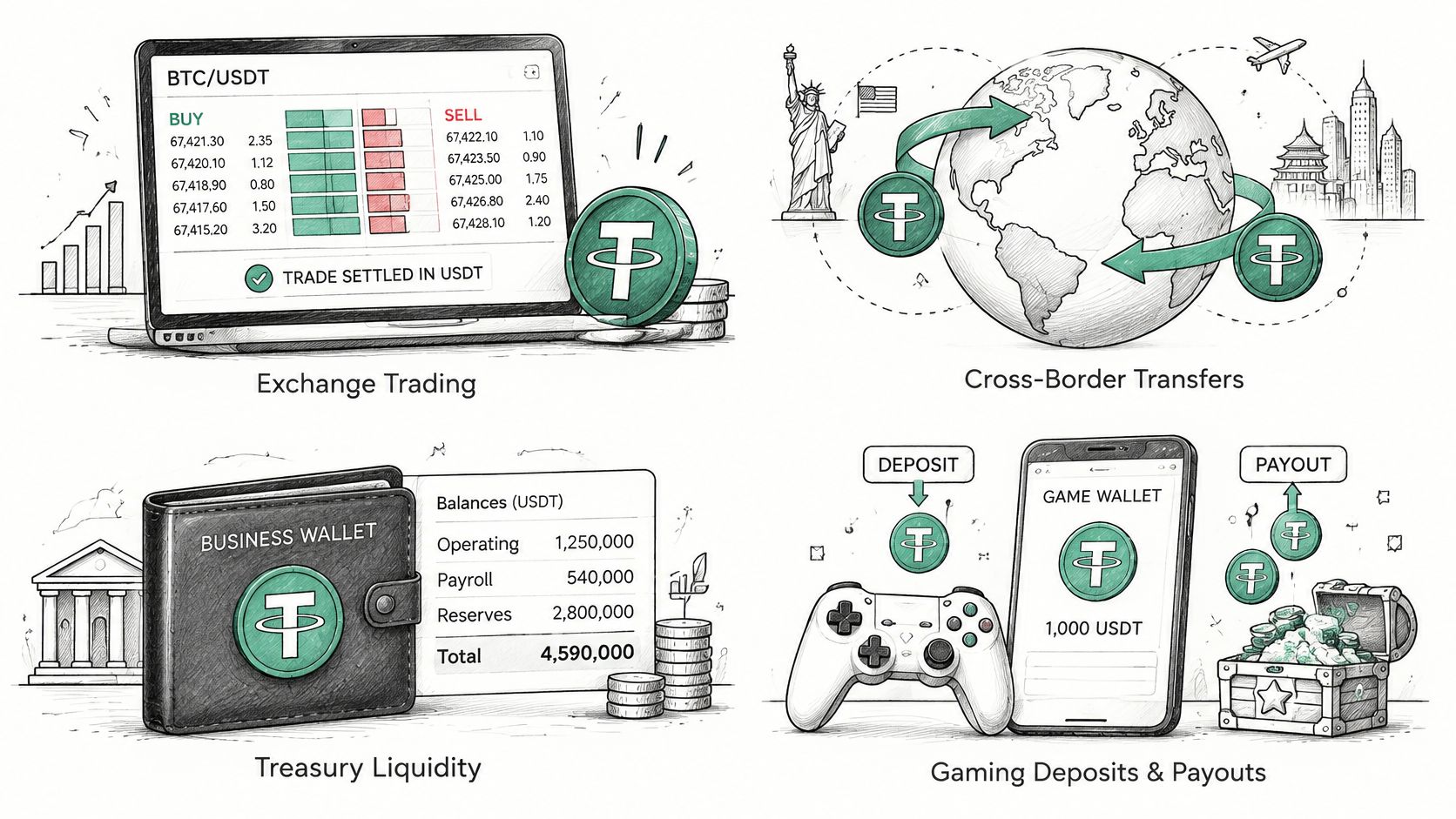
The main use cases are straightforward:
- Exchange settlement. Traders use dollar-denominated balances between trades.
- Cross-border transfers. Senders transfer tokens between compatible wallets, with any fiat conversion handled separately.
- Treasury liquidity. Businesses maintain balances for supported counterparties and settlement routes.
- Consumer deposits and payouts. Applications associate incoming and outgoing transfers with individual accounts.
Transfer Size Changes the Operating Problem
Cointribune's Q4 2025 activity report reports $4.4 trillion in USDT transfer value across 2.2 billion transactions, with 88.2% of transfers below $1,000. It also reports that wallets holding USDT increased by 14.7 million to 139.1 million, and identifies TRON as a major driver of Latin American activity, where USDT processed $32.4 billion from January 2021 through July 2025, nearly twice USDC's volume.
Wallet counts aren't counts of unique people, and transfer value isn't merchant revenue. Operationally, however, frequent smaller transfers make per-transfer fees, automatic matching, and exception handling important.
Consider a player who deposits while support is offline. The operator needs the assigned network, account mapping, and confirmation rule to work without a manual ticket. The iGaming operating scenario provides context for designing that account-level flow.
Consumer directories also shape expectations. Readers who browse anonymous Tether gambling sites through BetWithoutKYC may encounter anonymity claims; those claims don't establish an operator's legal obligations or withdrawal controls.
For your product, is the flow large and infrequent, or small and constant? Design the operating model around that answer.
Custody Models and Who Controls the Keys
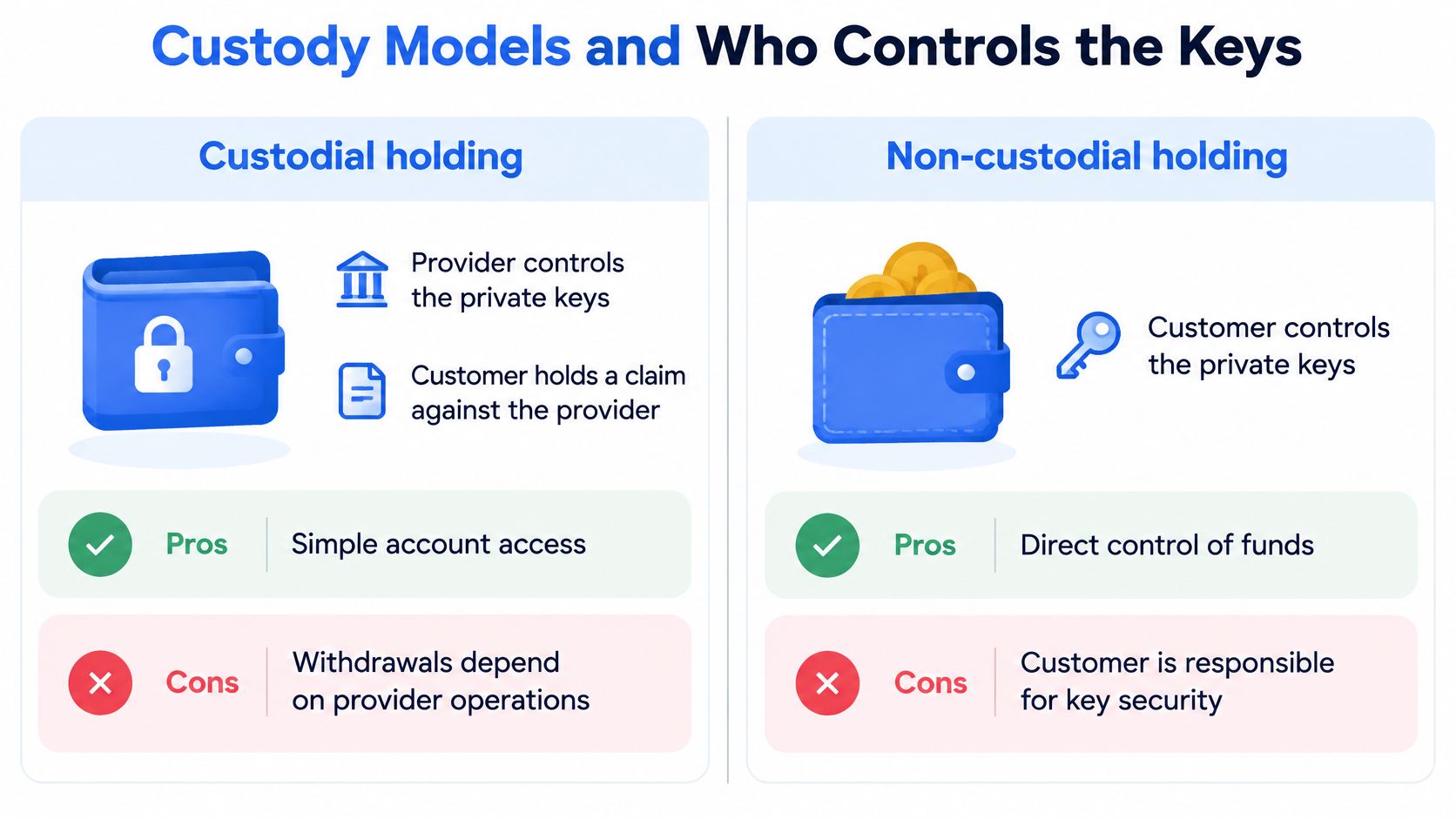
Custodial holding means a provider controls the private keys. The customer holds a claim against that provider, and withdrawals depend on its systems, approvals, and continued operations.
Non-custodial holding places signing authority with the customer or a customer-controlled arrangement. That doesn't automatically mean every non-custodial wallet uses shared approval. A single-key wallet and a threshold-signing wallet have different failure modes.
Threshold Signing Separates Authority
In our BroSettlement design, distributed key generation, or DKG, and MPC 2-of-3 signing distribute signing authority across key shares, with a Co-Signer under the customer's control. Three shares participate in the arrangement, and any two are required for signing; a single share isn't enough.
That design helps address key concentration, but the actual control rests in the share allocation and signing policy. A customer-controlled approval component must have documented deployment, recovery, and authorization procedures. A threshold label alone doesn't explain who can move funds.
The digital asset custody guide provides a useful framework for separating key possession, transaction approval, and operational responsibility.
Service access, signing authority, and ownership of assets are separate questions.
Our service restrictions apply only to the service. As stated in the service restriction terms, they don't deactivate an address on the public blockchain, transfer ownership of digital assets to BroLabel, or cancel blockchain transactions.
Make the Control Model Explicit
Document these questions before production access:
- Who holds each key share? Identify the organization, environment, and recovery owner.
- Who can approve a withdrawal? Separate customer instructions from transaction execution and signing permissions.
- What happens if the provider stops operating? Establish recovery dependencies, access requirements, and the customer's continuity procedure.
Don't describe a setup as customer-controlled merely because the customer can log into a dashboard. The decisive question is which parties can satisfy the signing threshold, under which policies, and with what recovery path.
Tracking Deposits and Reconciling USDT Records
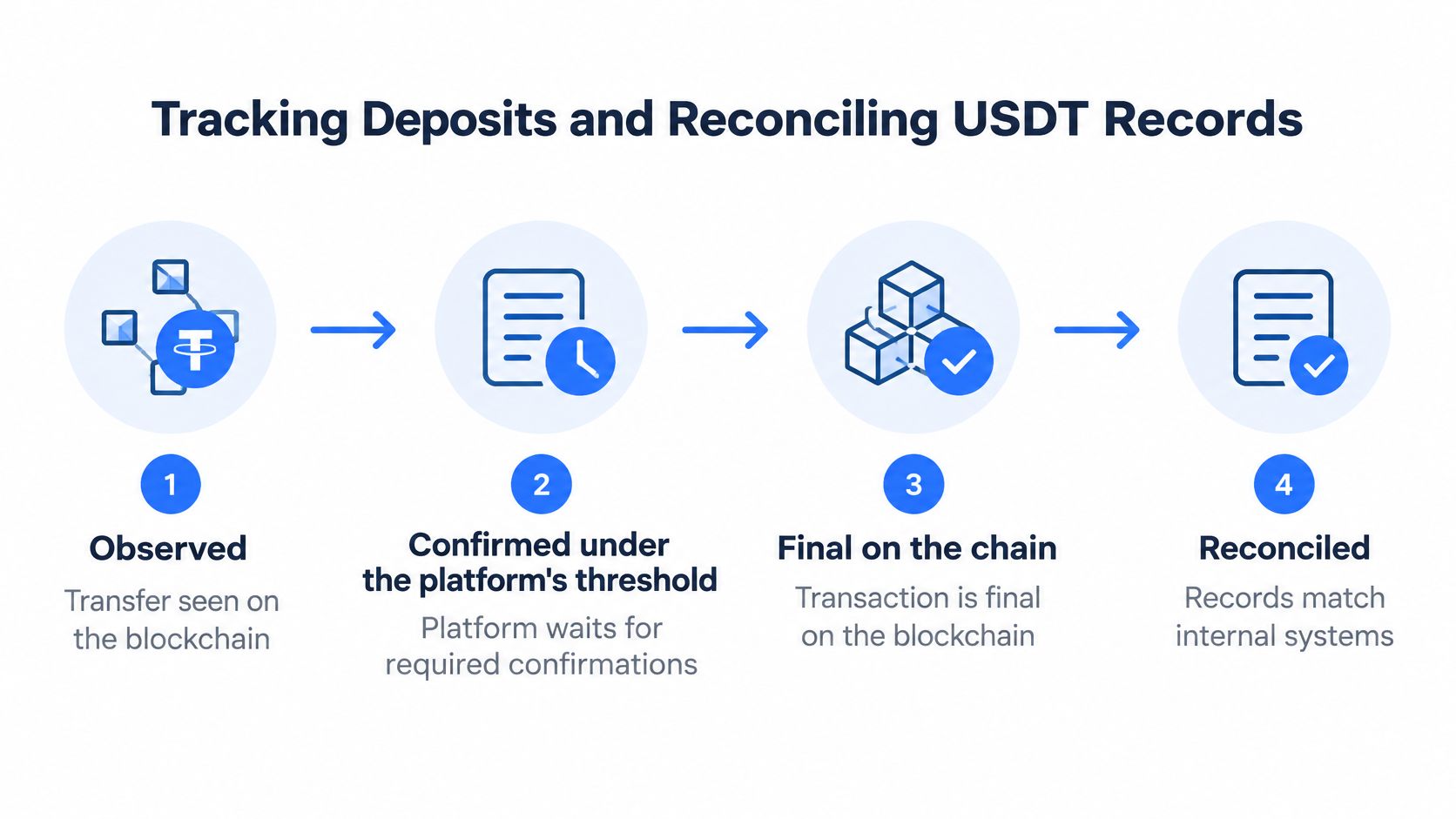
A blockchain transfer isn't final just because a monitoring system has seen it. An institutional application must distinguish observation, policy confirmation, chain finality, and ledger reconciliation.
TRON's transaction documentation describes transaction identifiers, execution status, confirmations, timestamps, participants, and contract information. For final-state workflows, its guidance supports using wallet-solidity queries or a locally indexed solidified-block record rather than treating the first observation as settlement.
USDT Transfer States and the Action Each Allows
| State | Meaning | Allowed action |
|---|---|---|
| Observed | Transaction seen on chain, not yet final | Show as pending; do not credit |
| Confirmed | Platform confirmation threshold met | Eligible for business action under policy |
| Final | Included in a finalized block under chain rules | Use for balance and report generation |
| Reconciled | Chain record matches the ledger entry | Close the item; exceptions go to review |
A deposit can emit deposit.observed, then deposit.confirmed when the configured policy is met. Credit for a business action follows that policy. Confirmation and finality may coincide in a particular implementation, but the application shouldn't assume they're identical.
Events Aren't Accounting Evidence by Themselves
WebSocket events help applications respond promptly. They don't prove settlement, guarantee delivery, or remove the need to replay and reconcile records.
Persist events before processing them. Deduplicate chain observations using transaction identity and, where applicable, the token-transfer event within that transaction. A transaction can contain multiple relevant movements, so transaction-hash deduplication alone shouldn't discard legitimate entries.
Use idempotency for business operations: retrying a credit or withdrawal request must return the existing result rather than create another movement. Keep the idempotency record separate from the chain transaction record, since a request can exist before broadcast.
Finance records should preserve:
- Asset identity. Issuer, chain, and contract address.
- Movement evidence. Quantity, transaction hash, and transfer-event identity where applicable.
- Accounting context. Valuation timestamp, customer account mapping, and reconciliation status.
- Review history. Status changes, exceptions, and the approvals that resolved them.
An append-only operating ledger preserves corrections as new entries instead of rewriting history. The digital payment process guide helps connect these records to application-level payment handling.
For withdrawals, separate signing and broadcast from final accounting. Record each transition immutably and route failed, replaced, or unmatched movements into a review queue.
Compliance Controls and a Planning Checklist
A stablecoin label doesn't settle regulatory status. Under FinCEN's virtual currency guidance, an administrator or exchanger of convertible virtual currency is a money transmitter when it accepts and transmits that currency, or buys and sells it for fiat or another convertible virtual currency, unless a limitation or exemption applies.
That's a U.S. regulatory analysis, not a global licensing conclusion. Teams serving other jurisdictions need advice on the activities, customers, and locations involved.
Match Each Risk to an Enforceable Control
Prepare a written role analysis answering who controls funds, who initiates transmission, who authorizes withdrawals, which jurisdictions are served, and which AML, screening, reporting, and recordkeeping duties apply.
Then translate those answers into enforceable permissions:
| Risk | Operating control |
|---|---|
| An application credential can initiate unauthorized payouts | Scoped API keys, role-based access, and separate signing approval |
| An automated agent exceeds its mandate | Per-agent wallet boundaries, policy limits, and retained audit trails |
| A retry creates duplicate financial activity | Idempotency records and deterministic request handling |
| A support action changes a financial record without evidence | Auditable approvals and append-only ledger corrections |
| A screening assumption isn't implemented | Written service-specific screening scope and exception ownership |
AI-driven workflows deserve the same separation as human-operated ones. An agent may prepare a transaction instruction without receiving unrestricted authority to approve and sign it. Give production credentials only the operations and account scope that the workflow requires.
Screening isn't automatically universal. We check transaction data for risk, fraud, or sanctions only when configured for the specific service and agreed with the customer. These checks aren't applied automatically to every service.
MPC reduces key-concentration risk. Non-custodial architecture changes control arrangements. Neither removes obligations created by the underlying business activity.
A Planning Checklist for Production
- Name the use case. Describe the customer, destination, conversion route, and whether flows are large and infrequent or small and constant. Assign an owner for failed transfers.
- Choose the initial networks. Bind each customer or player account to an explicit network and supported token configuration. Our coverage focuses on stablecoin-relevant networks, including TRON and major EVM and non-EVM networks, for practical USDT and USDC flows.
- Record custody authority. Identify key-share holders, withdrawal approvers, recovery responsibilities, and the boundary between customer instructions and infrastructure execution.
- Define events and reconciliation. Specify pending-credit behavior, confirmation policy, finality checks, and record fields. We support a TRON/USDT wallet per player without a custodial PSP, a TRC20 USDT deposit address per player account, and
deposit.observedanddeposit.confirmedevents. - Agree on screening scope. Identify which service performs which check, when it runs, who reviews a match, and what evidence is retained.
Before launch: Require the network list, event names, and key-control model in writing.
Also document what happens when monitoring is unavailable, native-token fee balances run low, or a reconciliation job finds an unmatched transfer. A production design needs a named exception owner, not just a successful sandbox transaction.
Request that written operating specification before accepting customer funds.
Frequently Asked Questions About USDT
What is USDT in one sentence?
USDT is a blockchain token issued by Tether that targets the value of one U.S. dollar and is backed by reserves.
Is USDT the same as U.S. dollars?
No. It's a privately issued, reserve-backed digital dollar instrument, not a bank deposit or government-issued currency.
Which network should I use?
Choose before sharing an address, based on recipient support, fees, confirmation policy, wallet compatibility, and recovery procedures. Institutional teams should enable only routes they can monitor and reconcile.
Transfer Questions Buyers Should Resolve
What happens if USDT is sent on the wrong network?
It may be unrecoverable or never reach a usable balance. Verify the network name, contract address, and chain identity before sending; don't assume a matching-looking address proves compatibility.
Who pays the gas fee?
The sending wallet generally funds the network fee using the native token or network resources. If an application manages that funding, confirm the arrangement before relying on the wallet for payouts.
- For finance teams. Establish valuation and reconciliation ownership before booking balances.
- For engineering teams. Test retries, missed events, rejected signatures, and unsupported deposits before production.
BroLabel offers BroSettlement for signing and network submission, BroWallet for wallet-facing flows, AI Agents for per-agent wallet operations, and a customer-controlled Co-Signer for approval boundaries. Visit BroLabel to request a USDT network and key-control review, bringing your deposit model, payout permissions, and reconciliation requirements. Bro has your back!