Wallet compromises accounted for more than $1.7 billion stolen across 34 incidents in the first half of 2025, according to CertiK reporting covered by Cointelegraph. That reframes the search for the best security wallets: the important question isn't which device looks safest, but what an attacker must obtain before your infrastructure produces a valid signature.
For an institution, recovery and accountability belong in that same decision. A wallet architecture must resist theft, survive unavailable signers, and leave finance and compliance teams enough evidence to explain every transfer.
Table of Contents
- Where Wallet Losses Actually Happen
- Best Security Wallets at a Glance by Use Case
- Comparing Seed Phrases, Hardware and MPC Signing
- Recovery Trade-offs Most Rankings Skip
- Evaluation Criteria for Exchanges and Fintech Wallets
- How to Set Operational Controls That Limit Blast Radius
- Frequently Asked Questions About Security Wallets
- Choose and Implement Your Wallet Architecture
- Compliance Records and Reconciliation Evidence
Where Wallet Losses Actually Happen
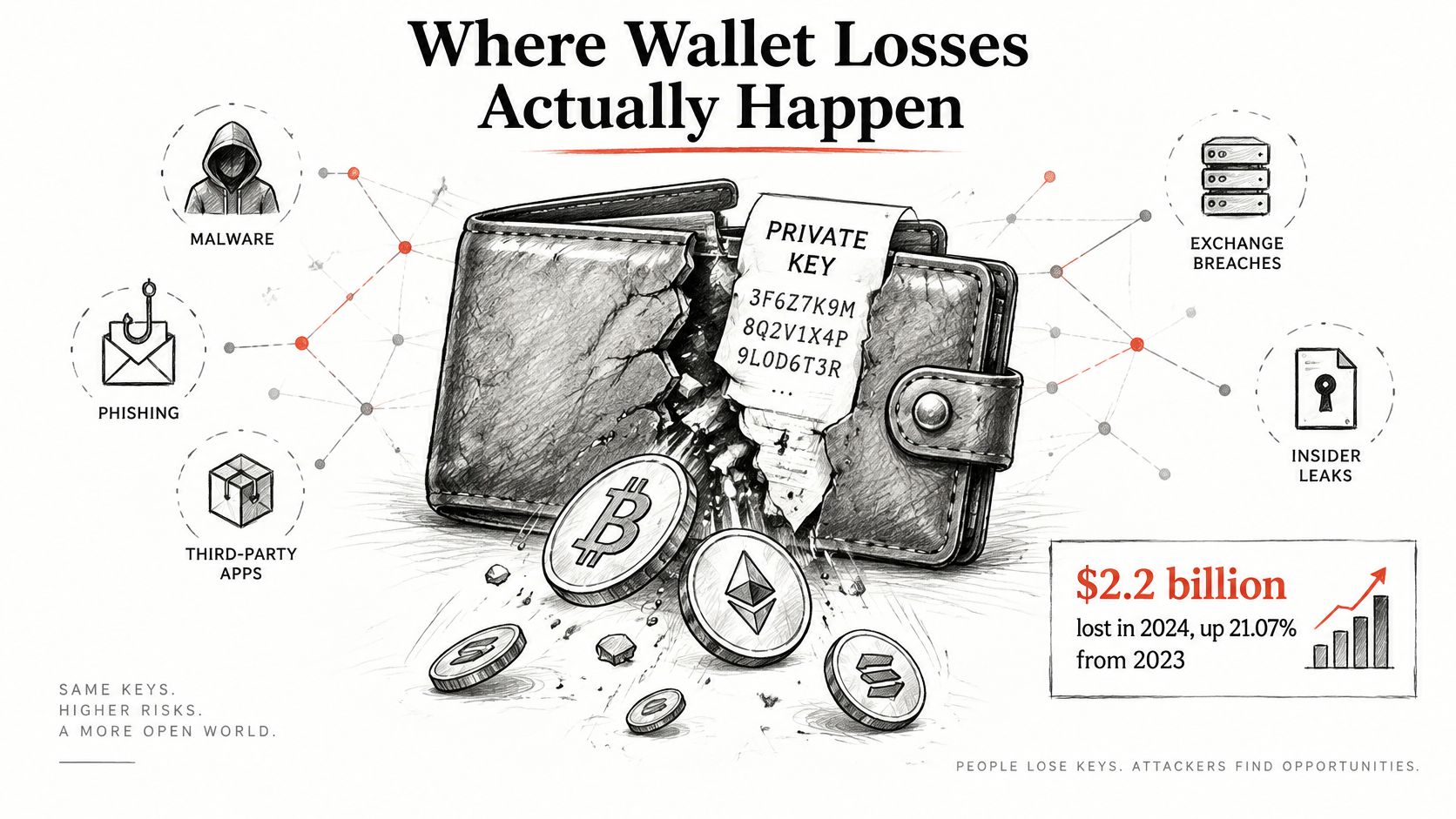
Cryptocurrency hacks caused approximately $2.2 billion in stolen value in 2024, up 21.07% from 2023, while incidents increased from 282 to 303, according to Chainalysis. The same analysis attributed 43.8% of stolen cryptocurrency in 2024 to private-key compromises. Its examples include DMM Bitcoin's approximately $305 million loss in May 2024 and WazirX's approximately $234.9 million loss in July 2024.
These are global figures covering centralized services and decentralized-finance ecosystems, not a failure rate for any particular wallet. They nevertheless identify a useful engineering priority: protect signing authority, not just account access.
The enemy is an attacker who gets a valid signature for a transfer your business didn't intend. That attacker can follow distinct paths:
- Extract key material. Steal a seed phrase, exposed private key, or enough independently held shares to defeat the threshold.
- Compromise the signing endpoint. Alter the transaction that an application prepares or exploit a component authorized to sign.
- Manipulate an approver. Use phishing or impersonation to persuade a legitimate operator to authorize the wrong transfer.
A valid signature isn't proof of business intent
Personal wallet compromises represented 44% of total stolen cryptocurrency value in 2024, compared with 7.3% in 2022, according to Chainalysis reporting covered by The Block. Separately, CertiK attributed more than $1 billion in cryptocurrency losses across 296 incidents in 2024 to phishing, as reported by Cointelegraph.
Key isolation addresses extraction. It doesn't establish whether the destination belongs to the intended beneficiary or whether an employee approved a fabricated instruction.
Map your exposure by asking who holds key material, how many parties must approve, what the approver sees, and what gets recorded. Require concrete answers, including service accounts and emergency procedures, rather than accepting an architecture diagram that shows only the normal path.
Practical lesson: A wallet is only as strong as the rule that must be satisfied before a signature exists.
Best Security Wallets at a Glance by Use Case
| Use case | Security model | Why it fits | Main gap |
|---|---|---|---|
| Individual holder, modest balance | Hardware wallet with written seed | Keys stay offline; device displays transaction details | Single seed backup; no approval policy |
| Individual holder, high value | Hardware wallet with multi-share backup or multisig | Splits recovery material or distributes signing authority | Recovery complexity that must be drilled |
| Small team or treasury | M-of-N multisig with hardware signers | Several approvers must agree before funds move | Signer coordination delay |
| Fintech or exchange payout flow | MPC 2-of-3 with client-controlled Co-Signer | No full key reconstructed; policy runs before signing | Policy quality and vendor dependency |
| Software wallet, user-held seed | Seed phrase in software | Low cost and fast start | Endpoint malware can read the seed or sign |
| Seedless or passkey-based wallet | Device or cloud-assisted key recovery | Lower onboarding friction | Recovery-provider and device security |
Read this as a deployment map, not a universal ranking. Transaction value, approver count, and signing frequency determine which compromise is acceptable.
A treasury making infrequent transfers can tolerate deliberate signer coordination. A payout service needs automated decisions, but automation shouldn't give a single application unrestricted authority over its entire balance.
Match the model to the operating burden
For an individual, a hardware wallet can provide a useful separation between an internet-connected application and the signing key. For a business, that same device may become an operational bottleneck if one employee holds it and nobody has rehearsed replacement.
Likewise, multi-share backup and multisig aren't interchangeable. The former distributes recovery material; the latter distributes authorization. A high-value holder may need both, but should understand which problem each addresses.
Seedless onboarding removes the need to handle a recovery phrase in the normal user journey. It doesn't remove the need to inspect account recovery, device replacement, provider availability, or administrative override paths.
No model wins every row. Select the model whose remaining failure modes your team can actually control.
The table's recommendations assume correct implementation. A nominally distributed design isn't independent if every signer uses the same administrator account, endpoint, or recovery channel.
Comparing Seed Phrases, Hardware and MPC Signing
| Criterion | Seed phrase in software | Hardware wallet | MPC 2-of-3 with Co-Signer |
|---|---|---|---|
| Key material at rest | Full seed on device or backup | Device-protected seed; secure element where implemented | Distributed key shares; full key isn't reconstructed during signing |
| What an attacker must obtain | Seed, or control of an authorized software signer | Usable device access, seed, or exploitation of the signing path | Enough independent participants to satisfy the threshold |
| Transaction verification | Computer or phone screen | Device display with supported clear signing | Policy checks plus client-controlled Co-Signer approval |
| Single compromised component | Can expose the wallet's signing authority | Outcome depends on the component and device protections | One share alone doesn't authorize a transaction |
| Audit trail | Application-dependent | Usually no business approval log on device | Requires linked operational records of requests and approvals |
For software signing, an attacker can target the seed or the process authorized to use it. Encrypting a backup does not protect a transaction after malware gains control of the signing application in active use. This model requires particularly strict balance limits and endpoint controls when used operationally.
For hardware signing, an attacker must defeat the device's protections, obtain the backup, or induce a permitted signature. Physical resistance and verifiability are separate considerations: the Spark hardware-wallet comparison identifies secure-element protection and firmware openness as different evaluation axes, including Trezor Safe 3's Infineon OPTIGA Trust M and Ledger's closed secure-element firmware.
Thresholds protect only the boundary they define
For MPC signing, an attacker must compromise enough independent signing participants or manipulate their authorization paths. NIST's threshold-cryptography introduction distinguishes the participation threshold, the parties required to perform an operation, from the corruption threshold, the malicious parties the system can tolerate. In a properly implemented 2-of-3 design, one compromised share alone cannot authorize a transaction, and the remaining participants can preserve availability when one is unavailable.
That assurance assumes genuine separation. Shared credentials, common deployment control, or a policy bypass can undermine the independence the diagram promises.
BroSettlement provides MPC custody and embedded wallets, with a Co-Signer under the customer's control. Our MPC versus multisig comparison helps distinguish threshold signing from designs that require multiple blockchain-visible signatures.
For human approval, require clear signing: recipient address, network, amount, and contract action must be understandable on the trusted display. Block approval when the system can't render the action reliably, rather than asking an operator to approve opaque payloads.
A secure element raises the difficulty of invasive extraction. Open firmware supports independent inspection. Neither replaces transaction policy, so score the attacker's required steps and the approver's actual visibility, not certification badges alone.
Recovery Trade-offs Most Rankings Skip
Stronger isolation isn't automatically safer if the legitimate owner can't recover access. A 2025 academic survey of 331 users found preferences for keeping keys on personal devices and maintaining copies across devices for usability. Redundancy improves availability, but poorly protected copies create additional theft paths.
| Scenario | Seed phrase only | Shamir 3-of-5 | MPC 2-of-3 |
|---|---|---|---|
| One device lost | Restore if seed backup is intact | Restore from any three shares | Remaining two participants can sign |
| Backup stolen or photographed | Full seed exposed; funds at risk | Two shares reveal insufficient information | One share cannot sign alone |
| Two recovery units lost | Total loss if no usable copy or signer remains | Remaining three shares permit recovery | Signing blocked; documented recovery or re-keying required |
| Three recovery units lost | Total loss if no usable copy or signer remains | Permanent loss without another recovery path | Signing blocked; only a previously established recovery path can help |
| Drill without moving funds | Restore a test wallet and compare address | Rebuild a test wallet offline | Simulate signer replacement in a sandbox |
The Shamir example uses the threshold mechanics described in Ledger's hardware-wallet selection guide: three of five shares can reconstruct the wallet, while two alone reveal insufficient information. Losing three shares leaves too few to recover.
Recovery must survive missing people
MPC continuity and disaster recovery are different. Remaining participants can continue within the signing threshold, but re-keying isn't a magic remedy after too many shares disappear. A viable replacement or emergency-access procedure must exist beforehand.
Document share locations, named custodians, inheritance and incident procedures, signer replacement, and escalation ownership. Our guide to private-key access and recovery is useful when separating exportable secrets from signing access.
Rehearse with a dedicated test wallet, not a production seed entered into an ordinary computer. Compare the derived address, complete the approval and replacement workflow, and record elapsed recovery time as an operational metric.
Evaluation Criteria for Exchanges and Fintech Wallets
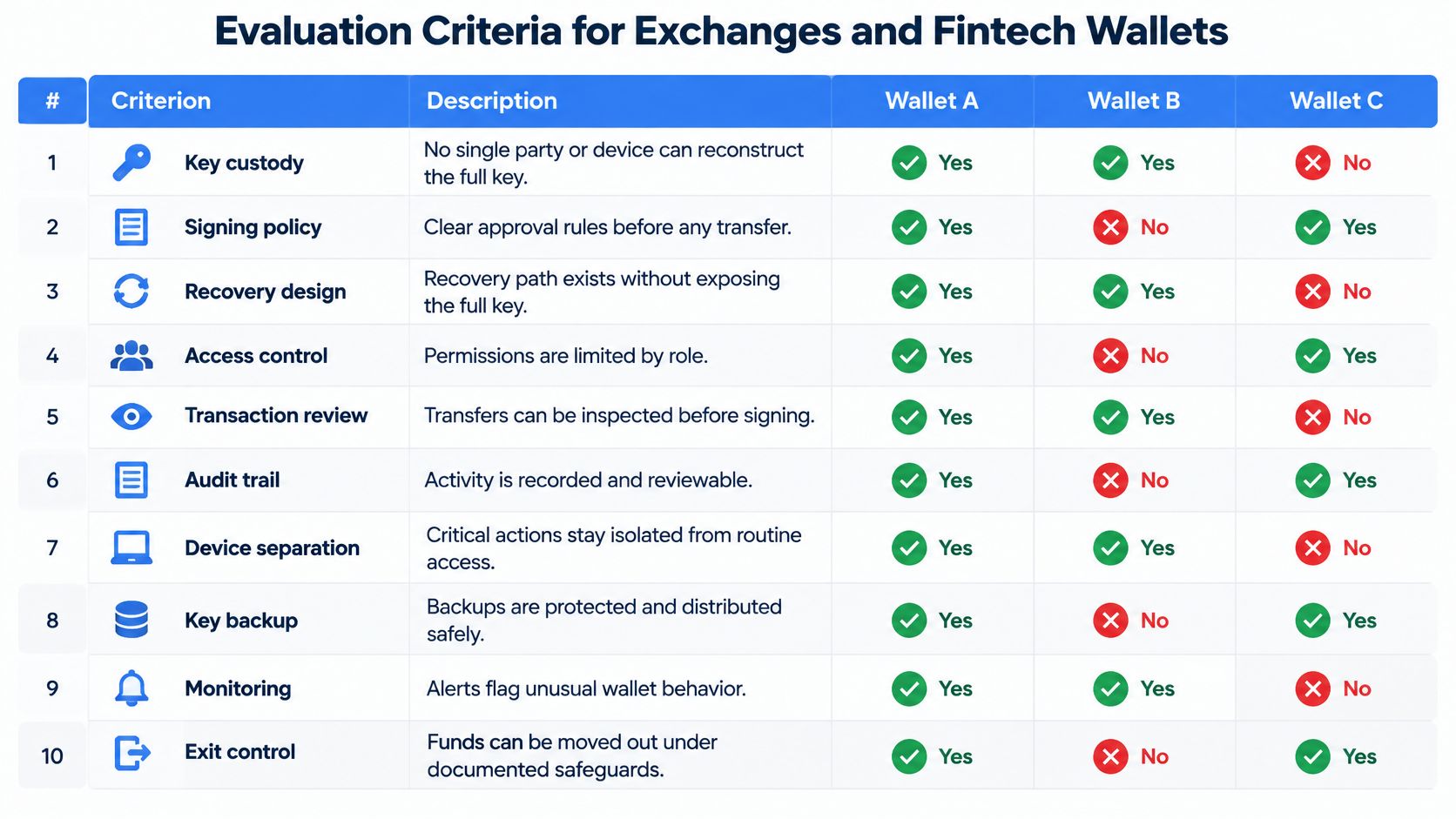
Score each candidate yes or no against demonstrated behavior, not roadmap promises. Attach a test result, configuration export, or sample record to every passing answer.
- Key custody: No single party or device can reconstruct the full key.
- Signing policy: Every request encounters enforced wallet limits, destination rules, and approval requirements before signing.
- Transaction preview: Every approver sees matching recipient, network, asset, and amount. Unrenderable transactions are blocked.
- Records: An append-only record connects the request, screening outcome, approval, and final transaction identifier.
- Travel Rule data: Required originator and beneficiary information is obtained, held, and transmitted securely within the applicable workflow before payout signing.
- Events and idempotency: Operations receives deposit, confirmation, and withdrawal events; retrying a payout cannot create another transfer.
- Access control: Role-based permissions, IP allowlists, wallet-and-action-scoped API keys, and authenticated requests with replay protection are enforced.
- Release verification: Signed releases and documented firmware or software update procedures are available.
- Recovery testing: A timed drill demonstrates recovery and signer replacement.
- Incident response: A tested freeze path has a named decision-maker.
Weight operational evidence above feature counts
The FATF virtual-asset guidance requires covered institutions to obtain, hold, and transmit specified originator and beneficiary information immediately and securely, and identifies USD/EUR 1,000 as the occasional-transaction customer-due-diligence threshold in the virtual-asset context. Apply the relevant jurisdiction's implementation rather than treating international guidance as a complete local legal assessment.
For automated payouts, give signing policy, records, and Travel Rule handling the greatest weight. Treat failure of transaction preview or recovery testing as disqualifying regardless of the total score.
BroLabel provides an operational log of wallets and transactions for reconciliation and audit. Your acceptance test should still prove that your integration joins those records to your own beneficiary, approval, and accounting systems.
A passing checklist needs evidence that your team can reproduce, not a vendor's unchecked yes.
How to Set Operational Controls That Limit Blast Radius
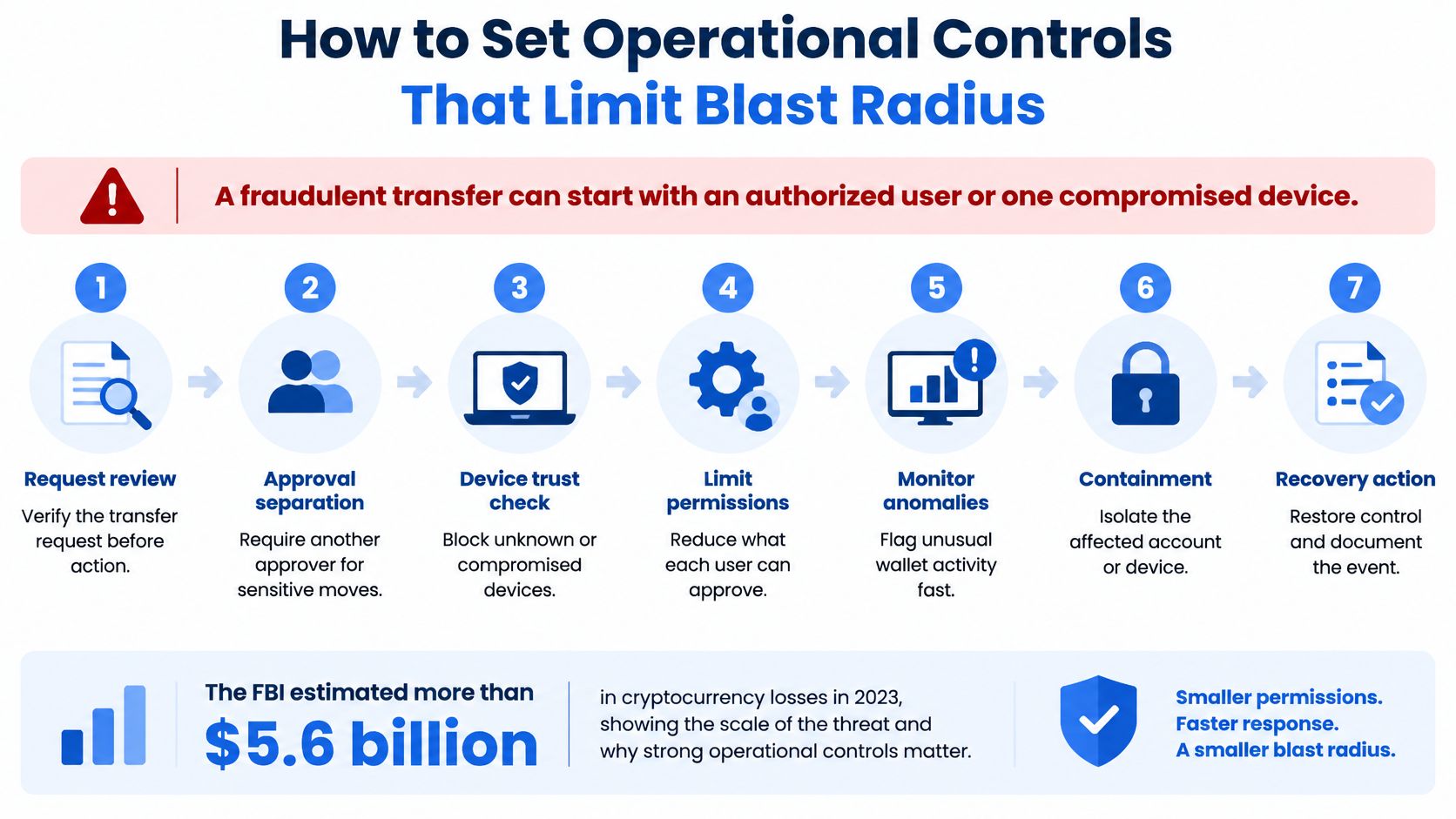
The FBI estimated more than $5.8 billion in reported cryptocurrency investment-fraud losses during 2024, while people aged 60 and older accounted for approximately $2.8 billion of broader cryptocurrency-fraud losses, according to the U.S. Department of Justice announcement. These losses reinforce the operational enemy: an authorized person manipulated into approving a fraudulent transfer, or a compromised endpoint with excessive authority.
Make each approval's exposure finite
- Classify wallets by value and initiator. Separate treasury, customer payouts, and agent-triggered activity so an application compromise doesn't inherit treasury authority.
- Set transaction and daily limits. Bound the loss possible before another decision is required.
- Maintain a verified address book. Independently validate new recipients instead of copying destinations from chat messages.
- Require independent approval above your threshold. Use a separate approver and device, not another session on the requester's machine.
- Delay first transfers to new destinations. Give monitoring and operators an opportunity to challenge a manipulated instruction.
- Verify on the approver's own screen. Match the signed transaction to the approved business request.
- Subscribe to withdrawal and policy events. Alert on unusual destinations, rejected requests, or unexpected transaction patterns.
- Rehearse freezing and key rotation at least quarterly. Treat this as a recommended operating cadence, with rehearsals after material architecture changes.
- Reconcile daily before the next payout run. Investigate unmatched instructions, broadcasts, and ledger entries instead of carrying unexplained differences forward.
Restrict machine authority too
For autonomous workflows, Agntz's discussion of over-permissioned credentials in AI agents provides useful context for credential reviews. Give an agent permission to request a bounded action, not unrestricted signing authority.
The customer must protect credentials and customer-controlled signing materials, comply with current authentication requirements, and immediately report suspected compromise or unauthorized access. Limits and independent approvals reduce what a single failure can cost, but only when operators enforce them every day.
Frequently Asked Questions About Security Wallets
Business custody questions
Is a hardware wallet enough for a business?
A single hardware signer protects a key, not your organization's approval policy. Use the pass conditions in Evaluation Criteria for Exchanges and Fintech Wallets to identify missing governance. Test a transfer that an operator should not be able to approve alone.
Does MPC 2-of-3 mean the provider can move my funds?
The threshold alone doesn't specify who controls each participant or which combinations may sign. A client-controlled Co-Signer must be an enforced requirement in the intended production path, not an optional check. Verify that topology and attempt a denied-signing test.
Recovery and approval questions
How many recovery copies should I keep?
Choose enough independently protected recovery material to meet your availability requirements without creating unmanaged copies. Recovery Trade-offs Most Rankings Skip distinguishes duplicate seeds from threshold shares. Assign custodians and rehearse restoration before funding the wallet.
Do phishing defenses matter if the key is safe?
Yes. The phishing losses discussed in Where Wallet Losses Happen show why protecting secrets doesn't establish recipient legitimacy. A legitimate signer can still approve an attacker's transaction. Test whether an unfamiliar destination triggers review before approval.
Choose and Implement Your Wallet Architecture
Implement the architecture as an operating system for transfers, not just a wallet integration. The launch path should produce evidence of safe refusal as well as successful payment.
- Define exposure. Record the value at risk per wallet and every human, application, or agent that can initiate a transfer.
- Select the security model. Match the use-case table to required transaction frequency and available approvers.
- Write policy before code. Specify limits, allowlists, approver requirements, and destination delays.
- Exercise the sandbox. Confirm required networks and test malformed transactions, denied signing, retries, and unavailable participants.
- Time recovery. Document share or participant replacement and the authority required to perform it.
- Launch with operational ownership. Assign event monitoring, daily reconciliation, and freeze decisions to named teams.
Separate available infrastructure from planned interfaces
BroSettlement provides MPC custody and embedded wallets, including a customer-controlled Co-Signer. Our engineers help design wallets, log records, signing policies, and events from start to finish.
BroWallet is planned for Telegram, web, and mobile, while AI Agent Wallets are in development. They shouldn't be treated as currently available BroSettlement features; separate terms apply when those products become available.
For agent integrations, design requests around scoped API keys and the same enforced signing policy used for other initiators. WebSocket events feed monitoring; implement and test idempotency keys so retries don't duplicate payouts, and join ledger entries to their approvals. Our integration tooling includes REST API, Ed25519 authentication, and WebSocket events.
Go-live boundary: The customer remains responsible for addresses, network and asset selection, amounts, recipient data, transaction instructions, and its compliance and risk decisions. Blockchain transactions may be irreversible.
Score a shortlist with the checklist, run the sandbox, and review the results with operations and compliance before enabling production transfers. Confirm that every claimed control exists in the contracted deployment, not merely in a proposed architecture.
Compliance Records and Reconciliation Evidence
A transaction hash proves that a blockchain transaction exists. It doesn't establish who requested the transfer, what beneficiary information was checked, whether the approval was valid, or how finance booked the movement.
FATF reports that 99 jurisdictions have passed or are in the process of passing legislation implementing the Travel Rule, according to its targeted virtual-assets update. That makes payment-transparency records an architectural concern, while the precise obligations still depend on applicable law.
Build an evidence chain around the transfer
| Record | Evidence to retain | Operational purpose |
|---|---|---|
| Transfer instruction | Request identifier, initiator, beneficiary reference | Establish intended action |
| Policy decision | Screening result, policy version, reason | Explain approval or rejection |
| Authorization | Approver identity and approved transaction details | Demonstrate permitted authority |
| Submission | Network, transaction identifier, submission status | Track execution |
| Reconciliation | Ledger postings, fees, exceptions, resolution | Explain accounting treatment |
Keep sensitive beneficiary information behind appropriate access controls. An audit trail shouldn't become a broadly accessible store of personal data or signing secrets.
Our audit workflow process guide helps structure the handoffs between operations, finance, and reviewers. Give each exception an owner and retain the resolution rather than overwriting the original event.
Events aren't a substitute for durable records
WebSocket events let operators react quickly, but consumers must handle disconnects, repeated delivery, and delayed processing. Reconciliation should use durable records and explicit transaction states, not assume that receiving an event means a payout has settled.
For control assurance, Foo Guard's guide to reuse SOC 2 evidence for ISO certification is useful when organizing overlapping evidence requests. Reuse relevant artifacts without assuming that one assessment automatically satisfies another framework.
Before launch, test missing events, duplicate requests, rejected approvals, and unconfirmed submissions. A freeze can stop future signing under your control; it can't reliably reverse a transaction already executed on-chain.
BroLabel offers MPC wallet infrastructure, customer-controlled co-signing, operational logs, and integration support for teams building governed transfer workflows. Visit BroLabel to review your wallet architecture and plan a sandbox that tests signing policy, recovery, and reconciliation before production. Bro has your back!