The most popular advice about cross-border payments is to start with corridor coverage. That's necessary, but it's not enough. A payment can reach the destination and still create operational failure if the wallet provider, blockchain broadcaster, FX service, payout partner, compliance system, and finance ledger each report a different version of what happened.
The enemy is the fragmented vendor chain. It forces teams to reconcile separate systems for custody, settlement, fiat conversion, cards, compliance, reporting, and customer support. The right cross borders solutions should therefore be judged by more than reach. Buyers need to compare settlement speed, control ownership, licensing responsibility, endpoint coverage, event reliability, reconciliation quality, and failure handling.
The market makes that discipline important. The World Bank reported that officially recorded remittances to low- and middle-income countries were expected to reach $685 billion in 2024, while total world remittances were projected at $905 billion in the same year. World Bank remittance data shows why cross-border infrastructure is a foundational financial channel, not a niche feature. Teams familiar with how SWIFT works will recognize the same underlying lesson: the network is only one part of the operating system.
The comparison below treats BroLabel as an integrated infrastructure option, not a default recommendation. Each platform is assessed by the work it removes, the responsibility it leaves with the buyer, and the controls serious finance and compliance teams must operate.
Table of Contents
- 1. BroLabel
- 2. Visa Direct and Visa Cross-Border Solutions
- 3. Mastercard Cross-Border Services and Mastercard Move
- 4. Wise Platform
- 5. Airwallex
- 6. Nium
- 7. Ripple Payments
- Top 7 Cross-Border Payment Solutions Comparison
- Choose the Architecture You Can Operate
1. BroLabel
BroLabel fits teams that need to assemble wallet, settlement, and fiat or card functionality before transaction volume is predictable. Its model combines embedded wallets, BroSettlement, multi-chain broadcast, ledgering, events, and planned card and fiat products through a modular API. The architectural question is who owns the operating state: the provider can supply signing and infrastructure, while the buyer still needs clear authority over policies, customer balances, payout status, and compliance decisions.
BroSettlement uses DKG and MPC with a 2-of-3 threshold. Two designated shares are required to produce a signature, so one share cannot authorize a transaction alone. A client-controlled Co-Signer and defined signing policies give the buyer a direct role in production authorization instead of placing every decision within a provider-controlled custody boundary. BroSettlement's signing model is relevant to exchanges, PSPs, treasuries, iGaming operators, and AI-agent products that require non-custodial controls.
Where the operating model stands out
BroLabel places the ledger and event layer inside the same operating model as wallets and settlement. Deposit, confirmation, withdrawal, and policy outcomes can feed reconciliation and customer-state updates, giving finance and operations teams a structured record rather than requiring them to reconstruct activity from blockchain explorers and separate dashboards.
The developer surface supports controlled deployment through REST APIs, OpenAPI and Swagger documentation, Ed25519 authentication, IP allowlists, replay protection, and a sandbox. BroLabel supports 10+ mainnets, including BTC, ETH, SOL, BNB, TRX, POL, BASE, and ARB, as listed in its infrastructure materials.
Practical rule: A timeout must not become a second withdrawal. Each request should carry a stable idempotency key and scoped authorization context, allowing retries to resolve to the original operation rather than trigger a new authorization. BroLabel's MPC guidance describes this control.
The architecture also supports specialized workflows. An iGaming operator can assign per-player TRC20 or USDT addresses, consume deposit.observed and deposit.confirmed events, and apply policy checks before payout signing. AI products can assign non-custodial wallets to individual agents while applying RBAC and audit trails to Co-Signer activation.
Production APIs, documentation, Swagger, a simulated sandbox demo, BroSettlement, embedded wallets, ledgering, events, and settlement are available. BroWallet and BroCard are marked as coming soon, and card issuing or wallet-experience features may depend on issuer and partner availability. Buyers should confirm the exact fiat and card scope during technical and compliance review. BroLabel advertises no upfront BroSettlement payment, trial month terms, flexible tiers, and hands-on support through sandbox integration, console setup, and fee-engine calibration.
2. Visa Direct and Visa Cross-Border Solutions
Visa is a network-led choice for buyers whose primary requirement is reliable delivery to existing payment endpoints. Visa Direct supports push-to-card, account, and wallet payouts, while Visa B2B Connect addresses large-value corporate payments outside the card model. Currencycloud adds multi-currency account and FX capabilities within the broader Visa portfolio.
That range makes Visa useful for marketplaces, gig-economy payouts, remittances, and enterprise treasury. A buyer can design around multiple endpoint types without treating every destination as a separate product decision. The operating tradeoff is that Visa provides network reach and payment execution, while the customer or approved partner usually owns more of the application layer, internal ledgering, authorization policy, and business-specific compliance workflow.
What buyers still need to build
Visa's global network can reduce the number of direct rail integrations, but it doesn't eliminate the need for a control plane. Teams still need to track beneficiary validation, payout status, reversals, exceptions, FX treatment, customer entitlements, and accounting entries in their own systems or through an implementation partner.
Program access commonly involves approved partners, enterprise onboarding, and negotiated commercial terms. That can work well for established institutions, but it may create a longer path for an early-stage product whose corridors, volumes, or regulatory model are still changing.
The network can move the money. Your architecture still has to explain who authorized it, which balance funded it, and what finance should reconcile when the endpoint rejects it.
Visa is also more naturally aligned with customer-facing card and account payouts than with a buyer seeking a non-custodial MPC signing layer. Teams comparing wallet custody, card programs, and settlement controls should read BroLabel's card issuing infrastructure guide alongside Visa's product documentation.

3. Mastercard Cross-Border Services and Mastercard Move
Mastercard Move is built around a broad payout proposition. It can deliver funds to bank accounts, cards, wallets, and cash-pickup locations, supporting remittances, payroll, supplier payments, marketplace payouts, tuition, and insurance use cases. Its main architectural advantage is endpoint variety behind a single commercial relationship.
That model is attractive when the buyer wants to serve different recipient preferences without assembling a separate provider for each one. It also suits banks, fintechs, corporates, and remittance businesses that need traditional payout infrastructure backed by Mastercard's compliance posture.
The responsibility boundary
Mastercard Move can simplify the external payout layer, but it doesn't automatically become the buyer's complete operating ledger or signing-policy engine. Product teams still need a durable internal representation of the payment lifecycle. Finance needs to distinguish an instruction, an accepted payout, a delivered payout, a failed payout, and a returned amount. Compliance needs to know which party made the screening decision and which party owns the record.
The platform's breadth also comes with corridor-specific variation. Pricing, endpoint availability, onboarding requirements, and delivery behavior can differ by market. Program access is commonly arranged through originating institutions or partners, so the buying team should evaluate the implementation path, not just the brand-level feature list.
A single connection can reduce integration work, but it can also centralize dependency on the provider's routing, eligibility rules, and partner network. Buyers should ask how they'll export status data, reconcile returns, handle duplicate requests, and maintain service continuity if a destination route changes.
Buyer question: Does “one API” mean one operational source of truth, or only one doorway into several external systems? The answer determines how much ledger and exception infrastructure you still need.

4. Wise Platform
Wise Platform fits organizations that want to embed cross-border transfers, multi-currency accounts, and card issuing through a provider known for clear fee presentation and a strong developer experience. Its Enterprise, Correspondent, and Embedded models give banks, fintechs, and businesses different ways to structure the relationship around their regulatory and product requirements.
The platform's appeal is clarity. Public developer guidance can shorten the discovery phase, while local-rail execution and transparent FX presentation help product teams explain the customer experience. For businesses that need multi-currency accounts and international payouts without building a global treasury stack from scratch, Wise Platform is a practical candidate.
Where the architecture stops
Wise Platform isn't a replacement for every internal control. The buyer still needs to define how account balances map to its own customer ledger, how product permissions govern transfers, and how finance reconciles provider statements with customer liabilities. Regional licensing and regulatory changes can also affect corridor and API availability, so teams need a review process that treats coverage as an operating condition rather than a permanent feature.
The platform is less directly aligned with teams that require crypto-native MPC signing, client-controlled transaction authorization, or multi-chain broadcast as a core primitive. It's stronger when the product starts with fiat transfers, multi-currency balances, and local payment rails.
The cost question also needs careful treatment. Consumer and business fee presentation may be transparent, but platform partner pricing remains contract-based. Buyers should model the complete flow, including FX, payout fees, returns, account services, compliance operations, and the cost of building any missing ledger or event controls.
For a broader architecture comparison, BroLabel's cross-border payments solution guide is useful because it frames settlement, wallets, fiat connectivity, and reconciliation as connected design decisions.
5. Airwallex
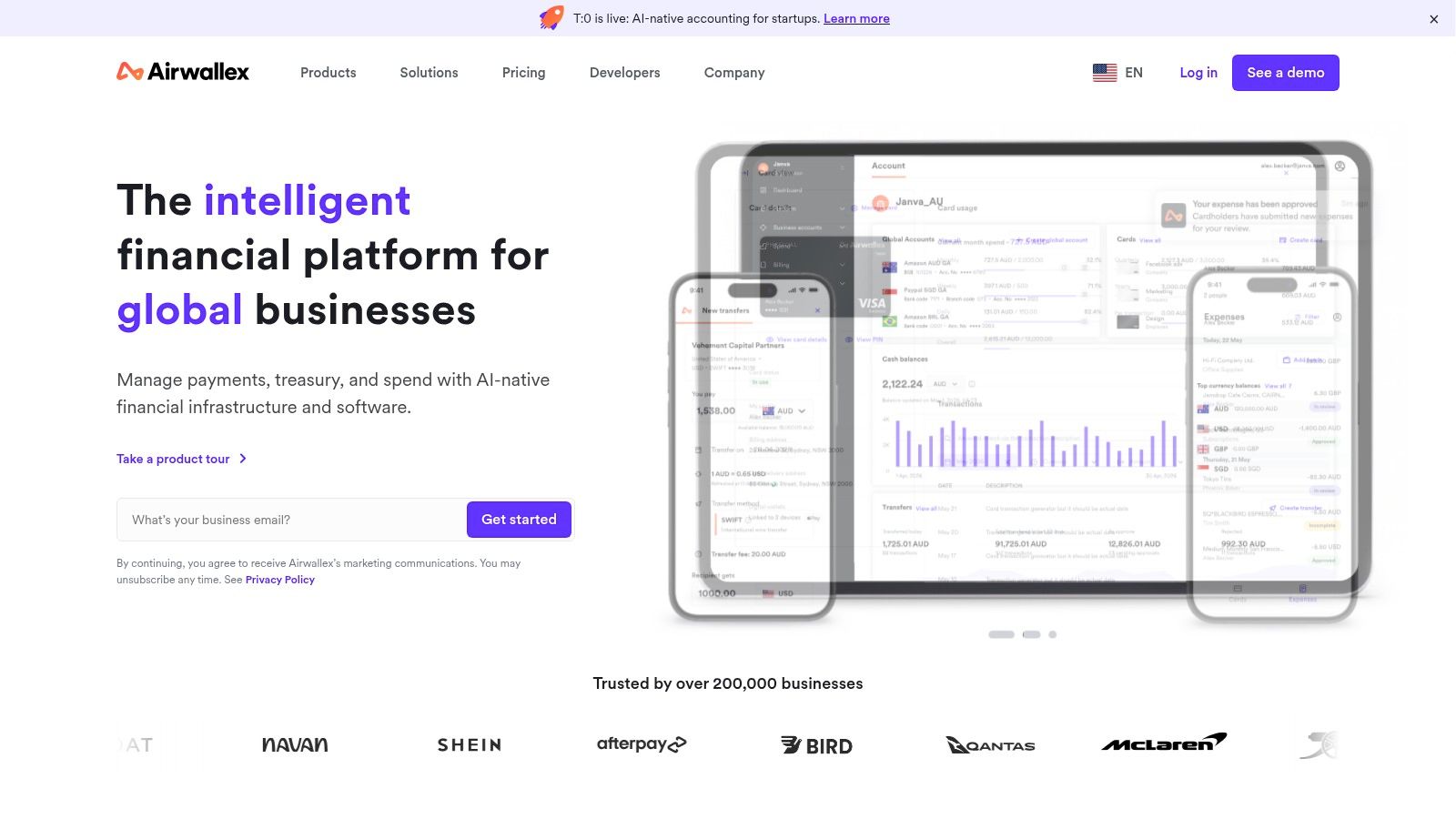
Airwallex combines several cross-border functions in one API-first platform, including multi-currency accounts, FX conversion, payment acceptance, card issuing, and payouts through local rails. That architecture suits SaaS platforms, marketplaces, contractor payroll, and businesses paying international operating expenses, where separate providers would otherwise create multiple operational boundaries.
Airwallex states that its local transfer network reaches 120+ countries. Airwallex's platform also publishes guidance on FX margins, including tiered treatment for major and other currencies. These public signals can support an initial cost model, while final pricing still depends on corridor and volume.
Strong product breadth, meaningful diligence
The main advantage is operating breadth. One integration can connect acceptance, accounts, cards, and payouts, reducing the number of vendor handoffs. The corresponding diligence must examine the operating stack, not only API endpoints. Buyers should map account balances to their internal ledger, define how payout and card events enter reconciliation, and test controls for holds, reserves, failed payouts, card permissions, and regulatory access.
Support and funds-access scenarios deserve specific testing. Some users report US support and account-hold issues. Those reports do not establish a universal weakness, but they justify asking how restricted transactions are identified, what evidence the provider requests, and how finance receives a complete statement during an investigation.
The architectural tradeoff is clear. Airwallex fits fiat-led programs that want local payouts and integrated cards under one operating relationship. A crypto product may need separate infrastructure if client-controlled MPC authorization, chain-specific transaction policy, or an append-only crypto ledger is central to settlement and reconciliation. Wallet design, signing responsibility, fiat connectivity, event handling, and compliance ownership should therefore be assessed together before selection.
6. Nium
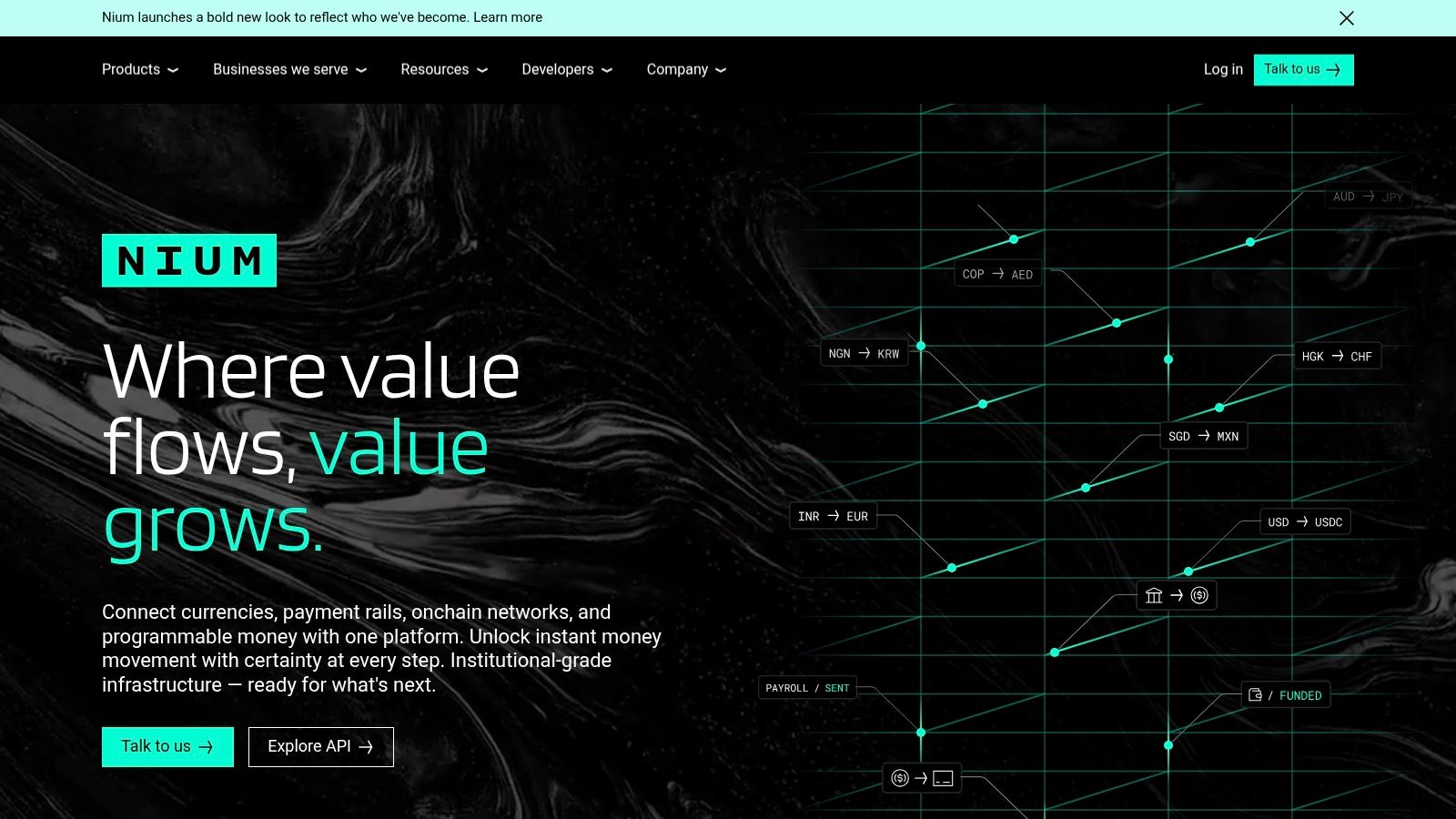
Nium is designed for enterprise payment programs that need payouts to bank accounts, cards, and wallets, alongside multi-currency accounts, card issuing, spend management, and newer settlement options. Its platform supports beneficiary validation across 50+ countries, a capability aimed at reducing avoidable payout failures before funds are released.
That focus on beneficiary quality is operationally important. A payment that fails because of an invalid account, unsupported recipient, or incomplete beneficiary record creates work for support, treasury, compliance, and reconciliation. Validation at the instruction stage can prevent some of that work, although it doesn't remove the need to manage downstream returns and exceptions.
Traditional and newer rails in one program
Nium offers webhook eventing and developer documentation for real-time status updates. Enterprise regulatory footprints and compliance tooling can also suit payroll, gig payouts, fintech platforms, and corporate programs that need a provider with established regional operating capabilities.
The tradeoff is access structure. Pricing is bespoke and may include minimums or tiering that doesn't suit an early-stage team with uncertain demand. Availability also varies by jurisdiction and licensing, so a product demo isn't enough. Buyers should test the exact corridors, recipient types, settlement currencies, screening responsibilities, and support escalation path required by the launch plan.
Nium's stablecoin settlement options may interest companies seeking an alternative to correspondent or local-rail flows. That option increases, rather than decreases, the need for policy design. Treasury teams must define when a stablecoin rail is permitted, which exposure is retained, how conversion occurs, and how the transaction appears in the accounting and compliance record.
Nium can work well when enterprise payout orchestration is the center of gravity. BroLabel is more directly differentiated when the buyer wants embedded non-custodial wallets, client-controlled signing, chain broadcast, and ledger events as core infrastructure.
7. Ripple Payments
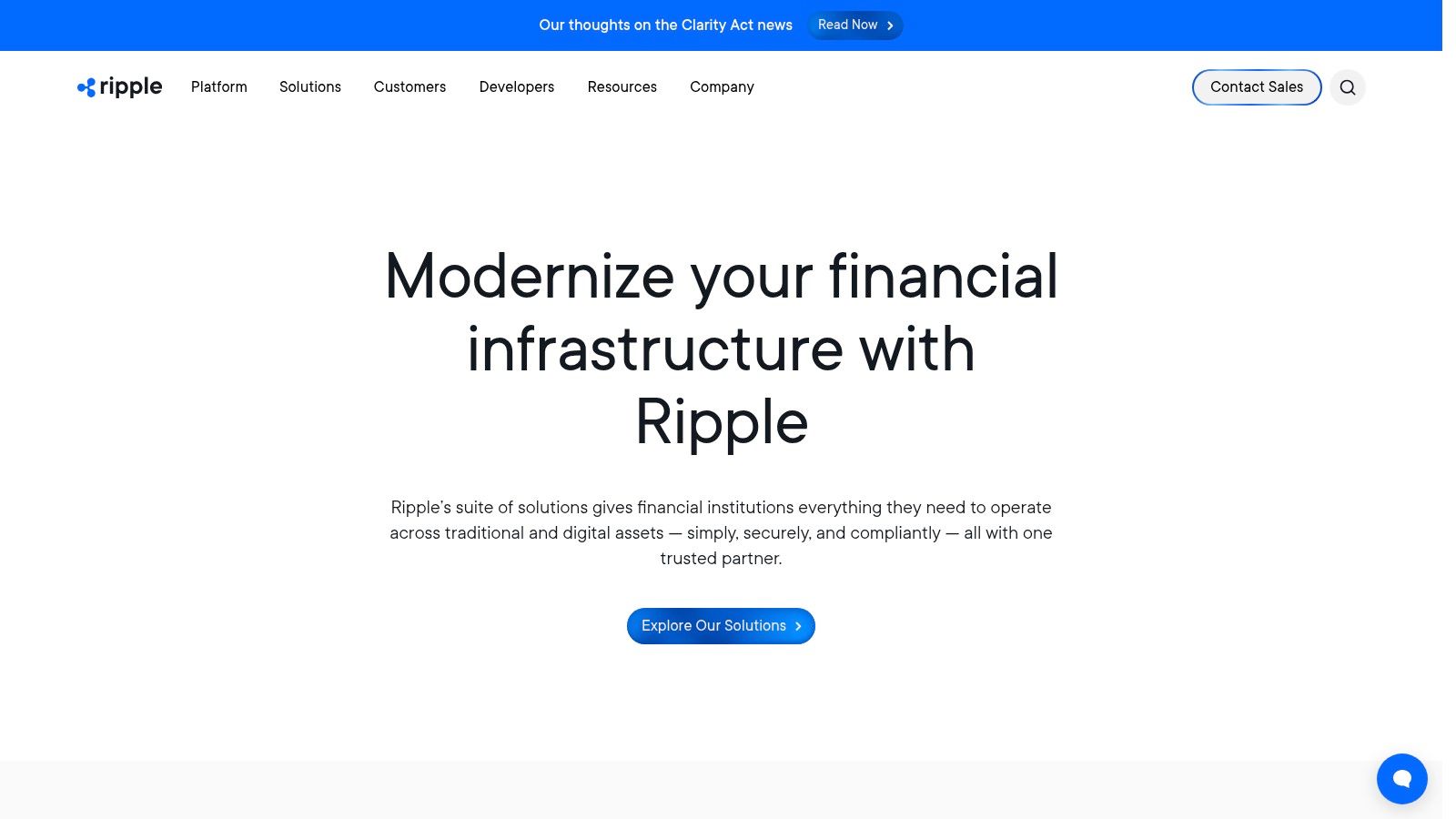
Ripple Payments is designed for enterprise cross-border flows, combining payment software, partner connectivity, liquidity, and compliance tooling. Its API can support institutional payouts and collections, with settlement through fiat and stablecoins. Optional On-Demand Liquidity using XRP depends on the corridor, so buyers must verify the destination, partner route, and operating responsibilities for each launch market.
Its payout partner network can reduce the need to build correspondent relationships and last-mile delivery arrangements internally. Ripple states that its payout coverage reaches 60+ destination countries Explore Ripple Payments, with corridor expansion supported by bank partnerships. The model therefore suits fintechs, PSPs, and institutions that need network access without owning every endpoint.
Liquidity optionality creates policy work
Ripple can bring payment instructions, liquidity, and compliance into one commercial relationship. The buyer still has to determine how liquidity decisions enter the ledger, how conversions are priced and reconciled, how rejected payouts are handled, and how customer funds remain distinct from operating balances. Enterprise contracting and custom pricing make those controls part of the implementation review, not a later configuration task.
Fiat, stablecoin, and XRP-based liquidity also create different treasury, regulatory, accounting, and volatility exposures. Speed alone is an incomplete selection criterion. The operating team must be able to approve each rail, explain every conversion, reconcile settlement events, and apply a fallback route when a corridor or partner is unavailable.
Control before speed: A liquidity option belongs in production only after the team can specify its approval policy, exposure limit, reconciliation treatment, and fallback route.
Ripple fits institutions that prioritize network access and liquidity orchestration. Teams evaluating wallets, MPC signing, ledger reconciliation, chain events, and fiat connectivity as one crypto payment stack should also review BroLabel's crypto payment infrastructure.
Top 7 Cross-Border Payment Solutions Comparison
| Solution | Implementation Complexity 🔄 | Resource Requirements 💡 | Expected Outcomes ⭐📊 | Ideal Use Cases ⚡ | Key Advantages 💡⭐ |
|---|---|---|---|---|---|
| BroLabel | Moderate, API‑first; MPC/DKG setup with sandbox & engineer support | Medium, engineering + compliance; low upfront fees/trial month | High, rapid non‑custodial wallets, audit‑ready ledger, multi‑chain support | Early‑stage crypto products, iGaming per‑player wallets, AI agent wallets, fintechs | Modular stack, MPC 2‑of‑3 non‑custodial, immutable ledger, real‑time events, flexible commercial terms |
| Visa Direct / Visa Cross‑Border | High, enterprise onboarding, partner approvals often required | High, legal/compliance, partner/issuer relationships | Very high, broad global reach and fast card/account settlement | Marketplaces, gig payouts, remittances, enterprise treasury | Massive global network; multiple rails (card/account/wallet/B2B) under one brand |
| Mastercard Move | High, enterprise integrations; corridor‑dependent capabilities | High, partner programs and corridor compliance | High, predictable global payouts to accounts/cards/wallets/cash | Banks, fintechs, remittances, payroll, supplier payments | Single connection for multi‑endpoint delivery; strong corridor coverage and compliance |
| Wise Platform | Low–Medium, clear APIs, multiple integration models (Enterprise/Embedded) | Medium, engineers; contract pricing and regional licensing checks | High, transparent fees, fast local‑rail transfers, multi‑currency accounts | Embedded transfers, multi‑currency accounts, card issuing for fintechs/banks | Excellent developer docs, fee transparency, flexible integration models |
| Airwallex | Medium, API‑first; local‑rail integrations vary by corridor | Medium, engineering + due diligence; corridor‑dependent features | High, wide country coverage, competitive FX, local‑rail speed | SaaS/platform payouts, contractor payroll, marketplace settlement | Broad product surface (accounts, FX, cards, payouts); published FX guidance |
| Nium | High, bespoke enterprise integrations and onboarding | High, regulatory footprints, compliance tooling, possible minimums | High, enterprise compliance, real‑time webhooks, stablecoin settlement options | Enterprise payroll, gig payouts, fintech platforms needing compliance | Regulated regional coverage, stablecoin/crypto settlement, spend management |
| Ripple Payments | High, enterprise contracting; corridor‑specific liquidity models | High, liquidity management, contracts and bank partnerships | High, reduced last‑mile complexity; fiat/stablecoin/XRP settlement choices | Fintechs/PSPs for institutional payouts, liquidity and collections | Unified payments+liquidity+compliance API; optional On‑Demand Liquidity (XRP) |
Choose the Architecture You Can Operate
The best cross borders solutions aren't selected by counting endpoints. They're selected by assigning responsibility clearly. Start with the corridors, currencies, and recipient types you need. Separate crypto settlement requirements from customer-facing fiat accounts, bank payouts, and cards. A product may need stablecoin liquidity behind the scenes while presenting a completely fiat-native experience to customers.
The market's scale makes weak operating design expensive. McKinsey estimates that global cross-border payments recently reached about $190 trillion in annual volume and generated more than $290 billion in revenue. McKinsey's market analysis shows why providers continue to converge around payments, FX, accounts, compliance, and finance operations rather than isolated transfer rails.
Cost and speed still expose architectural gaps. The World Bank's Q1 2024 data put the global average remittance cost at 6.35%, above the United Nations Sustainable Development Goal target of 3%, while the Financial Stability Board reported that 50.6% of cross-border payments were credited within one hour and 92% within one business day. The World Bank and Financial Stability Board findings point to the same buying conclusion: faster movement doesn't remove the need for observability and exception management.
The controls to test before signing
Ask each provider who owns the following decisions:
- Custody and signing: Can your team control the Co-Signer, define signing policies, and prevent a single operator or vendor from authorizing a withdrawal?
- AML and licensing: Which entity performs screening, which party makes the final decision, and which licenses or regulated partners cover each corridor?
- Ledger and reconciliation: Can finance reconcile customer balances, provider statements, blockchain movements, fees, returns, and FX adjustments without manual reconstruction?
- Events and retries: Are WebSocket or webhook events durable, replayable, authenticated, and tied to stable idempotency keys?
- Access control: Do scoped API keys, RBAC, IP allowlists, replay protection, and audit trails match the duties of engineering, operations, treasury, and compliance?
- Partner dependency: What happens when a card issuer, bank, local payout partner, blockchain, or stablecoin route becomes unavailable?
- Asset exposure: If stablecoins or XRP are available, who approves their use, who carries exposure, and how does the accounting record show the conversion?
Consumer trust adds another reason to make these controls visible. Visa's global cross-border consumer habits report found that users employ an average of four out of seven payment methods, only 16% rely on a default method, and 21% have had a bad experience sending or receiving cross-border payments. The same Visa consumer research said fear of fraud has stopped about two in three consumers from using a cross-border payment option. Fragmentation isn't just a back-office problem. It affects whether customers trust the payment path at all.
BroLabel's relevant architecture is designed around that operating layer. Buyers can assess BroLabel for BroSettlement, embedded wallets, the append-only ledger, real-time events, AI Agent Wallets, and developer tooling, but each module should still be tested against the actual product and regulatory model. The sandbox, API documentation, console setup, and engineer-assisted integration offer a practical way to validate signing, event delivery, reconciliation, policy enforcement, and failure handling before committing to production.
FAQ
Are crypto rails and fiat rails competing cross-border solutions?
Not always. A product may use crypto settlement or stablecoin liquidity between providers while delivering fiat balances, bank payouts, or cards to the customer. The important design question is where conversion occurs, who controls it, and how the ledger records both sides of the transaction.
What should a buyer ask about stablecoin settlement?
Ask which corridors support it, who performs compliance screening, how exposure is managed, what happens during a depeg or liquidity interruption, and whether the provider supplies complete transaction and conversion records. Stablecoin settlement should be evaluated as a controlled operating rail, not only as a speed or cost feature.
How do MPC and the Co-Signer divide responsibility?
BroSettlement uses DKG and MPC with a 2-of-3 threshold. Two designated shares are required to sign, while a single share isn't sufficient. The buyer should define the Co-Signer's operating role, approval policies, key-share protection, emergency procedures, and audit requirements before production launch.
Is BroCard ready for immediate card issuing?
BroCard is listed as coming soon. Card issuing, wallet experience, and related fiat features can depend on issuer and partner availability, so teams should confirm current production scope directly during evaluation.
How should teams compare corridor coverage?
Map each source currency, destination currency, recipient endpoint, settlement method, compliance requirement, and fallback route. A provider's global footprint doesn't guarantee that every corridor supports the same delivery speed, fees, licensing model, or payout type.
How can buyers evaluate pricing when public detail is limited?
Request a corridor-level commercial model that separates transfer fees, FX spread, account costs, card costs, compliance services, minimums, reserves, returns, and support. BroLabel advertises flexible tiers and no upfront BroSettlement payment, while several enterprise platforms use negotiated pricing.
What should a compliance workflow include?
It should define customer and beneficiary screening, transaction monitoring, sanctions decisions, risk escalation, approval authority, audit retention, and the regulated entity responsible for each step. RBAC and audit trails help, but they don't replace a documented compliance operating model.
Why do WebSocket events matter?
Events let product, operations, and finance react to observed deposits, confirmations, withdrawals, and policy outcomes without repeatedly polling separate providers. The team should test authentication, ordering, replay behavior, delivery recovery, and the connection between each event and its ledger entry.
What does ledger reconciliation need to prove?
It should connect the customer instruction, authorization, balance movement, network transaction, provider status, fees, FX conversion, payout result, and any return or correction. An append-only operating ledger gives finance a durable record, but the team must still define reconciliation rules and exception ownership.
Visit the BroLabel sandbox and test the full integration path across embedded wallets, BroSettlement, signing policies, WebSocket events, ledger reconciliation, and payout controls. Use that evaluation to determine whether BroLabel's modular API can replace fragmented cross-border vendors while preserving the custody, compliance, and finance controls your team needs.