
The usual advice about on off ramps is to compare conversion fees and choose the cheapest provider. That's incomplete. The enemy is the sell-button myth, the assumption that converting crypto into spendable bank money is just another fast, inexpensive wallet transfer.
For a product team, the useful price is the cost of a payout that clears and reconciles. For finance and compliance, a successful conversion also needs an explainable record of approvals, movement, fees, and exceptions.
Table of Contents
- What Finished On Off Ramps Actually Cost
- Four Ways to Embed Fiat Conversion
- AML Gates Before Crypto or Fiat Moves
- How a Ramp Settles and Reconciles
- Where Ramp Demand Is Not Checkout
- Risk Controls Before You Go Live
- Buyer Questions Answered
What Finished On Off Ramps Actually Cost
All-in cost of a finished on or off ramp
| Cost layer | What to expect | When it appears | What to book |
|---|---|---|---|
| Quoted conversion fee | Typical estimates of 0.5% to 3% by corridor, provider, and size, according to Bessemer Venture Partners | Provider price shown before submit | Completed-conversion fee, with failed-attempt charges recorded separately |
| FX spread | Not included in many quotes | Local currency versus a USD stablecoin | Realized FX, separate from the ramp fee |
| Blockchain gas | Extra network cost | Broadcast or sweep before fiat release | Chain cost, not the provider fee |
| Payout delay | Minutes up to multi-day bank timing, subject to the selected rail | Rail speed plus review queue | Cash timing, not completed revenue |
| Bank reject, freeze, or limit | Full amount delayed or returned | Name mismatch, sanctions, source of funds, limits | No completed payout value until an approved path settles |
| Manual-review retry | Extra time and operations cost | Rapid in-and-out, shared beneficiary, unresolved checks | Actual charges and operations cost attributable to the retry |
An on-ramp is the regulated path from bank money, a card payment, or a local funding rail into a blockchain asset. An off-ramp reverses that path, converting a blockchain asset into spendable fiat. Wallet-to-wallet stablecoin movement can be near-instant and inexpensive, but local-currency conversion crosses a different operational boundary.
The table separates price, expense, and cash availability. They aren't interchangeable. A provider can complete a conversion while the receiving bank still hasn't credited the beneficiary, and a failed payout can leave network costs or processing charges that finance must still record.
Compare completed routes, not quotes
Say a treasury team chooses a route advertised near the low end of the quoted fee range. The beneficiary bank rejects the payment because the account name doesn't match the approved beneficiary. Operations then investigates the return, obtains corrected details, and submits an approved replacement.
The original quote didn't capture the full outcome. The team may incur another conversion spread, additional network movement, or manual handling, while the intended recipient still lacks usable money. A more expensive advertised route could have produced a lower cost per successfully reconciled payout.
Bessemer's analysis also estimates that real-world stablecoin payment volume doubled in 2025 to about $400 billion, with about 60% attributed to B2B payments. That context matters because a business paying suppliers needs an accounting record and predictable fiat availability, not merely a transaction hash.
Practical lesson: Recognize completed payout value only after reconciliation. Record incurred fees and failed-attempt expenses when they arise, rather than hiding them until a replacement succeeds.
Build reporting around net fiat delivered, actual expenses, unresolved balances, and exception handling. Don't treat the principal moving through a ramp as revenue just because a provider returned a successful API response.
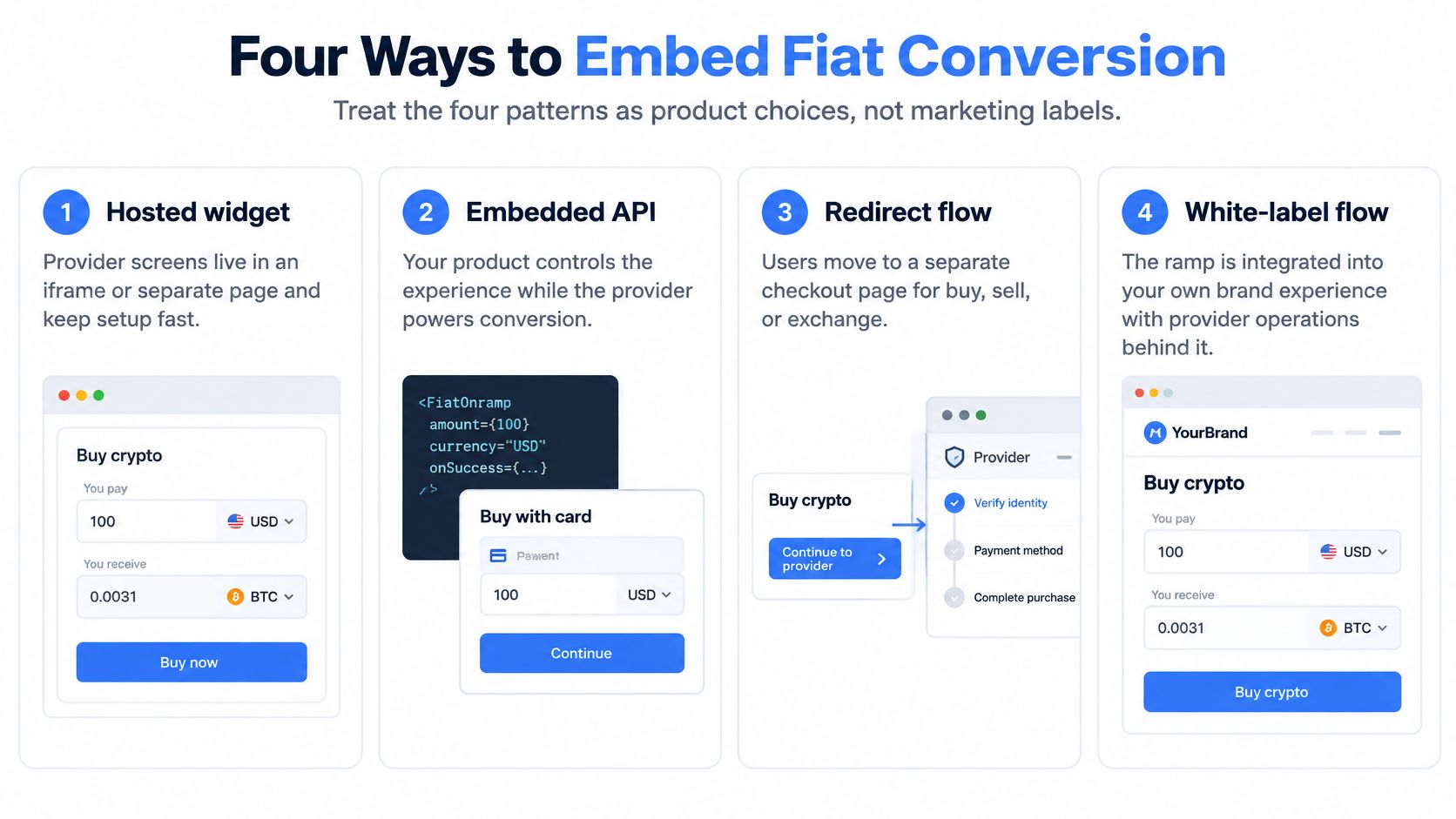
Four Ways to Embed Fiat Conversion
On and off ramp integration patterns
| Pattern | Who owns the experience | Control you keep | Best fit | First thing that breaks |
|---|---|---|---|---|
| Hosted widget | Provider screen or iframe | Low beyond branding and basic limits | Fast consumer buy and sell | Opaque status and weak reconciliation |
| Direct API | Your product | High if policy, keys, and events are scoped | Exchanges, neobanks, embedded apps | Missing idempotency or unsigned state changes |
| Card issuing | Card network spend | Spend limits, freeze, and wallet linkage | Everyday off-ramp without a bank payout | Issuer jurisdiction, MCC, and card-rail declines |
| Bank rails | Local bank, wire, or card funding | Beneficiary checks and return handling | B2B, treasury, and larger fiat payouts | Corridor liquidity, name mismatch, and bank rejects |
Treat these as operating choices, not interchangeable checkout designs. A hosted interface reduces the screen-building work, while an API gives your team responsibility for the journey and its exceptions. Card issuing and bank rails describe how money becomes useful, rather than merely how the conversion screen looks.
Decide who can stop the movement
With a hosted widget or redirect, the provider controls much of the customer interaction. That can suit an initial consumer flow, but your application still needs a durable transaction reference and meaningful status updates. A branded completion screen doesn't establish that a bank payout cleared.
With a direct API, your product creates the instruction and presents progress. Your backend must authenticate requests, handle expired quotes, distinguish retryable errors from rejected instructions, and consume policy outcomes. A provider webhook or WebSocket message must be authenticated and matched to the correct instruction before it changes customer balances.
For card issuing, the exit is merchant spending rather than a credit to a bank account. Virtual or physical cards, including supported Apple Pay or Google Pay provisioning, require controls for merchant category codes, available balance, freezes, and authorization declines. Don't describe a declined card authorization as a failed bank withdrawal.
Bank rails make beneficiary information and return handling central. Treasury and B2B teams need to know which entity receives the payment, which rail carries it, and what happens when the bank returns it.
Choose for unpredictable volume
Suby's guide to choosing a fiat to crypto provider is a useful starting point for provider selection. Turn the comparison into operating questions: who can pause a payout, which events reach your backend, and who investigates an ambiguous outcome?
When volume is unpredictable, operational blind spots can matter more than interface polish. A hosted flow may become difficult to support when users ask about pending funds; an API flow may fail earlier if the team hasn't built retry handling.
Our fiat integrations depend on the provider and jurisdiction. A working pattern in one corridor isn't a global availability promise.
AML Gates Before Crypto or Fiat Moves
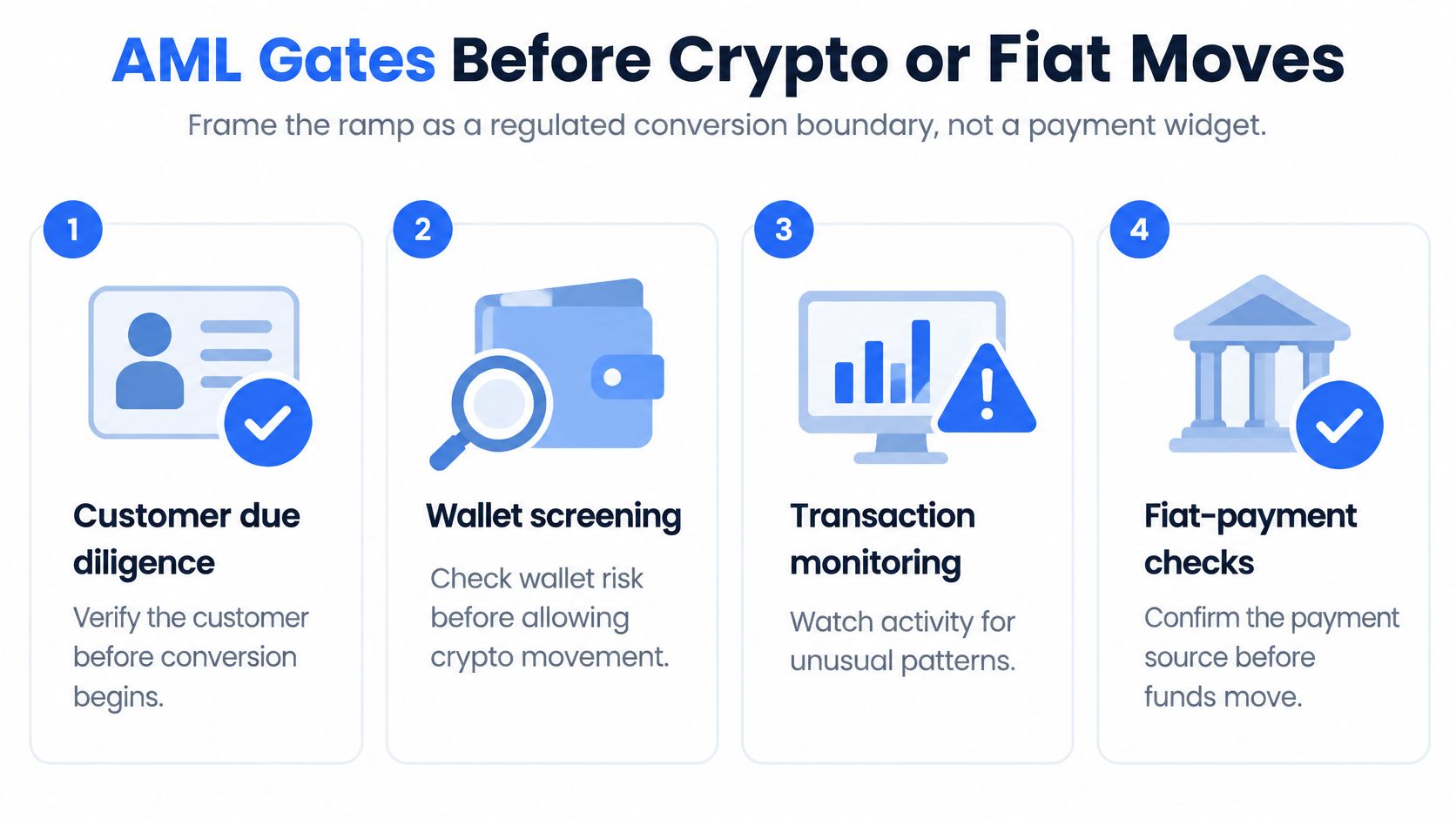
A ramp is a regulated conversion boundary, not merely a payment widget. FATF's guidance on virtual currencies calls for risk-based AML/CFT controls for convertible-virtual-currency exchangers and customer due diligence for occasional virtual-currency-to-fiat exchanges, or the reverse, above USD/EUR 15,000, with the same expectation for covered wire transfers.
That threshold isn't a safe harbor. Smaller transactions can still involve sanctions, structuring, cumulative exposure, or unexplained sources of funds. Apply the relevant local requirements and risk policy rather than designing a bypass beneath an amount threshold.
Connect identity to the movement
Persist a unified transaction record that connects the customer identity, bank account, wallet address, chain, asset, amount, blockchain transaction hash, and screening outcome. Keep the approval history alongside those identifiers so a reviewer can reconstruct why the movement was permitted.
Use distinct gates with explicit owners:
- Customer due diligence: Establish who the customer is and whether the intended activity fits the approved relationship.
- Wallet screening: Assess the relevant address and exposure before permitting movement.
- Transaction monitoring: Review behavior across transactions, rather than treating each transfer as unrelated.
- Fiat-payment checks: Validate the funding source or beneficiary account and resolve ownership discrepancies.
For implementation detail, our guide to AML transaction screening explains the role of screening within the transaction workflow. For a narrower example of preparing evidence, MyFundedCapital's verification tips for MyFundedCapital traders can help readers understand source-of-funds documentation, without replacing the ramp operator's own requirements.
Make unresolved checks enforceable
Queue or block settlement while identity, beneficiary ownership, sanctions status, chain analytics, or source of funds remains unresolved. An interface warning isn't enough if a separate worker can still submit the payment.
Expose the policy outcome through the API, including whether the instruction is approved, held, or rejected. Restrict exception approval through role-based access, scoped API keys, and an audit trail that identifies the actor and reason.
A broadcast transaction proves that an instruction reached a blockchain network. It doesn't prove that compliance approved a bank payout or card authorization.
AI Agents need equivalent controls per agent. Bind each automated actor to an accountable owner, permitted assets, approved destinations, and a review path; an automated signer must not become an exception to the customer's policy.
How a Ramp Settles and Reconciles
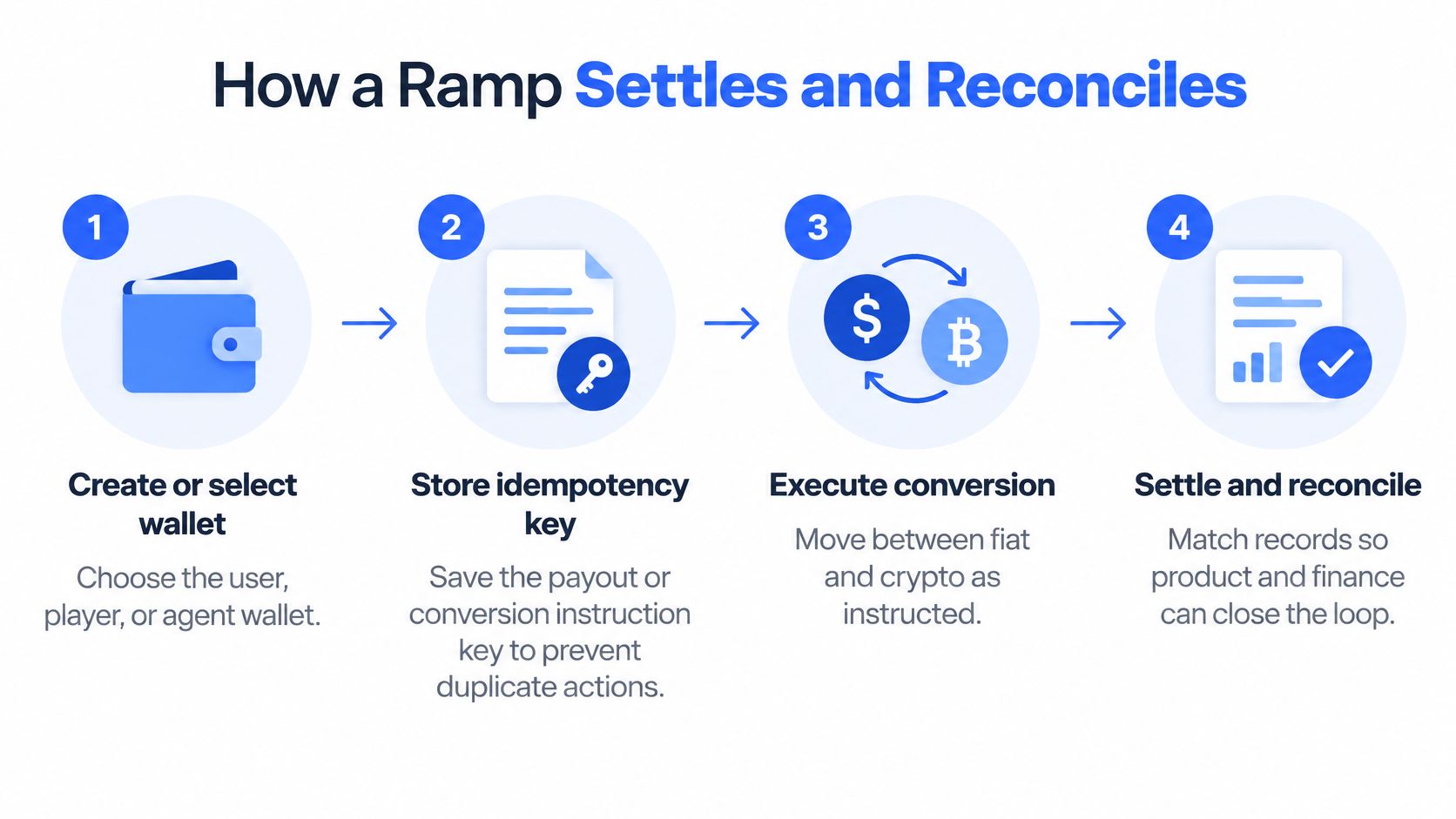
A product interface needs understandable progress. Finance needs evidence of what moved, what remains outstanding, and which charges belong to the instruction. Implement both through a durable transaction state machine rather than a single success field.
Execute through explicit states
- Create or select the wallet. Associate the user, player, or agent with the instruction. Store an idempotency key and the intended transaction details before submitting anything.
- Screen and apply policy. Move from initiated to screened, then approved only when the applicable gates pass. Keep the decision and its supporting references.
- Authorize the crypto leg. Require the client-controlled Co-Signer under the configured 2-of-3 MPC policy before broadcast, rather than relying on a single hosted signing key.
- Submit and confirm. Record submitted, broadcast on the chosen chain, and wait for the required confirmation depth before recording confirmed. Seeing a transaction in a block isn't sufficient when policy requires deeper confirmation.
- Publish operational events. Deliver WebSocket events for observed deposits, confirmations, withdrawals, and policy outcomes. Consumers should retain event identifiers and tolerate replay or reconnection.
- Release the fiat leg. Submit it only when the required crypto and compliance conditions are satisfied. Capture the provider's reference and subsequent outcome.
- Reconcile and close. Append results to the immutable operating ledger. Match the blockchain and fiat-provider records, preserving settled, rejected, and reversed outcomes rather than overwriting history.
A timeout illustrates why idempotency matters. If operations sends the same payout reference again after losing the original response, the system must return the original result rather than create another payment. Reject reuse of that reference with different transaction details.
Keep signing, funding, and accounting connected
BroSettlement provides MPC signing with the client-controlled Co-Signer; BroWallet supports hosted buy, sell, exchange, and bank or card funding. AI Agents use per-agent wallets, while BroCard connects supported card spending to wallet balances. WebSocket events, the append-only operating ledger, reconciliation support, and scoped API keys let teams operate these modules as a controlled workflow rather than disconnected features.
Use our digital asset payments operating guide to connect signing, wallet funding, card linkage, and ledger requirements. For finance's selection checklist, reconciliation software buying advice from BankStatementWizard offers a useful starting point for evaluating matching and exception workflows.
Keep internal ledger states separate from provider status labels. A provider's completed status may describe only its own processing step.
A deposit or withdrawal is done only when the ledger, the chain, and the relevant bank or card record agree.
Where Ramp Demand Is Not Checkout
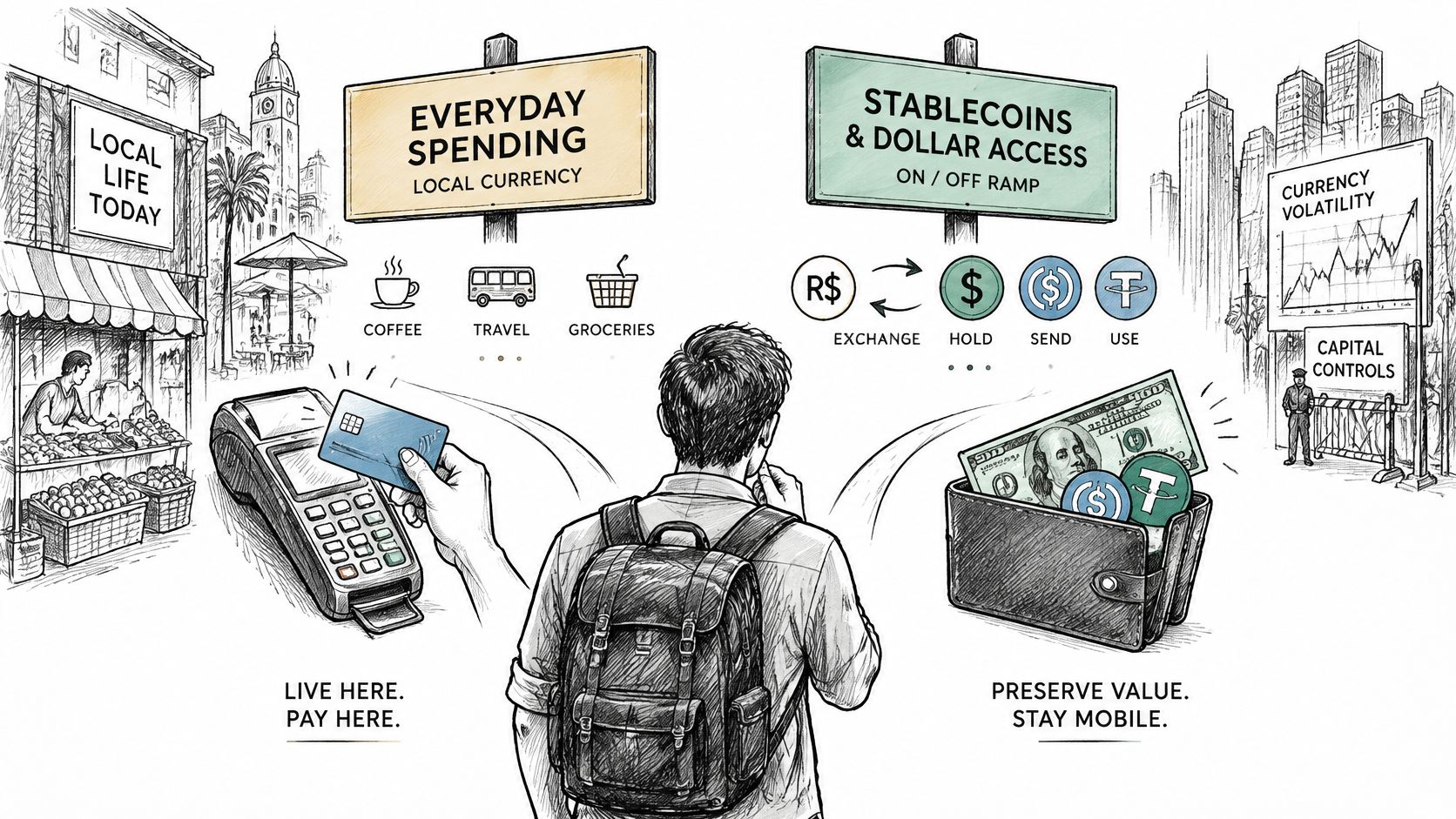
An emerging-market survey cited by Spark's stablecoin analysis found 47% of stablecoin users identified dollar access and savings as a use case, compared with 39% citing cross-border remittances. The same analysis places stablecoin supply above $270 billion by December 2025, while describing concentrated activity and uneven off-ramp liquidity.
Those motivations change the product requirement. A user facing currency depreciation or restricted dollar access may want to hold a stablecoin, not immediately convert it into domestic spending money. Faster checkout doesn't answer that need.
Follow the money to its intended use
Say a customer receives USDT or USDC and chooses to retain it until a household expense becomes due. Receiving the asset solves only the first part of the problem. The customer still needs an eligible, compliant route into a local bank account, cash service, or supported card-spend flow.
Don't promise every exit merely because the wallet supports the asset. Chain support, payout liquidity, beneficiary eligibility, review requirements, and local rails all need to fit together. Stablecoin ownership also isn't a guarantee of value preservation; the product should explain the asset and service risks rather than presenting dollar access as risk-free savings.
Different operators encounter the same final-mile gap in different ways:
- An iGaming operator needs a deposit address per player, observed and confirmed deposit events, and an operator policy before payout signing. A credited player balance must remain distinguishable from a withdrawal approved for release.
- A neobank needs wallet-linked card spending with an accurate available balance. Pending authorizations, reversals, and blocked spending must remain visible to the customer and operations.
- A treasury or B2B desk needs predictable fiat availability and an accounting record tied to the invoice or obligation. Receiving stablecoins doesn't close the payable if the supplier requires local bank money.
Design a corridor, not a global button
Build a corridor worksheet around the customer's intended destination. Specify the supported asset and chain, local payout rail, eligible beneficiary, review limits, and an approved fallback.
Our cross-border payments solution guide provides a related operating framework for connecting these handoffs. Per-user or per-agent wallets, policy-controlled payouts, confirmation events, cards, and auditable fiat matching are tools for serving that destination.
The product decision is whether users can reach their intended financial outcome. Don't measure success solely by how many people reach the conversion screen.
Risk Controls Before You Go Live
Chainalysis reported that 71.7% of illicit funds sent to fiat off-ramping services in 2023 went to just five services, up from 68.7% in 2022. An off-ramp is a high-value exit where suspicious funds can become spendable fiat, not just the final API call.
Financial-crime concentration and operational dependency are different risks, but both require attention. If an operator relies on a single banking or exchange channel, an outage or service restriction can leave approved withdrawals waiting.
Sign off the control register
Pre-launch risk control register
| Control | Rule | Failure it prevents |
|---|---|---|
| Exposure scoring | Score direct and indirect exposure separately across customers, addresses, counterparties, and beneficiaries | Screening one address in isolation |
| Velocity limit | Apply caps to newly created or recently funded addresses | Fast drain of freshly funded addresses |
| Manual review trigger | Review rapid asset-in and fiat-out, mixer or sanctioned exposure, high-risk gambling, and shared payout credentials | Suspicious funds becoming spendable fiat |
| Settlement redundancy | Maintain at least two vetted settlement paths | Approved withdrawals stuck when a channel fails |
| Idempotent payouts | Same payout reference returns the original result | Double payment after a timeout |
| Confirmation depth | Require explicit depth before the settled state | Paying out on a one-block sighting |
| Ledger reconciliation | Match chain, fiat provider, and ledger, including rejects and reversals | Unmatched cash and silent breaks |
Assign a named owner to every row. Compliance should own exposure policy and review escalation; engineering should own request integrity and state enforcement; treasury and operations should own funding, routing, and unresolved settlement. Finance must own the matching rules and disposition of accounting breaks.
Fallback routes need their own approval. Don't send a held transaction through another provider because the first provider declined it. Carry the original risk context into any rerouting decision.
Test the failure path deliberately
Exercise rejected beneficiaries, delayed confirmations, duplicate submissions, lost event connections, and returned fiat payments. For each scenario, identify the customer-visible status, the internal balance treatment, the person responsible, and the evidence needed to close the exception.
Govern liquidity, operational, cyber, legal, and compliance risks together. A signing policy won't solve missing fiat liquidity, and a funded bank account won't correct an unauthorized instruction.
Our working and test environments are separated. Test access doesn't establish availability, limits, or performance in the working environment, so sandbox behavior alone cannot justify commercial rollout.
Buyer Questions Answered
What does an off-ramp really cost?
Start with the quoted conversion charge, then include FX, network costs, and charges associated with failed or reviewed payouts. Track delayed cash separately from expenses, and measure the completed outcome against the ledger rather than treating a quote as the final cost.
Do AML checks only start above the occasional-transaction threshold?
No. Smaller flows can still require screening, monitoring, sanctions controls, and source-of-funds review. Configure the applicable jurisdictional requirements and customer risk policy rather than using transaction size as permission to skip controls.
Should we start with a hosted widget or an API?
Start with the integration your team can operate and monitor, not the one with the most customizable screen. Choose an API when you need to own the customer journey and can support authentication, durable states, retries, and exception handling; add card spending or additional bank rails when the operating need is established.
How do we know the integration is production-ready?
Agree acceptance criteria for the actual corridor, including supported rails, policy enforcement, reconciliation, and exception ownership. We agree specific launch criteria and the delivery plan separately for each project; test-environment access doesn't establish working-environment availability, limits, or performance metrics.
What should we bring to a first call?
Bring a corridor worksheet with the asset, chain, fiat currency, funding and payout rails, beneficiary type, policy owner, confirmation depth, and ledger fields finance will match. Include the intended user journey, expected exception handling, and who can approve a release or reversal.
Use the worksheet to align product, engineering, treasury, and compliance before choosing the interface. Bro has your back when the operating plan connects the API, event stream, and ledger to a payout your team can explain.
BroLabel offers modular wallet, signing, ledger, card, and fiat on/off-ramp integrations, with fiat availability dependent on the provider and jurisdiction. Visit BroLabel with your corridor worksheet to discuss the controls, settlement records, and project-specific launch criteria your conversion flow needs.