An electronic payment is a transfer of monetary value through an electronic channel and a payment system, not a single product, network, or currency.
The usual advice is to replace cash with a faster checkout. That misses the operating problem: electronic doesn't mean instant, final, or reversible. A customer can receive a green check while the merchant still has unsettled funds, open dispute exposure, and a ledger that needs reconciliation.
For founders and finance leads, the useful question isn't just whether a payment succeeded. It's what succeeded, which institution owes the money, and what evidence permits the next release.
Table of Contents
- What an Electronic Payment Is
- How Each Payment Rail Treats Paid
- How a Payment Moves from Intent to Settlement
- Who Sits in a Live Payment Flow
- Controls Before Money Is Treated as Final
- Run Payments on Separate Settlement States
- Questions Buyers Ask After the Definition
What an Electronic Payment Is
An electronic payment moves monetary value electronically instead of exchanging physical cash or a paper instrument. It includes card payments, mobile-money transfers, online purchases, account-to-account payments, and electronic bill payments.
Say a customer buys a subscription through your application. They could enter card details, authorize a bank transfer, or pay from a mobile-money balance. Each option qualifies as an electronic payment, but your application receives different evidence and assumes different obligations.
The World Bank's Global Findex measures digital-payment use through reported activity involving cards, mobile phones, mobile money, and internet purchases or bill payments during the previous year. In its 2021 survey, 64% of adults worldwide, equivalent to 84% of account owners, reported making or receiving at least one digital payment, according to the World Bank's Global Findex methodology and findings.
The interface isn't the payment
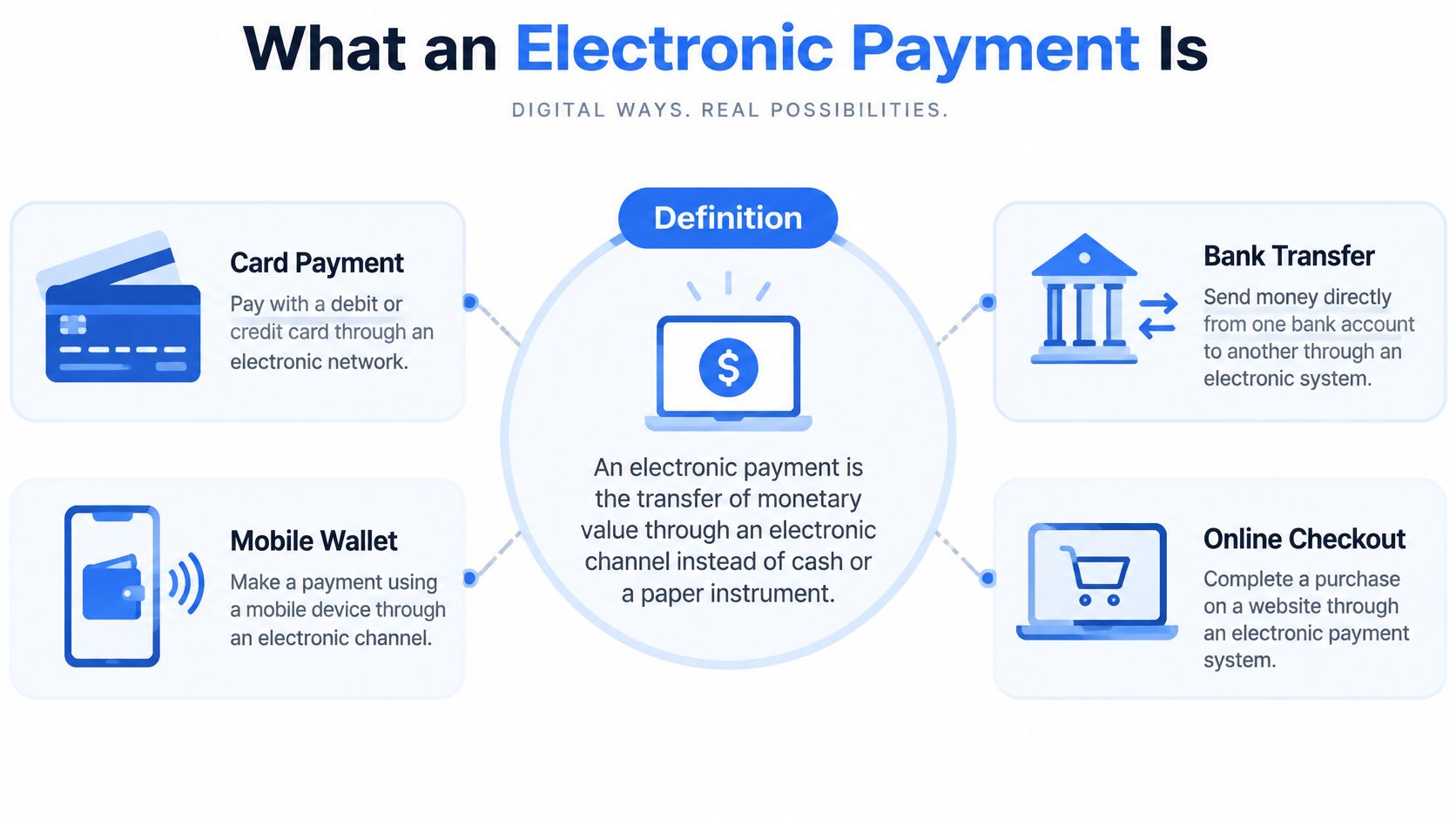
The mechanism can run through a bank account, a payment card, a mobile-money account, or another regulated digital channel. A wallet button tells you how the customer initiated the transaction. It doesn't necessarily tell you which underlying rail moved the value.
For the subscription business, the payment screen is only the entry point. Behind it, the operating flow needs:
- An account or stored-value arrangement that identifies where value comes from and where it goes.
- Authentication and authorization that establish who is acting and whether the request may proceed.
- Electronic messaging that carries instructions between participating systems.
- Settlement arrangements that discharge the resulting financial obligation.
The enemy is the false green check: a user-facing success that your application records as settled funds without settlement evidence.
That mistake can remain hidden while volumes are small. It becomes expensive when your application lets customers withdraw provisional credits or lets finance spend money that hasn't arrived.
A reusable answer to “what is an electronic payment?” therefore needs both halves: value moves through an electronic mechanism, and participating institutions apply rules to that movement. The checkout experience should reflect those rules rather than conceal them.
How Each Payment Rail Treats Paid
| Rail | What the payer sees | When value moves | Reversal path | Who usually pays |
|---|---|---|---|---|
| Card | Authorization in seconds | Scheme settlement often next day or later | Chargeback and representment | Merchant pays interchange and scheme fees |
| ACH | Batch accepted, not instant | Operator sorts files and posts to bank settlement accounts | Return codes inside network windows | Originator or receiver by agreement |
| Wire or RTGS bank transfer | Often same day | Each payment settled individually | Very hard once sent | Sender typically pays the wire fee |
| Instant account-to-account | Message in seconds | Scheme rules establish finality | Often limited or none | Low fee on payer, payee, or both |
| Mobile money | Handset confirmation | Stored-value ledger, then provider settlement | Provider rules, not a card chargeback | Cash-in, cash-out, and transfer fees |
| Stablecoin or crypto rail | Broadcast, then confirmations | Finality follows chain confirmation policy | Generally irreversible | Network fee from the sending wallet |
Treat these as operating characteristics, not contractual promises. Your provider agreement and the applicable scheme rules establish actual availability, pricing, return rights, and settlement conditions.
Speed doesn't establish the loss owner
A card authorization can support an immediate checkout decision without proving that the merchant has received cash. A chargeback also creates a dispute route after processing, so merchant access to funds doesn't eliminate every subsequent liability.
ACH acceptance means an instruction entered a batch-processing flow. A same-day or next-day schedule describes processing arrangements, not an assurance that no return can follow. With a wire, the more important buying question may be recall support rather than checkout speed.
Instant account-to-account products require particularly careful language. Ask whether real time describes message delivery, funds availability, or irrevocable settlement. Those are different commitments.
For mobile money, distinguish the provider's stored-value ledger from settlement between providers. For crypto, distinguish public broadcast from the confirmation policy your business accepts, and don't assume that every blockchain uses identical finality mechanics.
A phone wallet can also present a card-funded experience over a different underlying funding arrangement. For that interface question, NomadCards' mobile wallet guide for crypto holders is useful context, but wallet compatibility shouldn't substitute for identifying the settlement rail.
Authentication doesn't prove informed consent
The National Bank of Belgium's payment-fraud report reports that more than 99% of fraudulent credit-transfer transactions reported in Belgium in 2024 were initiated remotely, while social engineering accounted for more than half of their fraudulent value. The distinction matters: a technically authenticated instruction can still originate from a deceived payer.
Choose the rail by its failure conditions, not by the animation customers see after tapping pay.
Before selling any payment method, answer these questions:
- Cancellation: Can the payer stop the instruction, and until which event?
- Loss allocation: Who bears an authorized-scam loss under the applicable rules?
- Finality: Which event makes the value irrevocably settled?
- Evidence: What records support a return, recall, or dispute?
How a Payment Moves from Intent to Settlement
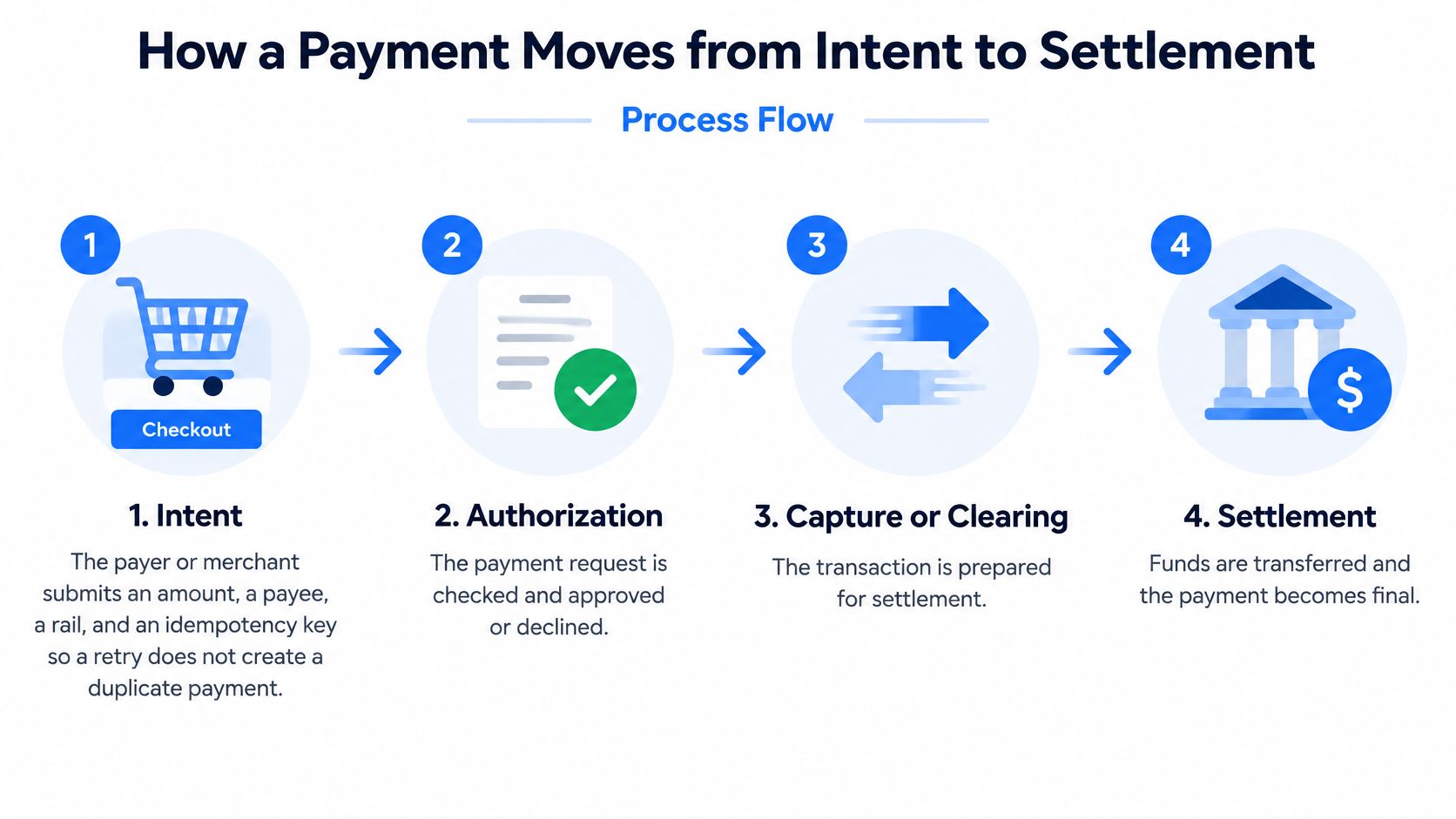
A merchant checkout should create a traceable sequence, not a single mutable success flag. The customer can receive immediate approval because approval and interinstitutional settlement are separate operations.
For US ACH, the Federal Reserve's FedACH operating description explains that institutions exchange batches, operators edit and sort files, receiving institutions receive those instructions, and settlement debits and credits participating institutions' settlement accounts. That sequence gives product teams a concrete reason to separate application states.
Keep the stages distinct
Intent received. The payer or merchant submits the amount, payee, and selected rail. Attach an idempotency key to creation so a network timeout and retry don't produce another payment. Preserve the original request and its business reference.
Authorization approved or instruction submitted. The provider applies the checks appropriate to the rail, such as identity, available balance, credit, or transaction policy. A card approval belongs here. For a crypto flow, broadcast acceptance records submission, not proof that the recipient has a settled bank balance.
Funds cleared. Participants transmit, reconcile, and, where applicable, confirm payment information. ACH file processing belongs in this stage. Blockchain confirmation progress can serve as an operational analogue, but it isn't bank clearing and shouldn't be represented as a bank credit.
Settlement final. Funds or settlement balances move to discharge the obligation. Your system should apply the rail's finality condition before recording an irrevocable and unconditional transfer.
The application should retain intent received, authorization approved, funds cleared, and settlement final as distinct states. Some rails compress stages or use different terminology; your adapter should preserve those differences rather than inventing a clearing event that the provider never supplies.
Make the accounting consequence explicit
Say a marketplace receives an authorization and immediately makes the seller's proceeds withdrawable. The platform has converted a provisional event into a cash obligation. If the incoming payment fails to settle, the platform must fund the seller payout itself or attempt recovery.
The error isn't just a misleading status label. Finance can overstate available cash, treasury can release funds prematurely, and reconciliation staff must explain a payout with no matching settled receipt.
For every state transition, emit an event, retain append-only ledger evidence, and store the provider reference needed for reconciliation. Separate the transaction's gross amount, fees, receivable, and settled cash rather than repeatedly overwriting a balance.
The digital payment process guide provides a useful companion for mapping these responsibilities across application boundaries.
Practical lesson: An approval may permit the next business action, but it must never silently become evidence of settled cash.
Who Sits in a Live Payment Flow
A payment owner needs more than a provider name. Operations must identify who originates the instruction, who authorizes it, who operates the rail, who receives value, and which ledger records the business obligation.
Who sits in each live payment flow
| Flow | Parties | Fee payer | Record of truth |
|---|---|---|---|
| Card checkout | Payer, issuing bank, card scheme, acquiring bank, merchant | Merchant pays interchange, scheme fees, and processor margin | Settlement credit to acquirer and merchant ledger |
| ACH credit | Originator, originating bank, ACH operator, receiving bank, receiver | Originator or receiver by agreement, plus return costs | Settlement-account debit and credit, tracked through the return window |
| Stablecoin invoice | Payer wallet, public network, recipient address, seller ledger | Sending wallet pays the network fee | Chain confirmations matched to amount, token, and confirmation policy in the internal ledger |
Follow the obligation through the participants
At a card checkout, the issuer authorizes the cardholder's transaction. The scheme supports clearing, settlement reaches the acquiring side, and the acquirer or processor pays the merchant under the agreed funding arrangement. The merchant receives proceeds after applicable deductions, so finance needs both the gross sale and the settlement breakdown.
The card issuer bank guide helps distinguish the issuer's role from the merchant's acquiring relationship. An authorization code belongs in the transaction record, not as a substitute for the merchant's cash receipt.
For a payroll-style ACH credit, the employer originates a batch through its bank. The operator routes instructions, and bank settlement accounts carry the corresponding debits and credits. A return can follow a visible credit, so treasury should establish a return reserve appropriate to the flow rather than assuming every posted receipt is freely releasable.
Public visibility still needs internal matching
For a stablecoin invoice, the payer's wallet submits to a public network such as Ethereum or Tron. There isn't an issuing bank authorizing the invoice payment, and the sending wallet pays the network fee. The seller's operator must match the recipient, token contract, amount, and confirmation policy before closing the receivable.
A transaction hash alone doesn't establish that the invoice was paid correctly. A transfer can reach the expected address with the wrong asset or insufficient value.
Assign a named owner to each boundary:
- Payer and payer's provider: Instruction, funding source, and submission evidence.
- Rail operator and payee's provider: Processing, settlement evidence, and exception handling.
- Payee and ledger of record: Allocation, fees, receivables, and release decisions.
Access requirements also affect the operating design. The BIS discussion of payment infrastructure and cashless adoption highlights the importance of market differences in digital access. A global product needs a fallback for failed connectivity, unavailable devices, identity barriers, or account-access restrictions, not just another retry button.
Controls Before Money Is Treated as Final
The settlement gap creates exposure between accepting an instruction and receiving final value. If your business releases an outgoing payment during that interval, it may become the party financing the incoming payment's failure.
The BIS Core Principles for Systemically Important Payment Systems distinguish real-time gross settlement from deferred net settlement. Gross settlement processes payments individually and generally reduces interparticipant credit exposure, but demands immediately available liquidity; deferred net settlement offsets obligations and saves liquidity while leaving exposure until settlement.
Credit risk arises if the payer or its provider fails before settlement. Liquidity risk arises if a participant can't fund its obligation when due. Prefunding, collateral, limits, and holds address different parts of that exposure.
Put the release gate before signing
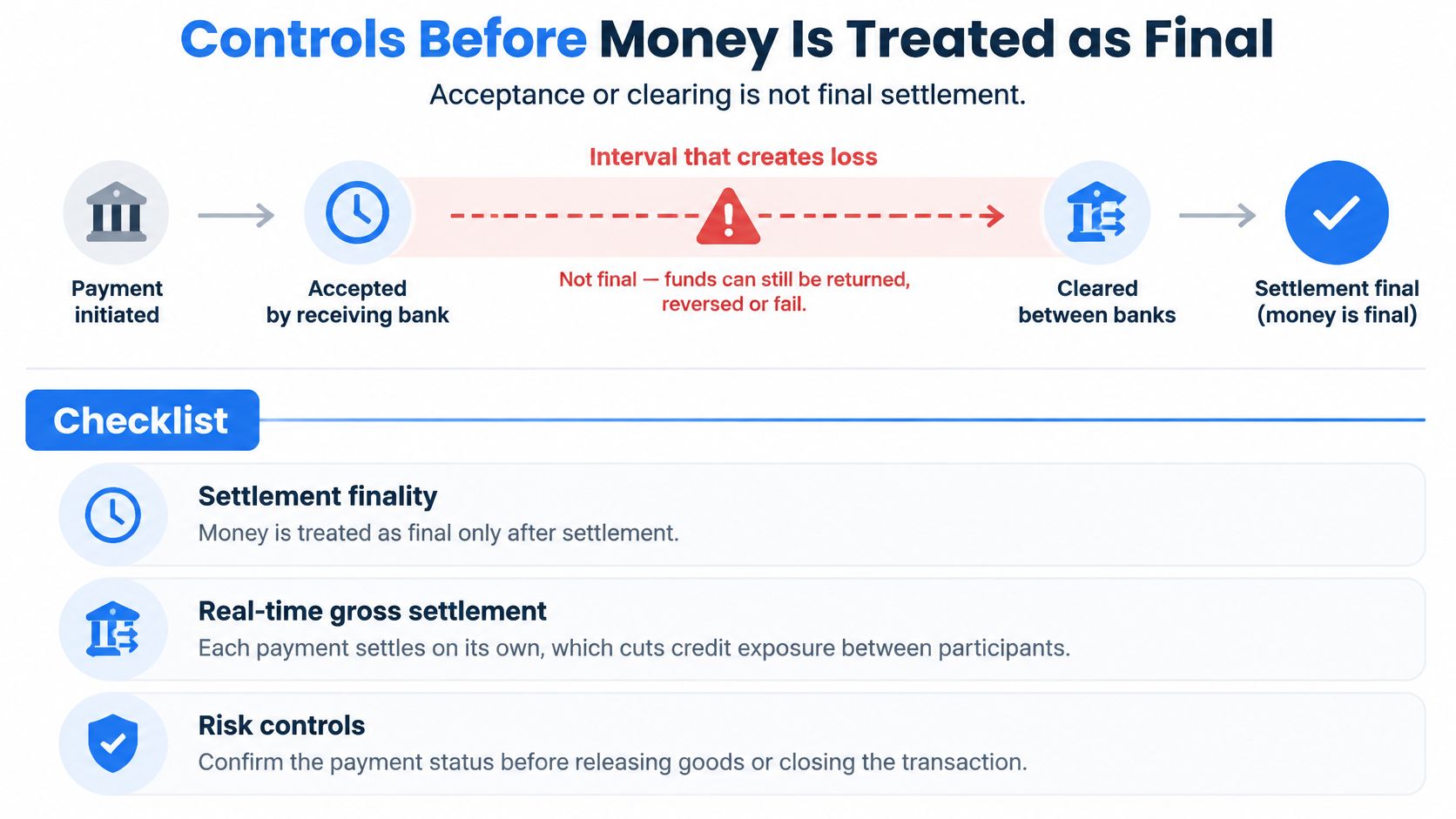
A card success, bank memo credit, or early blockchain confirmation may be provisional. Releasing a supplier payment or player withdrawal on that signal transfers the risk to your business.
Require these controls before release:
- Independent settlement status: Store acceptance separately from finality, including the evidence that supports each state.
- Balance and velocity policy: Check releasable funds, transaction limits, beneficiary restrictions, and approval requirements before signing or sending.
- Reconciliation evidence: Retain authenticated or signed events, append-only ledger entries, and provider confirmations. Route unmatched amounts and missing events into an exception queue.
- Party and beneficiary controls: Screen relevant parties, preserve required beneficiary information, and retain the approval or rejection decision with the payment record.
Faster rails shorten customer waiting time, but they also shorten the opportunity to catch a scam or mistyped destination. Move verification earlier in the flow rather than expecting an operations analyst to stop an already-final transfer.
Don't book available cash, and don't sign a release, until the rail's own finality condition is met and the ledger agrees.
Compliance belongs in the transaction record
FATF Recommendation 15 applies AML/CFT measures to virtual assets and virtual-asset service providers; its 2025 targeted update on virtual assets and VASPs reported that 99 jurisdictions had passed or were in the process of passing Travel Rule legislation, supporting originator and beneficiary transparency for qualifying transfers.
That isn't a universal rule for every payment in every market. Compliance must determine applicable obligations, required information, retention, and exception handling for each operating route.
Document who may authorize release and what happens when screening or beneficiary information is incomplete. The secure payment solutions guide is a companion for translating those requirements into application controls. Confirm rail terms and market-specific obligations with the relevant payment provider and counsel before go-live.
Run Payments on Separate Settlement States
A green check is an authorization event. Give it its own state, then make funds availability wait for clearing and final settlement. Choose the operating model before the vendor: intent, authorization, clearing, and settlement stay distinct; collection cannot automatically become withdrawal authority; finance gets a ledger it can reconcile.
Apply the model to crypto infrastructure
BroLabel's BroSettlement supplies API-oriented wallet infrastructure with distributed key generation, MPC signing, network submission, and support for 10 networks. Its customer-controlled Co-Signer supports a 2-of-3 signing model without placing the complete signing key with a single participant.
The NIST threshold-cryptography model supports joint operations using separate private inputs or key shares without reconstructing the complete key. The operational protection still requires signer roles, approval policy, recovery procedures, and auditable signing requests.
BroWallet covers user, agent, or player wallet experiences, including buy, sell, exchange, and bank or card funding where permitted. AI Agents can operate through per-agent wallets with role-based access and audit trails, rather than sharing an unrestricted treasury credential.
- WebSocket events: Track deposits, confirmations, withdrawals, and policy outcomes while keeping an initial observation out of the paid state.
- Ledger and reconciliation: Match append-only operating records to network outcomes and investigate exceptions.
- API access controls: Ed25519 authentication, an IP allowlist, and replay protection guard requests; a sandbox is available before go-live.
This model serves exchanges, neobanks, gateways, DeFi platforms, treasury teams, stablecoin platforms, and iGaming operators needing per-player deposit addresses and payout controls. Network fees are debited from the initiating wallet; BroLabel doesn't add a separate third-party fee.
Map one live flow this week. Mark it paid only when network finality, policy outcome, and ledger entry point to the same state.
Questions Buyers Ask After the Definition
Is an electronic payment the same as a digital payment?
In everyday operating use, yes. Both describe value moving through an electronic channel. Digital payment is commonly a survey or customer-facing term; electronic payment discussions often emphasize system participants, processing rules, and settlement responsibilities.
Can a payer cancel after tapping pay?
Sometimes, before the instruction becomes irrevocable. A cancellation request, dispute, ACH return, and wire recall are different procedures with different eligibility rules. Don't promise that a sent wire or confirmed stablecoin transfer can be reversed, and don't present a card dispute as guaranteed recovery.
When is a crypto payment final?
For invoice acceptance, it must satisfy the relevant network and token policy and match the internal settlement record. Validate the destination, token contract, amount, and required confirmation evidence. An observed transaction hash isn't enough, and confirmation policies should account for the network's finality mechanics.
Do I need a bank account to pay electronically?
No, not necessarily a full bank account. Mobile-money and stored-value arrangements can provide electronic-payment access through another account structure. They still require authentication, a reliable ledger, and provider arrangements for moving or redeeming value, with access and withdrawal conditions that the user needs to understand.
BroLabel offers embedded wallet, signing, network submission, event, and ledger infrastructure for teams that need payment status to match operational reality. Visit BroLabel with one deposit-to-payout flow and map its release policy, settlement evidence, and reconciliation requirements before implementation. Bro has your back!